
Why traditional grains matter: health benefits explained
TL;DR:
- Traditional grains offer higher protein and mineral content when consumed whole and unrefined.
- Eating a diverse range of whole, traditional grains provides measurable health benefits like improved heart health and weight management.
- Most traditional grains contain gluten, but gluten-free options like quinoa and teff are suitable for sensitive individuals.
Traditional grains have attracted a fair share of scepticism. Are they a genuine nutritional step forward, or simply clever marketing dressed up in heritage clothing? The honest answer sits somewhere more interesting than either extreme. These grains, many of which have been cultivated for thousands of years with minimal modification, offer real nutritional advantages rooted in science. But the full picture requires understanding what makes them valuable, when modern wholegrains work just as well, and how to build them into a practical, plant-rich UK diet that actually delivers results.
Table of Contents
- What are traditional grains, and how do they compare?
- The science-backed health benefits of traditional grains
- Traditional grains in plant-based diets: a versatile nutrition cornerstone
- Nuances and misconceptions: is the ‘ancient’ label always better?
- Why a bit of variety is the healthiest move
- Explore more wholefood essentials
- Frequently asked questions
Key Takeaways
| Point | Details |
|---|---|
| Nutrient-rich options | Traditional grains like spelt and einkorn are naturally high in protein, minerals, and fibre. |
| Evidence-based benefits | Whole/traditional grains support weight management and reduce health risks including heart disease and diabetes. |
| Versatile in plant diets | Traditional grains offer complete nutrition and fit perfectly into wholefood plant-based meals. |
| Balance and variety matter | Mixing different whole grains, not just focusing on ‘ancient’ labels, brings the best health outcomes. |
What are traditional grains, and how do they compare?
Traditional grains, often called ancient grains, are cereal crops and pseudo-cereals that have remained largely unchanged by industrial plant breeding. Think spelt, einkorn, emmer, Khorasan wheat (sold as Kamut), and pseudo-cereals like quinoa, amaranth, and teff. You can find a fuller breakdown of what counts as an ancient grain if you want to explore the full family tree.
Modern wheat, by contrast, has been selectively hybridised over decades to maximise yield, disease resistance, and baking properties. The result is a grain that produces more food per acre but has shifted in its nutritional profile. As research confirms, traditional grains offer higher protein and minerals than modern wheat, though the gap narrows considerably when you compare them to modern whole wheat rather than refined white flour.
This is perhaps the most important nuance in the entire conversation. It is not simply being ‘ancient’ that makes these grains valuable. It is the fact that they are almost always consumed in their whole, unrefined form. When you explore the detailed comparison of ancient grains vs modern wheat, the pattern becomes clear: the processing level matters as much as the grain’s lineage.
Here is how some popular traditional grains stack up nutritionally per 100g cooked:
| Grain | Protein (g) | Fibre (g) | Iron (mg) | Zinc (mg) |
|---|---|---|---|---|
| Spelt | 5.5 | 3.9 | 1.7 | 1.6 |
| Quinoa | 4.4 | 2.8 | 1.5 | 1.1 |
| Einkorn | 6.2 | 4.1 | 2.0 | 1.8 |
| Amaranth | 3.8 | 2.1 | 2.1 | 0.9 |
| Modern whole wheat | 5.0 | 3.7 | 1.5 | 1.3 |
The differences are real but modest. What traditional grains also carry is a broader range of antioxidants and polyphenols that resist degradation because they have not been subject to intense selective breeding for yield traits.
Popular traditional grains you will find in UK shops and health food stores include:
- Spelt — nutty flavour, widely available as flour and whole grain
- Quinoa — high protein, naturally gluten-free, versatile
- Einkorn — one of the oldest wheats, higher antioxidant content
- Amaranth — excellent source of iron and lysine
- Teff — tiny grain, huge on minerals, gluten-free
- Khorasan wheat — larger grain, rich, buttery flavour
The science-backed health benefits of traditional grains
The research on whole and traditional grains is substantial. It goes well beyond vague claims about ‘being good for you’ and points to measurable outcomes for heart health, weight, and metabolic function.

A recent randomised controlled trial published in Frontiers in Nutrition found that whole grains support weight loss, lower BMI, and improve cholesterol and triglyceride levels. These are not marginal changes. For people managing their weight alongside a busy working life, that is a meaningful contribution from a straightforward dietary shift.
The British Heart Foundation highlights that high wholefood diets reduce the risk of coronary heart disease, type 2 diabetes, and certain cancers. The NHS echoes this, recommending that adults base meals on starchy wholegrain foods as a core dietary habit.
Here is a summary of the key evidence-backed benefits:
| Health outcome | Evidence strength | Mechanism |
|---|---|---|
| Reduced CHD risk | Strong | Fibre, antioxidants, reduced LDL |
| Lower type 2 diabetes risk | Strong | Slow glucose release, improved insulin sensitivity |
| Weight management | Moderate to strong | Satiety, fibre, lower glycaemic load |
| Improved cholesterol | Moderate | Beta-glucan and soluble fibre |
| Digestive health | Strong | Insoluble fibre, prebiotic effect |
“Populations eating the most wholegrains have significantly lower rates of heart disease and diabetes compared with those eating the least.” — British Heart Foundation
Fibre is central to most of these outcomes. Wholegrains contain both soluble fibre, which binds to cholesterol and slows sugar absorption, and insoluble fibre, which feeds beneficial gut bacteria and supports bowel regularity. You can read more about the wellness benefits of ancient grains and the nutrition facts for ancient grains for a more detailed breakdown.
One important finding is that these benefits accumulate over time. A bowl of spelt porridge on a Wednesday will not transform your health overnight. But consistently choosing whole and traditional grains over refined alternatives across weeks and months produces measurable shifts in cardiovascular risk markers and blood sugar regulation.
Traditional grains in plant-based diets: a versatile nutrition cornerstone
For those following vegan, vegetarian, or flexitarian eating patterns, traditional grains do something particularly useful. They fill nutritional gaps that can appear when animal foods are reduced or removed.
Quinoa stands apart from almost every other grain because it is a complete protein source, meaning it contains all nine essential amino acids. Most grains fall short on lysine. Quinoa does not. For plant-based eaters who rely on a variety of sources to hit their protein targets, having a grain that does the heavy lifting on its own is genuinely useful.
Beyond protein, traditional grains bring a solid range of minerals that plant-based diets can sometimes lack:
- Iron — critical for energy and oxygen transport, particularly relevant for women
- Zinc — supports immune function and hormone balance
- Magnesium — involved in over 300 enzymatic reactions, supports muscle recovery
- B vitamins — essential for energy metabolism and nervous system function
These minerals are present in whole grains in meaningful quantities, making traditional grains a cost-effective way to support micronutrient intake without relying on supplementation. When you explore nutritious traditional grains suited to everyday cooking, it becomes clear how accessible this can be.
Traditional grains also offer strong satiety. Their fibre content slows gastric emptying, meaning you feel fuller for longer after a grain-based meal than after the equivalent in refined carbohydrates. This matters for anyone managing their appetite without calorie counting.
Pro Tip: Soaking grains like amaranth or spelt overnight before cooking reduces phytic acid, improving mineral absorption by up to 20%. It also cuts cooking time significantly. Learn how to cook ancient grains for simple, practical techniques.
Gut health is another underappreciated benefit. The prebiotic fibres in traditional grains feed Bifidobacterium and Lactobacillus strains, the same beneficial bacteria linked to reduced inflammation and improved mood via the gut-brain axis.
Nuances and misconceptions: is the ‘ancient’ label always better?
Here is where the marketing noise deserves honest scrutiny. The word ‘ancient’ on a packet does not automatically mean superior nutrition. The primary benefit, as the evidence consistently shows, comes from eating the grain in its whole, unrefined form — not from its historical pedigree.
The BBC’s coverage of this topic confirms that whole form matters most: a modern wholegrain oat or barley can be nutritionally comparable to spelt or einkorn. What sets traditional grains apart more reliably is that they are rarely sold in a heavily refined state. Their whole form is the default.
Four things worth thinking clearly about when choosing grains:
- Gluten content — Spelt, einkorn, emmer, and Khorasan wheat all contain gluten. They are not suitable for coeliac disease or serious gluten intolerance. The differences among ancient grains matter a great deal here. For those with sensitivities, quinoa, teff, amaranth, and millet are the safe options.
- Gluten structure — Some people with mild wheat sensitivity find spelt easier to digest because its gluten is more fragile. This is not the same as being gluten-free. Check what gluten is found in grains before making assumptions.
- Cost and availability — Traditional grains can cost more than modern wheat. UK-grown spelt is an exception: it is increasingly available from British farms, competitively priced, and carries a lower food-mile footprint.
- Sustainability — Many traditional grains require less fertiliser and fewer pesticides, suiting lower-input farming systems. The sustainability of ancient grains is a genuine argument for choosing them, particularly for UK consumers interested in food system impact.
“The most reliable signal for nutritional quality is not the grain’s age, but the degree to which it has been processed.”
Pro Tip: When buying grain-based foods, scan the ingredient list for the word ‘whole’ before the grain name. ‘Spelt flour’ and ‘whole spelt flour’ are not the same product nutritionally.
Why a bit of variety is the healthiest move
We have seen a pattern across years of working with whole and traditional foods: the people who get the most out of grain-based nutrition are not the ones who commit rigidly to one grain. They rotate. They experiment. They treat their grain selection the way a thoughtful cook treats their spice rack: varied, purposeful, and based on what each one actually does well.
The fixation on labels — ‘ancient,’ ‘heritage,’ ‘traditional’ — can obscure the simpler truth. An unrefined grain, however old or new its lineage, is almost always a better choice than its refined counterpart. What matters most is that you are eating whole, minimally processed grains regularly, in forms your body can use and your kitchen can handle.
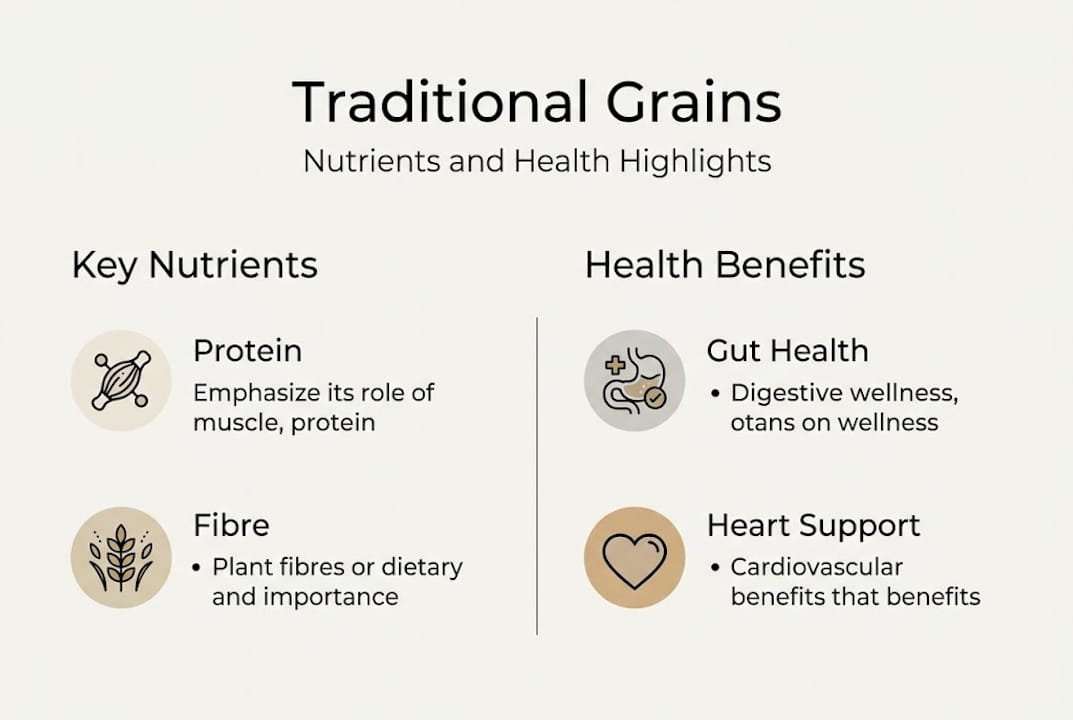
The nutritional impact of ancient grains across European dietary patterns shows a consistent benefit not from one specific grain but from grain diversity as a whole. Quinoa at breakfast, spelt at lunch, oats in the afternoon. That variety is where the real cumulative benefit lives. Avoid the dogma. Embrace the rotation.
Explore more wholefood essentials
If reading this has prompted you to think more carefully about what you are building your meals around, that is exactly the right instinct.
At Granavitalis, we source foods that complement traditional grains as part of a complete wholefood diet. Our organic nut and seed butter selection pairs beautifully with grain-based breakfasts, adding healthy fats and plant protein in one satisfying layer. For those building a lower-carbohydrate approach, our keto-friendly organic muesli is crafted to deliver fibre and flavour without compromise. Every product we offer is chosen with the same principle: whole ingredients, real nutrition, no shortcuts.
Frequently asked questions
Are traditional grains always better than modern grains?
Modern whole grains can be nutritionally similar to ancient grains. The key factor is whether the grain is consumed in its whole, unrefined form rather than which variety it is.
Do traditional grains help with weight loss?
Whole grain diets support modest weight loss and improved metabolic markers in clinical trials. Regular consumption over time produces the most meaningful results.
Are traditional grains gluten-free?
Most are not. Spelt, einkorn, and emmer all contain gluten. Quinoa is gluten-free, as are teff, amaranth, and millet, making them the suitable options for those avoiding gluten.
Why should I include traditional grains in a plant-based diet?
They supply complete proteins (particularly quinoa), iron, zinc, and magnesium that plant-based diets can fall short on. Research confirms that traditional grains provide key minerals that support energy, immunity, and recovery.
Are traditional grains sustainable and affordable in the UK?
UK-grown spelt is increasingly available at competitive prices and requires fewer agricultural inputs than modern wheat. The British Heart Foundation notes that wholegrains are a cost-effective foundation food, making them accessible for most budgets.