
Why food purity matters for health-conscious shoppers
Food purity matters because minimally processed, transparently sourced wholefoods preserve nutrient density and reduce your exposure to contaminants, additives and processing by-products that accumulate in diets heavy in ultra-processed foods. The practical upshot: choose wholefoods, read ingredient lists, and favour brands with clear sourcing statements.
The core case at a glance:
- Minimally processed foods retain more fibre, protein and potassium than their ultra-processed equivalents
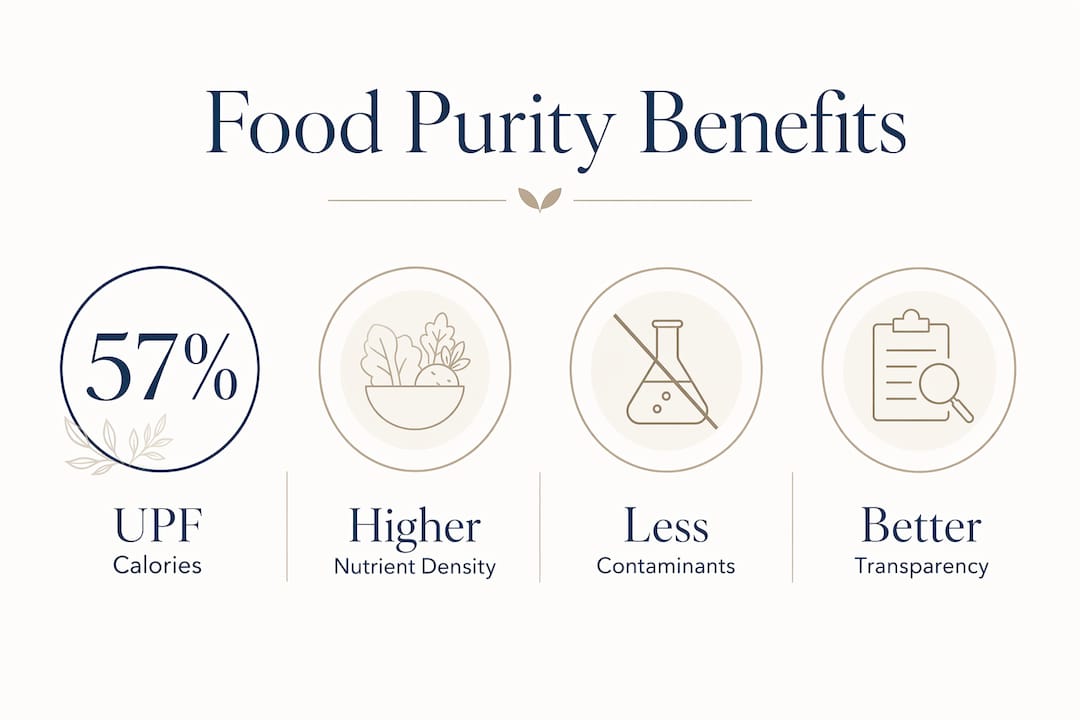
- UK NDNS data shows that 56.8% of UK dietary calories came from ultra-processed foods, with worse nutrient profiles across the board
- Contaminants such as pesticide residues, heavy metals and mycotoxins enter the food chain at source and concentrate through processing
- “Clean label” and “natural” are not legally defined terms in the UK — ingredient lists and sourcing transparency matter more than front-of-pack claims
- Granavitalis sources ancient grains, nuts, seeds and plant proteins with minimal processing and transparent provenance
Table of Contents
- Why food purity matters for your long-term health
- What safety risks come with impure or heavily processed foods?
- When does an “impure” ingredient actually help you?
- How do you assess food purity when shopping in the UK?
- Simple swaps that raise your dietary purity without breaking the budget
- Key takeaways
- The case for purity that most clean-eating content misses
- Granavitalis: wholefoods built around ingredient integrity
- Useful sources for further reading
Why food purity matters for your long-term health
The central finding is straightforward: diets dominated by ultra-processed foods (UPFs) tend to be higher in free sugars, saturated fat and sodium, and lower in fibre, protein and potassium. Analysis of UK National Diet and Nutrition Survey data found that 56.8% of UK calories came from ultra-processed foods, with higher UPF intake consistently linked to worse nutrient profiles and a greater likelihood of exceeding recommended limits for free sugars and sodium.
The NOVA classification system, which groups foods by degree of processing rather than nutrient content alone, has become the dominant framework for this research. SACN’s rapid evidence update found consistent associations between higher UPF consumption and adverse health outcomes, including obesity, type 2 diabetes and cardiovascular risk, while rightly cautioning that most evidence is observational. Causation is not proven, but the pattern is consistent enough that SACN recommends limiting foods high in fat, salt and sugar.
What gets lost in processing matters practically. Whole oats contain intact beta-glucan fibre; a flavoured instant porridge sachet may contain a fraction of that alongside added sugars and flavourings. A plain almond delivers vitamin E, magnesium and healthy fats; an almond-flavoured snack bar may deliver little of either alongside glucose syrup and emulsifiers. The gap between the two is where nutrient integrity is won or lost.
Statistic callout: UK NDNS data (2008–2014) found that the highest UPF consumers had higher free sugar and sodium intakes and lower fibre and potassium intakes compared with the lowest UPF consumers — a nutrient gap that compounds over years, not meals.
Replacing UPF with minimally processed wholefoods improves nutrient density and, in modelling studies, is associated with a reduction in diet-related non-communicable disease risk. That is not a guarantee, but it is a consistent signal across multiple datasets.
What safety risks come with impure or heavily processed foods?
Choosing purer, less processed foods reduces your exposure to several categories of contaminant that enter the food chain at source and can concentrate through processing.
The main contaminant categories:
| Contaminant type | How it enters the food chain | Practical risk reduction |
|---|---|---|
| Pesticide residues | Applied to crops; residues remain on or in produce | Choose organic where feasible; wash fresh produce thoroughly |
| Heavy metals (lead, cadmium, arsenic) | Soil and water contamination; concentrated in some grains, leafy veg and fish | Vary your diet; avoid over-reliance on a single grain or fish species |
| Mycotoxins | Fungal growth on stored grains, nuts and dried fruit | Buy from reputable suppliers with good storage and turnover |
| Packaging contaminants (MOSH/MOAH) | Mineral oil hydrocarbons from recycled cardboard packaging | Prefer glass or direct-food-grade packaging where possible |
| Food additives (emulsifiers, sweeteners) | Intentionally added during manufacturing | Read ingredient lists; choose products with shorter, recognisable lists |
Processing itself can introduce additional risks: high-temperature production creates process-induced contaminants, and packaging materials can leach into food. Additives are not uniformly harmful, as SACN notes that processing serves legitimate roles in food safety and shelf life, but the cumulative additive load in a diet heavy in UPFs is worth considering.
Pro Tip: When buying nuts, seeds or dried fruit, prioritise suppliers who can state country of origin and storage conditions. Mycotoxin contamination is largely invisible and odourless, so provenance and supplier auditing matter more than visual inspection.
When does an “impure” ingredient actually help you?
Purity is valuable, but it is not the only variable. Some reformulation choices offer genuine functional benefits, and understanding the difference protects you from both over-processed foods and from rejecting useful ingredients on the basis of unfamiliar names.
FMCG Gurus research shows that naturalness (68%) and recognisable ingredients (63%) are the primary drivers for clean-label consumers, but 41% will accept an artificial ingredient if it provides a measurable health benefit such as sugar reduction. That pragmatism is sensible. A product that uses a non-sugar sweetener to cut calories meaningfully is a different proposition from one that uses it purely to extend shelf life.
The problem is that “clean label” has no legal definition in the UK. As industry analysis in The Grocer has noted, reformulation can replace a “chemical-sounding” ingredient name with a simpler one without changing the ingredient’s function at all. Ascorbic acid becomes vitamin C on the label; the molecule is identical. That is not deception, but it illustrates why ingredient familiarity is a proxy for purity, not a guarantee of it.
“Clean label is not a single definition; it is influenced by marketing and external trends. Shoppers should verify ingredient function rather than rely on packaging buzzwords.”
Industry commentary, Bakery Info / The Grocer
Front-of-pack claims such as “natural,” “no artificial additives” and “clean” are marketing positions, not regulated standards. For a deeper look at how functional nutrition fits with purity goals, the distinction between an ingredient that adds genuine nutritional value and one that merely sounds better on a label is worth understanding.
How do you assess food purity when shopping in the UK?
A short checklist you can apply in any supermarket or online:
- Count the ingredients. Fewer is generally better. A plain rolled oat has one ingredient; a “healthy” granola pouch may have fifteen.
- Check for recognisable names. If you cannot picture the ingredient as a food or a simple extract of one, it is worth questioning why it is there.
- Identify the processing level. Whole grain, plain legumes and raw nuts sit at the minimally processed end. Anything with a long list of emulsifiers, stabilisers and flavourings is at the other.
- Look past front-of-pack claims. “Natural,” “clean” and “additive-free” are not legally defined in the UK. The ingredient list on the back is the authoritative source.
- Check allergen and additive detail. The Food Standards Agency provides guidance on allergen labelling requirements; use it as a baseline for what must be declared.
- Verify sourcing on brand sites. NSF research found 36% of UK consumers struggle to interpret food labels, and 32% will pay a 9–12% premium for clearer labelling. Brands that publish sourcing detail are responding to genuine demand, not just marketing.
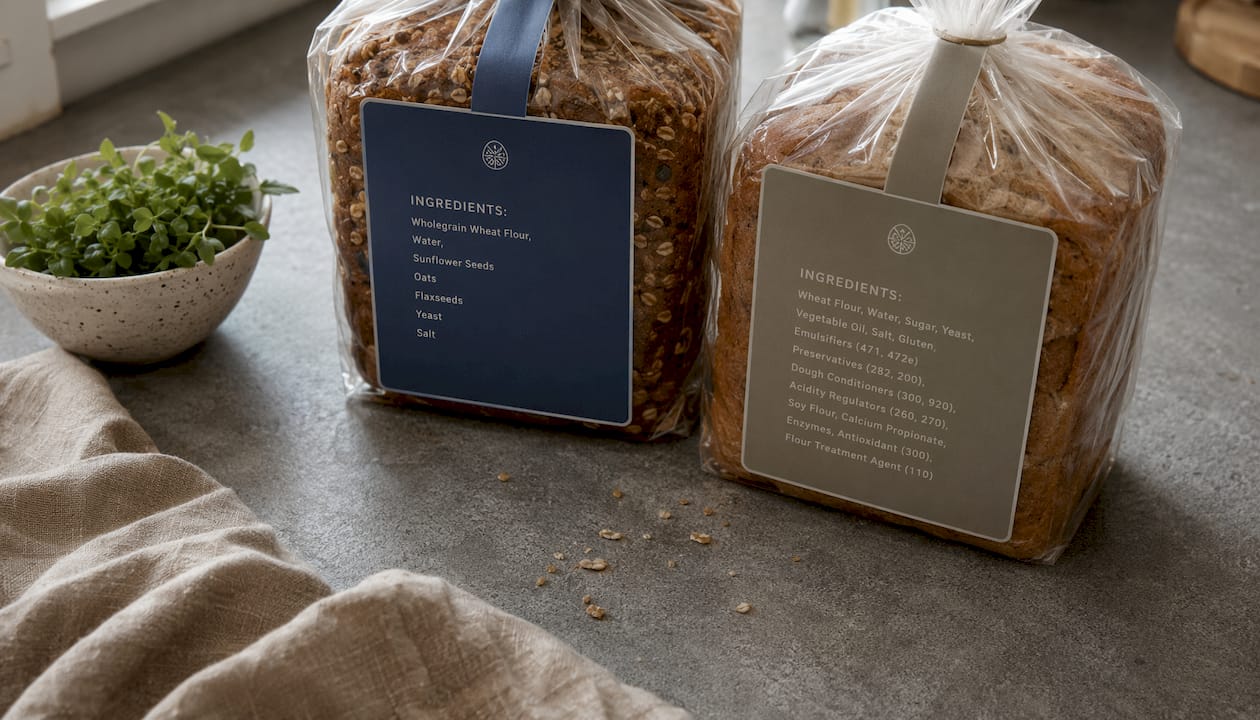
A practical comparison: two bread labels, both claiming “wholegrain.” One lists wholemeal wheat flour, water, yeast, salt. The other lists wholemeal wheat flour, water, yeast, salt, dextrose, emulsifier (E472e), preservative (calcium propionate), and flour treatment agent (ascorbic acid). Both are legal. Only one is minimally processed. Understanding what natural flavouring and similar terms actually mean helps you read those lists with confidence.
Pro Tip: Seasonal, locally grown produce tends to spend less time in storage and transit, which means fewer preservative treatments and fresher nutrient profiles. UK farmers’ markets and veg box schemes are a practical route to shorter supply chains.
Simple swaps that raise your dietary purity without breaking the budget
Small substitutions compound quickly. Swapping a few staples moves your diet meaningfully towards minimally processed eating without requiring a complete overhaul.
Direct swaps worth making:
- Packaged breakfast cereal → plain rolled oats (more fibre, no added sugar, one ingredient)
- Flavoured yoghurt → plain whole-milk yoghurt with fresh fruit (cuts added sugar, retains protein)
- Snack bars → a small handful of raw nuts and seeds (no emulsifiers, no glucose syrup)
- Flavoured nut spreads → single-ingredient nut butter (no palm oil, no added sugar)
- White rice → whole grain options such as brown rice, buckwheat or spelt (more fibre and micronutrients)
- Crisps → plain popcorn or roasted chickpeas with minimal seasoning
A simple assembly that uses these principles: rolled oats soaked overnight in water or milk, topped with a spoonful of raw nut butter, a handful of pumpkin seeds and fresh berries. No cooking required, five ingredients, and the nutrient profile is substantially better than most packaged breakfast options.
Where to spend more: cold-pressed oils, sustainably sourced oily fish and organic produce for the items you eat most frequently. Where to economise: frozen vegetables (nutritionally comparable to fresh), bulk-bought dried legumes and whole grains, and own-brand plain nuts and seeds.
Pro Tip: Buying whole ingredients rather than pre-prepared versions almost always reduces additive exposure and cost simultaneously. A bag of dried chickpeas costs a fraction of tinned, flavoured chickpea snacks and gives you full control over what goes in.
Key takeaways
Food purity matters most where it compounds: in the staples you eat every day, where small differences in processing level and ingredient quality accumulate into meaningful differences in nutrient intake and contaminant exposure over time.
| Point | Details |
|---|---|
| UPF dominates UK diets | 56.8% of UK calories came from ultra-processed foods in NDNS data, with consistently worse nutrient profiles. |
| Ingredient lists beat front-of-pack claims | “Natural” and “clean label” have no legal definition in the UK; the ingredient list is the only reliable guide. |
| Contaminants enter at source | Pesticides, heavy metals and mycotoxins concentrate through processing; sourcing transparency and supplier auditing reduce risk. |
| Small swaps compound | Replacing packaged cereals, flavoured spreads and snack bars with whole equivalents improves fibre, protein and potassium intake without large cost. |
| Granavitalis | Sources ancient grains, nuts, seeds and plant proteins with minimal processing and transparent provenance for clean, nutrient-dense eating. |
The case for purity that most clean-eating content misses
The clean-eating conversation tends to get stuck on two poles: either everything processed is harmful, or the whole thing is marketing nonsense. Both positions miss the actual point.
The evidence from SACN and the NDNS data is not that processing is inherently bad. Pasteurisation saves lives. Freezing preserves nutrients that would otherwise degrade in transit. Fortification corrects genuine deficiencies. The problem is not processing per se; it is the cumulative dietary pattern that emerges when ultra-processed foods displace wholefoods as the majority of what people eat. At 56.8% of UK calories, UPFs are not an occasional convenience. They are the default diet.
What that means practically is that purity is not a binary. You do not need to eat only raw, unprocessed food to benefit from prioritising ingredient simplicity. You need to shift the balance. Swap the staples. Read the lists. Choose suppliers who can tell you where their ingredients come from and why they chose them. The marginal effort is low; the cumulative effect on nutrient intake is not.
The other thing most guides understate: transparency is a signal of quality, not just a marketing tool. A brand that publishes sourcing detail, names its suppliers and explains its processing choices is making a verifiable claim. One that relies on “natural” and “clean” on the front of the pack is not. That distinction is worth applying every time you buy.
Granavitalis: wholefoods built around ingredient integrity
If the swaps above appeal but you want a starting point that removes the label-reading effort, Granavitalis is built around exactly this principle: minimal processing, transparent sourcing, and ingredients you can picture as food.

The range covers the staples most useful for a purity-focused pantry. The raw organic pecan butter is a single-ingredient spread with no added oil, sugar or salt. The organic nut and seed butter selection box lets you trial several minimally processed options before committing to a favourite. For baking and cooking, nibbed hazelnuts are a clean, whole ingredient with no additives. Every product comes with clear sourcing information, because that is the standard the brand holds itself to. Browse the full range at Granavitalis and check the sourcing notes for any product that interests you.
Useful sources for further reading
The claims in this guide rest on primary UK sources and peer-reviewed research. These are the most useful places to go deeper.
- SACN statement on processed foods and health — the UK’s Scientific Advisory Committee on Nutrition review of UPF evidence; the authoritative domestic source on processing and health outcomes
- UK NDNS ultra-processed food analysis (PMC) — peer-reviewed analysis of UK dietary data using NOVA classification; source of the 56.8% figure
- Food Standards Agency — UK regulator for food safety, allergen labelling and additive approvals; the primary source for what must be declared on a UK label
- NSF food labelling research — UK consumer survey on label comprehension and willingness to pay for transparency
- FMCG Gurus / Puratos clean-label consumer data — industry survey data on what drives clean-label purchasing decisions
- NHS food supplements guidance — explains the regulatory framework for supplements and why pre-market proof of efficacy is not required for food products
These sources are freely accessible and regularly updated. For any specific dietary or medical concern, consult a registered dietitian or your GP rather than relying on general guidance.