
What defines clean nutrition: your practical guide
TL;DR:
- There is no legal definition of “clean nutrition,” which leads to varied interpretations and packaging claims.
- Credible guidelines recommend focusing on minimally processed foods, limiting added sugars, and reducing sodium for genuine clean eating.
There is no legal definition of “clean nutrition.” None. That single fact explains why two products sitting side by side on a supermarket shelf can both carry the word “clean” on their packaging while differing completely in ingredients, processing level, and nutritional value. If you have ever felt confused about what clean nutrition really means, that confusion is entirely reasonable. This guide cuts through the marketing noise and gives you a grounded, evidence-based understanding of what the term genuinely means, how to apply it, and where it can go wrong.
Table of Contents
- Key takeaways
- What defines clean nutrition: the science behind the term
- Clean label claims versus actual nutritional quality
- Applying clean nutrition principles day to day
- Common misunderstandings about clean eating
- My honest take on clean nutrition
- Clean nutrition you can actually trust
- FAQ
Key takeaways
| Point | Details |
|---|---|
| No regulated definition exists | “Clean nutrition” is a consumer concept, not a legal or standardised term, so critical thinking is required. |
| Science offers clear markers | Current guidelines point to minimally processed foods, limited added sugars and reduced sodium as measurable targets. |
| Labels can mislead | “Clean label” claims carry no official weight; always check the ingredient list and nutrition facts panel. |
| It is a pattern, not perfection | Clean nutrition works as a dietary pattern over time, not a rigid set of rules applied to every single meal. |
| Flexibility protects your health | Overly rigid “clean” rules can harm your relationship with food; a balanced, adaptable approach is more sustainable. |
What defines clean nutrition: the science behind the term
The absence of a legal definition does not mean the concept is meaningless. It means you need to borrow from the bodies that have actually done the work. And several credible organisations have done exactly that.
The American Heart Association’s 2026 cardiovascular guidance outlines nine dietary features that align closely with what most people mean by clean nutrition. These include minimising ultraprocessed foods, limiting added sugars, reducing sodium, prioritising fruits, vegetables, whole grains, lean proteins, and favouring unsaturated fats. That is arguably the clearest scientific approximation of a clean eating definition available today.
The 2025 to 2030 U.S. Dietary Guidelines add further precision. They recommend limiting added sugars to no more than ten grams per meal and urge avoidance of highly processed foods, shifting the focus from marketing language to measurable nutrients and processing levels.
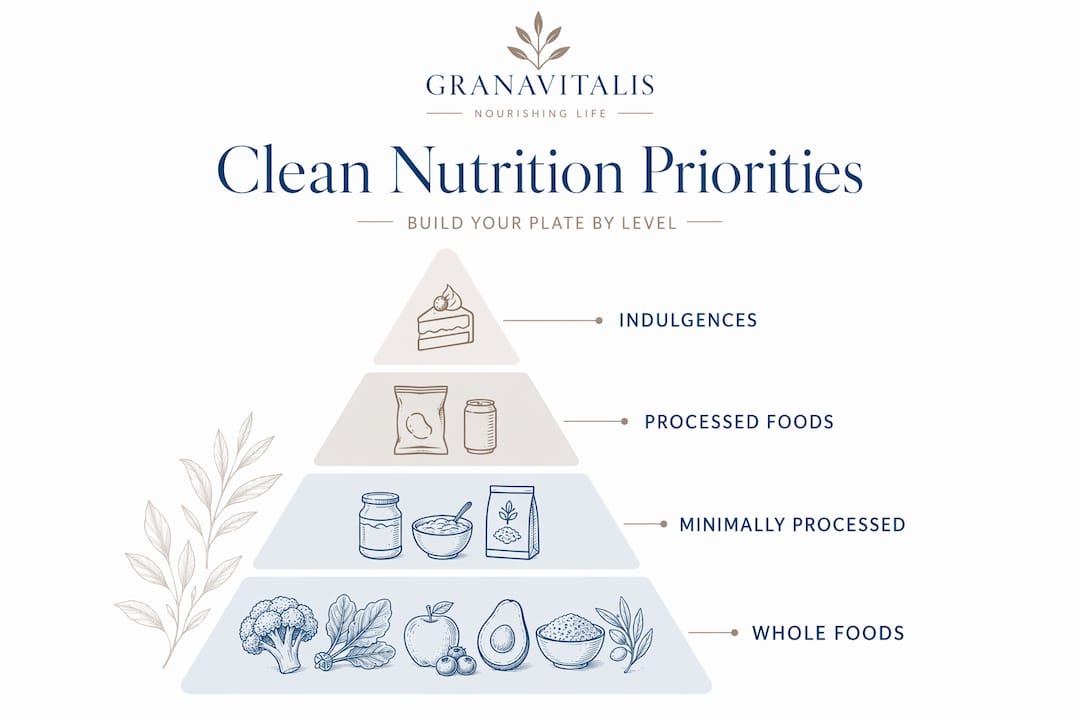
The NOVA classification system, developed by Brazilian researchers, is the most widely used academic framework for this. It divides foods into four groups by processing level:
- Group 1: Unprocessed or minimally processed foods (fresh fruit, plain oats, eggs, raw nuts)
- Group 2: Processed culinary ingredients (olive oil, salt, flour)
- Group 3: Processed foods (tinned fish, cheese, cured meats with minimal additives)
- Group 4: Ultraprocessed foods, which are industrial formulations containing additives not used in home cooking
Clean nutrition, applied practically, means building your diet around Groups 1 to 3 and minimising Group 4. It is not about avoiding all processing. It is about the level of processing and whether the food retains meaningful nutritional integrity.
The American Medical Association frames good nutrition as a balanced intake of fruits, vegetables, legumes, whole grains, and lean proteins, with careful attention to portion control and label reading. That framing confirms the pattern: clean nutrition is about overall diet quality, not individual “superfood” choices or arbitrary restrictions.
Clean label claims versus actual nutritional quality
Here is where things get genuinely complicated. The clean label market is estimated to be worth $136 billion globally. Not one dollar of that figure is backed by a regulated definition. “Clean label” simply means a brand has chosen to use simpler-sounding ingredients or shorter ingredient lists. It carries no nutritional guarantee whatsoever.
Some tactics worth knowing about:
- A product labelled “natural” or “clean” may still contain substantial added sugars, just under names like agave nectar, fruit juice concentrate, or brown rice syrup.
- “No artificial additives” does not mean low in sodium. Many “clean” snack products carry sodium levels that would surprise you.
- “Minimal ingredients” does not mean nutrient-dense. Some products with three ingredients are still calorie-dense with negligible fibre, protein, or micronutrients.
- Front-of-pack claims are marketing decisions, not health declarations. The nutrition facts panel and the ingredient list are where the truth lives.
Health supplement labelling follows similar patterns, where front-label simplicity rarely tells the whole story.
Pro Tip: When evaluating any product claiming to be “clean”, flip it over immediately. Scan the ingredient list for added sugars in disguise, check the sodium figure against your daily target, and count how many ingredients you genuinely recognise. That three-second habit is more reliable than any front-of-pack claim.
A useful personal checklist for assessing products:
- Are the first three ingredients whole foods or recognisable food-derived ingredients?
- Does the added sugar figure sit well below ten grams per serving?
- Is the sodium per serving below 400 mg?
- Are there additives listed that would never appear in a home kitchen?
- Does the fibre and protein content suggest the food has genuine nutritional substance?
Applying clean nutrition principles day to day
Understanding the theory matters, but what does clean nutrition actually look like at breakfast, lunch, and dinner?
Build your plate from NOVA groups 1 to 3
The most practical step you can take is consciously shifting the proportion of your meals towards minimally processed foods. Plain rolled oats with fresh berries and a spoonful of nut butter is a clean breakfast by every credible measure. A pre-packaged “granola bar” marketed as clean might be Group 4 with 18 grams of added sugar. Same category in your mind. Very different in reality.
Read the numbers, not just the words
Limiting added sugars and sodium is one of the most operationally clear targets in current dietary science. Train yourself to check the nutrition facts panel for both figures before buying packaged food. This one habit does more for your diet quality than memorising any list of “superfoods.”

Prioritise variety across food groups
Clean nutrition is not a single-ingredient philosophy. It requires:
- Multiple servings of vegetables and fruit daily, ideally in a range of colours
- Whole grains such as oats, quinoa, spelt, or ancient grain varieties rather than refined-grain products
- Clean protein sources, including legumes, fish, eggs, and minimally processed plant proteins
- Healthy fats from whole sources like nuts, seeds, avocado, and cold-pressed oils
- Limited reliance on anything in NOVA Group 4, particularly sweetened beverages, packaged snacks, and processed meat products
Pro Tip: Rather than overhauling everything at once, pick one meal per day to clean up first. Most people find breakfast the easiest starting point because the options are simple and habitual. Once that shift feels natural, move to the next meal.
Avoiding the hidden failure mode matters here. Many people replace genuinely ultraprocessed foods with equally poor alternatives that carry cleaner branding. A “natural” energy bar with 22 grams of added sugar is not a clean nutrition choice, regardless of how the packaging reads. Verifying numeric targets on sugar and sodium is the only reliable defence against this.
Common misunderstandings about clean eating
The concept of clean nutrition carries real risk when it moves from a useful framework to a rigid identity. Several misunderstandings repeatedly cause harm.
“Clean” versus “dirty” food moralises eating. The moment food becomes morally charged, eating decisions become emotionally loaded. Research confirms that rigid “clean eating” rules can promote disordered eating and harm mental health. A biscuit at a colleague’s birthday is not a moral failure. It is a biscuit.
Cutting entire food groups without medical need is not clean eating. Eliminating carbohydrates, dairy, or legumes wholesale is not supported by the scientific evidence underpinning clean nutrition. The dietary pattern framework from the American Medical Association emphasises balance, not elimination.
Other misunderstandings worth addressing include:
- Assuming “organic” automatically means “clean” (an organic biscuit is still a biscuit)
- Believing clean nutrition requires expensive or specialist products
- Conflating clean nutrition with weight loss as the primary goal, rather than overall health
- Treating any lapse as a reason to abandon the approach entirely
Clean nutrition works as a sustainable pattern, not a temporary purge. Evidence-based eating frameworks like the Mediterranean or DASH diets consistently outperform rigid “clean” rules because they build lasting habits rather than demanding perfection.
The healthiest reframe is to focus on what you are adding to your diet rather than what you are eliminating. More whole grains, more vegetables, more varied proteins. That positive addition mindset produces the same nutritional improvements without the psychological cost of restriction.
My honest take on clean nutrition
I have spent a long time thinking about how people actually use the concept of “clean nutrition” and I have come to one clear conclusion: it is a useful starting philosophy that becomes actively harmful when taken too literally.
What I have seen work consistently is translating the vague idea of “clean” into specific, measurable targets. Fewer than ten grams of added sugar per meal. Sodium under control. The majority of meals built from NOVA Groups 1 to 3. Those numbers give you something to act on. Vague aspirations to “eat clean” give you nothing except guilt when you inevitably eat something imperfect.
The distinction between processed and ultraprocessed has been more useful in my experience than any blanket ban on packaged food. Some packaged foods fit perfectly well within a clean nutrition pattern if the ingredient list is short, the processing is minimal, and the nutrients stack up. Tinned wild salmon. A quality nut butter with one ingredient. Frozen plain vegetables. These are processed in the technical sense. They are excellent nutrition choices in practice.
What I want people to move away from is the idea that clean nutrition requires perfection or an expensive overhaul. Granavitalis is built on this exact principle: that genuinely clean food is food with a short, transparent ingredient story, sourced with integrity, and nutritionally meaningful. Ancient grains, nuts, seeds, and clean plant proteins are not trends. They are what real nutrition has always looked like.
Flexibility is not a compromise. It is the point. Eat well most of the time, choose whole foods wherever you can, and stop assigning moral weight to what is on your plate.
— Jarrod
Clean nutrition you can actually trust

If the principles in this article resonate with you, the next practical step is finding products that genuinely live up to them. Granavitalis sources ingredients that meet a simple standard: minimal processing, transparent origins, and real nutritional value. The Raw Organic Pecan Butter from RAWGORILLA is a strong example. One ingredient. Organic. Cold-pressed. No additives. That is what clean label eating looks like when the label is telling the truth.
The Organic Nut and Seed Butter Selection Box offers a broader range of minimally processed options that fit naturally into clean nutrition meals and snacks. For those who want to explore the full range, nibbed hazelnuts and other whole food staples at Granavitalis support the foundational eating pattern that the science consistently recommends.
FAQ
What is the core definition of clean nutrition?
Clean nutrition means building your diet primarily around minimally processed whole foods, limiting added sugars and sodium, and reducing reliance on ultraprocessed food products. There is no legally regulated definition, but current guidelines from organisations such as the American Heart Association provide measurable targets to work from.
Is “clean label” the same as clean nutrition?
No. “Clean label” is a marketing term with no regulatory definition. A product can carry a clean label claim while still being high in added sugars or sodium. Checking the nutrition facts panel and ingredient list is the only reliable way to assess actual nutritional quality.
Can processed foods be part of clean nutrition?
Yes. The NOVA classification distinguishes between minimally processed foods and ultraprocessed formulations. Tinned vegetables, plain nut butters, and frozen fruit are all processed to some degree but align well with clean nutrition principles when they contain minimal additives and retain nutritional integrity.
Does clean eating mean cutting out entire food groups?
No. Removing whole food groups without a specific medical reason is not supported by the evidence that underpins clean nutrition. Evidence-based eating patterns like the Mediterranean and DASH diets include a broad range of food groups and consistently deliver better long-term health outcomes than restrictive approaches.
How much added sugar is acceptable in a clean nutrition approach?
The 2025 to 2030 U.S. Dietary Guidelines suggest no more than ten grams of added sugars per meal as a practical working target. Reading the nutrition facts panel for added sugar specifically, rather than total sugars, gives you the most useful information when evaluating products.