
What is natural flavouring? A clear UK guide
TL;DR:
- Natural flavouring must be entirely from natural sources and meet strict UK legal definitions. It is approved by the FSA with safety standards identical to artificial flavourings, and it offers negligible nutritional benefits. The label “natural” does not guarantee safety, allergen-free status, or nutritional value.
Natural flavouring is defined as any flavouring substance derived 100% from natural sources, including plants, animals, or microbiological materials, and regulated in the UK under Retained Regulation (EC) No 1334/2008. You will find the term on ingredient labels across thousands of food and drink products, from fruit yoghurts to protein bars. Yet most people have no clear picture of what it actually means, where it comes from, or whether it is genuinely safer than its synthetic counterpart. This guide answers all of that directly, with the regulatory detail and practical consumer advice that most food labels never give you.
What is natural flavouring under UK law?
The legal definition of natural flavouring is stricter than most people assume. Under UK assimilated law, a substance only qualifies as a natural flavouring if it is obtained entirely from plant, animal, or microbiological raw materials using physical, microbiological, or enzymatic processes. No synthetic chemistry is permitted at any stage.
The regulation also sets a specific rule for named flavours. If a label reads “natural lemon flavouring,” at least 95% of the flavouring must derive from lemon itself. The remaining 5% must still be natural in origin, though it may come from other sources to round out the flavour profile. This 95% rule prevents manufacturers from using a trace of lemon and calling the product lemon flavoured.
The UK Food Standards Agency (FSA) oversees enforcement and safety assessment. Every flavouring substance must appear on the UK positive list of authorised substances before it can be used in food production. The FSA and independent scientists monitor these substances on an ongoing basis, which means approval is not a one-time event.
Labelling rules add another layer of detail. Under the Food Information Regulations 2014, manufacturers may declare flavourings collectively as “natural flavouring” without listing every individual chemical component. The exception is allergens, which must always be declared explicitly. This collective labelling is permitted partly to protect trade secrets, since a flavour blend can represent years of development work.
- A substance must be 100% natural in origin to carry the label “natural flavouring.”
- Named flavours (e.g. “natural vanilla flavouring”) require at least 95% derivation from the named source.
- All flavourings must be on the FSA-approved positive list before use.
- Allergens within flavourings must be declared separately, regardless of collective labelling rules.
- The FSA conducts ongoing safety monitoring, not just one-off approvals.
Pro Tip: When you see “natural flavouring” on a label without a named source, the flavour may come from any combination of natural materials. If you have a specific allergy or dietary requirement, contact the manufacturer directly for the full breakdown.
How does natural flavouring differ from artificial flavouring?
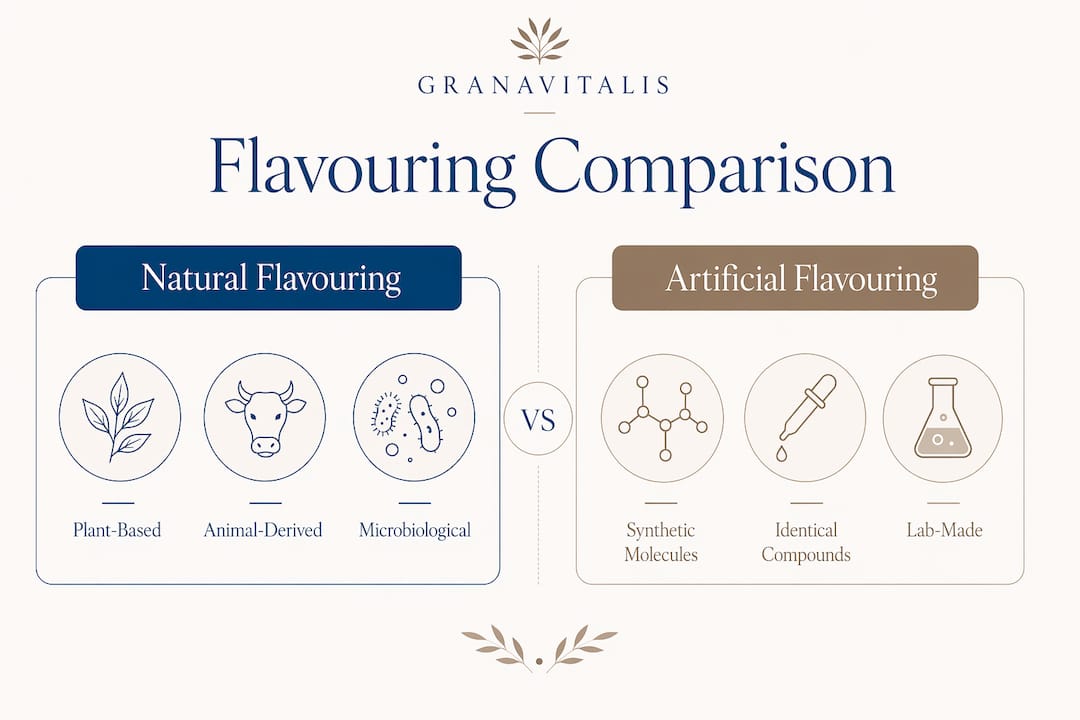
The core difference between natural and artificial flavouring is origin, not safety. Natural flavourings come from plant, animal, or microbiological sources. Artificial flavourings are produced through chemical synthesis, without using a natural raw material as the starting point.
Here is where the common misconception takes hold. Many people assume “natural” automatically means safer or healthier. The UK Food Standards Agency states clearly that there is no inherent safety difference between natural and synthetic flavourings. Both types undergo the same rigorous toxicological evaluation before they receive approval for use in food.
The chemistry reinforces this point. A molecule of vanillin derived from vanilla beans is structurally identical to a molecule of vanillin synthesised in a laboratory. The body’s sensory system cannot distinguish between the two, because identical molecular structures produce identical effects. Safety depends on toxicology, not on whether the source was a plant or a production facility.
| Feature | Natural flavouring | Artificial flavouring |
|---|---|---|
| Origin | Plant, animal, or microbiological | Chemically synthesised |
| Regulatory approval required | Yes | Yes |
| Safety evaluation process | Identical to artificial | Identical to natural |
| Molecular structure vs synthetic equivalent | Often identical | Often identical to natural |
| Allergen risk | Present in some cases | Present in some cases |
A few further misconceptions are worth addressing directly:
- “Natural” does not mean vegan. E120 (cochineal), a natural red colouring and flavouring derived from insects, is unsuitable for vegans and can trigger allergic reactions in some people.
- “Natural” does not mean allergen-free. Flavourings derived from nuts, milk, or celery carry the same allergen risk as the whole food.
- The flavouring industry operates under some of the strictest food sector controls in the UK, with regulation focused on provenance and safety rather than on marketing language.
What ingredients and sources make up natural flavourings?
Natural flavourings may include plant, animal, or microbiological sources, isolated and combined to create complex flavour profiles. The range of raw materials is broader than most people realise.
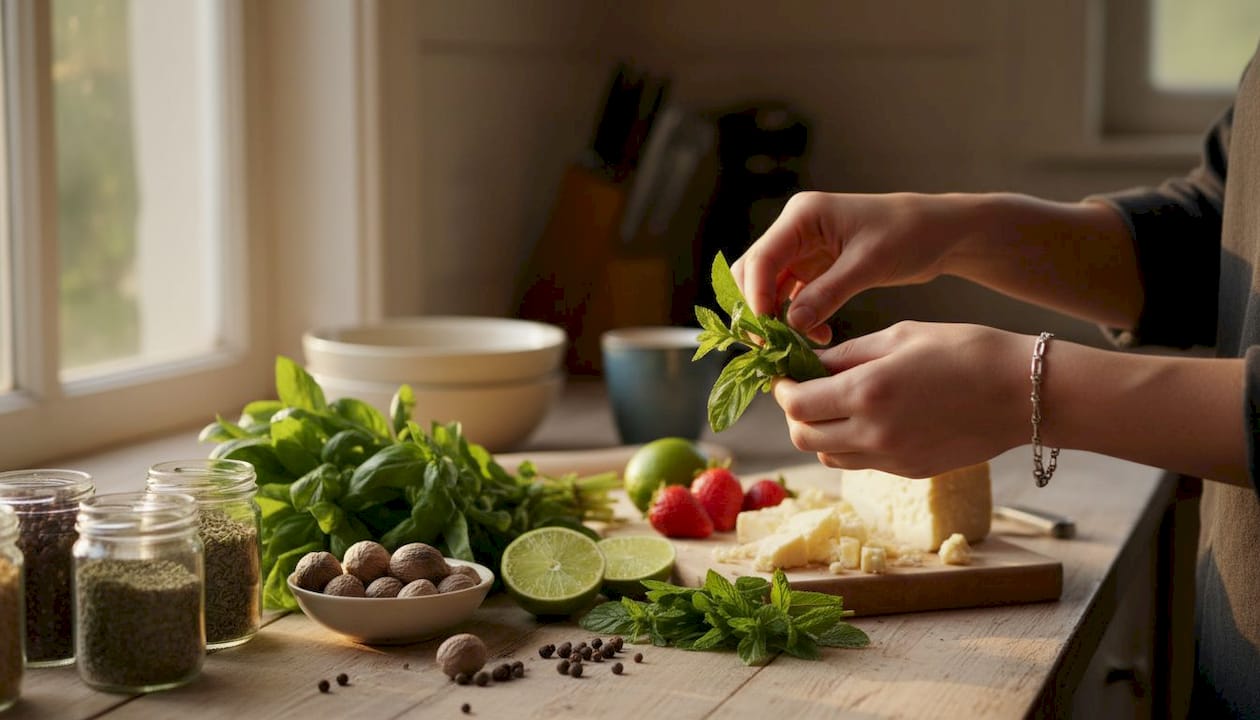
Plant-derived sources are the most common. Herbs such as rosemary and thyme, spices including cinnamon and cloves, fruits, vegetables, and roots all serve as starting points. Vanilla extract comes from the vanilla orchid pod. Citrus flavourings are extracted from the peel of oranges, lemons, and limes. These extractions use physical processes such as pressing and distillation, or enzymatic and microbiological processes where appropriate.
Animal-derived sources include dairy products, meat extracts, and substances such as cochineal. Microbiological sources involve fermentation processes, where bacteria or yeast produce flavour compounds as metabolic by-products. Fermented vanilla, for example, is produced this way and is increasingly common as a sustainable alternative to field-grown vanilla.
Flavour technologists rarely use a single extracted compound. Mixtures of natural flavouring substances are combined using isolation and blending techniques to build a complete sensory experience. A “natural strawberry flavouring” may contain dozens of individual compounds, all derived from natural sources, working together to replicate the full aroma and taste of a fresh strawberry.
Common natural flavouring sources at a glance:
- Plant-based: vanilla, citrus peel, herbs, spices, fruit extracts, vegetable distillates
- Animal-based: dairy extracts, meat extracts, cochineal (E120)
- Microbiological: fermentation-derived compounds from yeast or bacteria
- Combination blends: multi-compound mixtures created through isolation and blending
How do natural flavourings affect nutrition and what should you consider?
Natural flavourings contribute negligible nutritional value. Flavourings are used in tiny quantities primarily to enhance taste and smell, not to deliver protein, fibre, vitamins, or minerals. A product labelled with “natural flavouring” is not nutritionally superior because of that ingredient alone.
This matters because the “natural” label can create a halo effect. You might see “natural vanilla flavouring” on a product and assume the whole item is wholesome. The flavouring itself may well be natural and approved, but the product could still be high in added sugar, low in fibre, or nutritionally poor overall. The flavouring is a sensory tool, not a health marker.
Reading ingredient labels well requires a shift in focus. Industry experts advise prioritising the overall nutritional profile of a product rather than fixating on whether its flavouring is natural or synthetic. Look at the macronutrient breakdown, the fibre content, and the sugar levels. Those figures tell you far more about a product’s value to your body than the flavouring source does.
Allergen awareness is the one area where flavouring origin genuinely matters for your health. Labelling laws require allergen disclosure even when flavourings are listed collectively. If you have a nut, milk, or celery allergy, check the allergen statement carefully, since a “natural flavouring” could derive from any of those sources.
- Check the full nutritional panel, not just the ingredient list, when assessing a product’s health value.
- Look for explicit allergen declarations if you have a known food allergy or intolerance.
- Treat “natural flavouring” as a sensory ingredient, not a nutritional one.
- Contact the manufacturer if you need to know the specific source of a natural flavouring.
- Use resources such as the Granavitalis nutrient integrity guide to understand how ingredient choices affect overall nutritional quality.
Pro Tip: If a product lists “natural flavouring” near the end of its ingredient list, the quantity is almost certainly very small. Ingredients are listed in descending order by weight, so position tells you a great deal about how much of something is actually present.
Key takeaways
Natural flavouring is a legally defined term meaning 100% natural origin, subject to FSA approval and identical safety standards to artificial flavourings, with negligible nutritional impact.
| Point | Details |
|---|---|
| Legal definition is strict | Natural flavouring must be 100% derived from natural sources under UK Retained Regulation (EC) No 1334/2008. |
| Named flavours have a 95% rule | “Natural lemon flavouring” must contain at least 95% lemon-derived material; the rest must still be natural. |
| Safety is equal to artificial | The FSA applies identical toxicological evaluation to both natural and artificial flavourings before approval. |
| Nutritional contribution is negligible | Flavourings are used in trace quantities and add no meaningful protein, fibre, or vitamins to a product. |
| “Natural” does not mean allergen-free | Some natural flavourings, including cochineal (E120), can cause allergic reactions or be unsuitable for vegans. |
The natural label is not the whole story
I have spent years reading food labels and talking to people about what they actually mean. The single most persistent misconception I encounter is the belief that “natural” is a quality guarantee. It is not. It is a description of origin.
The regulatory framework around natural flavouring is genuinely rigorous. The FSA does not approve substances lightly, and the positive list system means every permitted flavouring has been evaluated by scientists. That is reassuring. But the word “natural” on a label tells you nothing about whether a product is nutritious, allergen-safe, or suited to your diet.
What I find more useful is treating the ingredient list as a whole document rather than scanning for reassuring words. Where does the named flavour sit in the list? What are the first three ingredients? Is there an allergen statement? Those questions give you real information. The word “natural” gives you marketing language that happens to have a legal definition behind it.
The flavour pairing approach used in wholefood cooking is a good model for thinking about this. When flavour comes from the ingredient itself, such as a spice, a herb, or a whole fruit, you get both the sensory experience and the nutritional benefit together. That is a different proposition from a trace of natural flavouring added to an otherwise processed product. Both are legal. Only one is nutritionally meaningful.
— Jarrod
Granavitalis and ingredient transparency
At Granavitalis, the commitment to clean ingredients goes beyond using the word “natural.” Every product in the range is built around whole, minimally processed foods with ingredient lists you can actually read and understand.
The Raw Organic Pecan Butter from Granavitalis is a clear example of that approach. The ingredient list is short, the source is traceable, and there are no hidden flavouring blends. For those who want to understand exactly what they are eating, that kind of transparency is the standard Granavitalis holds itself to across its full range of natural protein sources and wholefood products. Real food, clearly labelled, with nothing to hide.
FAQ
What does “natural flavouring” mean on a UK food label?
“Natural flavouring” means the flavouring substance is derived 100% from natural sources such as plants, animals, or microbiological materials, as defined under UK Retained Regulation (EC) No 1334/2008. Manufacturers may use this collective term without listing every individual component, except where allergens are present.
Is natural flavouring safer than artificial flavouring?
No. The UK Food Standards Agency applies identical safety evaluations to both natural and artificial flavourings before approving them for use. The molecular structure of a flavouring compound is the same regardless of whether it came from a natural source or was synthesised chemically.
Can natural flavouring contain allergens?
Yes. Some natural flavourings are derived from allergenic sources such as nuts, milk, or celery. UK labelling law requires allergens to be declared explicitly even when flavourings are listed collectively, so always check the allergen statement on the packaging.
Does natural flavouring add nutritional value to food?
No. Flavourings are used in very small quantities and contribute negligible nutritional value. Their purpose is to enhance taste and aroma, not to deliver vitamins, minerals, or macronutrients.
What is the 95% rule for named natural flavourings?
When a label specifies a source, such as “natural strawberry flavouring,” at least 95% of the flavouring must derive from strawberry. The remaining 5% must still be natural in origin but may come from other sources to complete the flavour profile.