
Low Quality Protein: 4 DIAAS Backed Meal Fixes
Low quality protein is a food whose amino acid profile or digestibility means fewer of its amino acids actually get absorbed and used by your body. It’s not “bad” protein, just less efficient per serving, and the fix is straightforward: pair it with a higher quality protein at the same meal, or swap in a better source at key sittings. Older adults, anyone eating fewer calories, and athletes chasing recovery should pay the closest attention.
TL;DR:
- Pairing low-quality protein sources with high-EAA foods or complementary plant proteins can significantly improve their digestibility and amino acid utilization.
- DIAAS provides a more accurate measure of individual food quality than PDCAAS, with scores below 75 indicating foods that need effective pairing or portion adjustments.
- Older adults, athletes on calorie-restricted diets, and vegetarians or vegans are the most vulnerable to the effects of low protein quality, requiring careful planning to meet amino acid needs.
- Minimal processing such as soaking, fermenting, and gentle cooking boosts digestibility and preserves reactive amino acids like lysine in plant-based foods.
- Relying on highly processed, heavily heat-treated proteins and single ingredients can reduce actual usable protein, so variety and strategic supplementation are key.
Table of Contents
- What is low quality protein, exactly?
- How is protein quality measured: DIAAS vs PDCAAS?
- Who is most affected by low protein quality?
- How to improve the quality of low-quality proteins
- Practical swaps and sample meal ideas
- How processing and storage affect real-world protein quality
- What to trust on labels and in protein claims
- Granavitalis perspective: sourcing and formulation for protein quality
- The bottom line on low quality protein
- What is low quality protein and how do you actually fix it in your meals?
- Sources
What is low quality protein, exactly?
Protein quality comes down to two things happening at once: what amino acids a food contains, and how much of that food your gut actually breaks down and absorbs. Get either one wrong and you end up with a low quality protein source, regardless of how much total protein sits on the label.
Your body needs nine indispensable amino acids, commonly called essential amino acids or EAAs, that it cannot make on its own. Histidine, isoleucine, leucine, lysine, methionine, phenylalanine, threonine, tryptophan and valine all have to come from food. A protein is only as useful as its scarcest essential amino acid. Nutritionists call this the limiting amino acid, and it works like a bottleneck: if a food is short on lysine, your body can only build new protein up to the point that lysine runs out, no matter how much of everything else is on offer.
That’s the composition half of the story. The other half is digestibility. Two foods can contain identical amino acid totals on paper and still behave completely differently in your gut. Fibre, antinutrients such as phytates and tannins, and the physical structure of a food (think a tough plant cell wall versus a soft curd of cheese) all slow or block absorption. Cook a bean and its protein becomes far more available than the same bean eaten raw. Grind a nut and you free up a little more of its amino acid content than if you’d eaten it whole.
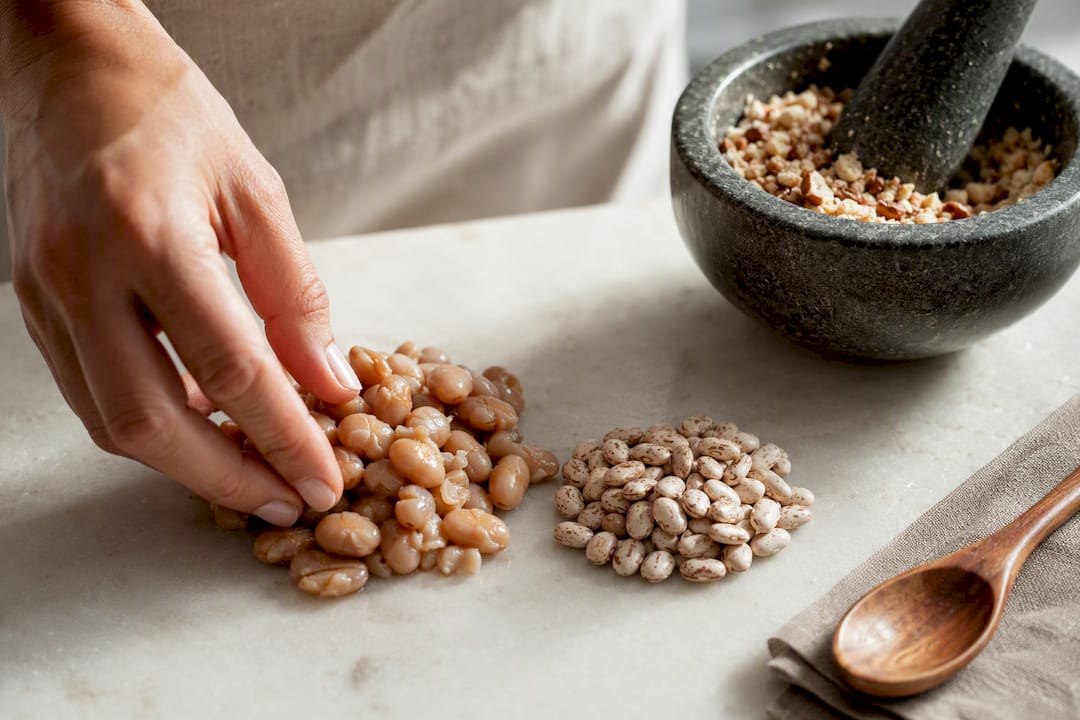
Composition and digestion are inseparable in practice, and that’s precisely why a single number matters more than a simple ingredients list. A grain might contain a decent theoretical spread of amino acids, but if antinutrients block a chunk of that from actually crossing the gut wall, the usable protein comes in far below what the packet suggests.
Common markers of a low quality protein include:
- A shortfall in one or more of the nine essential amino acids, most often lysine, methionine or tryptophan in plant foods
- Poor digestibility caused by fibre, antinutrients, or a dense, unprocessed food matrix
- A processing history (heavy heat, long storage) that has degraded reactive amino acids before the food even reaches your plate
- Reliance on a single ingredient rather than a varied combination across the day
None of this makes a food worthless. It just means the protein on the label overstates what your body can actually put to work.
How is protein quality measured: DIAAS vs PDCAAS?
The metric that matters now is DIAAS, the Digestible Indispensable Amino Acid Score, and it has largely superseded an older measure called PDCAAS. If you remember one thing from this section, make it that: DIAAS gives a truer picture of what a single food actually delivers, while PDCAAS tends to smooth over real gaps.
PDCAAS, the Protein Digestibility Corrected Amino Acid Score, was the industry standard for decades. It compares a food’s amino acid profile against a reference pattern, then applies a single digestibility correction based on faecal measurements for the whole protein. That approach has two weaknesses: faecal digestibility lumps in what gut bacteria do to protein further down the digestive tract, and a single blanket correction ignores that some amino acids in a food digest more easily than others.
DIAAS fixes both problems by measuring true ileal digestibility, sampling at the end of the small intestine before bacterial fermentation muddies the result, and scoring each indispensable amino acid individually rather than the protein as a whole. That’s a meaningfully more accurate estimate of what your body can genuinely use from a given food.
Statistic Callout: A DIAAS below 100% means that when a food is eaten alone, at least one essential amino acid falls short of what a reference protein would supply, according to a decade of DIAAS research. Above 100% signals a genuinely complete, high-efficiency protein source on its own.
Here’s how the scores break down in practice:
- DIAAS below 75%: Generally read as low quality on its own; expect a real limiting amino acid gap that needs correcting through pairing or portion increases.
- DIAAS 75% to 100%: Workable but imperfect; the food supplies most of what you need but leaves a small shortfall in at least one amino acid.
- DIAAS above 100%: A complete, high-efficiency protein when eaten alone, no complementary food required.
Whey protein isolate, eggs and casein routinely score above 100. Most single grains, plenty of legumes, and many nuts sit in that 75 to 100 middle band. That doesn’t disqualify them. It simply tells you they perform better in combination than in isolation, which is exactly the insight DIAAS was designed to surface.
One caveat worth flagging early: DIAAS is a single-food measure. It was never designed to score a full mixed meal, and current reviews acknowledge that gap as one of the metric’s practical limits. Treat it as a diagnostic tool for individual ingredients, not a final verdict on your dinner plate.
Who is most affected by low protein quality?
The people who feel the effects of low quality protein first are the ones with the least room to spare: older adults, anyone eating fewer calories than usual, and athletes who need protein to work hard for their size.
Population modelling puts this in concrete terms. When researchers factor DIAAS into dietary analysis instead of just tallying total grams of protein, a larger share of adults show habitual intakes below the estimated average requirement than when quality is ignored. Total protein on a food diary can look perfectly adequate while the usable amount, once digestibility and amino acid completeness are accounted for, tells a different story.
Older adults face a specific mechanism called anabolic resistance. Muscle in older bodies responds less efficiently to a given dose of amino acids than muscle in younger bodies, so hitting the same anabolic trigger requires a denser hit of essential amino acids, particularly leucine, per meal. A lower quality protein source that would barely register as a problem for a 25-year-old can leave a 70-year-old under threshold for stimulating muscle protein synthesis at all. This is one reason dietary guidance for older adults increasingly stresses protein quality per meal rather than just a daily gram target.
Athletes on calorie-restricted diets sit in an uncomfortable middle ground. Modelling around dietary protein quality and utilisable protein shows that when energy intake is capped and protein needs are high, relying on low quality protein sources forces an inefficient trade-off: you either eat considerably more food to compensate for the amino acid shortfall, which eats into your calorie budget, or you fall short on the amino acids your training actually demands. Swapping even part of that intake for a higher DIAAS source solves the problem without adding calories.
Vegans and vegetarians relying heavily on a narrow set of plant proteins carry a version of the same risk, though it’s manageable with planning. A diet built around varied legumes, grains and a plant-based protein blend can hit strong effective quality across the day, even if no single ingredient scores brilliantly alone.
The practical upshot across all three groups is the same: total protein intake is not the whole picture, and for anyone in a higher-risk category, the composition of that protein deserves as much attention as the number on the label.
How to improve the quality of low-quality proteins
You don’t need to eliminate lower quality proteins from your diet. You need to correct them, and there are four reliable ways to do it.
- Complement across the meal. Pair a protein that’s short on one amino acid with a protein that’s rich in it. Rice is short on lysine; lentils are rich in it. Put them on the same plate and the combined amino acid profile behaves far better than either food alone. Hummus is light on methionine; wholegrain bread supplies it. This principle, often called protein complementation, has been standard nutrition advice for decades and it still works because the underlying chemistry hasn’t changed.
- Add a small high-EAA “top-up” ingredient. You don’t need to double a meal’s protein to fix its amino acid gap. A single egg stirred into a grain bowl, a spoon of whey or soy isolate blended into a smoothie, or a splash of dairy alongside a legume-heavy dish disproportionately lifts the overall meal’s effective quality, because you’re filling the specific gap rather than adding more of what’s already there.
- Use processing to your advantage. Soaking, sprouting and fermenting grains, legumes and seeds break down antinutrients like phytates that otherwise block absorption. Fermentation and soaking measurably improve practical digestibility compared with the same food eaten raw or unprocessed. Gentle cooking generally helps too, though aggressive, prolonged high heat can start working against you by damaging reactive amino acids such as lysine, so there’s a sweet spot rather than a simple “more heat is better” rule.
- Watch the caloric trade-off when you’re increasing volume instead of quality. If your instinct is to just eat more of a low quality source to hit a protein target, check the calorie cost. Doubling a rice portion to compensate for its lysine gap adds a meaningful chunk of carbohydrate and energy that a smaller addition of a complementary protein wouldn’t. This matters most if you’re managing calories deliberately, whether for weight goals or because you’re already eating less than usual.
Pro Tip: Keep one high-EAA ingredient on hand that you can add to almost anything: a tub of plain whey, a jar of soy isolate powder, or even a couple of eggs. Ten grams stirred into a grain-based meal does more for that meal’s usable protein than an extra fifty grams of the grain itself.
Granavitalis leans on the same logic in how its plant protein sources are blended, combining ingredients that cover for each other’s amino acid gaps rather than relying on any single grain or legume to do the whole job. If you want a more structured walk-through of pairing logic, balancing plant protein sources across a day covers the mechanics in more depth than a single meal example can.
Practical swaps and sample meal ideas
Small substitutions raise the effective protein quality of a day’s eating without requiring a shopping overhaul or a total change in habits.
Quick swaps by meal:
- Breakfast: Swap plain oats for oats stirred with a scoop of whey or a plant protein blend; add a boiled egg alongside toast rather than butter alone.
- Lunch: Swap a plain rice bowl for rice plus a lentil or chickpea component; add a handful of edamame to a grain salad.
- Dinner: Swap a single-grain side (plain pasta, plain rice) for a grain and legume combination; add a small portion of fish, poultry or tofu alongside a vegetable-heavy, grain-based main.
- Snacks: Swap a plain nut butter on toast for a nut butter with a side of Greek yoghurt or a small dairy pairing; choose a mixed nut and seed butter over a single-nut variety to spread the amino acid gaps across more sources.
Two one-day templates illustrate how this plays out:
- Maintenance day: Breakfast of eggs with wholegrain toast; lunch of a grain and legume bowl (rice and black beans, or bulgur and chickpeas) with vegetables; dinner of a moderate portion of fish or tofu with a mixed grain side; a nut and seed butter snack with fruit.
- Muscle-support day: Breakfast with a protein-fortified oat bowl (whey or plant blend stirred in); a post-training shake or smoothie built around a higher-DIAAS protein source within the hour after exercise; lunch and dinner both built around a complete protein anchor (poultry, fish, dairy, or a well-complemented legume and grain combination) with a grain side; an evening casein or dairy-based snack to support overnight recovery.
Older adults benefit from shifting protein density earlier and more evenly across the day rather than loading most of it into one large evening meal, since anabolic resistance means each individual sitting needs its own strong EAA hit. Post-exercise timing matters less than total daily quality for most casual exercisers, but for anyone training hard, a higher-DIAAS source within an hour or two of a session remains a sound habit. For structured ideas aimed at training goals, Granavitalis’s plant protein guide for muscle support builds on these same swap principles.
How processing and storage affect real-world protein quality
What happens to a protein after harvest can matter as much as what’s naturally in the food. Heat, storage time, and formulation choices all move the needle on how much amino acid content actually survives to reach your plate.
- Heat degrades reactive lysine. High-temperature industrial processing, particularly prolonged heat during drying or sterilisation, triggers the Maillard reaction between amino acids and sugars, and lysine is usually the first casualty. Storage and heat exposure measurably reduce available lysine and overall digestibility compared with fresh or gently processed equivalents.
- Isolates and concentrates often outperform whole flours. Stripping away fibre and antinutrient-heavy components during isolation frequently raises DIAAS scores relative to the same source’s whole-flour form, because the barriers to digestion have been physically removed rather than left intact.
- Storage time isn’t neutral. Extended storage, especially at warm temperatures, continues degrading amino acid availability even after processing is complete, which is one reason freshness and storage conditions belong in the same conversation as ingredient choice.
For label reading, that means “isolate” or “concentrate” is a reasonable, if imperfect, positive signal, while vague claims about a “whole grain” or “raw” protein source tell you nothing about how it was actually handled before packaging.
What to trust on labels and in protein claims
Most protein packaging in shops still leans on total grams per serving, and that number alone tells you almost nothing about quality. DIAAS is the more informative metric, but it’s rarely printed on consumer labels because the testing is expensive and regulatory requirements haven’t caught up with the science, a gap that current reviews openly acknowledge.
In the absence of a DIAAS number, a short checklist helps you read between the lines:
- Good signs: “Isolate” or “concentrate” in the ingredient name, amino acid profiles listed on the back panel, a blend of multiple protein sources rather than a single ingredient, minimal heat processing claims.
- Caution signs: A single-source plant flour marketed simply as “high protein” with no amino acid breakdown, heavy reliance on gelatine or collagen as the primary protein, vague “protein blend” wording with no percentage disclosure.
- The real rule of thumb: variety beats any single “high protein” claim. A varied diet with small strategic additions of high-EAA foods consistently outperforms betting everything on one product’s marketing, regardless of how confidently that product is labelled.
Treat a “complete protein” claim on packaging as a starting point for further reading, not a verdict. The safest habit is the one covered earlier: pair, don’t rely.
Granavitalis perspective: sourcing and formulation for protein quality
Some companies build their ingredient range around the principle that composition and processing both decide whether a protein performs. Ancient grains, minimally processed nuts and seeds, and thoughtfully formulated plant proteins are central to this approach, chosen because industrial hybridisation and heavy processing can erode amino acid availability over time.
Blending is where the real gains happen. A single grain or legume rarely clears a strong DIAAS score alone, but combine a grain-based flour with a legume or seed protein, and the finished blend’s amino acid gaps start closing against each other, mirroring the same complementation logic that works at meal level. That’s the reasoning behind pairing ancient grain flours with nut and seed based additions rather than treating any one ingredient as a complete solution on its own.
Minimal processing matters just as much as the pairing itself. Gentle handling protects reactive amino acids like lysine from heat degradation that aggressive industrial methods cause, which explains why some favour nut butters and seed products processed with restraint rather than pushed through high-heat extraction. For readers who want to go deeper on the population-level context behind these choices, the quality protein overview covers how UK dietary patterns compare against actual amino acid needs, not just total grams consumed.
The bottom line on low quality protein
Low quality protein isn’t a food to avoid. It’s a food to pair, portion, or process differently, and the fix rarely requires more than a small adjustment.
- Prioritise high-EAA foods (eggs, dairy, whey, soy isolate, fish, poultry) at your most important meals, especially post-exercise or your largest meal of the day
- Complement plant proteins deliberately: grains with legumes, seeds with dairy, rather than relying on one source alone
- Favour isolates, concentrates, or soaked and fermented forms over heavily heat-processed whole flours where digestibility matters most
- Watch your calorie budget if you’re compensating for low quality with sheer volume rather than a targeted addition
- Older adults, people on restricted calories, and anyone with a diagnosed nutritional concern should get individual guidance from a registered dietitian or GP rather than relying on general rules alone
What is low quality protein and how do you actually fix it in your meals?
The conventional advice on protein quality spends too long on lab scores and not nearly enough on what to actually put on your fork. DIAAS is the right metric, genuinely more accurate than PDCAAS ever was, but a number on a research paper changes nothing if nobody translates it into a meal.
Here’s where most guidance falls short: it treats low quality protein as a category of food to fear rather than a gap to close. Rice isn’t a poor food. Rice eaten alone, day after day, as your only protein source, creates a lysine shortfall that a spoonful of lentils fixes in seconds. The problem was never the ingredient. It was the habit of eating it in isolation.
If you take one thing from this, prioritise pairing over avoidance. Build meals with at least two protein sources that cover each other’s gaps, lean on minimally processed forms where you can, and save the calorie-heavy workaround of “just eat more” for when nothing else fits. That’s a habit, not a diet overhaul, and it’s the one that actually moves the needle.
— Jarrod
This article is general information, not a substitute for advice from a qualified doctor. Consult a qualified healthcare professional about your own circumstances before acting on anything here.
Sources
Some foods land in the low quality bracket so consistently that it’s worth knowing them by name, along with which amino acid usually falls short.
Consumer health guidance also flags certain processed meats and some lower-grade protein powders as items worth scrutinising, per Cleveland Clinic’s review of protein sources, reinforcing that low quality protein isn’t confined to plant foods.
None of these foods deserve to be cut from your diet. Rice paired with lentils, or a nut butter stirred through a whey-based shake, closes the exact gap each ingredient has on its own. The problem only bites when one of these sources is the sole protein at a meal, day after day.