
The role of wholefoods in modern diets: 2026 guide
TL;DR:
- Eating a minimally processed wholefood diet increases food volume while reducing calorie intake. Wholefoods enhance nutrient absorption and satiety, supporting long-term health and balanced digestion. Incremental dietary changes and focusing on adding nutrients lead to sustainable, accessible improvements.
Wholefoods are defined as foods consumed in, or close to, their natural unprocessed state, and their role in modern diets is the single most evidence-backed lever for improving nutrition without calorie restriction. Research published in early 2026 by the Bristol Biomedical Research Centre found that people eating a minimally processed wholefood diet consumed 57% more food by weight yet took in 330 fewer calories daily compared to those eating ultra-processed foods. Nutritionist Jenna Hope and researchers at The American Journal of Clinical Nutrition have both highlighted that this is not about eating less. It is about eating smarter, with foods that deliver more volume, more nutrients, and better satiety per bite.
How do wholefoods compare nutritionally to ultra-processed foods?
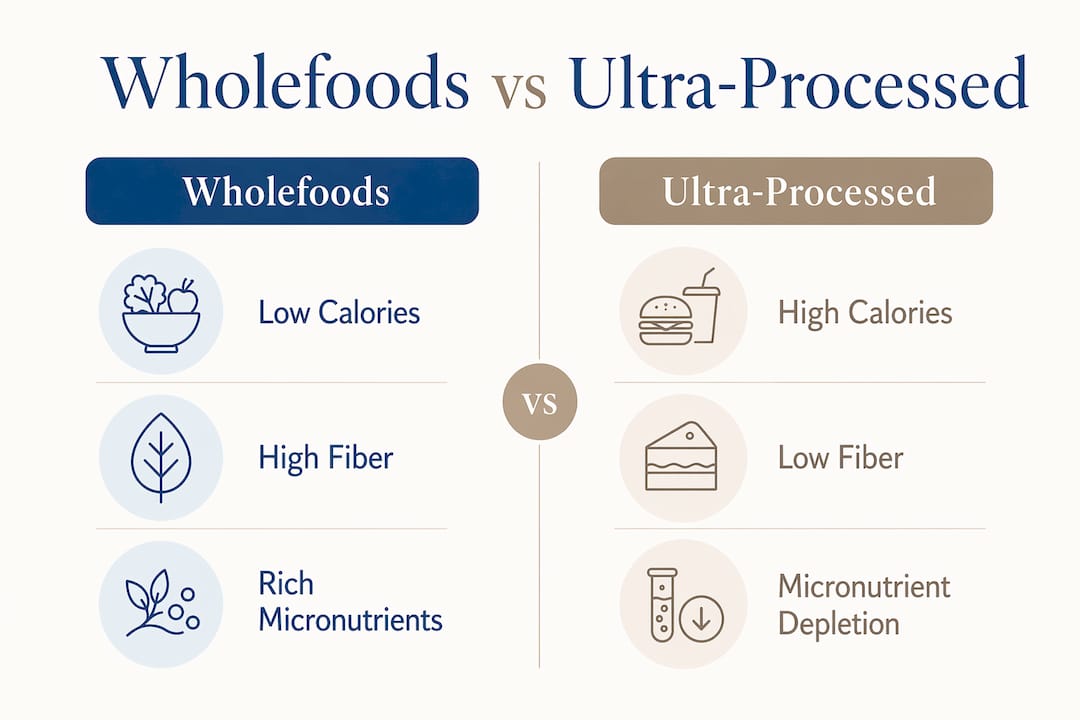
The calorie gap between wholefoods and ultra-processed foods is striking. People on wholefood diets eat 330 fewer calories daily while consuming significantly greater food mass. That means you feel fuller, not hungrier, on a wholefood pattern.
The mechanism behind this is partly what researchers call micronutrient deleveraging. Ultra-processed foods are engineered to bundle micronutrients with energy-dense ingredients, which disrupts natural appetite cues and encourages overconsumption. Wholefoods do the opposite. They deliver vitamins and minerals alongside fibre and water, which slow digestion and signal fullness earlier.
The Bristol BRC research also found that wholefood consumers chose more fruit and vegetables, naturally filling micronutrient gaps that calorie-dense processed foods leave open. This matters because vitamin and mineral deficiencies are common even in people who eat enough calories.
| Factor | Wholefoods | Ultra-Processed Foods |
|---|---|---|
| Calorie density | Low to moderate | High |
| Fibre content | High | Very low |
| Micronutrient profile | Broad and naturally occurring | Narrow, often artificially added |
| Satiety per gram | High | Low |
| Appetite signal integrity | Preserved | Frequently disrupted |
Pro Tip: Prioritise fruits and vegetables at every meal to fill micronutrient gaps without adding excess calories. Aim to cover at least half your plate before adding grains or proteins.
What makes wholefoods nutritionally superior at a cellular level?
The answer lies in two concepts: nutrient synergy and the food matrix effect. Nutrient synergy means that compounds in whole foods work together to improve absorption. Carotenoids and flavonoids, for example, enhance bioavailability in ways that isolated supplements simply cannot replicate. Taking a beta-carotene capsule is not the same as eating a carrot.

The food matrix refers to the physical structure of a whole food, and it directly controls how nutrients are released during digestion. The British Heart Foundation notes that this food matrix modulates nutrient absorption and metabolic responses in ways that processed equivalents cannot match. Whole almonds, for instance, slow fat absorption because their cell walls remain largely intact during digestion. Almond butter, by contrast, has a broken-down matrix and delivers fat more rapidly into the bloodstream.
The same principle applies to sugar. Eating a whole orange releases fructose slowly because the fibre matrix slows digestion. Drinking orange juice removes that matrix entirely, producing a faster blood sugar spike despite identical sugar content. Understanding this distinction is what separates informed eating from guesswork.
| Food Comparison | Whole Form Effect | Processed Form Effect |
|---|---|---|
| Whole almonds vs almond butter | Slower fat absorption | Faster fat uptake |
| Whole orange vs orange juice | Gradual sugar release | Rapid blood sugar spike |
| Fresh tomatoes vs tinned tomatoes | Lower lycopene bioavailability | Higher lycopene availability |
| Whole oats vs instant oats | Sustained energy release | Faster glucose response |
The tomato example is worth noting. Tinned tomatoes actually provide more bioavailable lycopene than raw fresh tomatoes because heat processing breaks down cell walls and releases the antioxidant. This is a useful reminder that not all processing is harmful. Some forms genuinely improve nutrient integrity and should be embraced rather than avoided.
Pro Tip: Pair fat-soluble nutrients like lycopene and beta-carotene with a small amount of healthy fat, such as olive oil or a handful of nuts, to maximise absorption from your meal.
How can you practically add more wholefoods to your daily eating?
The most common mistake people make when shifting to a wholefood pattern is trying to do it all at once. Experts consistently recommend gradual healthy swaps over complete elimination of processed foods. Rigid restriction leads to burnout, not better health.
The British Heart Foundation reinforces this, noting that sustainable wholefood eating relies on flexibility and the inclusion of minimally processed, high-quality convenience foods rather than all-or-nothing eliminations. A tin of lentils counts. Frozen spinach counts. The goal is nutrient density, not dietary purity.
Here are practical swaps that work in real life:
- Replace crisps and biscuits with fresh fruit, raw nuts, or seeds as your default snack
- Swap white bread for whole grain or sourdough varieties made with minimal ingredients
- Use rolled oats instead of sugary breakfast cereals for a fibre-rich, filling start
- Choose whole grain rice or quinoa over white rice to retain B vitamins and fibre
- Swap flavoured yoghurts for plain Greek yoghurt with fresh berries and a drizzle of honey
- Replace processed snack bars with a small handful of mixed nuts and dried fruit
- Add a portion of plant-based foods such as chickpeas or lentils to one meal per day
Incremental changes like these compound over weeks and months. You do not need to overhaul your kitchen in a weekend. One swap per week, sustained for a year, produces a fundamentally different diet without the psychological cost of restriction. For a structured approach, the Granavitalis guide on sustained energy from wholefoods offers a practical framework for building these habits around your daily routine.
What are the broader health benefits of a wholefood-focused diet?
The health case for wholefoods extends well beyond weight management. Clinical evidence links wholefood-based diets to improved cardiovascular markers including lower blood pressure, better lipid profiles, and improved endothelial function. These are the biological foundations of long-term heart health.
Fibre is central to many of these benefits. High fibre intake from whole foods improves colon function, feeds beneficial gut bacteria, and strengthens antioxidant defences. The gut microbiome, in turn, influences immune function, mood regulation, and metabolic health. Fibre is not just a digestive aid. It is a systemic health tool.
“Mediterranean-style diets rich in wholefoods correlate with significantly lower all-cause mortality and cardiovascular risk, making dietary pattern one of the most powerful modifiable factors in long-term health.”
The Mediterranean diet, built on vegetables, legumes, whole grains, nuts, and olive oil, is the most studied wholefood pattern in the world. Its association with reduced risk of type 2 diabetes, certain cancers, and cardiovascular disease is supported by decades of clinical data. You do not need to live in southern Europe to benefit. The principles translate directly to any kitchen. Exploring wholefood nutrition for longevity shows how these patterns map onto everyday British eating habits.
Mental wellbeing is also part of the picture. Diets high in ultra-processed foods are associated with higher rates of depression and anxiety, while wholefood patterns support stable blood sugar, which directly influences mood and cognitive clarity throughout the day.
Key takeaways
The role of wholefoods in modern diets is clear: they deliver more food volume, superior nutrient absorption, and measurable long-term health protection compared to ultra-processed alternatives.
| Point | Details |
|---|---|
| Volume without excess calories | Wholefood diets provide 57% more food by weight with 330 fewer calories daily. |
| Food matrix drives absorption | The physical structure of whole foods controls how nutrients and sugars are released during digestion. |
| Not all processing is harmful | Tinned tomatoes deliver more bioavailable lycopene than fresh, showing processing can improve nutrition. |
| Gradual swaps outperform restriction | Incremental substitutions maintain long-term adherence better than rigid elimination approaches. |
| Fibre is a systemic health tool | High fibre intake from whole foods supports gut health, cardiovascular function, and metabolic regulation. |
Why i think the wholefood conversation is missing its most important point
Most articles about wholefoods focus on what to cut out. Cut the crisps, cut the white bread, cut the processed snacks. That framing is both exhausting and counterproductive. In my experience, the people who sustain genuinely good diets are not the ones who eliminate the most. They are the ones who add the most.
When you focus on adding a handful of walnuts, a portion of lentils, or a bowl of whole grain porridge, the processed foods naturally get crowded out. You are not fighting your appetite. You are redirecting it. The 2026 Bristol BRC research backs this up. People eating more wholefoods did not white-knuckle their way through hunger. They simply felt satisfied on less energy because the food they ate was doing more work.
The other thing I would push back on is the idea that wholefood eating is expensive or time-consuming. Tinned legumes, frozen vegetables, oats, and seeds are among the cheapest foods per gram of nutrition available in any British supermarket. The premium is largely a perception problem, not a reality. Granavitalis builds its entire range around this principle: that foods rooted in tradition, minimally processed and transparently sourced, are both accessible and genuinely effective. You do not need a complicated protocol. You need better ingredients and a bit of patience.
— Jarrod
Real wholefoods, ready to go: Granavitalis
If you are ready to put these principles into practice, Granavitalis makes it straightforward. Every product in the range is built on the same foundation: minimal processing, maximum nutrient integrity, and ingredients you can actually recognise.

The Immune Booster Superfood Bundle brings together a curated selection of wholefood-based superfoods designed to support immune health and daily wellness. For everyday snacking and cooking, the Organic Nut and Seed Butter Selection Box by RAWGORILLA delivers the food matrix benefits of whole nuts in a convenient, minimally processed form. These are not shortcuts. They are the kind of unprocessed grain and nut foundations that make a wholefood diet sustainable in real life.
FAQ
What exactly counts as a wholefood?
A wholefood is any food consumed in, or very close to, its natural state with minimal industrial processing. Examples include whole grains, fresh fruit and vegetables, legumes, nuts, seeds, and eggs.
Are wholefoods necessary for good health?
Wholefoods are not strictly mandatory, but they are the most reliable way to meet micronutrient needs while managing calorie intake. Clinical evidence consistently links wholefood-rich diets to lower risks of cardiovascular disease, type 2 diabetes, and all-cause mortality.
How do wholefoods improve diets compared to supplements?
Whole foods supply phytochemicals like carotenoids and flavonoids that work together to enhance nutrient bioavailability in ways isolated supplements cannot replicate. The food matrix effect means nutrients are absorbed more effectively from real food than from pills.
Is all food processing bad for you?
No. Some processing genuinely improves nutrition. Tinned tomatoes, for example, provide more bioavailable lycopene than raw fresh tomatoes because heat breaks down cell walls and releases the antioxidant.
How quickly can you see benefits from eating more wholefoods?
Clinical studies show improvements in blood pressure, cholesterol, and energy levels within weeks of shifting to a wholefood-rich pattern. Gradual swaps rather than complete overhauls produce the most sustainable and measurable results.