
Discover the benefits of unprocessed grains for health
TL;DR:
- Many people believe “whole grain” products are inherently healthy, but refining removes vital nutrients from grains. Truly unprocessed grains retain all kernel parts, offering superior health benefits such as lower chronic disease risks and improved digestion. Choosing genuine whole grains involves reading labels carefully and prioritizing minimally processed, recognizable ingredients over marketing claims.
Most people reaching for a “whole grain” loaf or cereal at the supermarket genuinely believe they are making the healthiest choice available. The reality is more complicated. Keeping bran and germ intact is what makes a grain truly nutrient-dense, yet refining strips away precisely those layers, removing fibre, vitamins, minerals, phytonutrients, and healthy fats in the process. This guide cuts through the marketing noise so you can understand what genuinely unprocessed grains offer your body and how to confidently choose them every single time.
Table of Contents
- What makes unprocessed grains different?
- Health benefits of unprocessed grains: The scientific evidence
- Nutrient losses: What processing strips away
- The processing trap: Not all ‘whole grain’ foods are healthy
- How to identify and choose truly unprocessed grains
- Why real food choices matter more than labels
- Experience truly unprocessed goodness with Granavitalis
- Frequently asked questions
Key Takeaways
| Point | Details |
|---|---|
| Unprocessed grains retain nutrients | Grains in their natural form keep the bran, germ, and all essential nutrients lost in refining. |
| Whole grains support long-term health | Consuming unprocessed grains lowers disease risk and supports better metabolic and heart health. |
| Food labels can be misleading | Not all products labelled ‘whole grain’ are healthy, so careful label reading is vital. |
| Choose less-processed options | Prioritise grains and foods with minimal processing for the strongest wellness benefits. |
What makes unprocessed grains different?
Walk into any supermarket and you will find shelves stacked with foods carrying “whole grain” claims. Yet there is a meaningful gap between a grain that has been truly left intact and one that has been ground, reconstituted, or partially stripped and then relabelled. Understanding that gap is the first step toward eating for real, sustained wellness.
A whole grain retains all three parts of its original kernel: the bran (outer layer), the germ (nutrient-rich core), and the endosperm (starchy middle). When a grain is refined, most of the bran and germ are removed, leaving behind mostly starch with dramatically reduced nutritional value. It is a bit like peeling an apple and discarding the skin and seeds, then claiming you are still eating a whole apple.
Here is a quick breakdown of what each part of the kernel contributes:
| Kernel part | Key nutrients | What you lose when it’s removed |
|---|---|---|
| Bran | Fibre, B vitamins, iron, zinc, antioxidants | Slower digestion, reduced blood sugar control |
| Germ | Vitamin E, B vitamins, healthy fats, phytonutrients | Anti-inflammatory protection, long-term cellular health |
| Endosperm | Starch, some protein, small amounts of B vitamins | Remains in refined products, but alone it is nutritionally thin |
“The bran and germ are where the real nutritional work happens. Without them, you are essentially eating a concentrated source of starch.”
Key things to look for in a genuinely unprocessed grain:
- The grain looks recognisable: oat groats, brown rice, whole wheat berries, spelt, einkorn, or emmer
- There is no long list of added ingredients
- The fibre content is naturally high, not boosted by added isolated fibres
- It has not been puffed, extruded, or heavily milled into a powder before packaging
Exploring the benefits tied to traditional grains reveals how heritage varieties in particular tend to preserve far more nutritional integrity than their modern, industrially bred counterparts.
Health benefits of unprocessed grains: The scientific evidence
Now that you are clear on what unprocessed grains are, let us look at the concrete health impact of choosing these grains, with evidence from major studies.
The science here is striking. Whole grain intake is associated with meaningfully lower risk of several chronic diseases, including type 2 diabetes, cardiovascular disease, and stroke. This is not a fringe claim. It is one of the most consistently replicated findings in nutritional epidemiology over the past three decades.
The protective effects come from several mechanisms working together:
- Fibre slows glucose absorption, reducing insulin spikes and supporting long-term metabolic health
- Magnesium and potassium (present in the bran and germ) support healthy blood pressure regulation
- Phytonutrients and antioxidants combat oxidative stress, which is linked to accelerated ageing and chronic illness
- Healthy fats in the germ help reduce systemic inflammation over time
- B vitamins support energy metabolism and nervous system function, which matters for focus and daily performance
Studies tracking large populations over many years show that people who eat three or more servings of whole grains daily have significantly lower rates of heart disease than those who predominantly eat refined grains. The difference in risk can be substantial, often in the range of 20 to 30 percent for major cardiovascular events.
Weight management is another area where the evidence is compelling. Unprocessed grains keep you fuller for longer because their fibre content slows the rate at which your stomach empties. This means fewer energy crashes, less snacking between meals, and better appetite regulation across the day.
If you want to understand how ancient grains support wellness beyond just fibre, there is a wealth of specific research on heritage varieties that show even greater nutrient density than modern strains.
Nutrient losses: What processing strips away
Armed with knowledge of the health benefits, it is useful to see exactly how much you lose nutritionally when grains are processed, even if they are still sold under a “whole grain” label.
The numbers are sobering. Research shows that milling causes vitamin losses averaging 70 to 80 percent for several key nutrients. That is not a marginal reduction. It is the difference between a food that actively nourishes you and one that simply fills you up.
| Nutrient | Brown rice (unprocessed) | White rice (refined) | Approximate loss |
|---|---|---|---|
| Fibre | 3.5g per 100g | 0.4g per 100g | ~89% |
| Magnesium | 143mg per 100g | 25mg per 100g | ~83% |
| Vitamin B1 (thiamine) | 0.40mg per 100g | 0.07mg per 100g | ~83% |
| Vitamin B3 (niacin) | 5.09mg per 100g | 1.60mg per 100g | ~69% |
| Vitamin E | 1.0mg per 100g | 0.1mg per 100g | ~90% |
The brown rice versus white rice comparison is one of the clearest real-world illustrations. Both come from the same grain. The only difference is whether the outer layers have been removed. Yet the nutritional gap between them is enormous. Choosing brown rice over white rice consistently, over months and years, adds up to a genuinely different nutritional profile.
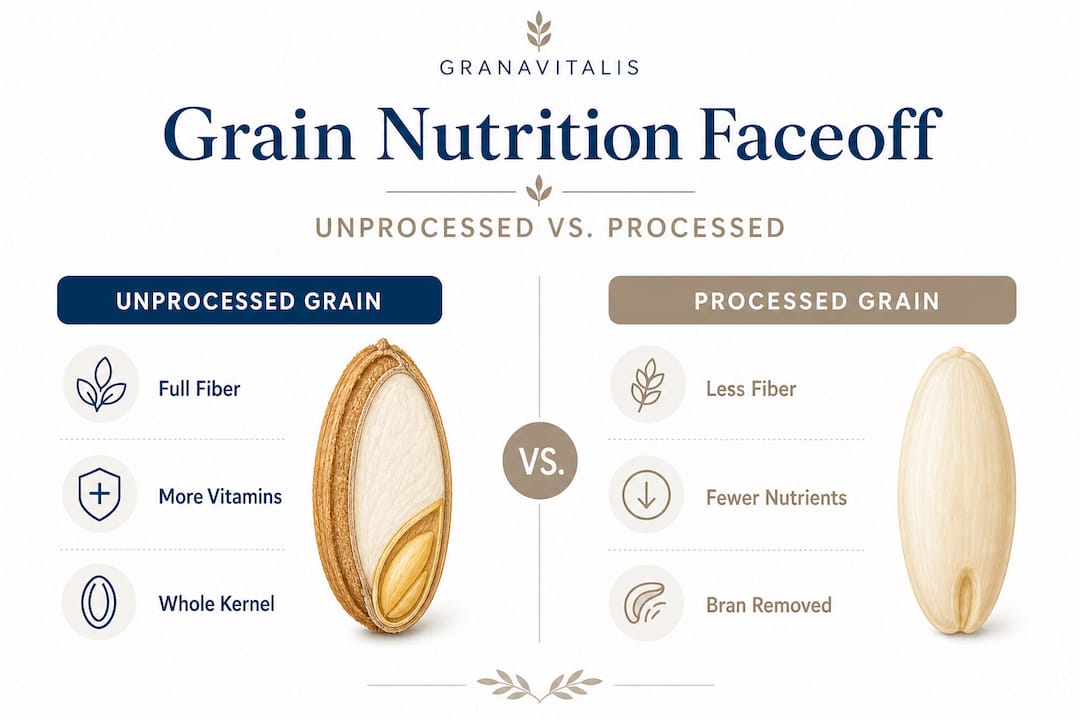
It is also worth noting that many refined grain products are then “enriched” with a handful of B vitamins after milling. This process adds back only a fraction of what was removed and does nothing to restore fibre, healthy fats, or phytonutrients. Enrichment is not the same as wholeness.
Pro Tip: When buying wheat-based products, look for wheat bran as a standalone ingredient you can add to porridge, bakes, and smoothies. It is one of the most direct ways to restore what refining removes.
The processing trap: Not all ‘whole grain’ foods are healthy
The next question you might find yourself asking is: aren’t most foods labelled as “whole grain” automatically healthy? Let us look closer, because the answer is often no.
Research makes this distinction clearly. Cardiometabolic benefits are stronger when whole grains come from non-ultra-processed sources, meaning the way a grain is packaged and produced matters as much as whether it technically contains whole grain. A breakfast cereal that lists whole grain oats as its first ingredient but also contains 30 grams of sugar per 100 grams is not nutritionally comparable to a bowl of plain rolled oats.
Ultra-processed whole grain products can include added sugars, emulsifiers, artificial flavourings, and preservatives that actively undermine the benefits the grain itself would provide. The food matrix, meaning the entire package of ingredients and their interactions, shapes how your body processes and responds to what you eat.
| Product type | Whole grain present? | Ultra-processed? | Practical health value |
|---|---|---|---|
| Rolled oats (plain) | Yes | No | High: intact grain, no additives |
| Wheat berries | Yes | No | High: minimally handled |
| Whole grain breakfast cereal (sweetened) | Yes | Yes | Moderate to low: sugar and additives offset benefits |
| Wholemeal bread (commercial) | Partial | Often yes | Variable: depends on added ingredients |
| Whole grain crackers | Partial | Often yes | Lower: refined fats and salt often added |
Practical tips for avoiding the ultra-processed trap:
- Look for products with five or fewer ingredients
- Avoid anything with added sugars in the first three ingredients
- Be sceptical of “high fibre” claims on otherwise highly processed foods
- Choose grains in their most recognisable form wherever possible: groats, berries, flakes, or whole kernels
Understanding digestibility differences between ancient grains is also important here, as some heritage grains have naturally lower gluten content and different starch structures that make them easier on the digestive system than modern, heavily processed varieties. Pairing this with knowledge of how ancient grains support gut health gives you an even stronger foundation for making smarter choices.
How to identify and choose truly unprocessed grains
Finally, let us make this practical. Here is how you can confidently select better grains and avoid common supermarket pitfalls.
The process of checking labels can feel intimidating the first few times, but it quickly becomes second nature. Harvard’s label-reading guidance highlights that fibre can be artificially boosted by isolated fibres such as inulin or chicory root, so it is essential to verify the grain itself is genuinely whole rather than relying on the fibre number alone.
A practical checklist for identifying genuinely unprocessed grains:
- Check the first ingredient. It should name a whole grain clearly: “whole oats,” “whole wheat,” “brown rice,” “whole rye,” or a heritage grain like “spelt” or “einkorn.”
- Count the ingredients. Fewer ingredients generally means less processing. A bag of whole grain groats should have one ingredient.
- Check the fibre source. If the label lists “chicory root fibre,” “inulin,” or “oat hull fibre” to boost fibre grams, the grain itself may not be doing the nutritional heavy lifting.
- Look at the sugar content. Anything above 5 grams of sugar per 100 grams warrants scrutiny, especially if the product is marketed as a health food.
- Consider the form. A grain in its whole kernel form (wheat berries, oat groats, whole rye) is almost always less processed than flakes, which are less processed than flours, which are less processed than extruded products.
- Research the variety. Heritage and ancient grains like einkorn, emmer, teff, and amaranth are rarely subjected to the same industrial hybridisation as modern wheat, making them more likely to retain their original nutritional character.
Pro Tip: Comparing ancient versus modern grain varieties is one of the most eye-opening things you can do when upgrading your pantry. The difference in nutrient density between an ancient grain and a modern commercial wheat product can be remarkable.
Why real food choices matter more than labels
Here is an honest reflection that most nutrition content glosses over. The “whole grain” label has been so effectively co-opted by food marketing that many people now associate the phrase with healthy eating in the abstract, without examining what is actually in the packet. That is precisely the outcome the food industry profits from.
We see this pattern repeatedly. A product gets reformulated to include a small percentage of whole grain flour, receives a prominent “whole grain” badge on the front of the pack, and is subsequently purchased in good faith by people who are genuinely trying to eat better. The real nutritional difference between that product and its non-whole-grain equivalent is often negligible. Yet the price is higher, the health halo is real, and the consumer feels virtuous.
The hidden cost of relying on modern grain products is not just nutritional. It is a slow erosion of your ability to trust your own food choices. When labels mislead, you stop connecting what you eat with how you feel.
The most effective approach we have seen, both in the evidence and in lived experience, is to stop shopping for labels and start shopping for ingredients. Whole grains in their recognisable, minimally handled form deliver what the research promises. A bag of heritage grain berries, a packet of rolled oats with nothing added, or a flour milled from the whole kernel of an ancient grain: these are the foods that actually move the needle on long-term wellness. There is no shortcut that replicates what nature has already perfected over thousands of years of cultivation.
Experience truly unprocessed goodness with Granavitalis
If this article has given you the confidence to rethink what is in your kitchen, we want to make the next step as straightforward as possible.

At Granavitalis, every product we offer is chosen for its integrity, from the grain to the nut to the seed. If you are building a cleaner, more nourishing pantry, our organic pecan butter is a brilliant starting point, delivering healthy fats and real flavour from a single, minimally processed ingredient. For broader variety, the nut and seed selection box gives you multiple nutrient-dense options to explore. And for a simple, satisfying whole-food snack, our nibbed hazelnuts are exactly what they appear to be: nothing added, nothing hidden. Real food, rooted in simplicity.
Frequently asked questions
What is the main difference between unprocessed and processed grains?
Unprocessed grains still contain the bran, germ, and endosperm, whereas processed grains lose the nutrient-rich bran and germ during milling. Keeping bran and germ intact is what preserves the fibre, vitamins, and minerals that make grains genuinely nourishing.
Are all bakery products labelled ‘whole grain’ actually healthy?
No. Many bakery items marked “whole grain” are still ultra-processed and may contain added sugar, emulsifiers, and artificial additives. Ultra-processed whole grain products can actively undermine the benefits the grain itself would otherwise provide.
How can I recognise genuinely unprocessed grains on ingredient lists?
Check that the first ingredient names a whole grain clearly and avoid products that use isolated fibres to inflate fibre counts. Checking ingredient order and fibre source together gives a much more accurate picture than looking at the front-of-pack claim alone.
Why are non-ultra-processed whole grains recommended over processed ones?
Research consistently shows that non-ultra-processed whole grains deliver stronger metabolic and cardiovascular health benefits than their ultra-processed equivalents, even when both technically contain whole grain ingredients. The overall food matrix shapes how your body responds to what you eat.