
Purpose-driven nutrition explained: your 2026 guide
TL;DR:
- Purpose-driven nutrition tailors dietary choices to individual goals, biology, and environment rather than relying on generic guidelines. It emphasizes context-specific strategies in performance, medical needs, and everyday wellness, integrating behavior, access, and outcome tracking for true effectiveness. Advancements in AI, multi-omics, and sustainability will further personalize and expand this approach, making nutrition more precise and holistic.
Most of us have spent years being told what to eat based on guidelines built for the average person. The problem? You are not the average person. Purpose-driven nutrition explained properly means understanding that what you eat should be tied directly to who you are, what you are trying to achieve, and the context of your daily life. This approach moves away from blanket dietary advice and towards goal-oriented nutrition that actually fits. In this guide, you will learn what purpose-driven nutrition is, the science behind it, and how to start applying it with confidence.
Table of Contents
- Key takeaways
- Purpose-driven nutrition explained: the foundations
- Three key contexts for purposeful eating
- The real complexities: biology, access, and behaviour
- Applying purpose-driven nutrition day to day
- What is coming next in purpose-driven nutrition
- My take on purpose-driven nutrition
- Fuel your goals with Granavitalis
- FAQ
Key takeaways
| Point | Details |
|---|---|
| Not one-size-fits-all | Purpose-driven nutrition tailors dietary choices to your individual biology, goals, and environment rather than generic guidelines. |
| Three core contexts | Performance, medical need, and everyday wellness each call for distinct nutritional strategies, timing, and food choices. |
| Behaviour matters as much as science | Knowing what to eat means little without addressing the habits, access, and environment that shape what you actually eat. |
| Measurement makes it real | Tracking specific outcomes such as blood pressure, energy levels, or dietary intake is what separates purposeful eating from guesswork. |
| Technology is reshaping the field | AI and multi-omics data are moving nutrition advice from broad recommendations to GPS-precise individual guidance. |
Purpose-driven nutrition explained: the foundations
At its core, purpose-driven nutrition is the practice of aligning what you eat with a defined, personal goal. That goal might be building muscle, managing a chronic condition, supporting mental focus, or simply ageing well. What makes it distinct from conventional dietary advice is that it does not start with a food pyramid and work outwards. It starts with you and works inward.
The scientific term most closely linked to this concept is precision nutrition. Think of old-school dietary guidelines as a paper map — same route for everyone, no matter where they are standing. Precision nutrition is the GPS version: it reads your current position (biology, environment, habits) and plots a route specific to your destination.
The Goals in Nutrition Science 2025–2030 agenda makes this explicit. Nutrition is now understood as inseparable from food security, sustainability, and individual biology. The field is moving towards integrated systems thinking, where a person’s microbiome, genetics, age, lifestyle, and even their food environment are considered together. Generic guidelines built on population averages are increasingly seen as insufficient for meaningful health outcomes.
What does this mean practically? It means a 55-year-old woman managing insulin resistance, a 25-year-old distance runner, and a teenager recovering from surgery all require fundamentally different dietary strategies, even if they share the same recommended daily calorie intake.
Pro Tip: If you are new to the concept of purpose-driven nutrition, start by writing down your single most important health or performance goal. Everything else builds from that clarity.
Three key contexts for purposeful eating
Understanding purpose-driven diets becomes much easier when you look at where the concept has been applied most rigorously. Three contexts stand out: athletic performance, medical nutrition therapy, and everyday wellness.
Performance nutrition
For athletes and active people, goal-oriented nutrition is built on timing and precision. A 2026 review introduced the 4Ps performance framework: Personalise, Periodise, Prefuel, and Prepare. Each element addresses a different layer of nutritional strategy, from individual body composition needs to pre-exercise fuelling windows in the 24 to 36 hours before activity.
The practical guidelines align with this framework:
- Eat within an hour of waking to prime metabolism and support hormonal balance.
- Space meals every 3 to 4 hours to maintain steady energy and prevent muscle catabolism.
- Combine carbohydrate and protein after exercise to accelerate glycogen replenishment and tissue repair.
- Periodise intake so that your nutritional strategy shifts with your training cycle, not just your hunger.
For Granavitalis customers training seriously, this is where nutrient-dense whole foods earn their place. Plant-based recovery fits naturally into the Prefuel and Prepare phases, where quality of fuel matters enormously.
Medical nutrition therapy

The “food as medicine” movement has been gaining clinical traction, and the data are compelling. Among Medicaid-insured adults in produce prescription programmes, participants showed a 17.1% reduction in food insecurity, increased fruit and vegetable intake, and a systolic blood pressure decrease of 8.6 mmHg over 12 months. These are not minor shifts. These are outcomes that rival pharmaceutical interventions for early-stage hypertension.
Clinical purpose-driven nutrition programmes operate through a structured loop: registered dietitians assess the patient, specify therapeutic goals, and design structured meal delivery accordingly. The Food is Medicine Coalition has published a blueprint for scaling this model within healthcare systems, underscoring that medically tailored meals are now a credible clinical intervention, not a lifestyle trend.
Everyday wellness
Not everyone has a chronic condition or a competition coming up. For the majority of people, the benefits of purposeful eating are found in the daily accumulation of better choices: better energy, mood, sleep, immunity, and longevity. Here the goal is not acute performance but sustained function. The nutritional strategy still needs a purpose though. “Eating healthy” without specificity is like training without a programme.
Pro Tip: For everyday wellness goals, choose foods built around nutrient density rather than just caloric targets. A breakfast of ancient grains, nut butter, and seeds delivers far more functional value than one built around processed cereals with equivalent calories.
The real complexities: biology, access, and behaviour
Here is where purpose-driven nutrition gets genuinely interesting, and where most popular coverage falls short. Personalised nutrition is not simply about running a genetic test and following a customised meal plan. The reality involves several layers of complexity.
Individual tailoring versus subgroup precision
Precision nutrition science distinguishes between two levels of tailoring. Subgroup-level precision means identifying dietary patterns that work well for people with similar phenotypes (say, individuals with a particular gut microbiome profile). Individual-level tailoring goes further, addressing specific nutrient timing, fuelling windows, and biomarker responses unique to you. Misunderstanding this difference leads to inflated expectations around genetic diet tests.
Access and environment
Nutrition equity is not a peripheral concern. The Goals in Nutrition Science 2025–2030 agenda places affordability, food safety, and access at the centre of evolving nutrition frameworks. Put simply: knowing that a person would benefit from a particular dietary pattern is not the same as that person being able to follow it. Cost, geography, time, and cultural context all shape real-world food choices.
| Factor | Impact on purpose-driven nutrition |
|---|---|
| Food access | Limits which whole foods are realistically available for tailored eating |
| Affordability | Determines whether nutrient-dense options are financially viable |
| Behaviour and habits | Shapes the gap between nutritional knowledge and actual dietary choices |
| Cultural context | Influences food preferences, meal structures, and dietary frameworks |
| Healthcare access | Affects whether clinical or dietitian-guided support is available |
The intention-to-action gap
Knowing what to eat and actually eating it are two very different things. Pairing dietary advice with structured behavioural support — such as dietitian coaching within produce prescription programmes — has shown measurable improvements in diet quality and even reductions in social isolation at 6 months. Behaviour change is not a soft addition to purpose-driven nutrition. It is a core component.
Applying purpose-driven nutrition day to day
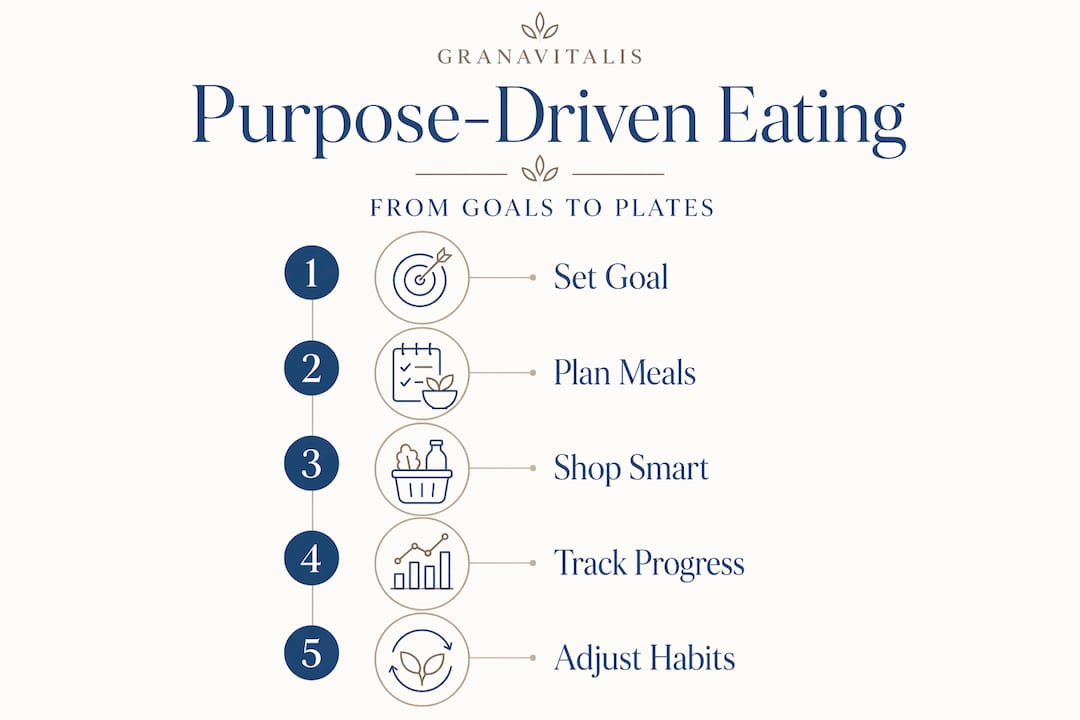
Moving from concept to practice requires a structured approach. Here is a realistic framework:
- Clarify your primary goal. Is it performance, disease management, weight, energy, or longevity? Your goal determines every subsequent decision.
- Assess your current baseline. Track what you eat for 3 to 5 days, honestly. Understanding your starting point is non-negotiable.
- Choose foods aligned with your purpose. A runner periodising for race season needs a different fuel mix than someone managing blood sugar. Understanding plant protein balance matters here.
- Time your nutrition deliberately. Nutrient timing is not just for elite athletes. Eating protein within 2 hours post-exercise improves recovery regardless of fitness level.
- Seek appropriate support. For medical goals, a registered dietitian is the starting point. For performance, a sports nutritionist familiar with the 4Ps model adds significant value.
- Measure outcomes, not just effort. Track blood pressure if cardiovascular health is the goal. Monitor energy levels if focus is the target. Outcome measurement is what proves whether your approach is working.
A critical but often overlooked point: start with one area of change, not everything at once. People who attempt to overhaul every eating habit simultaneously are far more likely to revert to old patterns within weeks.
Pro Tip: Use a simple traffic light system to evaluate your weekly eating: green for foods that directly serve your goal, amber for neutral choices, red for those that consistently work against it. Most people find the exercise genuinely surprising.
What is coming next in purpose-driven nutrition
The field is advancing rapidly, and the next five years will make current personalisation tools look primitive by comparison.
| Emerging development | What it means for you |
|---|---|
| AI-driven dietary advice | Real-time, adaptive meal suggestions based on wearable data, glucose monitoring, and sleep quality |
| Multi-omics integration | Combining genetic, microbiome, metabolomic, and proteomic data for deeper individual tailoring |
| Planetary health framing | Nutrition goals increasingly tied to food system sustainability and environmental impact |
| Evolving public guidelines | National recommendations shifting from generic targets to precision-based, population-segmented advice |
| Equity-centred design | Future programmes built to ensure personalised nutrition reaches underserved populations, not just the affluent |
The Goals in Nutrition Science 2025–2030 framework explicitly connects individual nutrition outcomes to planetary health. What you eat and how that food is produced are increasingly viewed as part of the same system. Purpose-driven nutrition, at its most evolved, is not just personal. It is planetary.
My take on purpose-driven nutrition
I have spent years watching people chase the perfect diet, only to abandon it within months because it was built on theory rather than their actual life. The most compelling thing about purpose-driven nutrition, from where I sit, is that it finally gives people permission to stop comparing their plate to someone else’s.
That said, I want to be honest: personalisation is not a magic solution. I have seen individuals with detailed genetic reports and microbiome analyses still struggle because their environment, stress levels, and eating habits were never addressed. Science without behaviour change is just expensive information.
What actually works, in my experience, is the combination. Clear personal goals, food that genuinely fits those goals, realistic planning that accounts for your actual life, and some form of accountability or tracking. The people who make meaningful, lasting dietary changes are rarely those who found the “perfect” plan. They are the ones who built a good enough plan they could actually live with, then refined it over time.
Purpose-driven nutrition is not a destination. It is an ongoing process of learning how your body responds, adjusting, and staying curious. The science is there to guide you. The rest is practice.
— Jarrod
Fuel your goals with Granavitalis
If reading this has clarified what purposeful eating could look like for you, the next step is making your food choices reflect that clarity. Granavitalis sources products specifically designed for people who eat with intent. The Raw Organic Pecan Butter by RAWGORILLA is a genuinely nutrient-dense option for anyone building a purposeful breakfast or recovery routine: rich in healthy fats, magnesium, and antioxidants with zero unnecessary additives. If you want to explore variety across different goals and flavour profiles, the Organic Nut & Seed Butter Selection Box offers a curated range built for personalised nutrition. Real food. Real purpose. That is the Granavitalis standard.
FAQ
What is purpose-driven nutrition?
Purpose-driven nutrition is the practice of aligning your dietary choices with a specific personal goal, such as athletic performance, managing a health condition, or supporting long-term wellbeing, rather than following generic eating guidelines.
How does purpose-driven nutrition differ from a regular diet?
A regular diet typically follows population-level guidelines. Purpose-driven nutrition starts with your individual biology, goals, and environment, then builds a food strategy around those specific factors, often guided by clinical or performance-based frameworks.
Can purpose-driven nutrition help with medical conditions?
Yes. Structured food as medicine programmes involving medically tailored meals have demonstrated measurable improvements in blood pressure, food security, and dietary quality in people with chronic conditions.
Do I need a dietitian to eat with purpose?
Not always. For general wellness goals, a clear personal objective and informed food choices are a strong starting point. For medical conditions or performance at a competitive level, working with a registered dietitian or sports nutritionist significantly improves outcomes.
What role does behaviour play in purpose-driven eating?
Behaviour is central. Research shows that pairing dietary advice with coaching improves adherence and real-world outcomes far more than nutritional knowledge alone. Understanding what to eat is only part of the equation.