
What is sustainable nutrition: your 2026 guide
TL;DR:
- Sustainable nutrition balances human health with environmental, cultural, and economic considerations, requiring all four pillars to be addressed simultaneously. It emphasizes plant-based, minimally processed foods, reducing ultra-processed foods and food waste to support both health and eco-friendliness. Systemic food policies and culturally appropriate guidance are essential for making sustainable eating accessible and adoptable worldwide.
Sustainable nutrition is the practice of eating in a way that supports both human health and the planet’s wellbeing by balancing nutritional needs with environmental, cultural, and economic considerations. The FAO/WHO 2019 framework defines sustainable healthy diets as those that promote health and well-being, carry low environmental impact, and remain accessible, affordable, safe, equitable, and culturally acceptable. This definition matters because it moves eco-friendly nutrition well beyond carbon footprints and reusable bags. It forces a reckoning with affordability, food processing, cultural identity, and systemic food access as equally weighted pillars.
What is sustainable nutrition and why does it matter now?
Sustainable nutrition, sometimes called eco-friendly nutrition in consumer circles, is the recognised framework for aligning what we eat with what the planet and our bodies can sustain long-term. The concept sits at the intersection of public health, environmental science, and food policy. It is not a single diet. It is a set of principles that any diet can be measured against.
The urgency is real. 2.6 billion people worldwide cannot afford a healthy diet, which means sustainable eating is not simply a lifestyle choice for the privileged. It is a global food security challenge. Meanwhile, ultra-processed foods now dominate supermarket shelves in both high and low-income countries, reshaping food cultures faster than policy can respond.
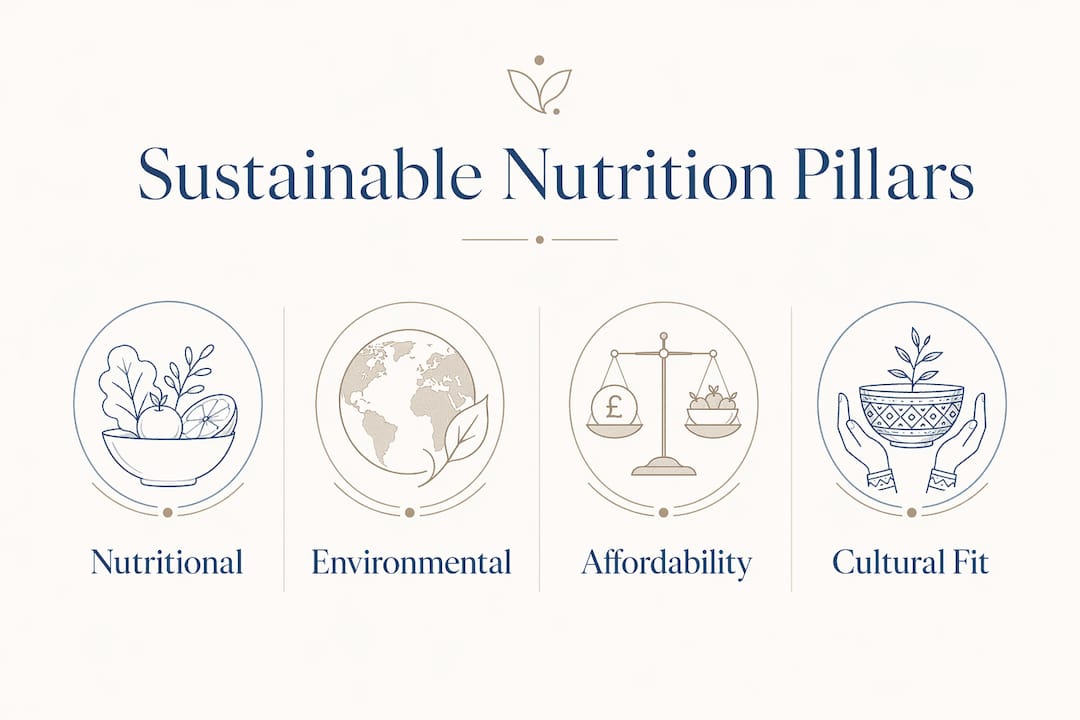
The four pillars of a sustainable diet are nutritional adequacy, low environmental impact, cultural acceptability, and affordability. Treating any one of these as optional produces guidance that fails in practice. A diet that is nutritionally perfect but unaffordable is not sustainable. A diet that is environmentally sound but culturally alien will not be adopted. All four pillars must hold simultaneously.
How sustainable eating supports your health and the planet
Sustainable diets are characterised by more fruits, vegetables, whole grains, and healthy fats, alongside minimal meat and ultra-processed foods. This pattern benefits both individual health and environmental outcomes at the same time. Reducing red meat consumption, for example, lowers saturated fat intake and simultaneously cuts greenhouse gas emissions from livestock farming.
The most studied sustainable diet frameworks each take a slightly different approach:
- Mediterranean diet: High in olive oil, legumes, fish, vegetables, and whole grains. Strong evidence for cardiovascular health and moderate environmental footprint compared to Western diets.
- Nordic diet: Emphasises rye, oats, barley, root vegetables, berries, and sustainably sourced fish. Particularly well-suited to Northern European food systems and seasonal availability.
- Plant-based and flexitarian diets: Reduce or eliminate animal products. Consistently show the lowest greenhouse gas emissions and land use, though nutritional adequacy requires planning around protein, iron, B12, and omega-3 sources.
Each framework shares a common thread: whole, minimally processed foods from diverse plant sources form the foundation. The differences lie in regional ingredients and cultural context, not in the underlying principles.
Pro Tip: Swapping one red meat meal per week for a legume-based alternative, such as lentil dal or black bean tacos, is one of the highest-impact single changes you can make for both your health and your environmental footprint.
Why affordability and cultural fit are non-negotiable
The most common misconception about sustainable eating practices is that they require expensive superfoods or dramatic dietary overhauls. The evidence says otherwise, but the barriers are real.
FAO data confirms that affordability is a critical barrier to healthy diets globally, with social protection and pricing policies identified as key levers for change. This means individual willpower alone cannot close the gap. Systemic changes in food pricing, subsidies, and access are required alongside personal choices.
Cultural acceptability is equally non-negotiable. Sustainable nutrition guidance that ignores traditional dietary practices tends to fail at the population level. A recommendation to replace rice with quinoa in a South Asian household, for instance, dismisses centuries of culinary tradition and introduces unnecessary cost. Effective sustainable nutrition guidance treats cultural acceptability as a constraint, not an afterthought.
“Designing sustainable nutrition guidance must treat nutritional adequacy and cultural acceptability as constraints, not afterthoughts, to ensure feasibility and adoption.” — Nature Food, 2026
The practical implication is this: sustainable eating looks different in Lagos, London, and Lima. The principles are universal. The ingredients and meals are not. Recognising this distinction is what separates workable guidance from well-intentioned but ineffective advice.
Ultra-processed foods and the hidden cost of convenience
Ultra-processed foods (UPFs) are industrial formulations made from extracted food substances, additives, and flavourings, with little or no whole food content. They include mass-produced bread, flavoured yoghurts, packaged snacks, reconstituted meat products, and most fast food. The distinction matters because ingredient lists alone do not capture the full sustainability picture.
WHO’s 2026 One Health agenda links UPFs with risks across human health, animal welfare, and environmental sustainability simultaneously. This framing is significant. It positions UPFs not as a personal health issue but as a systemic food system problem with consequences that extend well beyond the individual consumer.
A 2026 Cambridge scoping review found that most sustainability indices fail to account for food processing levels or socio-cultural-economic dimensions. This is a significant gap. A diet scored as “sustainable” by a standard index could still be heavily reliant on UPFs if the index only measures carbon emissions and nutrient content.
| Processing level | Health impact | Environmental impact |
|---|---|---|
| Whole foods (e.g. oats, lentils, nuts) | High nutrient density, low disease risk | Low emissions, minimal packaging |
| Minimally processed (e.g. frozen vegetables, plain yoghurt) | Nutrients largely preserved | Moderate emissions, some packaging |
| Ultra-processed (e.g. packaged snacks, reconstituted meats) | Linked to obesity, cardiovascular disease | High emissions, complex supply chains |
Pro Tip: The NOVA food classification system, developed by researchers at the University of São Paulo, is the most widely used tool for identifying ultra-processed foods. Checking whether a product falls into NOVA Group 4 is a faster and more reliable guide than reading ingredient lists alone.
How to eat sustainably: practical steps that actually work
Adopting sustainable eating practices does not require a complete dietary overhaul on day one. Small, consistent changes compound into meaningful impact over time. Here is a practical sequence that works for most households:
- Shift the plate ratio. Aim for at least half your plate to come from vegetables, legumes, whole grains, or fruit at every meal. This single change addresses both nutritional adequacy and environmental impact without eliminating any food group.
- Reduce food waste first. Preventing food waste is the single most effective personal action to reduce environmental harm, and it saves the average family nearly £2,400 per year. Plan meals weekly, use a first-in-first-out system in your fridge, and freeze anything approaching its use-by date.
- Choose whole over processed. Replace UPFs with whole food equivalents where possible. Swap flavoured rice packets for plain rice with herbs. Replace packaged snack bars with raw nuts, seeds, or a piece of fruit.
- Prioritise plant-based protein sources. Lentils, chickpeas, hemp seeds, and ancient grains such as spelt and teff deliver protein with a fraction of the environmental cost of beef or lamb.
- Buy seasonally and locally where budget allows. Seasonal produce requires less energy to grow and transport. It also tends to be cheaper and more nutritious at peak ripeness.
- Use budget-conscious substitutions. Dried legumes cost a fraction of tinned versions and a tiny fraction of meat. Frozen vegetables retain most of their nutrients and reduce spoilage. Oats, barley, and rye are among the most affordable and nutritious grains available.
Explore what foods are on a plant-based diet for a detailed breakdown of whole food options that fit these principles across every meal of the day.
Comparing sustainable diet frameworks: which suits you?
No single sustainable diet framework works for everyone. Regionally adapted dietary transitions with policy support consistently outperform global blanket strategies in both nutritional adequacy and environmental outcomes. The table below summarises the key tradeoffs across the most widely adopted frameworks.
| Diet framework | Environmental footprint | Nutritional strengths | Key challenge |
|---|---|---|---|
| Mediterranean | Moderate | Heart health, longevity | Cost of olive oil and fish in some regions |
| Nordic | Low to moderate | Fibre, omega-3, seasonal variety | Limited applicability outside Northern Europe |
| Flexitarian | Low to moderate | Flexible, culturally adaptable | Requires conscious meat reduction |
| Vegetarian | Low | High fibre, diverse micronutrients | B12 and iron planning needed |
| Vegan | Very low | Lowest emissions of all frameworks | B12, omega-3, zinc supplementation required |
The most important variable is not which framework scores best on a global index. It is which framework you can sustain within your budget, culture, and food environment. A flexitarian approach that you maintain for ten years delivers more benefit than a strict vegan diet abandoned after three months.
For guidance on building balanced plant-based meals within any of these frameworks, the Granavitalis blog offers practical meal-by-meal breakdowns.
Key takeaways
Sustainable nutrition works because it integrates health, environmental impact, affordability, and cultural acceptability as equally weighted pillars, not as optional extras.
| Point | Details |
|---|---|
| Four pillars, not one | Nutritional adequacy, environmental impact, affordability, and cultural fit must all be met for a diet to be truly sustainable. |
| Ultra-processed foods undermine sustainability | UPFs carry hidden environmental and health costs that standard sustainability indices often miss. |
| Food waste reduction is the highest-impact action | Cutting household food waste saves money and delivers the largest single reduction in personal environmental harm. |
| No universal sustainable diet exists | Regional tailoring and cultural acceptability determine whether sustainable dietary guidance is actually adopted. |
| Systemic change is required | Individual choices matter, but food pricing, marketing, and policy shape what most people actually eat. |
Why I think we’ve been measuring sustainability all wrong
I’ve spent years reading sustainable nutrition research, and the single most persistent mistake I see is treating carbon footprint as a proxy for the whole concept. It is not. A diet can score well on emissions and still be built on UPFs, unaffordable for most of the world’s population, and culturally irrelevant to the communities it claims to serve.
The limitations of personal willpower without supportive food system changes are well documented. Yet most sustainable eating content still frames the problem as a matter of individual choice. That framing lets food manufacturers, retailers, and policymakers off the hook entirely.
What I find genuinely encouraging is the shift in frameworks like WHO’s One Health agenda, which connects UPFs to human, animal, and environmental health in a single policy frame. That kind of systemic thinking is what the field has needed. The practical implication for you, right now, is this: do not wait for the perfect sustainable diet. Start with food waste reduction and one plant-rich meal swap per day. Those two changes alone put you ahead of most households, and they cost nothing extra. The collective impact of millions of small, sustained changes is what actually moves food systems.
— Jarrod
Fuel your sustainable eating with Granavitalis
Sustainable eating is built on whole, minimally processed foods, and that is exactly where Granavitalis starts. Every product in the range is selected for nutrient density, clean sourcing, and minimal processing, from ancient grain flours to raw organic nut butters.
If you are looking for a practical starting point, the Immune Booster Superfood Bundle brings together a curated selection of superfoods that slot directly into a sustainable, plant-rich diet. For a nutrient-dense plant fat that replaces processed spreads, the raw organic pecan butter from RAWGORILLA delivers healthy fats and minerals with nothing added. Real food, transparently sourced, built for the way you actually eat.
FAQ
What is sustainable nutrition in simple terms?
Sustainable nutrition is a way of eating that supports your health while minimising harm to the environment, remaining affordable, and respecting cultural food traditions. The FAO/WHO framework defines it across four pillars: health, environmental impact, affordability, and cultural acceptability.
Is a plant-based diet the only sustainable option?
No. Plant-based diets carry the lowest environmental footprint, but Mediterranean, Nordic, and flexitarian diets also meet sustainable nutrition principles. The most sustainable diet for you is one you can maintain within your budget and cultural context.
How does food waste connect to sustainable eating practices?
Reducing food waste is the single most effective personal action for cutting environmental harm. It also saves households significant money each year, making it both an ecological and economic priority within any sustainable nutrition plan.
Do ultra-processed foods affect sustainability?
Yes. WHO’s 2026 One Health agenda links ultra-processed foods to risks across human health, animal welfare, and environmental sustainability. Standard sustainability indices often miss this because they focus on ingredients rather than processing methods.
Can sustainable nutrition be affordable?
Dried legumes, oats, seasonal vegetables, and whole grains are among the most affordable foods available and form the backbone of every major sustainable diet framework. Affordability barriers are real at a global scale, but within most household budgets, sustainable eating is cheaper than a diet built on meat and ultra-processed foods.