
Non-wheat flours: the complete guide for home bakers
TL;DR:
- Non-wheat flours, derived from grains, seeds, pulses, or nuts, are used in baking as alternatives or supplements to wheat flour. Ancient grains like einkorn and spelt offer higher mineral content and distinct flavors but contain gluten, while gluten-free options like buckwheat and chickpea flour provide nutritious, earthier tastes and require different baking techniques. Blending protein-rich and starchy flours enhances structure, and proper substitution ratios, binders, and resting times are essential for successful gluten-free baking.
Non-wheat flours are any milled grain, seed, pulse or nut product used in place of — or alongside — wheat flour. The best starting point for most home bakers: oat flour for everyday bakes, ground almonds for moist cakes, buckwheat for pancakes and flatbreads, and spelt if you tolerate gluten. Those four cover the majority of what you will bake at home.
Quick-start checklist:
- Oat flour (certified gluten-free if needed): versatile, mild, nearly 1:1 swap by weight
- Ground almonds (almond flour): rich, moist crumb; cakes, biscuits, tray bakes
- Buckwheat flour: earthy, protein-rich; pancakes, blinis, soba-style noodles
- Spelt flour: nutty, easier to digest for some; bread, muffins, pastry (contains gluten)
Granavitalis sources several of these as stone-ground, minimally processed flours. For recipe ideas that use these flours in dairy-free breakfasts, dairy-free breakfast recipes offer a practical starting point.
Table of Contents
- Which non-wheat flours suit which bakes?
- Why ancient-grain and wholefood flours are worth the switch
- How to substitute non-wheat flours: ratios, binders and hydration
- Tested blend formulas for common bakes
- Practical baking tips by product type
- Where to buy and how to store non-wheat flours in the UK
- Key takeaways
- The case for baking with intention
- Granavitalis: ancient-grain flours, sourced with purpose
- Useful sources and further reading
Which non-wheat flours suit which bakes?
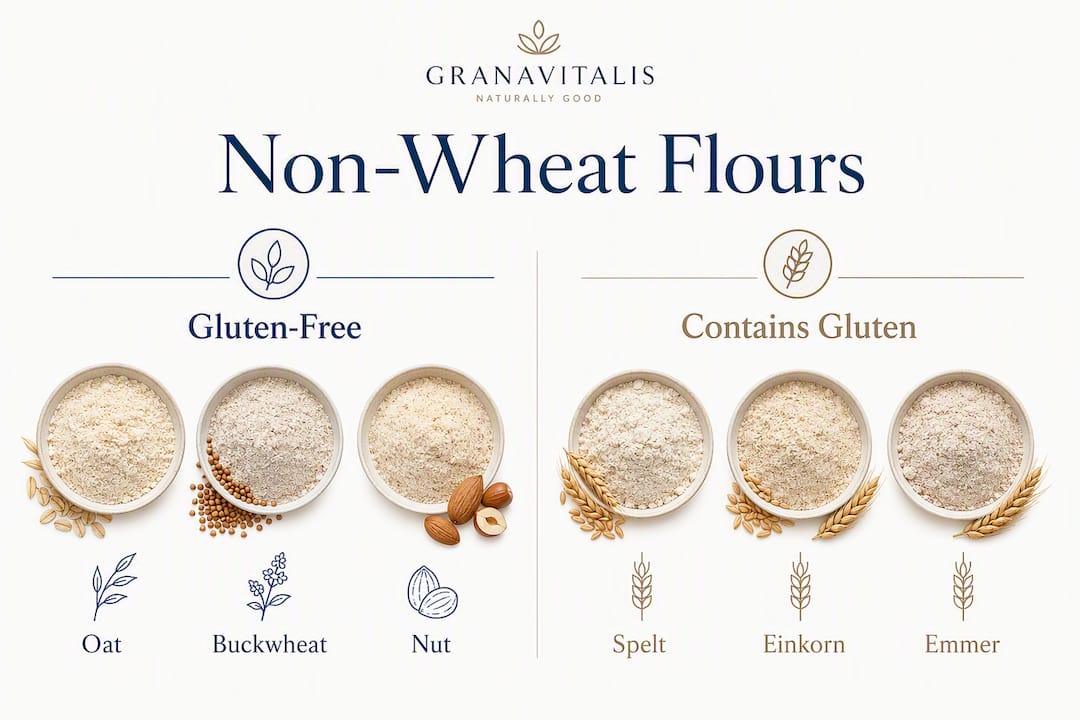
Not every flour works in every recipe. The table below maps each flour to its best uses, gluten status and standout quality.
| Flour | Gluten-free? | Best for | Flavour / texture |
|---|---|---|---|
| Oat flour | Yes (if certified) | Cakes, muffins, pancakes | Mild, slightly sweet |
| Ground almonds | Yes | Cakes, biscuits, tray bakes | Rich, moist, nutty |
| Buckwheat | Yes | Pancakes, flatbreads, crackers | Earthy, robust |
| Spelt | No | Bread, pastry, muffins | Nutty, lighter than wheat |
| Einkorn | No | Flatbreads, pasta, biscuits | Sweet, golden, complex |
| Chickpea (gram) | Yes | Socca, pakoras, savoury batters | Beany, dense |
| Quinoa flour | Yes | Protein-boosted bakes, muffins | Slightly bitter, nutty |
| Teff | Yes | Bread, porridge, injera | Earthy, molasses-like |
| Sorghum | Yes | Bread blends, wraps | Mild, close to wheat |
| Coconut flour | Yes | Cakes, brownies | Sweet, very absorbent |
| Tapioca starch | Yes | Blends, thickening, chew | Neutral, stretchy |
| Potato starch | Yes | Blends, lightening crumb | Neutral, light |
| Rice flour | Yes | Blends, tempura, shortbread | Neutral, slightly gritty |
Great British Chefs advise treating each flour as its own ingredient rather than a lesser substitute — buckwheat for robust pancakes, quinoa for protein-rich additions, teff for earthy wholegrain character. That framing changes how you shop and bake.
A note on nut flours: almond and hazelnut meals give beautifully moist cakes and crumbly biscuits, but they lack the structure for yeasted bread doughs. Use them in combination, not alone, for anything that needs a rise. For a deeper look at ancient varieties, Granavitalis covers the full range of ancient flour varieties and their nutritional profiles.
Why ancient-grain and wholefood flours are worth the switch
The nutritional case is straightforward. Ancient grains retain more fibre, micronutrients and antioxidants than refined modern wheat, which supports digestion and satiety. Research published in PMC found that common wheat flour contains a lower total mineral content compared with ancient wheat flours, with einkorn bran showing the highest ash content. That gap is meaningful when you bake with these flours regularly.
“Eating a variety of whole and ancient grains, rather than only modern wheat, offers a broader micronutrient profile and possible benefits for blood-sugar control — variety across grains is more valuable than replacing modern grains entirely.”
Flavour is the other argument. Buckwheat brings an earthy depth to pancakes that plain flour simply cannot replicate. Spelt has a gentle nuttiness that makes an ordinary loaf interesting. These are not compromises; they are upgrades in the right recipe.
Gluten status matters. Spelt and einkorn contain gluten and are unsuitable for coeliacs, though some people with non-coeliac wheat sensitivity find them easier to digest. Buckwheat, teff, sorghum, quinoa, rice, chickpea, almond and coconut flours are naturally gluten-free. Oats are naturally gluten-free but frequently contaminated during processing — always buy certified gluten-free oat flour if this is a concern. For a detailed breakdown of einkorn nutrition facts, Granavitalis has a dedicated guide.
General information only — if you have coeliac disease or a diagnosed allergy, confirm flour choices with a healthcare professional or dietitian.
How to substitute non-wheat flours: ratios, binders and hydration
The single biggest mistake is treating every flour as a 1:1 swap. Density, protein content and water absorption vary enormously.
Core substitution principles:
- Start with partial swaps (25–50% non-wheat flour) before going fully wheat free
- Oat flour: ~1:1 by weight but 1⅓ by volume compared with plain wheat flour; works well in cakes and muffins
- Almond flour: swap up to 25–50% in most cake recipes without major formula changes; adds fat and moisture
- Coconut flour: use roughly one quarter the amount of wheat flour called for, and add extra liquid and eggs — it absorbs aggressively
- Buckwheat: replace up to 50% in pancakes and quick breads; beyond that, expect a denser, earthier result
Binders for gluten-free bakes:
When gluten is absent, structure needs to come from somewhere else. Psyllium husk at 5–8% of total flour weight is the most effective binder for gluten-free bread and sourdough, mimicking the elasticity gluten provides. Ground flax (1 tablespoon plus 3 tablespoons water per egg) and xanthan gum (¼ teaspoon per 120g flour for cakes; ½ teaspoon for bread) are the other reliable options.
| Binder | Best use | Typical dosage |
|---|---|---|
| Psyllium husk | Bread, sourdough | 5–8% of total flour weight |
| Xanthan gum | Cakes, pastry | ¼–½ tsp per 120g flour |
| Ground flax | Cakes, muffins | 1 tbsp + 3 tbsp water per egg |
| Extra egg | Cakes, brownies | Add extra egg when using nut flour |
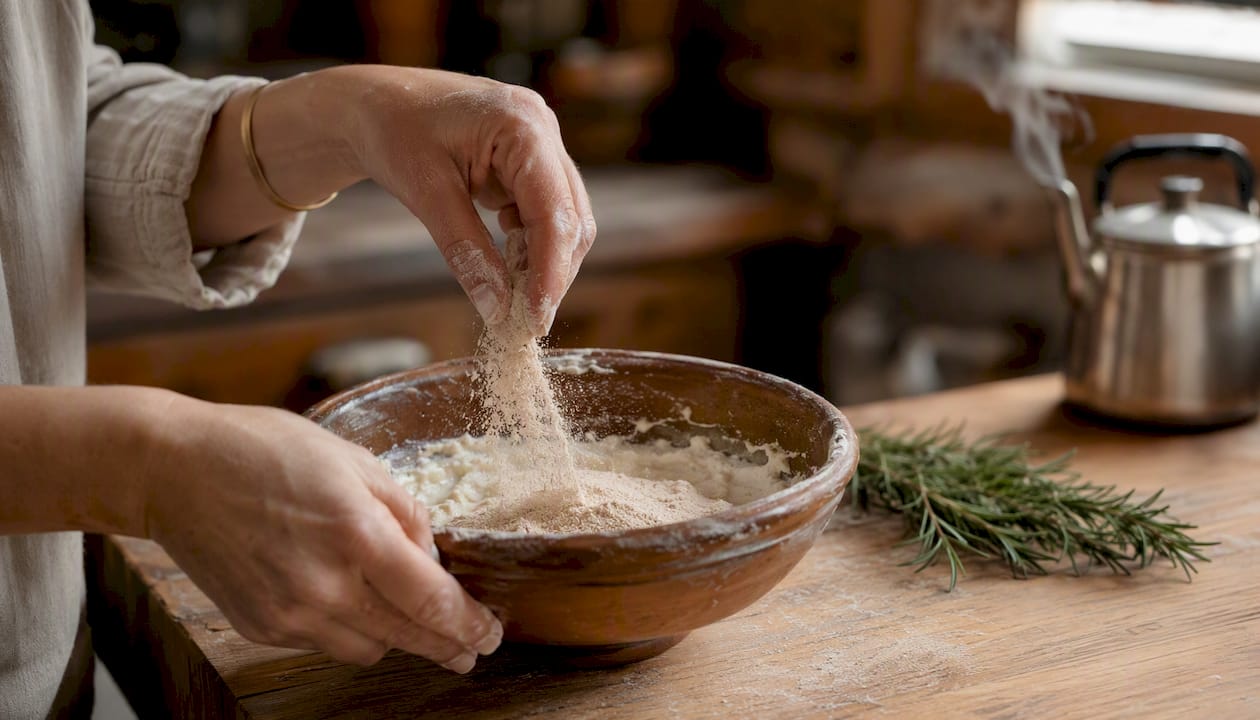
Pro Tip: Rest gluten-free batters for 20–30 minutes before baking. Coarser grains need time to fully absorb liquid; skipping this step is the most common cause of a sandy, gritty crumb.
Tested blend formulas for common bakes
Single flours rarely give the best results. Combining protein-rich flours with light starches replicates the mouthfeel and lift of wheat-based bakes far more reliably. These blends are starting points — adjust within ±5–10% to suit your recipe.
| Blend | Composition | Notes |
|---|---|---|
| All-purpose gluten-free | Rice flour, tapioca starch and potato starch blend | 1:1 swap in most cake and quick-bread recipes |
| Cake blend | 50% ground almonds, 30% oat flour, 20% tapioca starch | Moist, tender crumb; rest batter 20 minutes |
| Pastry blend | Spelt flour, ground almonds and tapioca starch blend | Chill dough 30 minutes before rolling |
| Gluten-free bread | 50% sorghum, 25% buckwheat, 25% tapioca starch + psyllium 6% | Add psyllium to dry ingredients first |
| Pancake/crêpe blend | 50% buckwheat, 30% oat flour, 20% tapioca starch | Rest batter 20–30 minutes for best texture |
- Weigh ingredients precisely — volume measures are unreliable with dense flours.
- Mix dry ingredients thoroughly before adding wet; uneven distribution causes patchy texture.
- Adjust liquid by tablespoon, not cup — these blends absorb differently from wheat flour.
- For the bread blend, add psyllium to the dry mix and allow it to gel before shaping.
- Taste the raw batter (where safe) — bitter notes from quinoa or buckwheat can be balanced with a pinch of salt or a touch of honey.
Practical baking tips by product type
Bread
Gluten-free bread needs more hydration than wheat bread — expect a wetter dough that is more like a thick batter. For sourdough starters, feed with at least 30% whole-grain gluten-free flour (buckwheat, teff or oat) so wild yeasts get sufficient nutrients; white starches alone will not sustain an active culture. Fermentation times are often shorter with ancient-grain flours.
Cakes and traybakes
Fat is your friend. Nut flours already carry fat, so reduce added butter slightly. Yoghurt, soured cream or fruit purée (banana, apple) add moisture and help bind. Avoid over-mixing — these batters develop structure quickly and can turn dense.
Pastry
Blind-bake at a slightly lower temperature (160–170°C fan) for longer; nut-flour pastry browns faster than wheat pastry.
Savoury bakes
Chickpea flour is the workhorse here. Socca (a Provençal chickpea flatbread) needs only chickpea flour, water, olive oil and salt — bake in a very hot cast-iron pan. For tempura-style batters, rice flour gives a lighter, crispier result than wheat flour. Flatbreads made with 50% buckwheat and 50% oat flour hold together well and cook in minutes on a dry griddle.
Troubleshooting:
- Sandy crumb: batter was not rested long enough; increase rest to 30 minutes
- Dense loaf: too little leavening or psyllium not fully hydrated before baking
- Collapse after baking: too much liquid or insufficient binder; reduce liquid by 10% or add extra psyllium
- Excessive chew: too much tapioca starch; reduce to 20% of blend
Where to buy and how to store non-wheat flours in the UK
Buying guidance
Look for wholegrain or stone-ground on the label — these retain more of the bran and germ, where most of the nutrition sits. For gluten-free certification, check for the Crossed Grain symbol (Coeliac UK’s mark) on oat flour and any blend. Organic options are widely available at Waitrose, Holland & Barrett, and independent wholefood shops. Farmers’ markets often stock freshly milled ancient-grain flours from small UK mills — worth asking about stone-ground spelt and einkorn specifically.
Shelf life and storage
| Flour type | Ambient shelf life | Fridge | Freezer |
|---|---|---|---|
| Cereal flours (spelt, buckwheat, oat) | 3–6 months sealed | Around 6 months | Up to 6 months |
| Nut flours (almond, hazelnut) | 1–3 months sealed | 3–6 months | Around 6 months |
| Starches (tapioca, potato, rice) | 6 months sealed | Not needed | Not needed |
| Coconut flour | Around 6 months sealed | Not needed | Up to 6 months |
Nut flours go rancid fastest — smell before you use them. A sharp, bitter or paint-like odour means the oils have oxidised; discard and replace. Store all nut and seed flours in airtight containers away from light and heat.
- Buy in smaller quantities unless you bake frequently
- Label containers with the purchase date
- Whole-grain flours from UK mills often carry a best-before of 6 months; use within that window for best flavour
Key takeaways
Ancient grains and wholefood non-wheat flours deliver measurably higher mineral content than refined wheat, and blending protein-rich flours with light starches gives the most reliable results across cakes, bread and pastry.
| Point | Details |
|---|---|
| Start with partial swaps | Replace 25–50% of wheat flour first; full swaps need binders and hydration adjustments. |
| Use blends for structure | Pair protein-rich flours (almond, buckwheat, sorghum) with starches (tapioca, potato) for lift and mouthfeel. |
| Watch hydration and rest | Rest gluten-free batters 20–30 minutes; coarser grains need time to absorb liquid fully. |
| Store nut flours cold | Almond and hazelnut flours last 3–6 months refrigerated; check for rancidity before use. |
| Granavitalis for ancient grains | Granavitalis sources stone-ground, minimally processed ancient-grain flours — a reliable UK starting point for einkorn, spelt and beyond. |
The case for baking with intention
There is a tendency in health-food circles to treat wheat-free baking as a problem to solve rather than an opportunity. That framing leads people to chase a perfect 1:1 substitute — something that behaves exactly like plain flour but happens to be made from almonds or rice. It rarely works, and the disappointment puts people off.
The more useful shift is to ask what each flour actually does well. Buckwheat makes a pancake that is genuinely better than a plain-flour version — more flavour, more nutrition, more character. Einkorn brings a golden sweetness to flatbreads that modern wheat simply does not have. Chickpea flour, properly seasoned, produces a socca that is a dish in its own right, not a compromise.
The nutritional argument reinforces this. Ancient wheat flours contain a higher total mineral content than common wheat flour; for example, einkorn bran shows notably greater mineral concentration. That is not a marginal difference. Baking with these flours is not about restriction; it is about choosing ingredients that do more.
Where most guides go wrong is in treating blends as a workaround rather than the standard approach. A well-designed blend — sorghum, buckwheat and tapioca for bread; almond, oat and tapioca for cakes — outperforms any single flour, wheat included, for the specific job it is designed for. The sooner bakers accept that, the sooner the results improve.
Granavitalis: ancient-grain flours, sourced with purpose
If you have read this far and want to start baking with stone-ground, minimally processed flours rather than supermarket blends, Granavitalis is the direct route. Every flour in the range is selected for provenance, nutrient density and flavour — ancient grains unchanged by industrial hybridisation, milled to preserve the bran and germ where the nutrition actually lives.
Pair your flour with Granavitalis’s organic nut and seed butters for bakes that go further on nutrition, or pick up nibbed hazelnuts for texture and crunch in traybakes and biscuits. Browse the full range and find the flours, nut meals and wholefood ingredients that suit your baking at granavitalis.com.
Useful sources and further reading
- Gluten-free flour guide — Great British Chefs: practical flavour and use-case profiles for common gluten-free flours
- Tips for gluten-free baking — BBC Food: blend ratios and technique guidance from a trusted UK food platform
- Whole-grain heroes: why eat ancient grains — Patient.info: accessible overview of the nutritional case for ancient and whole grains
- Gluten-free sourdough flours: complete UK guide — DoughDoughAtHome: psyllium ratios, starter feeding and flour selection for gluten-free sourdough
- A beginner’s guide to gluten-free baking — From the Larder: resting times, hydration tips and troubleshooting for new gluten-free bakers
- Are ancient grains better for you? — BBC Future: evidence-based look at metabolic benefits and the variety argument
- Ancient Wheats: A Nutritional and Sensory Analysis Review — PMC: peer-reviewed mineral content data for spelt, emmer, einkorn and kamut