
High calorie breakfast for bulking: recipes & templates
TL;DR:
- A high-calorie breakfast for bulking should combine 30–40 grams of protein with calorie-dense, whole foods. Consistent prep, including batch cooking and ingredient variety, helps meet daily surplus and nutrient needs effectively. Liquid shakes and simple recipes with minimal preparation are practical tools for those with low morning appetite.
A good bulking breakfast delivers calorie density, 30–40 g of protein, slow-release carbohydrates, and moderate healthy fats in a single sitting. That combination is what separates a breakfast that builds muscle from one that merely fills you up. Aim for 1.6–1.8 g of protein per kilogram of body weight per day, with roughly 30–40 g of that landing at breakfast to trigger muscle protein synthesis after the overnight fast.
Three quick examples to get you started:
- Dense porridge bowl — 80 g oats, 2 tbsp peanut butter, 1 scoop whey, whole milk, banana: approximately 810 kcal / 49 g protein
- Loaded omelette + toast — 4 eggs, 40 g cheddar, 2 slices wholegrain toast, butter: approximately 980 kcal / 54 g protein
- High-calorie breakfast smoothie — 500 ml whole milk, 2 tbsp nut butter, 1 banana, 1 scoop whey, 50 g oats: approximately 900 kcal / 45 g protein
TL;DR:
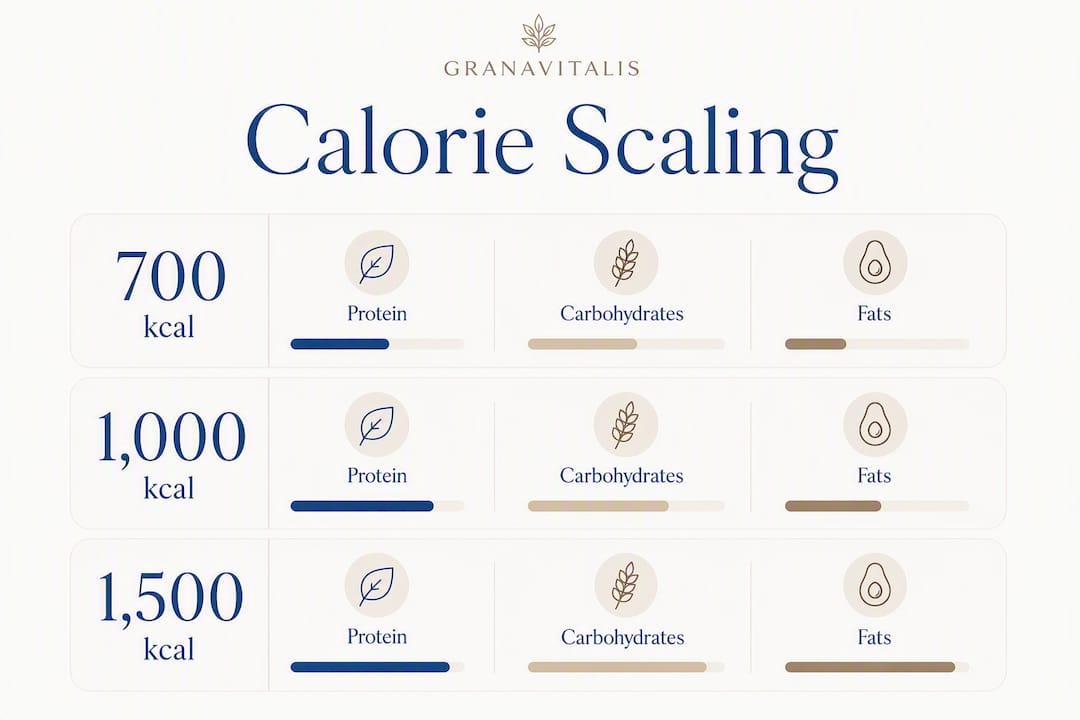
- Target 700–1,500 kcal at breakfast depending on your daily surplus goal.
- Hit 30–40 g protein per meal; protein at breakfast stabilises blood sugar and replaces overnight amino-acid depletion.
- Use calorie-dense ingredients (nut butters, whole milk, eggs, oats) rather than simply eating more volume.
- Batch prep on Sundays to stay consistent through the week.
Table of Contents
- High calorie breakfast recipes with full macro breakdowns
- How to build and scale a 700 / 1,000 / 1,500 kcal breakfast
- Quick high-calorie shakes for low-appetite mornings
- Meal prep and UK shopping tips for consistent bulking breakfasts
- Common mistakes when trying to increase breakfast calories
- Why protein at breakfast matters: the evidence and timing
- Key takeaways
- The breakfast habit most bulkers overlook
- Granavitalis products that make bulking breakfasts easier
- Useful sources and further reading
High calorie breakfast recipes with full macro breakdowns
The eight recipes below cover the most practical formats for a calorie-dense morning meal. Each one includes a macro snapshot and at least one swap to raise or lower calories. Prep times assume you have basic ingredients to hand.
1. Protein oats bowl
Cook 80 g rolled oats in 300 ml whole milk. Stir in 1 scoop vanilla whey protein and 2 tbsp peanut butter. Top with a sliced banana and a handful of granola. The peanut butter alone adds roughly 190 kcal and 8 g protein without meaningfully increasing the volume you have to eat.
Macros: ~810 kcal | 49 g protein | 95 g carbs | 28 g fat | Prep: 8 min | Serves: 1
Swaps: Replace peanut butter with Raw Organic Pecan Butter for a richer flavour and slightly higher fat content. Use oat milk + powdered milk to keep it dairy-free.
2. Loaded four-egg omelette with toast
Whisk 4 eggs with a splash of whole milk. Cook in butter, fold in 40 g grated cheddar and a handful of spinach. Serve with 2 thick slices of wholegrain toast spread with butter. A four-egg omelette stack built this way reaches approximately 980 kcal and 54 g protein.

Macros: ~980 kcal | 54 g protein | 52 g carbs | 58 g fat | Prep: 10 min | Serves: 1
Swaps: Add smoked salmon or a rasher of back bacon to push protein past 60 g. Drop to 3 eggs and skip the butter on toast to land closer to 700 kcal.
3. Breakfast burrito
Scramble 3 eggs with black beans (120 g, drained), 30 g cheddar, and a spoonful of Greek yoghurt. Wrap in a large wholegrain tortilla with sliced avocado. This is one of the most portable options for anyone training early.
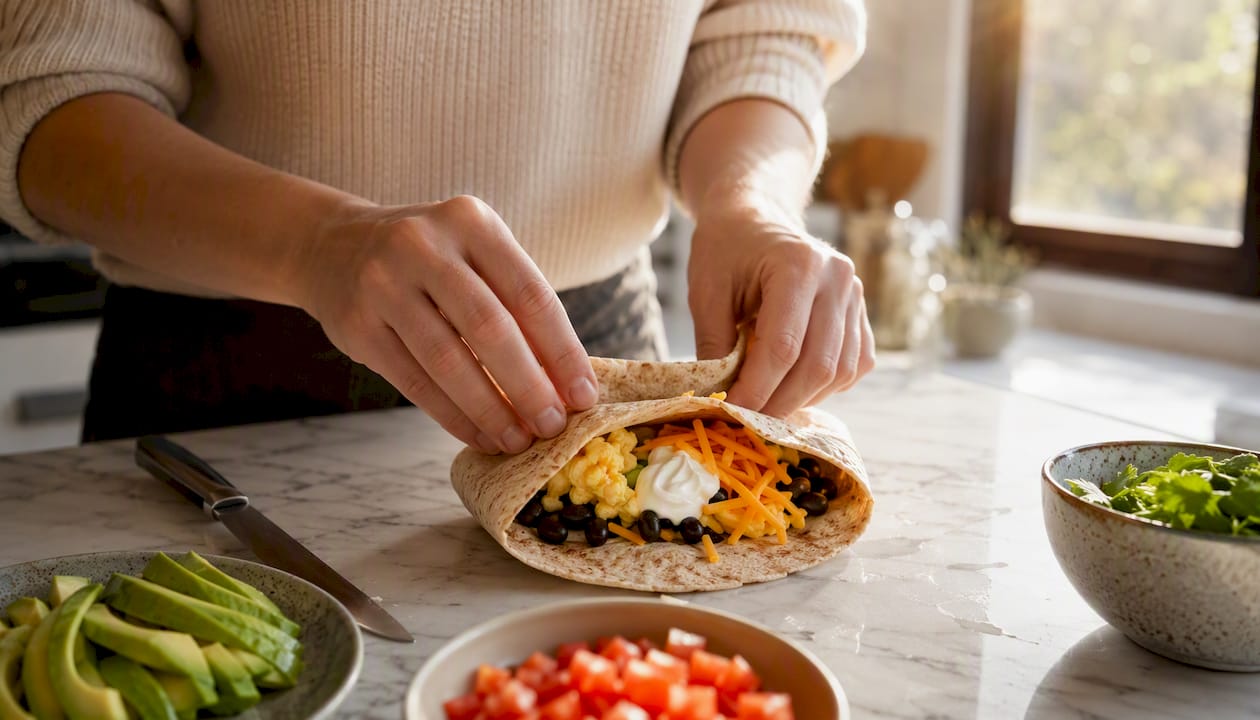
Macros: ~850 kcal | 45 g protein | 72 g carbs | 38 g fat | Prep: 12 min | Serves: 1
Swaps: Add a second tortilla layer or extra avocado to push past 1,000 kcal. Use a plant-based egg substitute and vegan cheese for a fully vegan version.
4. Greek yoghurt and whey granola bowl
Combine 250 g full-fat Greek yoghurt with 1 scoop whey protein (stirred in dry). Top with 60 g granola, a tablespoon of honey, and a handful of mixed berries. Mixing protein sources like Greek yoghurt and whey helps hit the leucine threshold needed to stimulate muscle protein synthesis.
Macros: ~750 kcal | 52 g protein | 78 g carbs | 22 g fat | Prep: 5 min | Serves: 1
Swaps: Add 2 tbsp nut butter or a handful of nibbed hazelnuts to add 150–200 kcal without extra volume.
5. Beans and eggs on toast
Heat a tin of baked beans (400 g) and serve alongside 2 fried eggs on 2 slices of thick wholegrain toast. A drizzle of olive oil over the eggs adds 40 kcal per teaspoon. Simple, cheap, and surprisingly close to a complete amino-acid profile when you pair legumes with eggs.
Macros: ~700 kcal | 38 g protein | 88 g carbs | 18 g fat | Prep: 10 min | Serves: 1
Swaps: Use butter instead of oil and add a third egg to reach 800 kcal. Swap baked beans for black beans or butter beans for lower sugar content.
6. Banana and nut-butter pancakes
Blend 2 ripe bananas, 3 eggs, 60 g oats, and 1 tbsp nut butter into a batter. Cook in coconut oil as 4–5 small pancakes. Top with Greek yoghurt, sliced banana, and a drizzle of maple syrup. These freeze well, making them a strong batch-prep option.
Macros: ~780 kcal | 36 g protein | 90 g carbs | 30 g fat | Prep: 15 min | Serves: 1
Swaps: Add a scoop of whey to the batter to push protein to 50 g. Serve with cottage cheese instead of yoghurt for a lower-sugar topping.
7. High-calorie overnight oats
The night before: combine 80 g oats, 300 ml whole milk, 1 scoop whey, 2 tbsp almond butter, and 1 tbsp chia seeds in a jar. Refrigerate overnight. In the morning, top with a banana and a tablespoon of honey. Zero morning cooking required.
Macros: ~900 kcal | 50 g protein | 100 g carbs | 30 g fat | Prep: 5 min (night before) | Serves: 1
Swaps: Use coconut milk for extra fat and a tropical flavour. Add powdered milk (30 g) to push past 1,000 kcal without changing the texture.
8. Salmon bagel with cream cheese and eggs
Toast a large wholegrain bagel, spread generously with full-fat cream cheese, and top with 100 g smoked salmon. Serve alongside 2 scrambled eggs cooked in butter. This is the highest-protein option per gram of food volume on this list.
Macros: ~950 kcal | 58 g protein | 65 g carbs | 42 g fat | Prep: 10 min | Serves: 1
Swaps: Use a second bagel half or add avocado to reach 1,100 kcal. Swap smoked salmon for tinned tuna to cut cost significantly.
Recipe macro summary
| Recipe | Approx. kcal | Protein (g) | Carbs (g) | Fat (g) |
|---|---|---|---|---|
| Protein oats bowl | 810 | 49 | 95 | 28 |
| Loaded omelette + toast | 980 | 54 | 52 | 58 |
| Breakfast burrito | 850 | 45 | 72 | 38 |
| Greek yoghurt + whey granola bowl | 750 | 52 | 78 | 22 |
| Beans and eggs on toast | 700 | 38 | 88 | 18 |
| Banana nut-butter pancakes | 780 | 36 | 90 | 30 |
| High-calorie overnight oats | 900 | 50 | 100 | 30 |
| Salmon bagel with eggs | 950 | 58 | 65 | 42 |
Pro Tip: Use nut butters and oils to add calories rather than simply eating more food. Two tablespoons of nut butter adds roughly 190 kcal and barely registers in terms of fullness — far more efficient than a second bowl of oats.
How to build and scale a 700 / 1,000 / 1,500 kcal breakfast
The simplest scaling rule: start with a protein anchor (eggs, Greek yoghurt, whey), add a carbohydrate base (oats, toast, bagel), then layer in calorie-dense fats (nut butter, oil, full-fat dairy) until you hit your target. Protein should stay at 30–40 g regardless of which calorie band you are building to.
Three ready templates
700 kcal template
- 60 g oats cooked in 250 ml semi-skimmed milk
- 1 scoop whey stirred in
- 1 tbsp peanut butter
- 1 medium banana
1,000 kcal template
- 80 g oats cooked in 300 ml whole milk
- 1 scoop whey
- 2 tbsp nut butter
- 1 banana + 1 tbsp honey
- 30 g granola on top
1,500 kcal template
- 100 g oats cooked in 400 ml whole milk + 30 g powdered milk stirred in
- 1 scoop whey
- 3 tbsp nut butter
- 1 banana + 1 tbsp honey
- 60 g granola
- 2 boiled eggs on the side
To adjust by roughly 200–300 kcal in either direction, use the portioning table below.
Portioning reference
| Ingredient | Portion | Approx. kcal | Protein (g) |
|---|---|---|---|
| Rolled oats (dry) | 80 g | 300 | 10 |
| Whole milk | 300 ml | 190 | 10 |
| Powdered milk | 30 g | 115 | 11 |
| Peanut / nut butter | 2 tbsp | 190 | 8 |
| Banana (medium) | 1 (120 g) | 100 | 1 |
| Whey protein (1 scoop) | 30 g | 120 | 24 |
| Large egg | 1 | 78 | 6 |
| Wholegrain toast | 1 slice (40 g) | 95 | 4 |
| Full-fat Greek yoghurt | 250 g | 225 | 18 |
| Granola | 60 g | 255 | 6 |
Scaling checklist
- Fix your protein anchor first (aim for 30–40 g before adding carbs or fats).
- Choose a carbohydrate base that suits your appetite (oats for volume, toast for speed, bagel for portability).
- Add one calorie-dense fat source (nut butter, oil, avocado, full-fat dairy).
- Check the running total against your target band using the table above.
- If you are still short, add powdered milk to liquid or an extra egg rather than a second carb source.
- If you are over, reduce the fat portion first — it has the highest calorie density and the smallest impact on satiety.
- Calorie-dense swaps that barely affect volume: powdered milk, nut butters, coconut oil, full-fat dairy, avocado.
- Protein-boosting add-ons: extra egg, extra scoop of whey, cottage cheese, Greek yoghurt.
- Carb add-ons for energy: extra slice of toast, second portion of oats, a larger banana.
Quick high-calorie shakes for low-appetite mornings
When eating a large solid breakfast feels like a chore, liquid calories are one of the most practical ways to hit 700+ kcal without the volume. A well-built shake can deliver 800–1,200 kcal in a 500–700 ml drink. The key is choosing ingredients with a high calorie-to-volume ratio: full-fat milk, powdered milk, nut butters, oats, and avocado.
Shake templates
| Shake | Key ingredients | Approx. kcal | Protein (g) | Prep time |
|---|---|---|---|---|
| Mass builder | 500 ml whole milk, 2 tbsp peanut butter, 1 banana, 1 scoop whey, 50 g oats | 900 | 45 | 3 min |
| Nut butter banana shake | 400 ml whole milk, 3 tbsp almond butter, 1 banana, 1 scoop whey | 810 | 42 | 3 min |
| Avocado power blend | 400 ml whole milk, ½ avocado, 1 scoop whey, 50 g oats, 1 tbsp honey | 850 | 38 | 4 min |
| Yoghurt parfait blender | 200 g Greek yoghurt, 250 ml whole milk, 1 scoop whey, 40 g oats, 1 tbsp nut butter | 780 | 52 | 4 min |
| High-calorie oat milk blend | 500 ml oat milk, 30 g powdered milk, 2 tbsp nut butter, 1 banana, 1 scoop whey | 850 | 40 | 3 min |
Pro Tip: If even a 500 ml shake feels like too much first thing, split it: drink half before training and the other half within 30 minutes of finishing. You still hit the calorie target without the discomfort of forcing a large volume on an empty stomach.
Adding powdered milk (30 g) to any shake adds roughly 115 kcal and 11 g protein with no change in texture or volume. It is one of the most underused tools for people who struggle with morning appetite.
Meal prep and UK shopping tips for consistent bulking breakfasts
Consistency beats perfection every time during a bulk. Missing breakfast calories on three mornings a week is far more damaging to progress than having a slightly imperfect recipe. Batch prepping breakfast burritos, pancakes, and egg muffins and freezing them individually makes hitting your calorie target reliable on busy mornings.
Sunday batch prep plan
- Overnight oats: Prepare 5 jars (one per weekday) in 15 minutes. Store in the fridge for up to 4 days.
- Egg muffins: Whisk 12 eggs with cheese, spinach, and diced peppers. Pour into a muffin tin and bake at 180°C for 20 minutes. Refrigerate for up to 4 days or freeze for up to 3 months.
- Breakfast burritos: Make 6–8 burritos, wrap individually in foil, and freeze. Reheat from frozen in a microwave for 2–3 minutes or in an oven at 180°C for 15 minutes.
- Banana pancakes: Cook a double batch, cool completely, and freeze in pairs separated by baking paper. Reheat in a toaster or oven from frozen.
- Portioned nut butter: Decant into small containers so you can grab and add without measuring each morning.
UK shopping tips
- Own-brand oats from Tesco, Sainsbury’s, or Lidl cost a fraction of branded versions and are nutritionally identical. A 1 kg bag covers roughly 12 breakfasts.
- Frozen berries are cheaper than fresh and retain their micronutrient content. A 1 kg bag from Aldi or Asda typically costs under £2.
- Tinned beans (baked, black, or butter beans) are a cheap, shelf-stable protein and carbohydrate source. Keep a dozen tins in the cupboard.
- Powdered milk (Tesco or Asda own-brand) is one of the most cost-effective calorie-density tools available in UK supermarkets.
- Bulk nuts and seeds from Holland & Barrett or online wholesalers cost significantly less per 100 g than pre-portioned snack packs.
Storage and food safety
- Cooked egg dishes: refrigerate within 2 hours of cooking, consume within 3–4 days.
- Frozen burritos and pancakes: safe for up to 3 months; label with the date.
- Overnight oats: consume within 4 days; do not freeze once assembled with fresh fruit.
- Reheat all egg-based dishes to a core temperature of 75°C before eating.
Common mistakes when trying to increase breakfast calories
Most people who stall on a bulk are not eating too little — they are eating the wrong things at breakfast. The errors below are the most common, and each one has a straightforward fix.
Prioritising sugar over nutrients. Croissants, sugary cereals, and flavoured yoghurts can deliver 400–500 kcal, but they spike blood sugar and leave you hungry an hour later. Worse, they crowd out the protein and micronutrients your muscles actually need. Swap them for oats, eggs, or Greek yoghurt as the base, and add calorie density through nut butters and whole milk rather than sugar.
Under-estimating protein. A bowl of granola with oat milk might hit 600 kcal but deliver only 10–12 g protein. That is not enough to stimulate muscle protein synthesis. An ideal high-protein breakfast combines 30–40 g protein with slow-release carbohydrates and moderate healthy fats. Always check the protein column, not just the calorie total.
Relying too heavily on a single fat source. Eating four tablespoons of peanut butter every morning adds calories, but it also means you are getting the same fatty-acid profile every day and missing out on the micronutrients that come from variety. Rotate between nut butters, oily fish, eggs, avocado, and dairy fats across the week.
Key insight: If you are not gaining weight despite consistently eating high-calorie breakfasts, the root cause is usually fullness and meal volume rather than a knowledge gap. Switch to calorie-dense, low-volume ingredients and consider adding a mid-morning snack rather than forcing more food at breakfast.
Ignoring micronutrients. A calorie surplus built on processed food will eventually show up as fatigue, poor recovery, and sluggish training. Whole foods supply complete amino acids plus vitamins, minerals, and fibre that supplements cannot replace. Add a handful of spinach to your omelette, frozen berries to your oats, and a piece of fruit alongside any shake. These additions cost almost nothing in terms of calories but meaningfully improve the nutritional quality of your surplus.
Pro Tip: If persistent fullness is stopping you from hitting your calorie target, reduce fibre at breakfast temporarily (swap wholegrain toast for white, reduce oat volume) and replace those calories with nut butter or whole milk. Once your appetite adapts over 2–3 weeks, you can reintroduce higher-fibre options.
Why protein at breakfast matters: the evidence and timing
The case for prioritising protein at breakfast is not just about hitting a daily number. After an overnight fast of 7–9 hours, circulating amino-acid levels are at their lowest point of the day. Performance nutritionists stress that breakfast protein restores those amino acids and helps stabilise blood glucose and satiety, setting up both training performance and recovery.
The target that consistently appears in clinical nutrition guidance: 1.6–1.8 g of protein per kilogram of body weight per day for muscle growth, with 30–40 g at each meal to stimulate muscle protein synthesis. Intake beyond roughly 40 g in a single sitting gives little additional synthesis benefit for most people, so spreading protein across meals matters as much as the daily total.
Practical timing rules
- Pre-training (60–90 min before): A moderate meal of 30–40 g protein and slow carbs (oats, wholegrain toast) fuels the session without causing digestive discomfort.
- Post-training (within 2 hours): If breakfast is your pre-training meal, prioritise a protein-rich snack or meal within 2 hours of finishing to support recovery.
- Protein spacing: Aim for 30–40 g protein at each of 3–4 meals rather than concentrating it at one sitting. This approach tends to produce better muscle-protein synthesis outcomes across the day.
- Rest days: The same breakfast protein target applies. Muscle repair continues on rest days, and amino-acid availability remains important.
Best breakfast protein sources
- Eggs: ~6 g protein each, complete amino-acid profile, high leucine content. Four eggs deliver 24 g before any other ingredient.
- Greek yoghurt (full-fat): ~18 g per 250 g serving, slow-digesting casein fraction extends satiety.
- Whey protein: Fast-digesting, high leucine, ideal for post-training or when solid food appetite is low.
- Smoked salmon / tinned fish: 20–25 g protein per 100 g, rich in omega-3 fatty acids.
- Legumes (beans, lentils): 7–9 g per 100 g cooked, useful as a secondary protein source alongside eggs or dairy.
- Cottage cheese: ~12 g per 100 g, mixes well into pancake batter or smoothies without altering flavour significantly.
For plant-based bulkers, combining legumes with a plant-based protein powder or fortified soya products is the most reliable way to hit the leucine threshold. The Granavitalis plant protein breakfast guide covers this in detail.
One caution: consuming very high single-meal protein amounts (above 60–70 g) is unlikely to cause harm in healthy individuals, but it offers no additional muscle-building benefit and may cause digestive discomfort. If you have specific medical conditions affecting protein metabolism, consult a registered dietitian or your GP before significantly increasing intake.
Key takeaways
A high calorie breakfast for bulking works when it combines 30–40 g of protein with calorie-dense whole foods, scaled to your daily surplus target and prepared consistently across the week.
| Point | Details |
|---|---|
| Protein target per meal | Aim for 30–40 g protein at breakfast to stimulate muscle protein synthesis after the overnight fast. |
| Daily protein guidance | Target 1.6–1.8 g of protein per kilogram of body weight per day across all meals. |
| Calorie scaling | Use nut butters, whole milk, and powdered milk to add calories without increasing food volume uncomfortably. |
| Batch prep is the habit | Preparing overnight oats, egg muffins, and frozen burritos on Sunday removes the friction that causes missed calories mid-week. |
| Granavitalis products | Raw Organic Pecan Butter and Nibbed Hazel Nuts add calorie density and healthy fats to porridge, shakes, and granola bowls with minimal effort. |
The breakfast habit most bulkers overlook
Most nutrition advice focuses on what to eat. The harder problem is eating enough of it, consistently, at 7 AM when you are half asleep and not particularly hungry. That is where the real work happens.
The readers who make the fastest progress during a bulk are rarely the ones with the most sophisticated meal plans. They are the ones who have removed every possible barrier between waking up and eating 800 kcal. That usually means one of two things: a jar of overnight oats already in the fridge, or a shake that takes three minutes to blend. Neither requires culinary skill. Both require five minutes of thought the night before.
Liquid calories get dismissed as a shortcut, but for anyone with a small morning appetite, they are genuinely the most practical tool available. A 900 kcal shake is not cheating — it is just physics. You are getting the same amino acids, the same energy, and the same muscle-building signal as a cooked meal, in a format your body can actually accept at 6:30 AM.
The micronutrient side of bulking also gets underestimated. Eating in a calorie surplus does not protect you from deficiencies — it can actually mask them if the surplus is built on low-quality food. Adding spinach to an omelette, frozen berries to oats, or a handful of nuts to a shake costs almost nothing in terms of effort and meaningfully improves what your body has to work with. For anyone building high-fibre, high-protein breakfasts, that combination of gut health and calorie density is where the real long-term gains come from.
Granavitalis’s approach to ingredients — minimal processing, transparent sourcing, whole-food nutrition — fits naturally into this framework. Not because it is a marketing position, but because it is the right way to build a calorie surplus that actually supports performance rather than just adding numbers to a food diary.
Granavitalis products that make bulking breakfasts easier
Three Granavitalis products slot directly into the recipes and templates above, each adding calorie density and nutritional quality without requiring any extra cooking.
Raw Organic Pecan Butter is the highest-calorie nut butter in the Granavitalis range. Two tablespoons add approximately 200 kcal and a rich, naturally sweet flavour to porridge, overnight oats, or smoothies. Because it is raw and minimally processed, it retains the full fatty-acid profile of whole pecans — a meaningful difference from heat-processed alternatives. Stir it into your 1,000 kcal oat template and you are done.
Organic Nut & Seed Butter Selection Box is the practical choice if you want to rotate fat sources across the week rather than eating the same butter every morning. Variety in fat sources means variety in micronutrients — different butters bring different vitamin E fractions, mineral profiles, and fatty-acid ratios. It is also the easiest way to find which nut butter you actually enjoy enough to eat consistently at 7 AM.
Nibbed Hazel Nuts work as a granola topper, a porridge add-in, or a quick handful alongside a shake. A 30 g portion adds roughly 190 kcal, 4 g protein, and a satisfying crunch that makes a bowl of oats feel like an actual meal rather than a chore. They are also shelf-stable, which makes them one of the easiest calorie-dense ingredients to keep in stock.
All three products are sourced and processed in line with Granavitalis’s commitment to purity: no unnecessary additives, no industrial processing, just the ingredient itself. Browse the full range at granavitalis.com and add whichever fits your current recipe rotation.
Useful sources and further reading
| Source | What it covers |
|---|---|
| UCLH NHS: How to build muscle with Type 1 diabetes | Per-meal protein targets (30–40 g) and daily guidance (1.6–1.8 g/kg); basis for the breakfast protein recommendations throughout this article. |
| Royal Berkshire NHS: Nutrition for improving muscle strength | Clinical guidance on protein requirements for muscle maintenance and growth; supports the daily protein target and whole-food sourcing advice. |
| Mersey Care NHS: Protein packing | Dietitian guidance prioritising whole-food protein sources over supplements; supports the micronutrient and food-quality sections. |
| Opulence Mag: Fitness experts share their go-to high-protein breakfasts | Practitioner perspective on breakfast protein priority and amino-acid replenishment after overnight fasting. |
| British GQ: High-protein breakfasts | Dietitian-recommended pairing strategies (eggs + cottage cheese, Greek yoghurt + whey) for hitting the leucine threshold. |
| Flaming Phoenix: Bulking meals | Practical recipe calorie examples (protein oats ~810 kcal / 49 g protein; omelette stack ~980 kcal / 54 g protein) and batch-prep tactics. |
| Fuel the Gains: Best high-calorie breakfast for bulking | Liquid calorie strategy for low-appetite mornings; shake templates and calorie-to-volume ingredient guidance. |
| Granavitalis: How to build a 30 g plant protein breakfast | Plant-based protein breakfast templates for readers following a vegan or vegetarian bulking approach. |
| Granavitalis: High fibre high protein breakfast guide | Fibre and protein combinations for sustained energy, digestion support, and long-term gut health during a calorie surplus. |