
Explain nutrient preservation: your 2026 health guide
TL;DR:
- Proper food handling and cooking techniques are essential for maximizing nutrient retention in your diet. Using methods like steaming, microwaving, and freezing helps preserve vitamins, minerals, and antioxidants more effectively than boiling or frying. Combining raw and cooked foods, pairing vegetables with healthy fats, and storing ingredients properly can significantly enhance nutrient absorption and overall health.
Nutrient preservation is defined as the techniques and methods used to retain vitamins, minerals, antioxidants, and other beneficial compounds in food during handling, storage, and preparation. The formal term used in food science is nutrient retention, and understanding it changes how you cook, shop, and store food. Heat, light, oxygen, and pH are the four primary forces that degrade nutritional value, and every decision you make in the kitchen either works with or against them. This guide explains nutrient preservation from the ground up, covering what causes nutrient loss, which cooking methods protect the most, and what practical steps deliver real results.
What does explain nutrient preservation actually mean?
Nutrient preservation covers every deliberate choice that slows or prevents the breakdown of nutritional compounds in food. Vitamins, minerals, and antioxidants are chemically unstable. They react to their environment, and without careful handling, a significant portion of their value is lost before food reaches your plate.
The nutrients most at risk fall into two categories. Water-soluble vitamins, including vitamin C and the B vitamins, dissolve easily into cooking liquids and are sensitive to heat. Fat-soluble vitamins, including A, D, E, and K, are more stable during cooking but require dietary fat to be absorbed properly. Minerals such as iron, calcium, and zinc are generally more heat-stable, though their bioavailability (how much your body can actually absorb) is affected by other compounds in the food.
Understanding nutrient integrity is the foundation of making genuinely better food choices, not just healthier-sounding ones.
What are the main factors that cause nutrient loss in food?
Heat, light, oxygen, and pH are the primary environmental factors responsible for nutrient degradation, and loss is directly proportional to the intensity and duration of exposure. That last point matters: a vegetable boiled for 20 minutes loses far more than one steamed for five.
Here is how each factor works:
- Heat destroys heat-sensitive vitamins, particularly vitamin C and folate. Boiling and frying cause the highest losses because they combine high temperatures with prolonged exposure.
- Light triggers photodegradation. Ultraviolet light is especially damaging to riboflavin (vitamin B2) and vitamin A. This is why milk in opaque cartons retains more nutritional value than milk in clear glass bottles.
- Oxygen causes oxidation, which breaks down vitamins C and E and degrades polyunsaturated fats. Cut surfaces on fruit and vegetables accelerate this process, which is why a sliced apple browns quickly.
- pH changes affect nutrient stability. Vitamin C, for example, is more stable in acidic environments. Adding a squeeze of lemon to cooked greens is not just for flavour; it genuinely helps protect the vitamin content.
Processing methods compound these effects. Boiling and frying cause higher nutrient loss than steaming, microwaving, or sautéing. This finding from food processing research is consistent across multiple studies and applies equally to home kitchens and industrial food production.
How do cooking and storage methods affect nutrient retention?
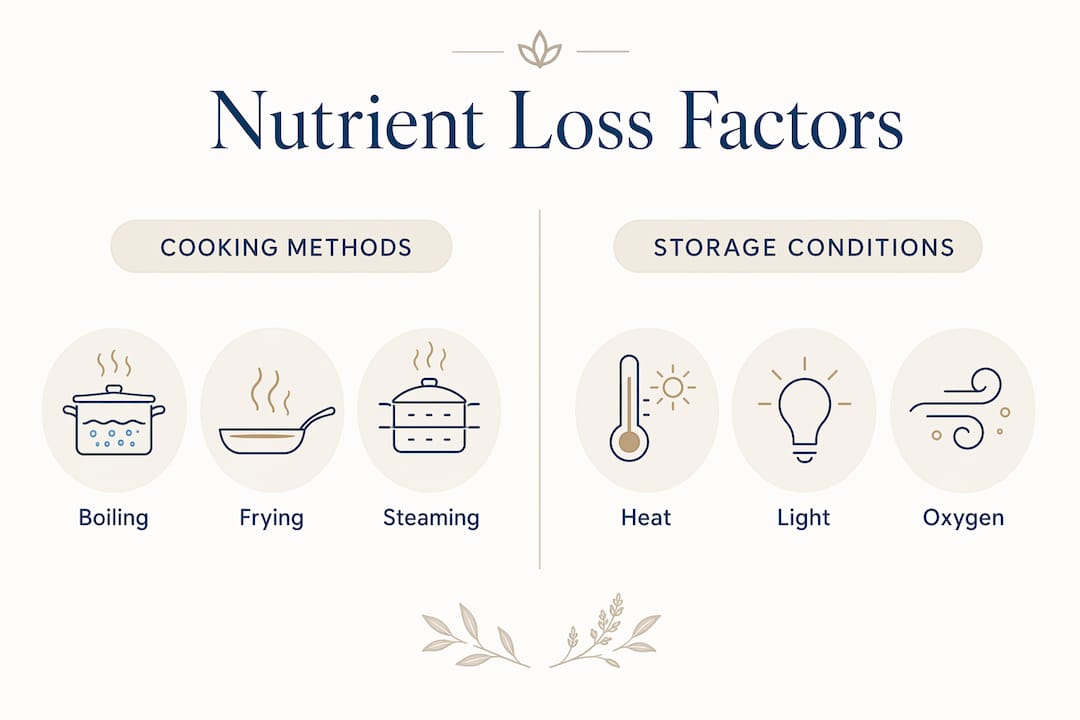
The method you choose to cook with is one of the most controllable variables in nutrient retention. The differences between techniques are significant enough to change the nutritional profile of a meal.

| Method | Nutrient Retention | Key Reason |
|---|---|---|
| Steaming | High | Minimal water contact, lower temperatures |
| Microwaving | High | Short cooking time, little liquid required |
| Boiling | Low to moderate | Water-soluble vitamins leach into cooking water |
| Frying | Low | High heat degrades heat-sensitive vitamins |
| Blanching | Moderate to high | Inactivates enzymes quickly with controlled exposure |
| Freezing | High | Halts degradation when done at peak ripeness |
Microwave and steaming methods consistently outperform boiling and frying because they reduce both water contact and heat exposure. Microwaving is particularly effective due to its short cooking times and minimal liquid requirement.
Freezing deserves special attention. Frozen produce often retains equal or higher nutrient density than fresh produce because it is flash-frozen at peak ripeness. Fresh produce, by contrast, continues to degrade during transport and storage. A bag of frozen peas bought in January may contain more vitamin C than “fresh” peas that have spent a week in transit and two days on a supermarket shelf.
Blanching inactivates the enzymes responsible for nutrient degradation with minimal nutrient loss when time and temperature are properly controlled. It is the standard step before freezing vegetables commercially, and it works just as well at home.
Pro Tip: Never discard the water used to boil or steam vegetables. Water-soluble vitamins leach into cooking water during boiling. Use that liquid as a base for soups, gravies, or sauces to recover those nutrients rather than pouring them down the sink.
When does cooking improve nutrient absorption rather than reduce it?
Cooking is not purely destructive. For several key nutrients, heat actually increases how much your body can absorb, a property called bioavailability.
The clearest example is lycopene in tomatoes. Cooking tomatoes increases lycopene bioavailability, particularly when combined with healthy fats. Heat breaks down the cell walls that trap lycopene, releasing it in a form the body absorbs more readily. Lycopene is linked to reduced inflammation and improved heart health, so a cooked tomato sauce with olive oil is nutritionally superior to a raw tomato in this specific respect.
Spinach and other leafy greens tell a similar story. Raw spinach contains oxalates, compounds that bind to iron and calcium and prevent their absorption. Light cooking reduces oxalate levels, improving the bioavailability of both minerals. The trade-off is a reduction in vitamin C, which is why combining cooking methods across your diet gives better overall results than committing to one approach.
Here is where fat plays a critical role:
- Fat-soluble vitamins (A, D, E, and K) require dietary fat to be absorbed at all.
- Adding olive oil when cooking or serving vegetables improves uptake of these vitamins significantly.
- Sautéing carrots or roasting sweet potato with a drizzle of oil is not indulgent. It is nutritionally correct.
- Cooking leafy greens with vitamin C-rich foods, such as lemon juice or bell peppers, enhances iron absorption by counteracting inhibitors like oxalates and tannins.
The optimal approach combines raw and cooked foods across the day. Raw foods preserve heat-sensitive vitamins. Cooked foods unlock minerals and fat-soluble compounds. Neither approach alone is complete.
Pro Tip: Pair cooked spinach or kale with a squeeze of lemon juice. The vitamin C in the lemon counteracts oxalates and tannins, meaningfully increasing how much iron your body absorbs from the greens. This is nutrient synergy in practice.
What practical steps maximise nutrient preservation at home?
Applying nutrient retention methods in a real kitchen does not require specialist equipment or complicated techniques. The following steps produce consistent results with minimal effort.
- Shorten cooking time wherever possible. The time-temperature relationship is the single most important variable. Even small reductions in cook duration reduce nutrient losses meaningfully. Aim for tender-crisp rather than soft when cooking vegetables.
- Choose steaming or microwaving over boiling. Both methods use less water and lower effective temperatures, preserving more of the water-soluble vitamins that boiling strips away.
- Reuse cooking water. Leached water-soluble vitamins end up in the cooking liquid. Add it to soups, stews, or sauces rather than discarding it.
- Use frozen produce when fresh is not at peak quality. Flash-frozen vegetables captured at peak ripeness often outperform out-of-season fresh produce on nutrient content. Keep a well-stocked freezer as a nutritional backup.
- Add healthy fats to cooked vegetables. Olive oil, nut butters, or avocado alongside fat-soluble vitamins dramatically improves absorption. This applies to both cooked and raw preparations.
- Store foods away from light and oxygen. Use opaque, airtight containers for cut produce, grains, nuts, and seeds. Exposure to air and light degrades vitamins and oxidises fats.
- Eat a varied diet of raw and cooked foods. No single preparation method preserves every nutrient. Rotating between raw salads, lightly steamed vegetables, and gently cooked dishes covers the full spectrum of nutrient retention methods.
- Blanch before freezing at home. A brief blanch in boiling water followed by immediate cooling in ice water inactivates degrading enzymes and locks in colour, texture, and nutrients before freezing.
Pro Tip: Store nuts and seeds in sealed glass jars away from direct sunlight. The polyunsaturated fats in walnuts, flaxseeds, and hemp seeds oxidise quickly when exposed to air and light, reducing both nutritional value and flavour. A cool, dark cupboard extends their nutritional life significantly.
Key takeaways
Nutrient preservation requires combining the right cooking methods, storage conditions, and ingredient pairings, because no single technique protects every nutrient equally.
| Point | Details |
|---|---|
| Heat, light, and oxygen are the main threats | Minimise exposure duration and intensity to reduce nutrient degradation. |
| Steaming and microwaving outperform boiling | Both methods retain more water-soluble vitamins by reducing water contact and cook time. |
| Frozen produce is nutritionally competitive | Flash-frozen vegetables often match or exceed fresh produce in vitamin content. |
| Cooking can improve bioavailability | Heat unlocks lycopene, beta-carotene, and minerals bound by oxalates in raw foods. |
| Fat is required for fat-soluble vitamins | Adding olive oil or nut butter to meals significantly improves absorption of vitamins A, D, E, and K. |
Why i think most people are getting this backwards
People obsess over what they eat and almost entirely ignore how they prepare it. I have seen this repeatedly: someone buys organic spinach, boils it for ten minutes in a large pot of water, drains it, and congratulates themselves on eating healthily. They have just poured a significant portion of the water-soluble vitamins down the drain and left the minerals partially locked behind oxalates.
The “fresh is always best” myth is the other persistent problem. Nutritionists have been clear on this for years. A frozen broccoli floret harvested and frozen the same day is nutritionally superior to a fresh one that spent five days in a lorry and three more on a shelf. Accepting that fact is not settling for less. It is understanding food science.
What I find genuinely useful is thinking about cooking as a two-stage decision: first, which method preserves the most for this specific food, and second, what can I add or pair it with to improve absorption. Steamed carrots with a spoonful of nut butter. Cooked tomatoes with olive oil. Lemon juice over wilted greens. These are not complicated. They are just informed.
The best dietary approach is not raw, not cooked, not frozen exclusively. It is all three, rotated intelligently. Small adjustments to cooking time, storage habits, and ingredient pairings compound into meaningful differences in what your body actually receives from the food you eat. That is the real value of understanding wholefood nutrition.
— Jarrod
Nutrient-dense foods that do the work for you
Understanding nutrient preservation is one part of the equation. The other is starting with foods that are genuinely dense in nutrients to begin with.

Granavitalis sources nuts, seeds, and nut butters with minimal processing precisely because processing is where nutrient loss begins. The Raw Organic Pecan Butter from RAWGORILLA is a strong example: cold-processed to preserve the natural vitamin E, healthy fats, and mineral content that heat-intensive processing destroys. For variety, the Organic Nut & Seed Butter Selection Box brings together a range of minimally processed butters, each selected for nutritional integrity. If you are building a diet around real nutrient density, these are the kinds of foundation foods that make the difference.
FAQ
What is nutrient preservation in simple terms?
Nutrient preservation is the practice of retaining vitamins, minerals, and antioxidants in food during storage, preparation, and cooking. It involves controlling factors like heat, light, oxygen, and moisture that cause nutritional compounds to break down.
Which cooking method preserves the most nutrients?
Steaming and microwaving preserve the most nutrients because they use minimal water and shorter cooking times. Both methods significantly outperform boiling, which causes water-soluble vitamins to leach into the cooking liquid.
Is frozen food as nutritious as fresh food?
Frozen produce is often equally or more nutritious than fresh because it is flash-frozen at peak ripeness, halting degradation. Fresh produce continues to lose nutrients during transport and storage before it reaches your kitchen.
Does cooking destroy all the nutrients in vegetables?
Cooking destroys some nutrients, particularly heat-sensitive vitamins like vitamin C, but it improves the bioavailability of others. Lycopene in tomatoes and minerals in spinach are more accessible to the body after light cooking than in raw form.
How should i store food to prevent nutrient loss?
Store food in airtight, opaque containers away from direct light and heat. Oxygen and UV light are the primary causes of oxidative nutrient loss in stored foods, particularly in nuts, seeds, and cut produce.