
What makes a food a true nutrient powerhouse
TL;DR:
- Nutrient powerhouses provide high nutrients relative to their calorie content, not just low calories.
- Different ranking systems highlight varying foods; diversity and pattern are more important than single superfoods.
- Incorporating whole, minimally processed foods from various groups supports optimal absorption, affordability, and health.
The word “superfood” gets thrown around so casually that it’s easy to assume kale and goji berries sit at the very top of every scientific ranking. They don’t, always. Some foods celebrated in wellness culture score surprisingly low on the measures health authorities actually use, while genuinely extraordinary options like watercress and Chinese cabbage quietly outperform them. If you’re serious about fuelling your body well, understanding what separates a true nutrient powerhouse from clever marketing is one of the most useful things you can do for your long-term energy, recovery, and overall vitality.
Table of Contents
- Defining a nutrient powerhouse: more than just calories
- How nutrient density is measured: different approaches and what they miss
- Top nutrient powerhouse foods: examples across food groups
- Making nutrient powerhouses work for you: absorbing, affording, and applying
- Why most people misunderstand nutrient powerhouses and how you can do better
- Find your next nutrient powerhouse with Granavitalis
- Frequently asked questions
Key Takeaways
| Point | Details |
|---|---|
| Look beyond calories | True nutrient powerhouses give more vitamins, minerals, and fibre per calorie, not just less energy. |
| Use diverse rankings | No single chart is perfect—consider several when evaluating nutrient-rich foods. |
| Mix and pair wisely | Combine foods for better absorption and balance—like vitamin C with iron-rich greens. |
| Whole foods win out | Plant-rich, minimally processed foods support well-being and healthy ageing. |
| Practicality and variety matter | Affordable, accessible options help you stick with nutrient-dense eating long term. |
Defining a nutrient powerhouse: more than just calories
Building from this introduction, let us clarify what experts mean when they call a food a “nutrient powerhouse.”
At its core, nutrient density defined comes down to one simple principle: how much nutritional value does a food deliver for the calories it contains? A nutrient powerhouse provides high levels of essential nutrients, covering vitamins, minerals, fibre, and protein, relative to its calorie content. It’s not about eating the lowest-calorie food possible. It’s about getting the most return on every calorie you consume.
The distinction matters enormously in practice. A handful of white crackers and a handful of almonds might have similar calorie counts, but their nutritional profiles are worlds apart. The almonds bring magnesium, vitamin E, healthy fats, fibre, and protein. The crackers bring very little of lasting value. One supports your recovery after a hard training session; the other simply fills a gap until the next meal.
Health authorities have formalised this idea in practical ways. The CDC developed its Powerhouse Fruits and Vegetables classification, which defines powerhouse foods as those providing, on average, 10% or more of the daily value per 100 kcal across 17 key nutrients. Those nutrients include potassium, fibre, protein, calcium, iron, zinc, and vitamins A, B6, B12, C, D, E, and K, among others.
The essential nutrients typically included in leading nutrient density rankings are:
- Vitamins: A, C, D, E, K, and the B-complex group
- Minerals: Calcium, iron, magnesium, potassium, zinc
- Macronutrients: Protein and fibre
- Phytonutrients: Polyphenols, carotenoids, glucosinolates (not always included, but increasingly recognised)
Here’s a quick comparison of how different food categories can vary:
| Food category | Typical nutrient density | Key nutrients delivered |
|---|---|---|
| Leafy greens | Very high | Vitamins K, C, A, folate, iron |
| Berries | High | Vitamin C, antioxidants, fibre |
| Refined grains | Low | Carbohydrates, minimal micronutrients |
| Eggs | Moderate to high | Protein, B12, choline, selenium |
| Processed snack foods | Very low | Energy with minimal micronutrients |
Pro Tip: When evaluating a food’s value, ask yourself: “What does this give me beyond energy?” If the answer is very little, consider pairing it with something that fills those nutritional gaps.
The key insight here is that nutrient density is not synonymous with low calories. Nutrient powerhouses range from watercress at almost zero calories per serving to almonds at around 165 calories per 28 grams. What they share is the ability to deliver meaningful, measurable nutrition relative to what they cost your body in energy.
How nutrient density is measured: different approaches and what they miss
Now that we’ve defined what counts as a nutrient powerhouse, let’s examine how these foods are measured and why rankings can differ.
Two of the most widely referenced scoring systems are the CDC’s Powerhouse classification and the Aggregate Nutrient Density Index, known as ANDI. Each takes a different approach, and understanding their logic helps you read any “top superfoods” list with appropriate scepticism.
The CDC system, as mentioned, scores foods on 17 essential nutrients per 100 kcal. Foods must hit the 10% daily value threshold across those nutrients to qualify. This approach heavily favours very low-calorie vegetables because calorie density is baked into the formula. A food delivering great nutrition but also meaningful calories will score lower, not because it’s less nutritious in real terms, but because the formula penalises its energy content.
ANDI, developed by Dr Joel Fuhrman, takes a different view. It scores foods on a scale of 1 to 1,000 based on the quantity of micronutrients per calorie, but it includes a broader range of phytonutrients, antioxidants, and disease-fighting compounds. Under ANDI, kale scores extraordinarily high. Under the CDC system, different methods rank the same food differently, and kale actually scores a relatively modest 49.07, largely because of its caloric density compared to watercress.
“No single scoring system captures everything that makes a food valuable to human health. Rankings are useful tools, not definitive verdicts. The most honest approach is to look at what multiple systems agree on, then apply your own context.”
Both systems have meaningful gaps. They largely ignore bioavailability, which refers to how much of a nutrient your body can actually absorb and use. Spinach, for instance, contains substantial iron and calcium, but also oxalates, which bind to these minerals and reduce how much you absorb. Raw spinach in a salad delivers less usable iron than cooked spinach or lentils paired with vitamin C.
Neither system adequately accounts for:
- Cost and accessibility of a food for everyday shoppers
- Phytonutrients beyond the standard 17 vitamins and minerals
- Preparation methods that dramatically affect nutrient availability
- Individual needs, such as those with higher iron requirements or restricted diets
The meaning of nutrient density is therefore broader than any single score. And when you start comparing nutrient powerhouses across systems, you realise the most useful take-away is not a ranked list but a principle: prioritise whole, minimally processed foods from diverse categories, and you will naturally consume a wide spectrum of essential nutrients.
Top nutrient powerhouse foods: examples across food groups
With the methods explained, let’s spotlight real examples of foods that meet the nutrient powerhouse criteria across all main food groups.
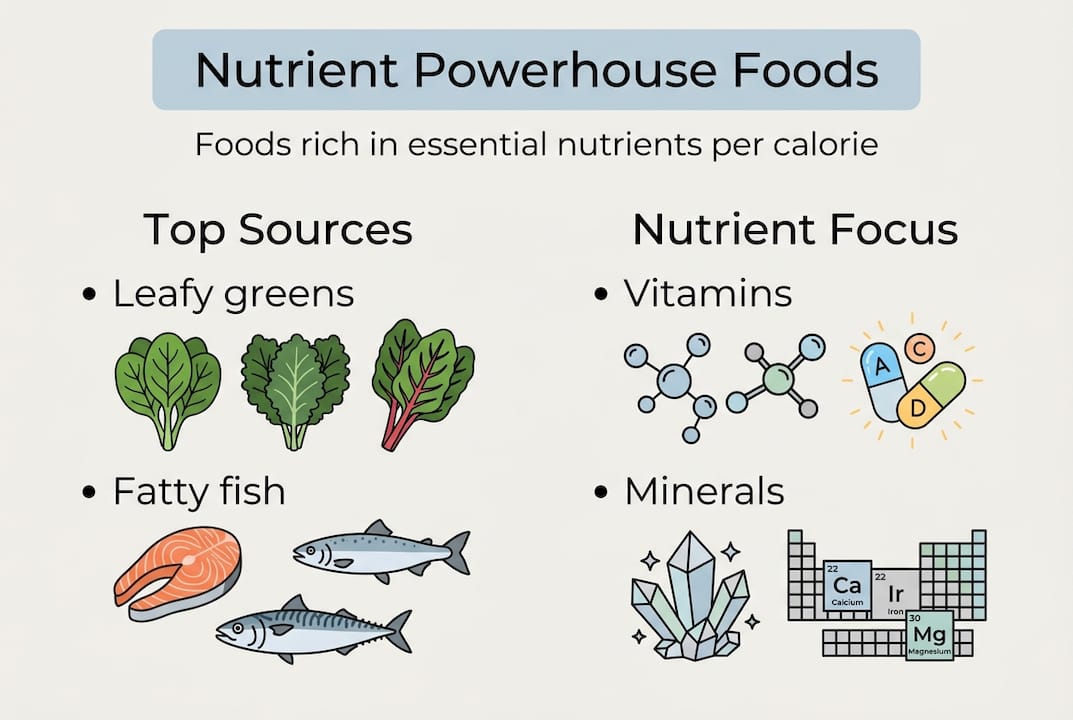
Starting with vegetables, the CDC rankings are revealing. Top CDC powerhouse foods include watercress scoring a perfect 100, Chinese cabbage at 91.99, chard at 89.27, spinach at 86.43, and collard greens at 62.49. Kale, despite its fame, scores 49.07 due to its higher calorie content per 100 kcal serving.
These scores reflect the formula, but all of these foods are genuinely outstanding. Watercress delivers vitamin K, vitamin C, calcium, and potent glucosinolates in almost no calories at all. Swiss chard provides magnesium, potassium, and antioxidant pigments. Spinach brings iron, folate, and lutein for eye health. None of these should be dismissed because they’re not the most photogenic items on the wellness scene.

Here are the top nutrient powerhouse foods worth building your diet around, organised by food group:
Vegetables:
- Watercress
- Chinese cabbage (pak choi)
- Swiss chard
- Spinach
- Kale and collard greens
Fruits:
- Blueberries (exceptionally high in antioxidants)
- Papaya (rich in vitamin C and digestive enzymes)
- Red peppers (technically a fruit, delivers more vitamin C than oranges)
- Citrus fruits (vitamin C, flavonoids, folate)
- Pomegranate (punicalagins, vitamin K, folate)
Animal proteins:
- Salmon delivers omega-3 fatty acids, vitamin D, and B12 in abundance
- Eggs offer complete protein, choline, selenium, and lutein, all in a remarkably affordable package
- Sardines provide calcium via edible bones, omega-3s, and B12 at low cost
Plant proteins:
- Lentils are among the most nutrient-dense affordable foods on the planet
- Hemp seeds deliver complete protein with an excellent omega-3 to omega-6 ratio
- Pumpkin seeds are concentrated sources of zinc, magnesium, and iron
Nutrient-dense foods that score well share a common profile: low in saturated fat, free from added sugars and excessive sodium, and rich in micronutrients your body actively uses for cellular repair, immune function, and sustained energy.
One striking example is eggs. Many rigid scoring systems under-rate eggs because they contain fat and dietary cholesterol, yet eggs are one of the most bioavailable sources of choline (critical for brain health), high-quality protein, and fat-soluble vitamins like D and A. For anyone focused on recovery and performance, eggs consistently earn their place on the plate. Explore plant-based protein powerhouses if you’re building a fully plant-forward approach, or consider how breakfast nutrient powerhouses can anchor your mornings with sustained energy.
The broader point stands: no single food covers all your nutritional bases. Diversity is not a nice-to-have. It’s a nutritional requirement. A good rule of thumb is to aim for at least five distinct food groups across your day, drawing on vegetables, fruits, whole grains, quality proteins, and healthy fats. If you’re curious how nutrition transforms complexion, the research backs what many people notice anecdotally. The foods that fuel recovery and energy often show up on your skin too.
Making nutrient powerhouses work for you: absorbing, affording, and applying
Now that you know the top contenders, it’s time to put this knowledge into practice and benefit from nutrient powerhouses in your daily life.
Knowing which foods are nutrient-dense is only half the equation. Getting the most from them means understanding how to absorb, afford, and practically apply them to everyday eating.
Maximising absorption: pairing matters
Absorption is where many well-intentioned diets fall short. Prioritise pairing for absorption with simple strategies. Vitamin C dramatically increases the absorption of non-haem iron (the type found in plant foods). Eating lentils with a squeeze of lemon juice or a portion of red pepper is not a quirky habit. It’s biochemistry working in your favour. Fat-soluble vitamins, specifically A, D, E, and K, require dietary fat to be absorbed properly. A salad of kale and spinach drizzled with olive oil absorbs far more of those vitamins than the same salad eaten dry.
Here are four practical steps for building absorption-smart meals:
- Pair iron-rich plants with vitamin C. Lentils with tomatoes, spinach with citrus dressing, beans with salsa.
- Add healthy fats to greens. Olive oil, avocado, or nuts alongside leafy vegetables support fat-soluble vitamin uptake.
- Cook smartly. Light steaming breaks down cell walls and increases the availability of carotenoids in vegetables like carrots and tomatoes.
- Reduce antinutrient interference. Soaking legumes overnight reduces phytates, which otherwise limit mineral absorption.
Affordability: powerhouses don’t have to be expensive
The idea that nutrient-dense eating is expensive is one of the most persistent myths in nutrition. Nutrient-dense diets are cheaper long-term when you account for disease prevention and reduced reliance on supplements. Frozen spinach, tinned sardines, dried lentils, eggs, and seasonal root vegetables are among the most affordable and nutritionally powerful foods available in any UK supermarket.
Pro Tip: Build your meals around a base of frozen greens and legumes first, then layer in fresh seasonal produce and quality proteins. This approach covers your micronutrient needs without straining your budget.
Simple everyday swaps
You don’t need to overhaul your entire diet. Small, consistent swaps accumulate into meaningful nutritional improvements:
- Swap white rice for a mixture of brown rice and lentils
- Replace crisps with a portion of pumpkin seeds or walnuts
- Choose Greek yoghurt over flavoured dessert yoghurt
- Add a handful of frozen spinach to smoothies, soups, and curries
- Use hemp protein or a quality plant-based blend in your morning porridge
The 80/20 principle applies here. Aim for nutrient-dense choices about 80% of the time, and give yourself flexibility for the remaining 20%. Sustainable eating patterns, not perfect ones, are what actually build long-term health. Explore affordable nutrient-dense proteins for budget-friendly options, and consider low-calorie plant proteins if you’re working within specific calorie targets.
Why most people misunderstand nutrient powerhouses and how you can do better
Most people approach the idea of nutrient powerhouses by assembling a short list of “approved” superfoods and rotating them repeatedly. Kale every day. Blueberries every morning. Salmon twice a week. The intention is good, but the approach misses something fundamental.
The real strength of nutrient-dense foods lies in variety and pattern, not in the repetition of a few celebrated options. No single food can supply every nutrient your body requires. Watercress tops the CDC chart, but it won’t give you the omega-3s that salmon provides, or the complete amino acid profile of eggs, or the magnesium density of pumpkin seeds.
What’s more, bioavailability and personal context shape the value you actually get from any food. Spinach might score brilliantly on paper, but if you’re eating it raw alongside high-oxalate foods every single day, your actual mineral absorption could be compromised. Rotating your greens, alternating your protein sources, and varying your fruits and whole grains is the most effective way to ensure your body receives the full spectrum of what it needs.
The mindset shift we’d encourage is this: stop thinking in terms of individual superfoods and start thinking in terms of nutrient-dense patterns. A day built on diverse whole foods, with a solid base of vegetables, quality proteins, whole grains, and natural fats, will always outperform a diet obsessed with a handful of trendy items.
Find your next nutrient powerhouse with Granavitalis
Ready to act on what you’ve just learnt? At Granavitalis, we’ve done the sourcing work so you don’t have to.

Our range is built around exactly the principles this article covers: whole foods with exceptional nutrient density, minimal processing, and transparent sourcing. Whether you’re exploring our superfoods mix for immunity, packed with zinc and vitamin B1 to support your body’s natural defences, or reaching for our raw pecan butter as a nutrient-rich addition to your mornings, every product is chosen with your real nutritional goals in mind. Browse our full range to find the nutrient powerhouses that fit your life.
Frequently asked questions
Is a nutrient powerhouse always low in calories?
Most nutrient powerhouses are low in calories, but foods like nuts, eggs, and salmon are calorie-dense yet nutritious, delivering concentrated vitamins, healthy fats, and complete proteins that justify their energy contribution.
How do I know if a food is a nutrient powerhouse?
Look for foods that deliver significant vitamins, minerals, fibre, and protein relative to their calorie count. The CDC defines powerhouse foods as those providing at least 10% of the daily value per 100 kcal across 17 key nutrients.
Why do different nutrient rankings rate the same food differently?
Each system uses distinct criteria, so rankings differ depending on whether calorie density, phytonutrients, bioavailability, or disease-prevention compounds are included in the formula. No single ranking is universally definitive.
How can I make nutrient-dense eating more affordable?
Frozen vegetables, tinned legumes, eggs, and dried pulses are among the most cost-effective nutrient powerhouses available. Nutrient-dense diets are cheaper long-term because they reduce the likelihood of nutrient deficiencies and associated health costs.