
Why wholefoods matter for your health in 2026
TL;DR:
- Most adults in the UK fall short of the recommended 30 grams of daily fiber, increasing health risks. Whole foods deliver nutrients through their physical structure, which slows digestion and supports long-term health. Gradual, sustainable changes and mindful food choices enhance overall dietary quality and disease prevention.
Whole foods are defined as foods consumed in their natural state or with minimal processing, retaining their full complement of fibre, vitamins, minerals, and antioxidants. Understanding why wholefoods matter is not a question of dietary fashion. It is a question of biological necessity. The UK’s Scientific Advisory Committee on Nutrition (SACN) and the British Heart Foundation both identify whole food intake as a primary lever for reducing chronic disease risk. Yet 96% of UK adults fall short of the recommended 30g of daily fibre, almost all of which comes most effectively from whole food sources. That gap has real consequences for long-term health.
Why wholefoods matter: what the nutrition science actually shows
Whole foods deliver nutrients in a way that processed alternatives cannot replicate. The key distinction is not just what nutrients are present, but how the body receives them. Vitamins, minerals, and antioxidants exist in whole foods within a complex physical structure that shapes how they are digested and absorbed.

The food matrix effect is the clearest illustration of this. The physical structure of whole foods slows the digestion and absorption of fats and sugars, producing a more stable metabolic response than the same nutrients delivered in processed form. An apple and apple juice contain similar sugars, but the apple’s fibre matrix slows absorption and prolongs satiety. That difference matters across every meal, every day.
Fibre is the nutrient most directly tied to whole food consumption. Fibre supports fullness, cholesterol control, and blood pressure regulation, making it central to cardiovascular health. Beyond fibre, whole foods supply a dense array of micronutrients. The role of micronutrients in immune function, energy metabolism, and cellular repair is well established, and whole foods remain the most reliable delivery mechanism for them.
Key nutritional advantages of whole foods include:
- Fibre: Feeds beneficial gut bacteria, regulates bowel function, and reduces cholesterol.
- Antioxidants: Protect cells from oxidative damage linked to ageing and chronic disease.
- Vitamins and minerals: Support immune defence, bone density, and hormone production.
- Phytonutrients: Plant compounds with anti-inflammatory properties not found in supplements.
- Slow-release energy: Complex carbohydrates in whole grains sustain energy without blood sugar spikes.
Pro Tip: Pair whole grain foods with a source of healthy fat, such as nut butter, to further slow carbohydrate absorption and extend satiety.
How do whole foods reduce the risk of chronic disease?
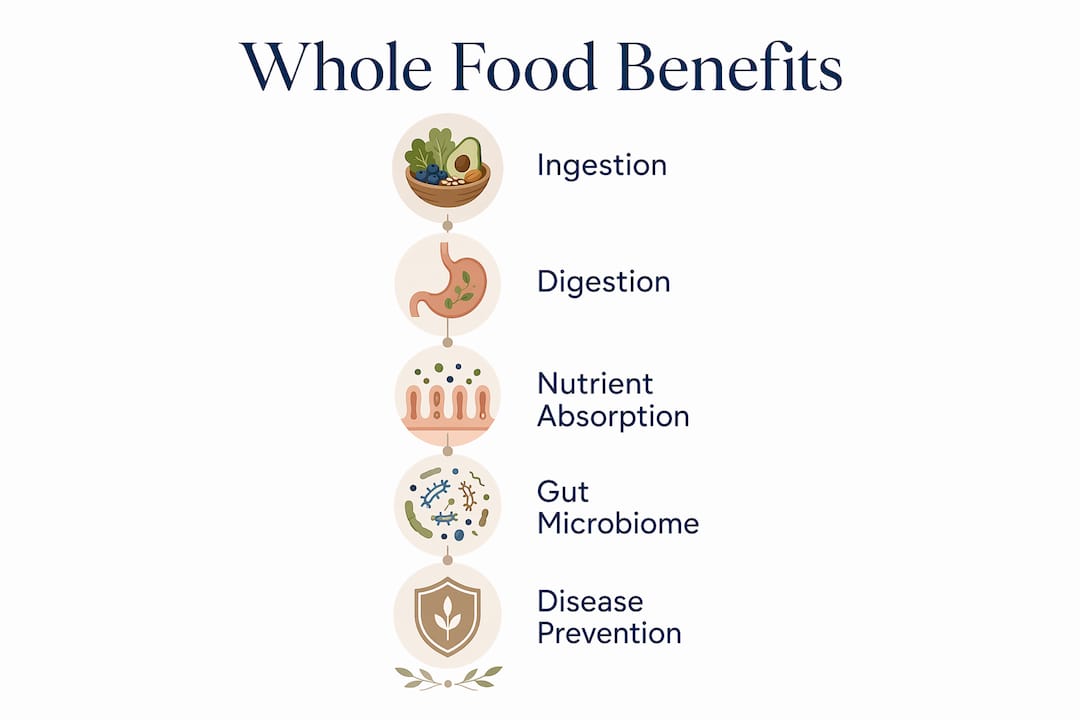
The evidence linking whole food consumption to chronic disease prevention is substantial and consistent. Adults who meet the 30g daily fibre target show measurably lower risks of heart disease, stroke, type 2 diabetes, and bowel cancer. That target is not arbitrary. It reflects decades of epidemiological data showing dose-dependent protection as fibre intake rises.
The gut microbiome is one of the central mechanisms. Whole foods, particularly legumes, vegetables, and whole grains, feed diverse communities of gut bacteria. A diverse microbiome produces short-chain fatty acids that reduce systemic inflammation, regulate immune responses, and support metabolic function. Processed foods, by contrast, tend to reduce microbial diversity over time.
The table below summarises the disease risk reductions associated with meeting whole food and fibre intake targets, based on current UK dietary guidance.
| Health outcome | Whole food benefit |
|---|---|
| Heart disease | Fibre lowers LDL cholesterol and blood pressure |
| Type 2 diabetes | Slow sugar absorption reduces insulin demand |
| Bowel cancer | Fibre speeds transit time, reducing carcinogen exposure |
| Stroke | Potassium and fibre from whole foods reduce vascular risk |
| Obesity | Satiety from fibre reduces overall calorie intake |
UK guidelines from the British Heart Foundation recommend that fruits and vegetables make up more than a third of daily food intake, targeting five 80g portions daily. That recommendation exists because the protective effect of whole foods is cumulative. Each additional portion adds measurable benefit. For a deeper look at how whole foods fit into the broader picture of modern eating, the role of wholefoods in modern diets guide from Granavitalis covers the 2026 context in detail.
Are all processed foods bad for you?
Not all processed foods are harmful. This is one of the most important distinctions in modern nutrition, and conflating “processed” with “unhealthy” leads to unnecessary dietary anxiety and poor food choices.
The NOVA classification system categorises foods by degree of processing, from minimally processed to ultra-processed. Ultra-processed foods (UPFs) are formulated with additives, flavourings, and preservatives not typically found in home cooking. Nearly 60% of UK dietary energy comes from highly processed foods, a pattern linked to obesity and cardiometabolic risk. That figure reflects a genuine public health concern.
However, the NOVA system labels some nutritious foods as ultra-processed. Wholemeal bread, canned beans, and fortified plant milks may carry a UPF classification, yet many minimally processed foods like these provide essential nutrients and fibre. Discarding them based on a processing label alone would reduce diet quality, not improve it.
A practical approach works as follows:
- Identify the UPFs that offer little nutritional value. Crisps, sugary cereals, reconstituted meat products, and sweetened fizzy drinks are the primary targets for reduction.
- Retain processed foods with genuine nutritional merit. Frozen vegetables, tinned fish, plain yoghurt, and wholemeal bread all belong in a health-conscious diet.
- Read ingredient lists rather than processing labels. A short ingredient list of recognisable whole food components is a reliable quality signal.
- Focus on overall dietary pattern. Dietary pattern quality, not individual food processing status, is the strongest predictor of long-term health outcomes.
Pro Tip: When travelling or eating away from home, eating well on holiday is easier than most people expect. Choosing whole fruit, nuts, and plain dairy over packaged snacks keeps your dietary pattern intact without requiring perfection.
How can you eat more whole foods without overhauling your diet?
Increasing whole food intake does not require a complete dietary reset. Gradual, sustainable changes produce better long-term results than sudden overhauls.
Increasing fibre intake gradually and pairing it with increased fluid intake is the clinically recommended approach. Adding fibre too quickly without adequate hydration causes bloating and digestive discomfort, which discourages people from continuing. Start by adding one additional portion of vegetables or a serving of whole grains per day, then build from there over several weeks.
Affordable whole food options are more accessible than many people assume:
- Frozen fruits and vegetables retain more vitamins and minerals than fresh produce stored for several days, making them a nutrient-rich option that is often cheaper than fresh.
- Tinned legumes such as chickpeas, lentils, and kidney beans provide fibre and protein at low cost with no preparation time.
- Whole grains including oats, brown rice, and wholemeal pasta are widely available and straightforward to substitute for refined grain equivalents.
- Nuts and seeds offer concentrated fibre, healthy fats, and micronutrients in small portions. A handful of hazelnuts or a tablespoon of nut butter adds meaningful nutrition to any meal.
- Seasonal produce delivers peak nutrient density at lower cost. The benefits of seasonal produce extend beyond nutrition to flavour and environmental impact.
Simple swaps make a significant difference over time. Swap white bread for wholemeal. Replace a mid-morning biscuit with a piece of fruit and a small handful of nuts. Add a tin of lentils to a soup or stew. None of these changes require cooking skills or a large food budget. A high-fibre breakfast built around oats, seeds, and nut butter is one of the most effective single daily habits for meeting fibre targets.
Key takeaways
Whole foods are the most reliable foundation for long-term health because they deliver fibre, micronutrients, and protective compounds in a physical form the body is built to use.
| Point | Details |
|---|---|
| Fibre gap is critical | 96% of UK adults fall short of the 30g daily fibre target, increasing disease risk. |
| Food matrix effect matters | Whole food structure slows absorption of fats and sugars, improving metabolic outcomes. |
| Not all processing is harmful | Frozen veg, tinned beans, and wholemeal bread are processed yet nutritionally valuable. |
| Gradual change works best | Increase fibre slowly with more fluid to avoid digestive discomfort and sustain the habit. |
| Pattern beats perfection | Overall dietary quality, not individual food labels, determines long-term health outcomes. |
Whole foods in real life: what I’ve actually found works
The nutrition conversation around whole foods often gets stuck in two unhelpful extremes. On one side, there is the view that anything processed is poison. On the other, there is the dismissal of dietary quality as irrelevant. Neither position holds up in practice.
What I have found, working with people across a wide range of eating habits, is that the biggest gains come from the simplest shifts. Replacing a refined grain with a whole grain at one meal per day. Adding a handful of nuts to an afternoon snack. Choosing frozen spinach over no spinach because fresh ran out. These are not dramatic interventions. They are the kind of consistent, low-effort choices that compound over months and years into genuinely different health outcomes.
The people who struggle most are those who treat whole food eating as an all-or-nothing commitment. They eat perfectly for two weeks, then have a difficult week and abandon the whole approach. Sustainability requires flexibility. A diet that is 80% whole food focused and 20% pragmatic is far superior to a diet that cycles between rigid restriction and collapse.
The food matrix concept changed how I think about this. Knowing that the physical structure of food matters, not just its nutrient content, makes the case for eating actual food rather than supplements or fortified products far more compelling. A Brazil nut delivers selenium differently than a selenium tablet. An oat delivers beta-glucan differently than a fibre supplement. The whole food is not just a delivery vehicle. It is the point.
Mindful eating, rather than obsessive label-reading, is the practical outcome of understanding this. Pay attention to how food is grown, how minimally it has been altered, and how it makes you feel. That awareness, applied consistently, does more for long-term wellness than any specific dietary rule.
— Jarrod
Granavitalis: whole food nutrition made straightforward
Real whole food eating starts with having the right ingredients to hand. Granavitalis sources ancient grains, premium nuts, seeds, and clean plant proteins so that every meal can be built on a genuinely nutritious foundation.

The raw organic pecan butter from Granavitalis is a concentrated source of fibre, healthy fats, and micronutrients with a minimal ingredient list. It works as a breakfast addition, a post-workout snack, or a simple way to add nutritional depth to any meal. For those wanting variety, the nut and seed butter selection brings together a range of organic butters that complement a whole food diet without compromise. Purity, performance, and purpose in every jar.
FAQ
What counts as a whole food?
A whole food is any food consumed in its natural state or with minimal processing, such as fruits, vegetables, whole grains, nuts, seeds, and legumes. Minimal processing that does not significantly alter nutritional content, such as freezing or cooking, still qualifies.
How much fibre do adults need each day?
Adults need 30g of fibre daily to reduce the risk of heart disease, stroke, type 2 diabetes, and bowel cancer. Whole grains, legumes, vegetables, and nuts are the most effective sources.
Are frozen vegetables as nutritious as fresh?
Frozen vegetables often retain more vitamins and minerals than fresh produce stored for several days, because they are frozen shortly after harvest. They are a practical and affordable whole food option.
Do I need to avoid all processed foods?
Avoiding all processed foods is neither necessary nor beneficial. Foods like wholemeal bread, tinned beans, and plain yoghurt are processed yet nutritionally valuable. The focus should be on reducing ultra-processed foods high in added sugar, salt, and fat.
How quickly should I increase my fibre intake?
Increase fibre intake gradually over several weeks and drink more water alongside each increase. Rapid changes cause bloating and digestive discomfort, which reduces the likelihood of maintaining the habit long term.