
Whey vs vegan protein: Which is better for fitness?
TL;DR:
- Vegan protein blends can match whey in muscle building when properly formulated and dosed.
- Both protein types support muscle gains effectively with adequate total daily intake.
- Vegan proteins are more sustainable and suitable for those with dairy allergies or intolerances.
If you’ve ever stood in a supplement aisle wondering whether your protein powder choice could make or break your training, you’re not alone. The assumption that whey is the gold standard for muscle and recovery is deeply ingrained in fitness culture. Yet the evidence tells a more interesting story. Vegan blends can match whey for muscle protein synthesis and strength gains when properly dosed and balanced. This article cuts through the noise, compares both options honestly across nutrition, performance, digestion, and sustainability, and helps you make a confident choice that fits your goals, your body, and your values.
Table of Contents
- Understanding whey and vegan protein: What are they, and how do they work?
- Nutrition comparison: Amino acids, absorption, and effectiveness
- Performance, recovery, and real-world results
- Diet, digestibility, allergies, and the sustainability factor
- Choosing the right protein: Practical recommendations for your goals
- Our take: What most people miss about whey vs vegan protein
- Discover more plant-powered nutrition at Granavitalis
- Frequently asked questions
Key Takeaways
| Point | Details |
|---|---|
| Both types support muscle | Whey and blended vegan protein offer similar muscle and strength benefits when dosed properly. |
| Absorption and digestion differ | Whey acts quickly while vegan blends are slower but often gentler for digestion and allergies. |
| Diet and values matter | Choose protein based on your dietary needs, digestion, and sustainability concerns, not just gym trends. |
| Blending solves plant gaps | Mixing vegan protein sources ensures a complete amino acid profile, matching whey’s effectiveness. |
| Check UK protein targets | Active adults in the UK need 0.75–1.5g/kg daily, achievable with either protein type and balanced meals. |
Understanding whey and vegan protein: What are they, and how do they work?
With these questions in mind, let’s first break down exactly what each protein type is and how it functions.
Whey protein is a by-product of cheese production. When milk is curdled, the liquid left behind is whey. It’s processed into concentrate, isolate, or hydrolysate forms, each varying in protein purity and processing level. Whey is a complete protein, meaning it contains all nine essential amino acids your body cannot produce on its own.
Vegan protein powders draw from sources like pea, brown rice, soy, hemp, and sunflower seed. A single source often misses one or more essential amino acids. Pea protein, for instance, is low in methionine. Rice protein is low in lysine. This is why blends matter enormously. Combining pea and rice, for example, creates an amino acid profile that closely mirrors whey. You can explore a wider picture of no meat protein sources to see how varied plant options really are.
Both protein types support muscle repair, recovery, and energy by supplying amino acids that rebuild muscle fibres broken down during exercise. The key differentiators are absorption rate and amino acid profile. Plant and animal protein absorption differs meaningfully, with whey absorbing at 8-10g per hour compared to 3-7g per hour for most plant sources. For a deeper look at what makes a protein truly complete, visit this guide on sources of complete protein.
Here’s a quick summary of where each type fits:
- Whey: Fast-absorbing, complete amino acid profile, ideal post-workout for rapid muscle repair
- Single vegan sources: Often incomplete, lower absorption, best used as part of a varied diet
- Vegan blends: Engineered to fill amino acid gaps, effective for performance and recovery
- Both types: Suitable for everyday diets when total daily protein targets are met
Pro Tip: If you’re using a plant-based powder, always check the label for a blend of at least two protein sources. Pea and rice together cover each other’s amino acid gaps and create a profile that rivals whey without the dairy.
Nutrition comparison: Amino acids, absorption, and effectiveness
Now that the basics are clear, let’s see how the numbers stack up when you compare nutrition directly.
The most important factor in any protein’s effectiveness is its amino acid profile, particularly leucine, which triggers muscle protein synthesis (MPS). Whey is naturally high in leucine, around 10-11% of its amino acid content. Well-formulated vegan blends can reach comparable levels when leucine is added or when sources are strategically combined.
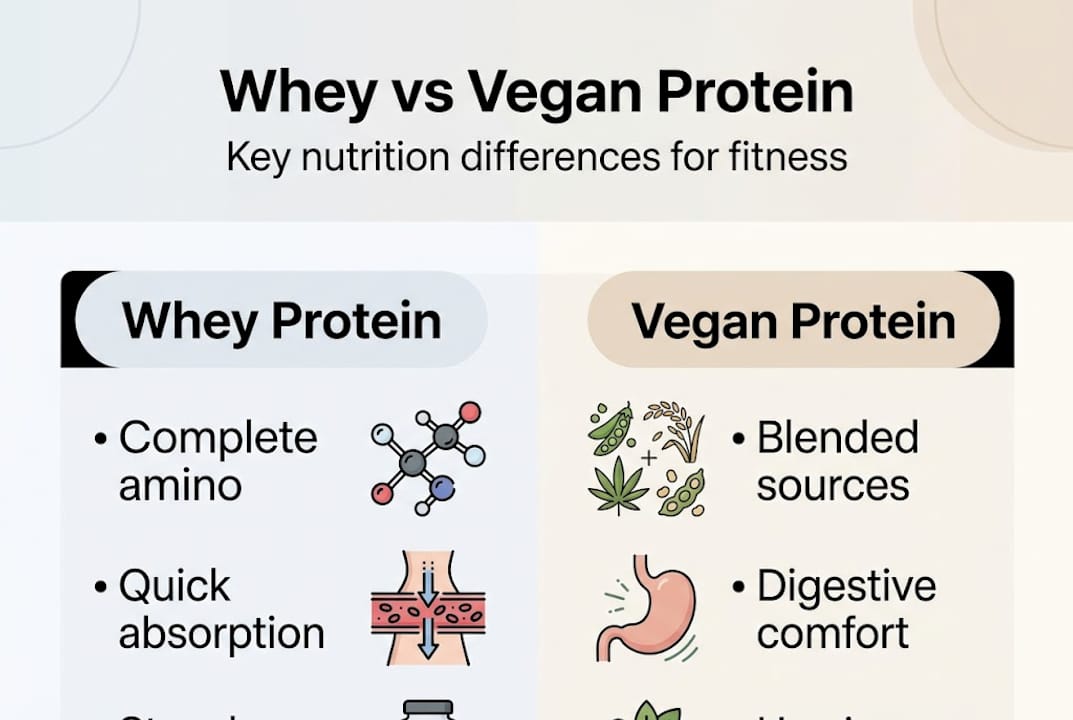
| Nutrient factor | Whey protein | Vegan blend |
|---|---|---|
| Complete amino acids | Yes | Yes (when blended) |
| Leucine content | ~10-11% | ~7-10% (blend-dependent) |
| Absorption rate | 8-10g/hour | 3-7g/hour |
| PDCAAS score | ~1.0 | ~0.8-1.0 (blend) |
| DIAAS score | ~1.09 | ~0.8-1.0 (blend) |
| Dairy-free | No | Yes |
The research is increasingly clear. Blended vegan proteins can match whey for muscle protein synthesis rates and muscle gains when properly dosed. This is not a fringe finding.
“No significant difference in muscle protein synthesis or strength gains when vegan blends are leucine-matched to whey.”
The slightly faster absorption of whey does give it a minor edge in the immediate post-workout window, roughly 30 to 60 minutes after training. In practice, though, this difference rarely translates to measurable long-term gains if your total daily protein intake is on target. You can dig deeper into the vegan protein vs whey debate and explore the vegan protein essentials for UK-specific guidance. For those focused on building mass, the guide on plant protein for muscle gain is worth reading alongside this. For a broader overview, best vegan protein powders provides useful comparisons across popular UK products.
Performance, recovery, and real-world results
With a clear nutrition comparison, let’s translate these facts into real-world fitness performance and recovery.
The question most active people actually want answered is simple: will I see the same results? The short answer is yes, provided intake and dosing are right. RCTs confirm that vegan diets and proteins are equivalent to omnivorous or whey-based approaches for muscle protein synthesis and lean mass gains when intake reaches approximately 1.6g per kg of bodyweight per day.

Stat callout: The British Nutrition Foundation recommends 0.75 to 1.5g of protein per kg of bodyweight daily for active UK adults. For a 70kg person, that’s 52 to 105g per day depending on training intensity.
Here’s a practical framework for getting the most from either protein type:
- Set your daily target first. Work out your bodyweight in kg and multiply by 1.2 to 1.6 depending on how hard you train.
- Prioritise whole foods. Lentils, chickpeas, tofu, eggs, and Greek yoghurt should form your base before you reach for a supplement.
- Time your supplement wisely. Within two hours post-workout is the most useful window, though total daily intake matters more than timing.
- Choose a quality blend. For vegan options, look for pea and rice combinations with added leucine.
- Be consistent. Neither whey nor vegan protein works if usage is sporadic. Daily consistency drives results.
For women with specific performance goals, the vegan protein for women guide addresses common questions around dosing and food pairing. You can also find inspiration in high protein plant based meals for building your food-first approach around real, satisfying meals. Further evidence on vegan diets and resistance training outcomes is worth reviewing if you want the full research picture.
Diet, digestibility, allergies, and the sustainability factor
Fitness isn’t just numbers. Personal values and gut comfort matter, too. Here’s how each type fits into broader lifestyle and dietary choices.
Whey is simply not suitable for everyone. It contains lactose and dairy proteins, which rules it out for vegans, those following a plant-centric lifestyle, and anyone with lactose intolerance or a dairy allergy. Whey is unsuitable for vegans and lactose-intolerant individuals, and plant sources use significantly less water and emit fewer greenhouse gases.
Key considerations by lifestyle:
- Lactose intolerance: Whey concentrate can cause bloating and discomfort; whey isolate has less lactose but is not fully safe for all; vegan blends are the clear choice
- Vegan or vegetarian: Vegan blends are the only viable option
- Omnivores: Both types work well; personal preference and digestion tolerance guide the decision
- Sensitive digestion: Plant proteins tend to digest more slowly, which can actually improve satiety and reduce digestive stress for many people
For those concerned about environmental impact, the contrast is stark:
| Factor | Whey protein | Vegan protein |
|---|---|---|
| Water use per kg | High (dairy farming) | Significantly lower |
| Greenhouse gas emissions | Higher | Substantially lower |
| Land use | Higher | Lower |
| Suitability for vegans | No | Yes |
For further context on how protein powders for digestion compare in real-world use, particularly for endurance athletes, it’s a useful read. The full picture of plant-based protein wellness shows how plant proteins fit naturally into a daily routine without compromise.
Pro Tip: If you experience bloating or discomfort with whey, switching to a pea and rice blend often resolves the issue within a week. Many people find their digestion improves noticeably, and energy levels feel more stable throughout the day.
Choosing the right protein: Practical recommendations for your goals
Let’s turn this knowledge into action with some direct, evidence-based recommendations.
The honest truth is that whey is optimal for those without dairy issues, vegan blends are highly effective for fitness and recovery, and plant options are the stronger choice for sustainability. Neither option is universally superior. Context is everything.
What to look for when buying any protein supplement:
- Amino acid profile: Check leucine content; aim for at least 2-3g leucine per serving
- Blend composition: For vegan, look for two or more protein sources listed
- Allergen labelling: Confirm dairy-free status if needed
- Added ingredients: Avoid unnecessary fillers, artificial sweeteners, or excessive additives
- Sustainability claims: Look for transparent sourcing information
- Third-party testing: Verified products reduce the risk of contamination
A protein meta-analysis confirms that both types deliver equivalent outcomes for most active adults when intake is adequate and consistent. The food-first approach remains the foundation. Supplements fill the gap when training loads are high and whole food intake alone isn’t practical. For those managing calories alongside protein goals, the low-calorie plant protein guide is a practical resource, and the overview of plant protein isolate options in the UK helps narrow down quality choices.
Our take: What most people miss about whey vs vegan protein
Before you decide, here’s our honest view as people deeply familiar with both approaches.
The protein debate is almost always framed as a competition. Whey versus vegan. Animal versus plant. Fast versus slow. But that framing misses the point entirely. The real question is never “which is best” in the abstract. It’s “what fits your goals, your values, and your body right now?”
We’ve seen too many people dismiss vegan blends based on outdated assumptions, and just as many chase whey out of habit rather than need. Most people genuinely underestimate how effective a well-formulated vegan blend is when it’s dosed correctly and consumed consistently. The gap that once existed has largely closed.
What actually drives results is not the source of your protein. It’s your total daily intake, the quality of your overall diet, and the consistency of your training. Both types fuel great results when used intelligently. The whey vs vegan insights we’ve gathered point to one conclusion: context and personal preference drive optimal choice far more than any marketing slogan ever could.
Discover more plant-powered nutrition at Granavitalis
If you’re ready to put these insights into practice, our selection makes it easy.
At Granavitalis, we’ve built our range around exactly the kind of clean, purposeful nutrition this article describes. Whether you’re looking for high-quality plant-based protein blends, nutrient-dense superfood mixes, or nut butters that deliver real flavour and function, we’ve sourced and crafted each product with your performance and wellbeing in mind.
Explore our immunity superfood bundle for a convenient way to support recovery and resilience, or try the superfoods beauty mix packed with acai, chia, and acerola for everyday vitality. Browse the full plant nutrition range and find the products that complement your training, your values, and your daily routine. Real food. Real results.
Frequently asked questions
Is whey protein more effective than vegan protein for muscle gain?
Vegan protein blends match whey for muscle synthesis and lean mass gains when dosed and balanced correctly. Neither type has a definitive edge when total intake is adequate.
Can you build muscle with vegan protein as quickly as with whey?
Yes. Muscle protein synthesis rates are equivalent between vegan and whey-based approaches if total daily protein and leucine are sufficient. Consistency matters more than protein source.
Which is easier to digest: whey or vegan protein?
Whey digests quickly but can cause issues for lactose-intolerant individuals. Vegan protein is better for sustained release and sensitive digestion, making it a gentler daily option for many people.
What is the UK recommended daily protein intake for active adults?
The recommended range is 0.75 to 1.5 grams per kg of bodyweight per day, which equates to 52 to 105g daily for a 70kg active adult.
Which protein option is more sustainable for the environment?
Plant sources use less water and produce lower greenhouse gas emissions than whey, making vegan protein the more environmentally responsible choice overall.
Recommended
- Vegan protein vs whey: which boosts fitness best? – Granavitalis
- Best vegan protein powder for women: 2026 guide – Granavitalis
- Why Use Vegan Protein Powders for Everyday Wellness – Granavitalis
- Top 10 Vegan Sources of Protein for Your Diet – Granavitalis
- Whey protein explained: benefits, types, and how to use it – ElevateSupplements