
What is purposeful nutrition: your 2026 guide
TL;DR:
- Purposeful nutrition involves eating with intention based on body cues and health goals rather than rigid dieting. It emphasizes self-awareness, flexible choices, and goal alignment, leading to benefits like reduced overeating and improved digestion. Research supports its effectiveness, demonstrating that attention training can change eating habits within two weeks.
Purposeful nutrition is defined as eating with clear intention, choosing foods based on personal health goals and internal body cues rather than rigid diets or external rules. Unlike calorie counting or restrictive meal plans, this approach asks you to align what you eat with how you feel, what your body needs, and what you want to achieve. The concept sits at the intersection of evidence-based nutrition science and mindful body awareness. Frameworks like Purposeful Eating and functional nutrition both point to the same core idea: self-regulation and flexible, goal-directed food choices produce better long-term outcomes than willpower alone.
What is purposeful nutrition and why does it matter?
Purposeful nutrition is the practice of pairing nutrition knowledge with interoceptive awareness, which means reading your body’s internal signals before, during, and after eating. The standard industry term for this broader category is intentional eating, and purposeful nutrition sits within it as a structured yet flexible framework. It is not a diet. It has no banned foods, no points system, and no weekly weigh-ins.
The distinction matters because most adults aged 25–45 have already tried restrictive approaches and found them unsustainable. Purposeful nutrition replaces the question “what am I allowed to eat?” with “what does my body need right now, and why?” That shift in framing changes the entire relationship with food.
Functional nutrition, as defined by the Institute for Functional Medicine, takes a personalised, systems-based approach to dietary health. It addresses root causes rather than symptoms. Purposeful nutrition borrows this logic and applies it to everyday meal decisions, without requiring a clinical appointment.
What are the core principles and benefits of purposeful nutrition?
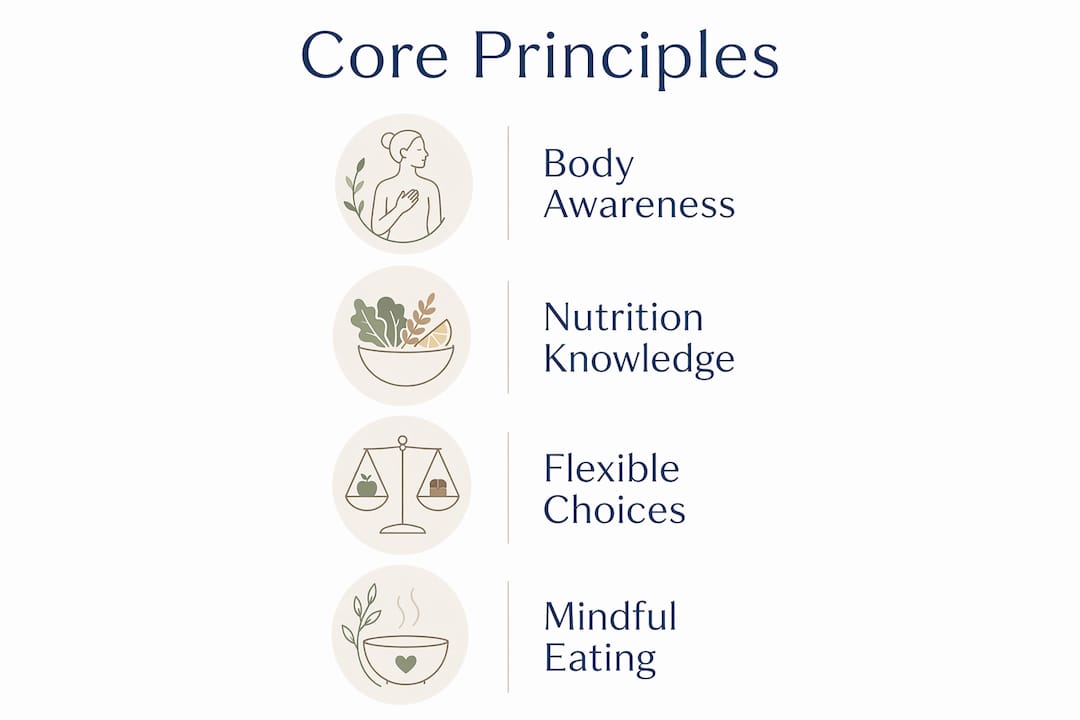
The principles of purposeful nutrition rest on four foundations: body awareness, nutrition knowledge, flexible decision-making, and goal alignment. Each one reinforces the others.
Body awareness means recognising hunger, fullness, and emotional states before reaching for food. Nutrition knowledge means understanding broadly what different foods do, such as which support energy, recovery, or sleep. Flexible decision-making means adapting choices to context rather than following a fixed plan. Goal alignment means connecting each meal to a short-term or long-term outcome.
The benefits of purposeful nutrition are measurable. A 2026 meta-analysis found that mindful eating interventions significantly reduced calorie intake and emotional eating in young people. That finding suggests the same mechanisms apply across age groups: slowing down and paying attention produces real behavioural change.
Practical benefits include:
- Reduced overeating by recognising fullness before it becomes discomfort
- Lower emotional eating through awareness of stress versus hunger cues
- Sustained energy across the day by matching food choices to activity demands
- Improved digestion through slower, more thorough eating
- Greater food enjoyment by removing guilt and rigidity from mealtimes
Pro Tip: Slow your eating pace deliberately. Fullness signals take about 20 minutes to reach the brain, so finishing a meal in under 20 minutes almost guarantees you will eat past the point of satisfaction.
How does purposeful nutrition differ from intuitive and mindful eating?
These three approaches overlap significantly, but each has a distinct focus. Understanding the differences helps you choose the right tool for your situation.
Intuitive eating, developed by dietitians Evelyn Tribole and Elyse Resch, centres on rejecting diet culture and rebuilding trust with the body. It is primarily a healing framework, particularly useful for people recovering from disordered eating or chronic dieting. Mindful eating focuses on the sensory experience of food: taste, texture, pace, and presence at the table. It is a practice rooted in mindfulness meditation traditions. Purposeful nutrition adds a third layer: goal orientation. It asks not just “how does this food feel?” but “what is this food doing for me right now?”
| Approach | Primary focus | Key tool | Best suited for |
|---|---|---|---|
| Intuitive eating | Body trust and diet culture rejection | Hunger and fullness scale | Recovery from restriction |
| Mindful eating | Sensory presence during meals | Slow, attentive eating | Stress eating and pace issues |
| Purposeful nutrition | Goal-aligned, flexible food choices | Interoceptive cue checks | Active health and wellness goals |
Purposeful nutrition suits people who want some structure without rigidity. It works well alongside a mindful breakfast practice or a wholefood-centred diet. It does not replace intuitive eating for those who need to heal their relationship with food first.
How can you practise purposeful nutrition in daily meals?
Applying purposeful nutrition does not require a nutritionist or a meal plan app. It requires a short pause before each meal and a simple question: “What do I need from this food right now?”
Here is a practical four-step process you can start today:
- Set a meal intention. Before eating, identify one short-term purpose for the meal. Examples include sustained energy for a long afternoon, recovery after exercise, or calm focus before a meeting. This takes ten seconds and reframes the entire eating experience.
- Run an interoceptive check. Ask yourself: “Am I physically hungry, or am I stressed, bored, or tired?” This single question, drawn from intentional eating research, separates genuine hunger from emotional eating triggers.
- Slow your pace. Put your fork down between bites. Chew thoroughly. Experts note that thorough chewing prevents bloating and supports nutrient absorption. Aim for at least 20 minutes per main meal.
- Adjust for context. On a high-activity day, prioritise carbohydrates before exercise and protein afterwards. On a rest day, lighter meals with quality fats and vegetables serve the body better. Flexibility is the point.
A 2025 study found that 14 days of attention training focused on internal and sensory food cues significantly reduced desire-driven unhealthy snacking. Two weeks of consistent practice is enough to begin rewiring eating habits.
Pro Tip: Avoid turning purposeful nutrition into another set of rules. The goal is awareness, not perfection. If you eat a biscuit without a “purpose,” that is fine. Rigidity is the enemy of sustainability.
What are purposeful nutrition examples in real meals?
Purposeful nutrition examples make the concept concrete. The principle is simple: match the nutritional content of a meal to the function you need it to serve.

Here are real-world examples across different contexts:
Before a workout: A meal or snack containing complex carbohydrates provides readily available fuel. Adding omega-3-rich foods such as walnuts or flaxseed supports recovery and inflammation reduction after training.
After a workout: Protein is the priority. A post-exercise meal built around eggs, legumes, or a quality nut butter on wholegrain bread begins muscle repair within the critical recovery window.
Before sleep: Foods containing tryptophan, such as pumpkin seeds or turkey, support serotonin and melatonin production. Magnesium-rich foods like almonds and dark leafy greens promote muscular relaxation.
On a sedentary day: Lighter meals with more vegetables, quality fats, and moderate protein match lower energy demands without excess. This is purposeful nutrition in its simplest form: less fuel when less is needed.
| Meal context | Key nutrient focus | Example foods |
|---|---|---|
| Pre-workout | Complex carbohydrates, omega-3s | Oats, walnuts, flaxseed |
| Post-workout | Protein, electrolytes | Eggs, nut butter, legumes |
| Pre-sleep | Tryptophan, magnesium | Pumpkin seeds, almonds, dark greens |
| Rest day | Quality fats, fibre, vegetables | Avocado, leafy greens, seeds |
The point is not to follow this table rigidly. It is to develop the habit of asking “what does today require?” before building a meal. Over time, that question becomes automatic. You can read more about nutrient-dense food choices to deepen your understanding of which foods serve which functions.
What does the science say about purposeful nutrition?
The research base for purposeful and mindful eating has grown considerably in recent years. The findings consistently support the same conclusion: attention changes behaviour.
A 2026 meta-analysis demonstrated that mindful eating interventions produced a meaningful reduction in calorie intake and a statistically significant drop in emotional eating. The result was not marginal. It shows that structured attention to eating behaviour produces measurable dietary change without restriction.
“Repeated attention training to internal and external food cues over two weeks reduces desire-driven eating better than willpower alone.” — 2025 Attention Training Study
The physiology supports this too. Satiety signals take approximately 20 minutes to travel from the gut to the brain. Eating quickly bypasses this feedback loop entirely. Slowing down is not a soft suggestion. It is a physiological necessity for accurate hunger regulation.
Columbia University’s nutrition resources confirm that mindful eating supports cravings management and improves diet quality over time. The Institute for Functional Medicine adds that personalised nutrition interventions can address chronic disease risk by targeting individual dietary triggers rather than applying blanket guidelines. Together, these sources make a strong case for purposeful nutrition as a practical, evidence-backed approach to long-term wellness.
Key takeaways
Purposeful nutrition works because it replaces rigid rules with body awareness, goal alignment, and flexible food choices grounded in evidence.
| Point | Details |
|---|---|
| Definition is clear | Purposeful nutrition means eating with intention, guided by body cues and personal health goals. |
| Science backs it | Mindful eating reduces calorie intake and emotional eating; attention training cuts desire-driven snacking in two weeks. |
| Pace is critical | Fullness signals take 20 minutes to reach the brain; eating slowly prevents overeating. |
| Examples are practical | Match meals to context: carbs before activity, protein after, tryptophan-rich foods before sleep. |
| Flexibility is the point | Purposeful nutrition fails when it becomes rigid; awareness and enjoyment must coexist. |
Why I think most people are one question away from eating better
People spend enormous energy searching for the perfect diet. They read about intermittent fasting, low-carb protocols, and elimination plans. What they rarely do is pause before a meal and ask: “What do I actually need right now?”
That question is the entire practice. Not a supplement stack. Not a macro calculator. Just a moment of honest self-enquiry before eating.
What I have observed, both personally and in watching others apply these principles, is that the biggest barrier is not knowledge. Most people aged 25–45 know roughly what constitutes a nutritious meal. The barrier is the automatic, distracted, emotionally-driven eating that fills the gap between knowing and doing.
The research on attention training confirms this. Two weeks of practising interoceptive awareness before meals produces measurable change. That is a remarkably short window for a habit shift. The problem is that most people expect transformation to feel dramatic. It does not. It feels like pausing for ten seconds before you eat.
The other pitfall I see regularly is perfectionism creeping in. People start purposeful nutrition with genuine curiosity, then gradually turn it into another system of rules. They obsess over nutrient timing, feel guilty for eating off-plan, and eventually abandon the whole approach. The antidote is to treat every meal as a fresh start, not a performance review.
Start with one meal a day. Set one intention. Ask one question. That is enough.
— Jarrod
Granavitalis and the foods that support purposeful eating
Purposeful nutrition requires ingredients that actually do what you need them to do. That means nutrient-dense, minimally processed foods with clear functional value.

Granavitalis sources premium nuts, seeds, and ancient grains precisely because they fit this brief. A spoonful of organic pecan butter before a long morning delivers quality fats and sustained energy without a sugar spike. The nut and seed butter selection box gives you variety across different meal contexts, from pre-workout fuel to a mindful evening snack. Every product in the Granavitalis range is chosen to serve a real nutritional purpose, not just to fill a shelf. That is purposeful nutrition made practical.
FAQ
What is the simplest definition of purposeful nutrition?
Purposeful nutrition means eating with intention, choosing foods based on your body’s signals and personal health goals rather than following a rigid diet plan.
How does purposeful nutrition differ from a diet?
A diet imposes external rules about what you can and cannot eat. Purposeful nutrition builds internal awareness so you make flexible, goal-aligned choices based on how you feel and what you need.
How long does it take to see results from purposeful nutrition?
A 2025 study found that 14 days of consistent attention training reduced desire-driven snacking. Meaningful habit change is possible within two weeks of regular practice.
What are good purposeful nutrition examples for beginners?
Start by setting one meal intention per day, such as “this meal is for sustained afternoon energy,” then choose foods that match that goal, like complex carbohydrates and quality protein.
Is purposeful nutrition backed by science?
Yes. A 2026 meta-analysis showed mindful eating interventions significantly reduced calorie intake and emotional eating. Research from the Institute for Functional Medicine also supports personalised, goal-directed nutrition as a tool for chronic disease prevention.