
What grains can coeliacs eat? A UK guide
TL;DR:
- Coeliacs must avoid wheat, barley, and rye, including all their derivatives, and only consume products labeled ‘gluten-free’ with levels at or below 20 ppm. Naturally gluten-free grains such as rice, maize, quinoa, and millet are safe, but oats require a ‘gluten-free’ label and testing due to contamination risks. Strict adherence to a gluten-free diet and proper label reading are essential to prevent health complications from cross-contamination.
Coeliacs must avoid wheat (including spelt, kamut, durum, semolina, einkorn, emmer, farro and triticale), barley, and rye. The grains that are safe are rice, maize/corn, quinoa, millet, sorghum, buckwheat, teff, amaranth, tapioca/cassava, potato, and legume or nut flours. Coeliac UK and the NHS both confirm this list, and the UK legal threshold for a product to carry the ‘gluten-free’ label is ≤20 parts per million (ppm) of gluten.
The short version: avoid wheat, barley, rye and all their derivatives. Choose products labelled ‘gluten-free’. For oats, only those explicitly labelled ‘gluten-free’ and tested to ≤20 ppm are safe for most people with coeliac disease.
A few quick rules before you read further:
- Always read the ingredient list, not just the front of pack.
- ‘Wheat-free’ does not mean ‘gluten-free’.
- Oats need their own label check (more on this below).
- When in doubt, contact the manufacturer or use Coeliac UK’s Food Information Service.
Table of Contents
- Which grains must coeliacs avoid?
- Which grains and flours are naturally gluten-free?
- Are oats safe for coeliacs?
- How to avoid cross-contamination and read UK labels correctly
- Why lifelong strict avoidance matters, and when to involve a clinician
- Practical swaps for replacing gluten-containing grains
- Key takeaways
- The case for knowing your grain, not just your label
- Granavitalis: gluten-free grains and nut products worth checking
- Trusted UK sources for further reading
Which grains must coeliacs avoid?
The three primary gluten sources are wheat, barley, and rye. Each comes with a long list of aliases and derivatives that appear on ingredient labels under names that don’t always shout “gluten.”
Wheat and its varieties:
- Spelt, farro, durum, semolina, einkorn, emmer, kamut, triticale
- Bulgur wheat, couscous (both are wheat products, not separate grains)
- Hydrolysed wheat protein (found in some sauces and processed foods)
- Wheat starch — only safe if the finished product is explicitly labelled gluten-free
Barley and its derivatives:
- Pearl barley, pot barley, barley flakes
- Malt, malt extract, malted barley — a hidden source of gluten found in some breakfast cereals, flavourings, and sauces
- Barley malt extract appears in many products where you wouldn’t expect it: certain crisps, malted drinks, and some chocolate bars
Rye:
- Rye flour, rye bread, rye crispbreads
- Triticale (a wheat-rye hybrid) sits in both categories
One label trap catches people repeatedly: ‘wheat-free’ is not the same as ‘gluten-free.’ A product can be wheat-free and still contain barley malt extract or rye flour. Only the explicit ‘gluten-free’ label, backed by testing to ≤20 ppm, confirms safety for a coeliac diet.
Which grains and flours are naturally gluten-free?
Rice, maize, potatoes, pulses, nuts and seeds are naturally gluten-free, and a wide range of gluten-free flours are available for cooking and baking. The table below covers the most commonly used options.
| Grain / Flour | Typical uses | Label / processing note |
|---|---|---|
| Rice (white and brown) | Risotto, rice flour for baking, rice noodles, porridge | Brown rice is a wholegrain choice; check rice flour is labelled gluten-free |
| Maize / corn / polenta | Polenta, cornmeal, corn tortillas, popcorn, corn pasta | Usually safe; check flavoured products for added malt |
| Buckwheat | Soba noodles (check label), pancakes, porridge, flour blends | Despite the name, not related to wheat; cross-contamination risk in some mills |
| Quinoa | Salads, grain bowls, flour for baking, porridge | High protein; buy labelled gluten-free to avoid mill contamination |
| Millet | Flatbreads, porridge, flour blends | Mild flavour; good fibre source |
| Sorghum | Flour for bread and wraps, grain bowls | Naturally gluten-free; recommended by Coeliac UK as a wholegrain |
| Teff | Injera flatbread, porridge, flour blends | High in iron and fibre; buy from dedicated gluten-free suppliers |
| Amaranth | Flour for baking, puffed grain, porridge | Nutritionally dense; Coeliac UK lists it as a recommended wholegrain |
| Tapioca / cassava | Thickening sauces, flatbreads, boba, flour blends | Derived from cassava root; naturally gluten-free |
| Potato / potato starch | Thickening, gnocchi, potato flour in baking | Naturally gluten-free; potato starch is a useful binder |
| Gram / chickpea flour | Savoury batters, flatbreads, pakoras | High protein; naturally gluten-free |
| Nut flours (almond, hazelnut, coconut) | Cakes, biscuits, pastry | Naturally gluten-free; check for shared-facility warnings |
Fibre matters. Switching to a gluten-free diet can reduce fibre intake if refined white rice and corn starch replace wholegrain foods. Coeliac UK specifically recommends gluten-free wholegrains such as brown rice, amaranth, millet, quinoa, sorghum and teff to maintain adequate fibre. Choosing these over refined alternatives is worth the habit.
For a deeper look at which grains naturally contain gluten and which don’t, the Granavitalis guide to gluten in grains covers the science behind the distinction.
Are oats safe for coeliacs?
Oats are the most misunderstood food in a coeliac diet. The short answer: standard oats are not safe. Oats labelled ‘gluten-free’ usually are, for most people.
Oats do not naturally contain gluten. The problem is contamination. Standard oats are frequently processed in the same facilities as wheat, barley and rye, which means the finished product can carry gluten at levels that cause intestinal damage in coeliacs. Specialist manufacturers grow and mill oats in dedicated supply chains and test every batch to confirm levels at or below 20 ppm. Those are the only oats worth buying.
Coeliac UK’s position (November 2024): Only oats explicitly labelled ‘gluten-free’ and tested to ≤20 ppm are considered safe for most people with coeliac disease in the UK. Standard oats, even those marketed as ‘pure’ or ‘uncontaminated’, should not be assumed safe without that label and test evidence.
There is a second complication. A small subset of people with coeliac disease react not to contamination but to avenin, an oat protein structurally similar to gluten. NHS guidance acknowledges this and advises clinical supervision when introducing oats into a coeliac diet. If you add certified gluten-free oats and symptoms return, stop and speak to your gastroenterologist or dietitian.
Practical steps for oats:
- Only buy oats with a ‘gluten-free’ label tested to ≤20 ppm.
- Introduce them gradually and under clinician guidance.
- Use Coeliac UK’s Food Information Service to check specific brands.
- If symptoms appear after eating certified oats, seek clinical review for possible avenin sensitivity.
How to avoid cross-contamination and read UK labels correctly
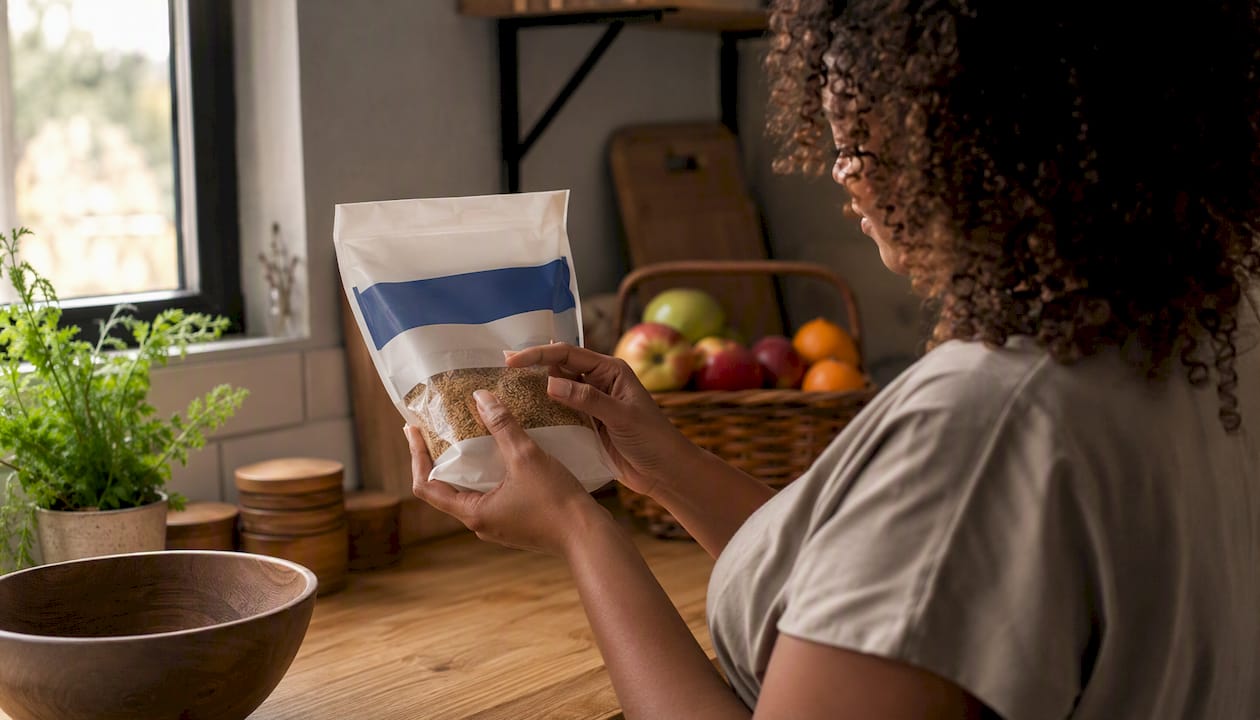
A grain can be naturally gluten-free and still cause a reaction if it has been processed alongside gluten-containing cereals. Cross-contamination is the most common reason coeliacs continue to experience symptoms despite following a gluten-free diet.
Where contamination happens
Contamination can occur at every stage: shared harvesting equipment in the field, shared milling facilities, shared factory lines, and in your own kitchen. Household appliances are a real risk: a shared toaster, a deep fryer used for battered fish, or a colander that has held wheat pasta can transfer enough gluten to trigger damage. Practical steps at home:
- Keep a dedicated toaster for gluten-free bread.
- Use separate chopping boards, colanders, and wooden utensils.
- Store gluten-free flours and grains in sealed, clearly labelled containers, away from wheat flour.
- Clean shared surfaces thoroughly before preparing gluten-free food.
Reading UK labels
Under UK food law, a product labelled ‘gluten-free’ must contain 20 ppm or less of gluten. That threshold is the same standard that applied under EU law before Brexit and remains in force. The Crossed Grain symbol (a registered Coeliac UK trademark) indicates the product has been independently assessed and meets this standard.
‘May contain’ statements are a different matter. These precautionary allergen labels are voluntary and unregulated, meaning manufacturers use them inconsistently. Some products with a ‘may contain wheat’ warning are produced in facilities with rigorous controls; others are not. When the risk is unacceptable, contact the manufacturer directly and ask about their testing protocols and facility segregation.
Shopper checklist:
- Look for ‘gluten-free’ on the label (≤20 ppm confirmed by testing).
- Check for the Crossed Grain symbol where present.
- Scan the ingredient list for barley, malt, malt extract, rye, wheat, spelt, or kamut.
- Treat ‘may contain’ warnings seriously if your sensitivity is high; contact the manufacturer for specifics.
- Prefer brands that operate dedicated gluten-free production facilities.
Pro Tip: When buying loose grains or flours from bulk bins or market stalls, the risk of cross-contamination is high and there is no label to check. Stick to pre-packaged products with a clear ‘gluten-free’ declaration for anything you plan to use regularly.
NICE guidance is clear that strict lifelong adherence to a gluten-free diet is required for histological and clinical recovery. Even small, repeated exposures can prevent the intestinal lining from healing fully.
Why lifelong strict avoidance matters, and when to involve a clinician
The gluten-free diet is not a preference for people with coeliac disease. It is the only effective treatment. NICE guidance recommends lifelong adherence and regular assessments to monitor both clinical symptoms and histological recovery (the state of the intestinal lining). There is no medication that replaces dietary management.
Untreated or poorly managed coeliac disease carries real consequences beyond digestive symptoms. Persistent intestinal damage can reduce the absorption of iron, calcium, and B vitamins. Some patients also develop secondary lactose intolerance because damage to the intestinal mucosa reduces lactase activity, which can cause overlapping symptoms that complicate dietary management and warrant clinical follow-up.
When to involve your GP, gastroenterologist, or dietitian:
- At diagnosis: ask for a referral to a registered dietitian with coeliac experience.
- If symptoms persist despite following a strict gluten-free diet.
- If you develop new symptoms (bloating, fatigue, anaemia) after a period of stability.
- Annually: Coeliac UK and NHS guidance recommend regular review appointments to monitor nutritional status and dietary adherence.
- Before introducing oats: get clinical sign-off first.
Keeping a food diary is one of the most practical tools available. It helps identify accidental exposures, patterns in symptoms, and foods that may be causing problems beyond gluten. Coeliac UK’s Food Information Service is a reliable resource for checking specific products between appointments.
Practical swaps for replacing gluten-containing grains
Replacing wheat in everyday cooking is more straightforward than it looks once you know which substitutes behave similarly.
Direct swaps:
- Pasta: rice pasta or buckwheat pasta for durum wheat pasta. Corn pasta holds its shape well in baked dishes.
- Semolina: polenta or fine cornmeal works in similar savoury preparations; the texture differs slightly but the result is satisfying.
- Savoury batters: gram (chickpea) flour produces a crisp, flavourful batter for fritters and pakoras. It needs no blending with other flours.
- Thickening sauces and gravies: tapioca starch or potato starch instead of plain flour. Use roughly half the quantity, as both thicken more efficiently.
- Porridge: certified gluten-free oats, or buckwheat flakes, or millet flakes cooked with milk or water.
Baking with gluten-free flours:
Single gluten-free flours rarely replicate wheat flour on their own. Blending works better. A common starting point is two parts rice flour, one part gram flour, and one part tapioca starch. This combination gives structure (rice), protein (gram), and elasticity (tapioca). For bread and cakes, xanthan gum (typically ¼ teaspoon per 150g of flour) helps bind the mixture and trap air. Gluten-free batters often need more liquid and a longer rest before baking.
For detailed substitution ratios and recipe guidance, the Granavitalis flour substitution guide is a practical reference.
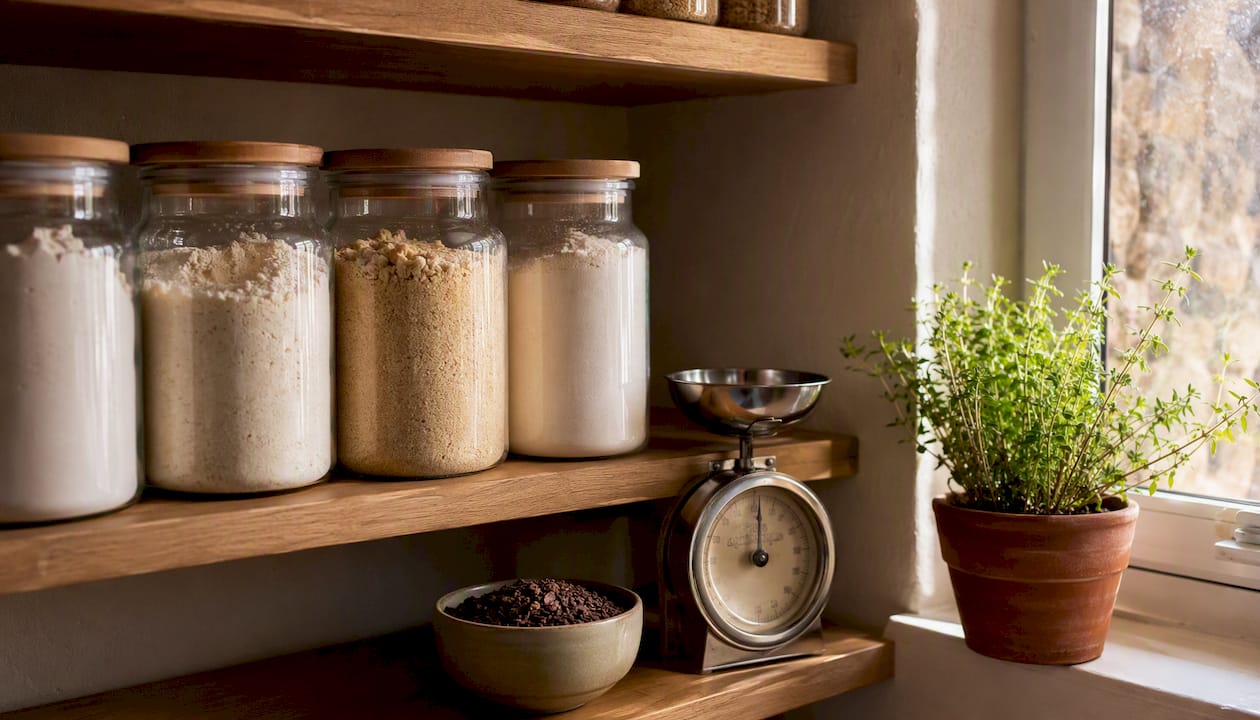
Storage: keep gluten-free flours in airtight containers, clearly labelled, and stored away from any wheat flour in the kitchen. Most nut and legume flours have a shorter shelf life than wheat flour and benefit from refrigeration once opened.
Key takeaways
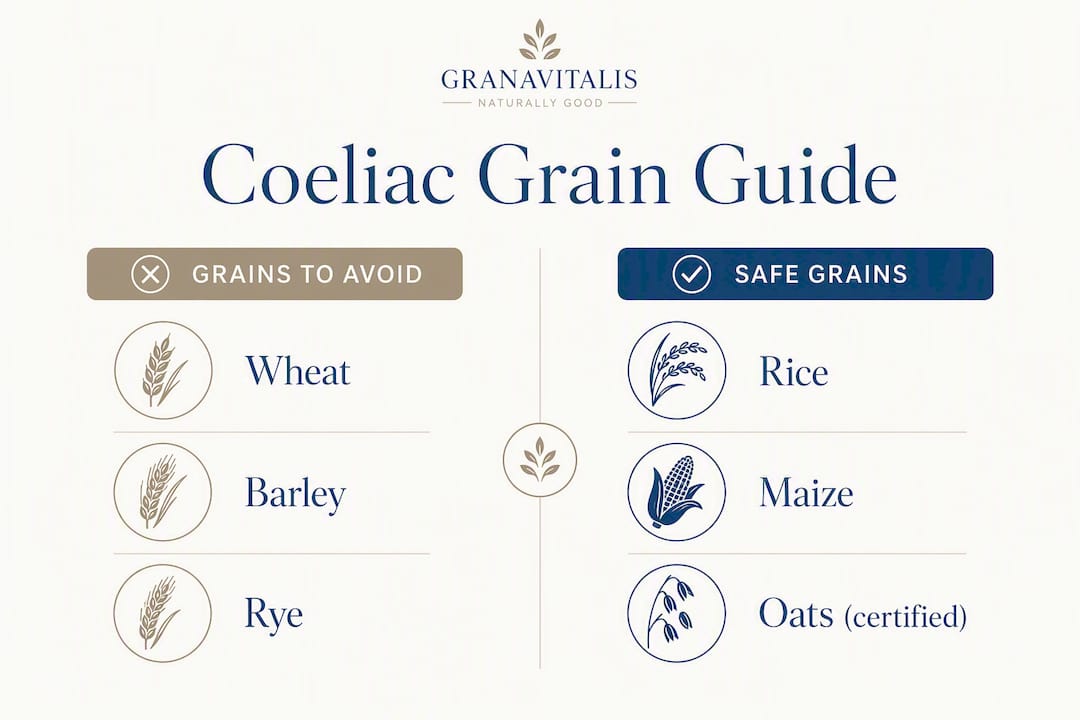
Coeliacs must avoid wheat, barley, rye and all derivatives, and choose only products labelled ‘gluten-free’ (≤20 ppm) for safe grain consumption.
| Point | Details |
|---|---|
| Grains to avoid | Wheat (all varieties), barley, rye and derivatives including malt, spelt, kamut, triticale, couscous and bulgur. |
| Safe gluten-free grains | Rice, maize, quinoa, millet, sorghum, buckwheat, teff, amaranth, tapioca, potato, gram and nut flours are all naturally gluten-free. |
| Oats need a label check | Only oats labelled ‘gluten-free’ and tested to ≤20 ppm are safe; introduce under clinician guidance due to avenin sensitivity risk. |
| UK labelling standard | ‘Gluten-free’ on a UK label means the product has been tested to ≤20 ppm; ‘wheat-free’ does not carry the same guarantee. |
| Granavitalis range | Granavitalis sources ancient and naturally gluten-free grains and nut-based products; always check individual product labels and contact the manufacturer to confirm certified gluten-free status. |
The case for knowing your grain, not just your label
Most people newly diagnosed with coeliac disease focus on what they can’t eat. That’s understandable. But the more useful shift is learning which grains are genuinely worth eating, not just which ones are technically permitted.
The gluten-free market has expanded enormously, and a lot of what fills the shelves is refined, low-fibre, and nutritionally thin. Processed gluten-free bread made primarily from tapioca starch and rice flour is safe, but it is not nourishing in the way that brown rice, quinoa, or teff can be. The ancient grains that Granavitalis is built around, such as teff, amaranth, and sorghum, were staple foods long before industrial wheat dominated the food supply. They are not novelty health foods. They are genuinely nutrient-dense, naturally gluten-free, and far more interesting to cook with than most people expect.
There is also a tendency to treat ‘gluten-free’ certification as the end of the story. It isn’t. The 20 ppm threshold is clinically appropriate for most coeliacs, but the quality of the supply chain behind that label varies considerably. A dedicated gluten-free facility with rigorous batch testing is meaningfully different from a shared facility that tests the finished product. Asking manufacturers about their process is not overcautious. It is exactly the right question.
The oat situation is the clearest example of why the label alone is not enough. Certified gluten-free oats are safe for most coeliacs, but a minority react to avenin regardless of contamination levels. That distinction matters clinically and practically, and no label tells you which group you’re in. Your dietitian does.
Granavitalis: gluten-free grains and nut products worth checking
If you are building a gluten-free pantry from scratch, the hardest part is usually finding products you can trust without spending an hour on every label. Granavitalis sources ancient grains, nut butters, and seed-based products with purity and traceability at the centre of every decision. That means minimal processing, transparent sourcing, and products selected for genuine nutritional value rather than shelf appeal.
For readers looking for safe, naturally gluten-free pantry staples, the Granavitalis organic nut and seed butter selection is a practical starting point: no gluten-containing grains, no unnecessary additives, and a range of flavours that work across breakfasts, snacks, and cooking. As with any product, check the label and contact Granavitalis directly if you need confirmation of certified gluten-free status for your specific dietary needs. This is general nutritional information, not medical advice; always confirm suitability with your clinician or dietitian.
Browse the full range at granavitalis.com and use the product pages to check ingredients and sourcing details before you buy.
Trusted UK sources for further reading
These are the primary resources to consult for product checks, clinical guidance, and up-to-date dietary information:
- Coeliac UK — the leading UK charity for coeliac disease; their Food Information Service provides tested product lists, oat brand guidance, and a searchable database of safe foods. Their November 2024 factsheets on oats and wholegrains are particularly useful.
- NHS: Coeliac Disease Treatment — clear patient information on the gluten-free diet, oat guidance, and when to seek clinical review.
- NICE Guideline NG20 — the clinical guideline for coeliac disease recognition, assessment and management; the authoritative reference for healthcare professionals and informed patients.
- Frimley Health NHS Foundation Trust: Gluten-Free Diet — a practical patient leaflet covering allowed and avoided foods with clear tables.
- Kent Community Health NHS Foundation Trust: Gluten-Free Diet Leaflet — covers cross-contamination risks and household safety measures in accessible language.
For product-specific queries, Coeliac UK’s Food Information Service is the most reliable first stop before contacting a manufacturer directly.