
What defines natural food sourcing: a clear 2026 guide
TL;DR:
- Natural food sourcing emphasizes minimally processed ingredients free from synthetic additives, but the term is loosely regulated. Consumers should check ingredient lists for whole, recognizable foods and avoid synthetic flavours, preservatives, and refined additives to identify genuinely natural products. Labels claiming “natural” often mislead, so third-party certifications like USDA Organic or Fair Trade provide more reliable guarantees.
Natural food sourcing is defined as obtaining ingredients that are minimally processed and free from synthetic additives, prioritising ingredient purity above all else. The term sits at the centre of a growing consumer movement, yet what defines natural food sourcing is far less regulated than most shoppers assume. The FDA holds no formal regulatory definition for “natural” on packaged food labels, relying instead on an informal policy focused on minimal processing and the absence of synthetic additives. Understanding this gap is the first step to making genuinely informed food choices.
What criteria determine if food is naturally sourced?
The core criteria for natural food sourcing centre on two pillars: minimal processing and the absence of synthetic ingredients. Minimal processing means physical methods only, such as grinding, drying, cutting, or fermenting. It excludes chemical extraction, artificial preservation, or industrial refining.
The USDA applies a strict definition for meat, poultry, and egg products, requiring no artificial ingredients and only minimal processing. Outside those categories, no equivalent government standard exists for packaged foods. That absence gives brands considerable freedom to use the word “natural” on labels without meeting any formal benchmark.
The practical criteria consumers should look for include:
- No synthetic flavours or colours. Artificial dyes and lab-made flavour compounds disqualify a product from any credible natural claim.
- No synthetic preservatives. Ingredients like sodium benzoate, BHA, or BHT signal industrial processing.
- No refined additives. Emulsifiers, stabilisers, and modified starches are common in products still marketed as natural.
- Whole or recognisable ingredients. Each item on the label should be something you could find in a kitchen or a field.
- Short ingredient lists. Genuinely natural products rarely need more than a handful of ingredients.
The ingredient list is the most reliable document on any food package. Front-of-pack claims are marketing. The back panel is evidence.
Pro Tip: Scan the ingredient list for anything ending in “-ate”, “-ite”, or “-ose” beyond naturally occurring sugars. These suffixes frequently signal synthetic additives or heavily refined compounds that undermine a natural claim.
Understanding minimal processing nutrition in depth helps you apply these criteria with confidence rather than guesswork.
How do consumer perceptions align with reality on natural labelling?
Consumer trust in “natural” labelling is high, but that trust is largely misplaced. 86% of consumers incorrectly believe “natural” guarantees zero artificial ingredients, and 63% actively prefer products labelled natural despite the marketing ambiguity behind the term. That gap between perception and reality is exactly what food marketers exploit.
Three common misconceptions drive most of the confusion:
- “Natural flavours” are simple. The FDA definition of natural flavour includes chemically processed extracts derived from plant or animal sources. A “natural strawberry flavour” may involve dozens of processing steps and bear little resemblance to an actual strawberry.
- “Natural sugars” are unprocessed. Cane sugar, coconut sugar, and agave syrup are all marketed as natural. Each undergoes significant industrial processing before it reaches a product.
- “Natural” implies sustainability. The word says nothing about how a crop was grown, whether workers were fairly paid, or what the environmental footprint of production looks like.
“Natural labelling can be misleading. The term is largely a marketing construct; brands can label heavily processed foods as natural if they avoid specific artificial ingredients per FDA informal policy.”
The result is a market where the word “natural” functions as a reassurance signal rather than a factual guarantee. Consumers who rely on front-of-pack claims alone are making decisions based on marketing, not evidence. Reading labels critically, particularly the ingredient list, is the only reliable counter to this.
What distinguishes natural sourcing from organic and sustainable sourcing?
Natural, organic, and sustainable sourcing are three distinct concepts that the food industry frequently conflates. Each operates under different rules, different oversight, and different guarantees.
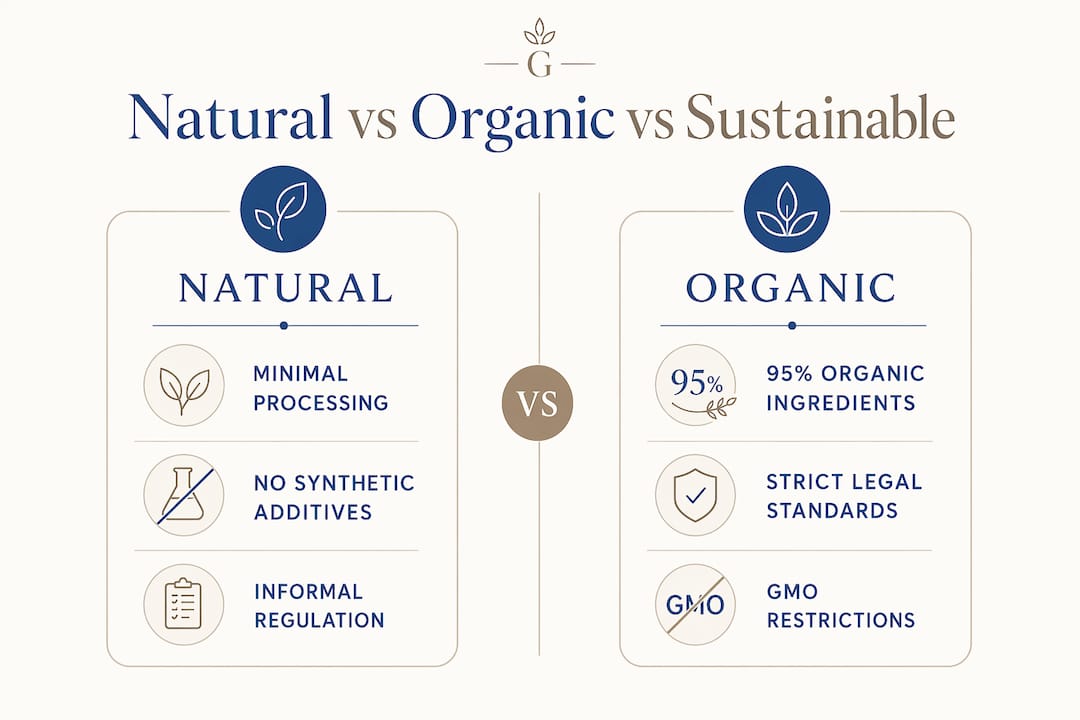
Organic is a process claim with legal teeth. Organic labelling requires at least 95% organic ingredients and compliance with strict USDA standards. Those standards restrict synthetic pesticides, prohibit GMOs, and mandate specific farming practices. Organic certification is audited and renewed. A product either meets the standard or it does not.
Natural carries no equivalent legal weight outside the USDA’s meat and poultry categories. A brand can call a product natural without any third-party verification, without restricting GMO use, and without any commitment to farming practices.
Sustainable sourcing goes further than either term. Sustainable sourcing involves environmental, social, and economic responsibility, including fair labour practices, biodiversity conservation, and carbon footprint reduction. It is a systemic commitment, not a single ingredient claim.
| Criteria | Natural | Organic | Sustainable |
|---|---|---|---|
| Regulated standard | Informal (FDA) or USDA meat/poultry only | USDA certified, legally enforced | No single standard; varies by scheme |
| GMO restriction | No | Yes | Depends on certification |
| Synthetic pesticide restriction | No | Yes | Often yes |
| Third-party audit required | No | Yes | Yes (Fair Trade, Rainforest Alliance) |
| Environmental commitment | No | Partial | Yes |
| Labour standards | No | No | Yes (Fair Trade) |
Natural food sourcing prioritises ingredient purity but does not guarantee sustainable farming, ethical labour, or environmental protection. Those assurances require separate certifications.
Pro Tip: When you want genuine sustainability credentials, look for third-party marks such as USDA Organic, Fair Trade, or Rainforest Alliance. These certifications require transparent supply chain practices and independent audits, unlike the word “natural” alone.
For a fuller picture of how these principles connect, the Granavitalis guide to sustainable nutrition explains how ingredient integrity and environmental responsibility work together.
How can you practically identify and choose natural foods?
Choosing genuinely natural foods requires reading past the front of the pack and into the detail. The ingredient list, the nutrition panel, and any certifications present are your three tools.

Start with the first three to five ingredients. Reading the first three to five ingredients by weight gives the clearest picture of what a product actually is. If refined sugar, a syrup, or a gum appears in the top five, the product is more processed than its label suggests. Whole foods, nuts, seeds, grains, and legumes should dominate that list.
Check the nutrition panel for processing signals. Added sugar, fibre, and protein content reveal the real processing level. A product with high added sugar and low fibre has been significantly refined, regardless of what the front label claims. Wholegrain or nut-based products typically show meaningful fibre and balanced macronutrients.
Look for certifications, not just claims. Credible sustainability claims require transparent third-party audits rather than vague marketing language. USDA Organic, Fair Trade, and Rainforest Alliance each require documented supply chain practices.
Use QR codes and product websites. Many brands now offer traceability information online. A brand that publishes its sourcing origins, farming partners, and processing methods is demonstrating the transparency that the word “natural” alone cannot provide.
| What to check | What to look for | Red flag |
|---|---|---|
| First 3–5 ingredients | Whole foods, nuts, seeds, grains | Refined sugars, syrups, gums |
| Nutrition panel | Fibre present, low added sugar | High added sugar, zero fibre |
| Certifications | USDA Organic, Fair Trade | No third-party mark |
| Ingredient list length | Short, recognisable items | Long list with chemical names |
| Brand transparency | Sourcing info published | No origin or supply chain detail |
Understanding nutrient integrity in food choices gives you the analytical framework to apply these checks consistently.
Key takeaways
Natural food sourcing means minimal processing and no synthetic additives, but without formal regulation, the term requires consumer scrutiny of ingredient lists and third-party certifications to carry real meaning.
| Point | Details |
|---|---|
| No formal regulation for “natural” | The FDA uses only an informal policy; USDA rules apply to meat and poultry only. |
| Ingredient list over front-of-pack claims | The first three to five ingredients by weight reveal true processing levels. |
| Natural does not mean organic or sustainable | Organic requires USDA certification; sustainability requires Fair Trade or equivalent audits. |
| “Natural flavours” can be complex | FDA rules allow chemically processed extracts to carry the “natural” label. |
| Certifications are the reliable signal | USDA Organic, Fair Trade, and Rainforest Alliance provide audited, enforceable guarantees. |
The word “natural” is doing a lot of heavy lifting
I have spent years reading food labels, and the single most consistent pattern I have noticed is this: the louder a brand shouts “natural” on the front of a pack, the more carefully you need to read the back. That is not cynicism. It is a pattern backed by how labelling regulation actually works.
The word “natural” in 2026 is more marketing signal than factual guarantee. Brands use it because greenwashing is common and vague language is rarely challenged. Consumers respond to it emotionally, and that emotional response is worth money. The result is a market where the term has been stretched so far it barely means anything.
What I find genuinely useful is treating “natural” as a prompt to investigate, not a conclusion. When I see it on a label, I flip the pack over immediately. I check the first five ingredients. I look for a certification mark. I ask whether the brand publishes anything about where its ingredients come from. Most of the time, that thirty-second check tells me everything the front label was designed to obscure.
The deeper issue is that natural sourcing and sustainable sourcing are not the same thing, and conflating them does real harm. A product can be free of artificial additives and still rely on exploitative labour, monoculture farming, or high-carbon logistics. True food integrity requires both ingredient purity and supply chain accountability. Consumers deserve labelling standards that reflect that complexity, not marketing shorthand that papers over it.
— Jarrod
Granavitalis: natural sourcing you can actually verify
Knowing what natural food sourcing should mean is one thing. Finding products that live up to it is another.
Granavitalis builds its range around the principles this article describes: minimal processing, recognisable ingredients, and transparent sourcing. The Raw Organic Pecan Butter is a single-origin product with certified organic credentials and no additives beyond the nut itself. The Organic Nut & Seed Butter Selection Box brings together a range of butters that meet the same standard, each with third-party organic certification and a short, auditable ingredient list. When Granavitalis says natural, there is a certification mark and a supply chain behind it.
FAQ
What does “natural” mean on a food label?
“Natural” on most food labels refers to an informal FDA policy requiring minimal processing and no synthetic additives. Outside USDA-regulated meat and poultry categories, no formal legal standard enforces the claim.
Is natural food the same as organic food?
Natural and organic are not the same. Organic certification requires at least 95% organic ingredients, restricts GMOs and synthetic pesticides, and demands third-party auditing. Natural labelling carries none of those requirements.
How can I tell if a product is genuinely natural?
Read the first three to five ingredients by weight. Whole foods, nuts, seeds, and grains should dominate the list. Refined sugars, syrups, emulsifiers, or chemical names signal heavy processing regardless of front-of-pack claims.
Does “natural” mean a product is sustainably sourced?
Natural labelling does not guarantee sustainable farming, fair labour, or environmental protection. Certifications such as Fair Trade or Rainforest Alliance are required for those assurances.
Are “natural flavours” actually natural?
Not in the way most consumers expect. The FDA definition of natural flavour permits chemically processed extracts from plant or animal sources, meaning the final compound can be far removed from its original ingredient.