
Nutrient-dense foods: what they mean for your wellness
TL;DR:
- Nutrient density measures beneficial nutrients relative to a food’s calorie content.
- Choosing nutrient-dense foods like ancient grains supports long-term health and weight management.
- Cost and processing level can impact access and the accurate assessment of food’s true nutritional value.
Most of us know we should “eat well,” yet the guidance on what that actually means keeps shifting. Calories in, calories out. Low fat. High protein. The noise is relentless. But one concept quietly underpins genuine, lasting wellness, and it is not a trend: nutrient density, which refers to the amount of beneficial nutrients in a food relative to its energy content. Understanding this single idea can untangle most of the confusion around healthy eating, help you make smarter choices without obsessing over every gram, and explain why two foods with identical calories can have wildly different effects on your body.
Table of Contents
- What nutrient dense truly means
- How nutrient density is measured: systems and scoring
- Nutrient-dense foods vs. ‘empty calorie’ foods: clear differences
- Ancient grains and modern plant-based choices: nutrient density in action
- A fresh perspective: nutrient density beyond the numbers
- Connect with nutrient-dense choices: experience wellness with Granavitalis
- Frequently asked questions
Key Takeaways
| Point | Details |
|---|---|
| Nutrient density defined | Nutrient density measures beneficial nutrients per calorie, not just ingredients or labels. |
| Measurement systems matter | NRF9.3 scoring reveals which foods truly maximise nutrition for wellness. |
| Ancient grains excel | Teff, wild rice, and other ancient grains provide vital protein, fibre, and minerals. |
| Cost is a barrier | Nutrient-dense foods can be expensive, affecting accessibility and routine choices. |
| Balance over single nutrients | Wellness improves when you prioritise overall dietary patterns, not just isolated nutrient scores. |
What nutrient dense truly means
At its core, nutrient density describes how much nutritional value a food delivers relative to the energy or calories it contains. A food that is rich in vitamins, minerals, fibre, and protein for every 100 kilocalories scores high. A food that delivers mostly energy with little else scores low. Simple in theory, but the implications are enormous.
This is a fundamentally different lens from calorie counting. Two foods can contain the same number of calories, yet one might nourish you and the other leave you depleted. Whole almonds and a handful of sweets might both clock in at around 170 calories, but they are nutritionally worlds apart. The almonds supply magnesium, vitamin E, healthy fats, and fibre. The sweets supply sugar and not much else.
For a deeper look at what the nutrient dense definition actually covers, it helps to understand how scoring systems calculate it.
“Maximising nutrition without excess calories is not about eating less. It is about eating smarter, choosing foods where every calorie earns its place at the table.”
Nutrient profiling systems formalise this idea by calculating scores per 100 kcal, with higher scores indicating a better nutrient-to-energy ratio. One widely used approach is the Nutrient Rich Foods Index, known as NRF9.3. It evaluates foods based on nine beneficial nutrients and three nutrients that most people should limit.
The nine beneficial nutrients typically assessed include:
- Protein
- Fibre
- Vitamins A, C, and E
- Calcium
- Iron
- Potassium
- Magnesium
These are balanced against sodium, saturated fat, and added sugars. The resulting score gives a much more honest picture of a food’s value than its calorie count alone, and it explains why nutrient density has become a cornerstone concept for anyone serious about long-term wellness and weight management.
How nutrient density is measured: systems and scoring
The science behind nutrient profiling is more nuanced than a single score might suggest. No universal standard exists for measuring nutrient density. Different systems, including the NRF9.3, the Nutri-Score used across parts of Europe, and various governmental frameworks, each use slightly different criteria, which is why you will find foods ranked differently depending on the source.
The NRF9.3 remains one of the most rigorously researched tools. It works by totalling the percentage of daily values for the nine beneficial nutrients per 100 kcal, then subtracting the percentage contributions of the three nutrients to limit. Foods with higher net scores are considered more nutrient dense.
Here is a simplified example of how common foods compare:
| Food | Protein | Fibre | Vitamins and minerals | NRF9.3 direction |
|---|---|---|---|---|
| Spinach | High | High | Excellent | Very high score |
| Teff grain | High | High | Good | High score |
| Whole oats | Moderate | High | Good | High score |
| White bread | Low | Low | Poor | Low score |
| Fizzy drinks | None | None | None | Very low score |
In terms of regulatory guidance, the FDA “healthy” label requires foods to contribute to healthy dietary patterns, with defined limits on sodium, saturated fat, and added sugars alongside minimum contributions from core food groups. It is a pattern-based approach rather than a pure nutrient score, which reflects a growing understanding that no single food makes or breaks a diet.
Here is how to read the landscape practically:
- Look beyond the front-of-pack claim and check the nutrition panel for the big players: protein, fibre, iron, and calcium.
- Compare per 100g or per 100 kcal rather than per serving, since serving sizes vary wildly.
- Use tools like the NRF9.3 concept as a mental framework, even if you are not calculating exact scores.
- Consider the food’s processing level alongside its nutrient score for a fuller picture.
Pro Tip: A food can be lightly processed and still score poorly on nutrient density. Check the actual nutrient content rather than assuming “less processed” automatically means more nutritious.
To explore how nutrient dense foods explained in practical terms, the key is understanding what you are comparing and why.
Nutrient-dense foods vs. ‘empty calorie’ foods: clear differences
The phrase “empty calories” gets thrown around a lot, but it is worth pinning down. Nutrient-dense foods include fruits, vegetables, whole grains, lean proteins, nuts, and seeds. Their counterparts, the so-called empty calorie foods, are energy-dense but low in the nutrients your body actually needs. Think refined sugars, white flour products, many ultra-processed snacks, and sweetened drinks.
The contrast in practice:
| Nutrient-dense option | Empty calorie equivalent | Key difference |
|---|---|---|
| Blueberries | Fruit-flavoured sweets | Antioxidants, fibre vs. sugar alone |
| Quinoa | White rice | Complete protein, minerals vs. starch |
| Nut butter | Margarine spread | Healthy fats, protein vs. trans fats |
| Roasted seeds | Salted crisps | Zinc, magnesium vs. sodium and refined starch |
The real-world health implications are significant:
- Consistently choosing nutrient-dense foods supports stable energy levels throughout the day.
- Higher fibre and protein from whole foods improve satiety, reducing the urge to overeat.
- Micronutrient sufficiency from varied whole foods is linked to better immune function and cognitive performance.
- Relying on empty calorie foods is associated with higher risk of nutrient deficiencies even when calorie intake is adequate.
One practical barrier deserves honest acknowledgement. Access to energy-dense foods guide solutions is not purely about education or willpower. In 2021, vegetables were recorded as being approximately 11.9 times more expensive per kilocalorie than staple foods such as cereals and tubers. That price gap makes it genuinely harder for many households to prioritise nutrient-dense options, and any honest conversation about healthy eating must acknowledge this reality.
The good news is that some of the most nutrient-dense foods available, particularly ancient grains, dried legumes, and seeds, offer outstanding nutrition at a relatively modest cost per serving.

Ancient grains and modern plant-based choices: nutrient density in action
Abstract concepts become real when you look at specific foods. Ancient grains are among the best practical examples of nutrient density done right, and they are increasingly relevant for plant-based, gluten-free, and low-GI eating patterns.
Consider teff, a tiny Ethiopian grain with a nutritional profile that is genuinely impressive. Ancient grains like teff deliver protein content ranging from 12.8 to 20.99%, alongside around 8% fibre, plus iron, calcium, and a low glycaemic index. It is also naturally gluten-free. Wild rice, another standout, is rich in vitamins, minerals, and antioxidants that are rarely found in this concentration in conventional grains. Freekeh, a roasted young wheat, delivers protein and resistant starch that feeds the gut microbiome.
These are not niche health foods. They are traditional staples from cultures that understood, long before nutrient profiling existed, that quality of food matters as much as quantity.
For practical guidance on which ancient grains to choose, look for those that offer a combination of protein, fibre, and micronutrients together, as this combination is what drives high nutrient density scores.
Practical ways to include ancient grains in your daily routine:
- Swap white rice for wild rice or freekeh in grain bowls and salads.
- Use teff flour in pancakes, flatbreads, or porridge for a high-protein breakfast.
- Add cooked amaranth or millet to soups for a mineral boost without altering flavour.
- Batch cook grains at the weekend and use throughout the week to reduce prep time.
Understanding the micronutrients in ancient grains reveals why rotating varieties matters: different grains emphasise different minerals and vitamins, so variety is genuinely protective. For inspiration on how to start the day well, a nutrient-dense breakfast guide can help you build meals that sustain energy and focus from morning onwards.
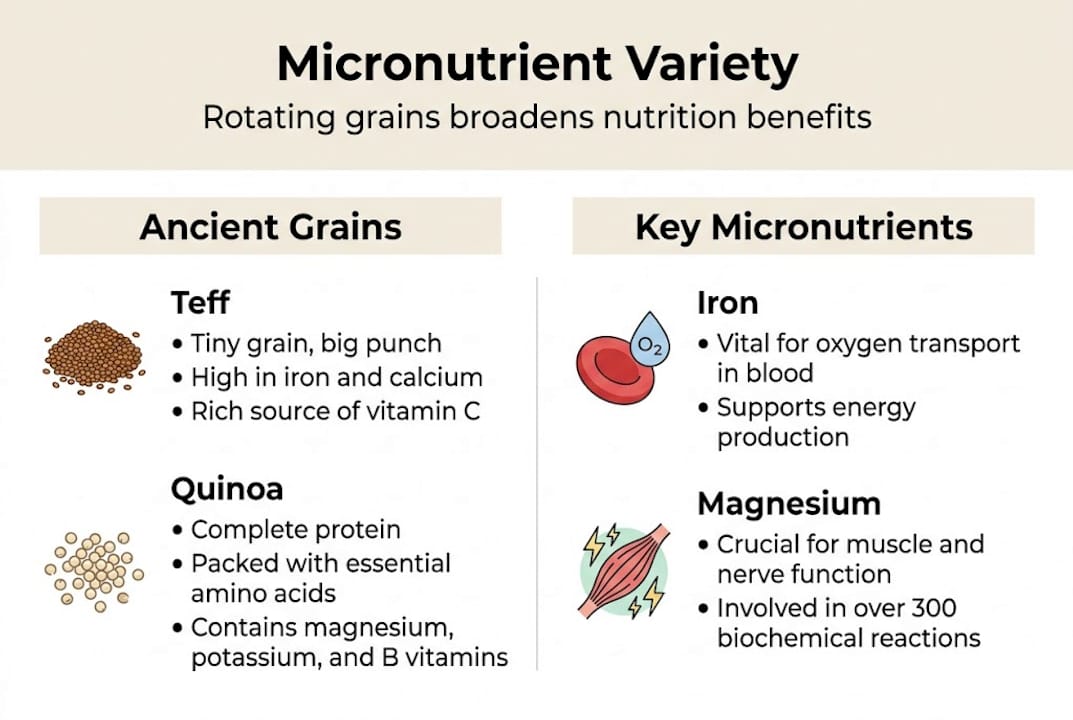
Pro Tip: Rotate at least three different ancient grains through your week. This simple habit broadens your micronutrient intake far more effectively than eating the same “superfood” grain every day.
A fresh perspective: nutrient density beyond the numbers
Here is something most nutrition articles will not say plainly: chasing nutrient density scores alone can become its own kind of noise. Numbers matter, but they are a tool, not the full picture.
One important nuance concerns processing. The NOVA classification system, widely cited in health media, groups foods by degree of processing. But NOVA processing is critiqued for mislabelling genuinely nutrient-dense foods as “ultra-processed,” simply because they were fortified or blended. A pea protein powder or a fortified oat milk may carry a NOVA category 4 label yet offer genuine nutritional value. Nutrient profiling systems like NRF9.3 are more reliable guides than processing classification alone.
Affordability remains the sharpest practical challenge. Higher costs of nutrient-dense foods mean that access is not equal. Wellness advice that ignores this is incomplete.
Our perspective: focus on the most nutrient dense foods guide as a starting point, then build patterns that are sustainable, varied, and realistic for your life.
“Diversity of whole foods, across grains, vegetables, legumes, and seeds, will consistently outperform any single ‘superfood’ in building long-term nutritional resilience.”
Connect with nutrient-dense choices: experience wellness with Granavitalis
Putting nutrient density into daily practice is easier when you start with the right ingredients. At Granavitalis, everything we source is selected because it earns its place nutritionally.

Our raw pecan butter is a perfect example: rich in healthy fats, magnesium, and zinc, with nothing added. For those who want variety in one box, the nut and seed butter box brings together a curated range of nutrient-dense spreads that work beautifully on ancient grain bread, in smoothies, or straight from the jar. Explore the full range at the Granavitalis wellness shop and find the wholefood ingredients that match your wellness goals. Real food, honestly sourced, ready for your table.
Frequently asked questions
How do I know if a food is nutrient dense?
Look for foods that score high in vitamins, minerals, fibre, and protein per 100 kilocalories, using frameworks like the NRF9.3 scoring system as a guide. Foods like leafy greens, ancient grains, nuts, and seeds consistently rank well.
Are ancient grains always nutrient dense?
Most ancient grains deliver superior protein, fibre, and minerals compared to refined grains, though values vary. Teff protein reaches 20.99% and wild rice is particularly rich in vitamins and antioxidants, making both standout choices.
What is the main challenge with choosing nutrient-dense foods?
Cost is the primary barrier. In 2021, vegetables cost 11.9 times more per kilocalorie than staple foods, making consistent access to nutrient-dense options genuinely difficult for many households.
Is processing level more important than nutrient density?
Not necessarily. NOVA classification mislabels some nutrient-dense foods as ultra-processed, so relying solely on processing categories can mislead. Nutrient profiling scores give a more accurate picture of a food’s actual value.
Recommended
- Nutrient-dense breakfast guide for wellness 2026 – Granavitalis
- Complete Guide to the Most Nutrient Dense Foods – Granavitalis
- Nutrient Dense Foods: Fuel for Modern Well-Being – Granavitalis
- Nutrient Dense Foods: Real Strength for Modern Living – Granavitalis
- Wellness supplementation: enhance performance, recovery and health – ElevateSupplements