
The role of tradition in daily nutrition: a UK guide
Traditional food practices do more than preserve culture. They alter how your body absorbs minerals, digests protein, and manages blood glucose — changes that no nutrient label captures. The core claim: how food is prepared, paired, and sourced matters as much as what it contains. Fermentation, soaking, whole-kernel use, and seasonal sourcing are not nostalgic habits; they are nutrient optimisation architectures that modern food science is only now quantifying.
Two things to take away immediately:
- Better mineral and protein use: traditional preparation techniques lower antinutrients and raise fractional iron, zinc, and protein digestibility.
- Practical for UK life: simple swaps and one-day-a-week prep routines are enough to capture most of the benefit.
Table of Contents
- What does ‘tradition’ actually mean in nutrition?
- How traditional preparation changes what your body actually absorbs
- What does the evidence show about health and performance benefits?
- Practical ways to bring traditional foods into your UK week
- Sourcing and labelling in the UK: what to look for
- Common myths and when traditional approaches may not apply
- How Granavitalis translates these principles into everyday products
- Key takeaways
- Why small changes beat complete dietary overhauls
- Granavitalis: heritage nutrition, ready to use
- Further reading and authoritative sources
What does ‘tradition’ actually mean in nutrition?
Not nostalgia. Not a strict ancestral re-enactment. In nutritional terms, tradition refers to place-based food systems combined with time-tested preparation methods that have been refined across generations to make food more digestible, more nutritious, and more sustainable.
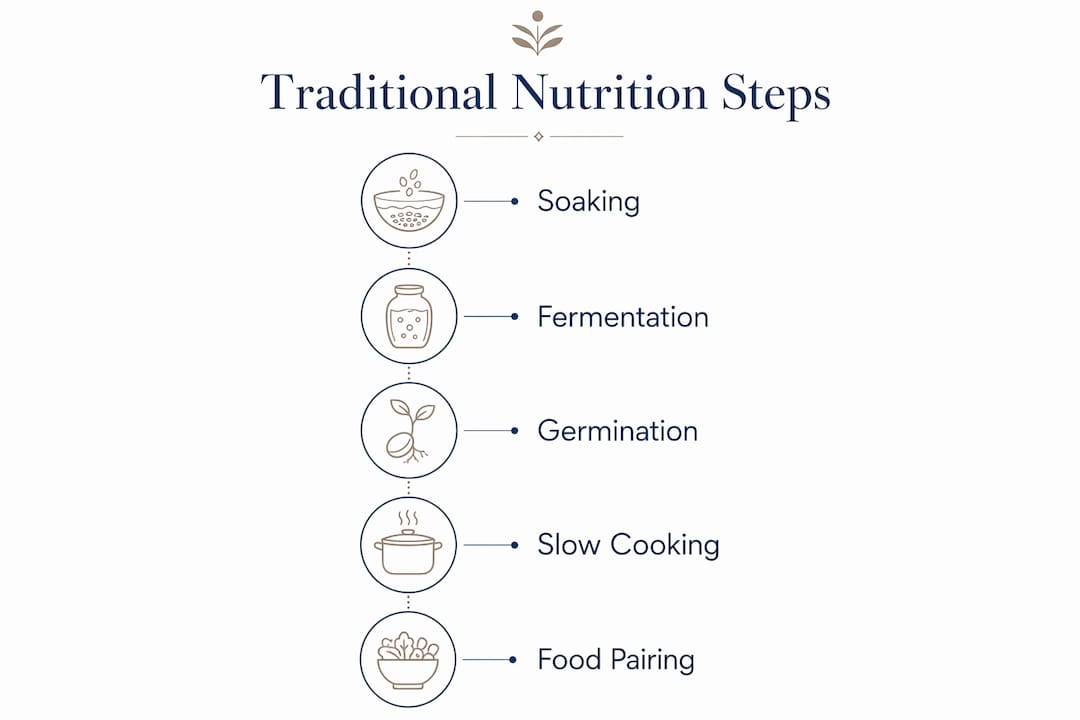
The practical components this guide covers:
- Fermentation: lactic-acid and wild-yeast processes that reduce antinutrients and feed gut microbiota
- Soaking and sprouting: hydration and germination that lower phytate-to-mineral ratios
- Whole-kernel use: retaining bran, germ, and endosperm for full phenolic and fibre content
- Food pairing: combining ingredients to improve absorption (vitamin C with iron sources, fat with fat-soluble vitamins)
- Seasonal and local sourcing: aligning intake with what regional soils and climates produce at peak nutritional density
Pro Tip: Think of traditional food systems as a dietary ‘configuration’ — the combination and preparation of foods matters more than the macronutrient count of any single ingredient.
This is about structural practices that affect bioavailability and metabolic resilience, not a romanticised rejection of modern kitchens.
How traditional preparation changes what your body actually absorbs
Fermentation
Lactic-acid fermentation in sourdough bread, kefir, and traditionally prepared legumes reduces phytates, the compounds that bind iron and zinc and block their absorption. The result is measurably higher mineral solubility. Fermented foods also introduce short-chain fatty acids and live cultures that support gut-barrier integrity.
Soaking and germination
Soaking pulses and grains overnight, or allowing seeds to sprout, lowers phytate-to-mineral molar ratios and improves protein digestibility indices. For anyone eating a predominantly plant-based diet, this is not optional — it is the difference between adequate and poor mineral status.
Whole-kernel integrity
Ancient wheats such as einkorn, emmer, and khorasan show higher phenolic content at kernel level compared with modern varieties. Standard milling and baking reduce some phenolic content, making minimally processed or whole-kernel forms more beneficial. The benefit is in the structure, not just the species.
Slow cooking and food pairing
Long, low-heat cooking breaks down cell walls and improves the bioavailability of carotenoids and fat-soluble vitamins. Pairing iron-rich legumes with vitamin C sources (tomatoes, peppers) can roughly double non-haem iron absorption. Fat alongside fat-soluble vitamins A, D, E, and K is another pairing the body depends on.
| Practice | Primary nutrient outcome |
|---|---|
| Fermentation | Iron and zinc absorption; microbiome diversity |
| Soaking and sprouting | Protein digestibility; mineral bioavailability |
| Whole-kernel use | Phenolics, fibre, B vitamins |
| Slow cooking | Carotenoids, fat-soluble vitamins |
| Food pairing | Non-haem iron, fat-soluble vitamin uptake |
What does the evidence show about health and performance benefits?
The strongest findings cluster around four areas:
- Mineral absorption: fermentation and soaking reliably increase fractional iron and zinc uptake from plant foods
- Protein digestibility: germination improves protein digestibility scores across legumes and grains
- Glycaemic stability: low-glycaemic carbohydrates from whole fruits, vegetables, and unrefined grains attenuate postprandial blood glucose spikes, with one randomised controlled study showing a palaeolithic-style diet produced significantly greater improvement in glucose tolerance than a Mediterranean diet
- Sustainability: a systematic literature review concluded that traditional, place-based diets have positive effects on both health outcomes and sustainable food transitions
A note on limits: most mechanistic evidence comes from controlled laboratory conditions or population-level observations. Human comparative trials remain limited in scale. Traditional techniques improve the nutritional configuration of food; they do not replace targeted supplementation when a clinical deficiency is confirmed.
For performance specifically, prioritising intact cellular carbohydrates and nutrient-dense wholefoods can reduce reliance on refined sports products and support metabolic flexibility — though adaptation takes several weeks and should be staged carefully.
Practical ways to bring traditional foods into your UK week
- Week one — soak your pulses. Cover lentils, chickpeas, or black beans in cold water for 8–12 hours before cooking. Discard the soaking water. This alone reduces cooking time and antinutrient load.
- Week two — add one fermented staple. Introduce live-culture yoghurt, kefir, or a quality sourdough loaf (look for long-fermented, not just sourdough-flavoured). Regular daily servings can begin shifting gut microbiota composition.
- Week three — swap refined grains for whole-kernel alternatives. Replace white rice with whole spelt, farro, or oat groats. Use whole-grain flours for baking where possible.
- Week four — add a heritage-food snack. A tablespoon of nut or seed butter on whole-grain crispbread, or a small handful of whole hazelnuts, provides mineral-dense, slow-release energy between meals.
Pre-workout (60–90 minutes before): a small bowl of soaked oats with a teaspoon of artisan honey and a handful of seeds gives cellular carbohydrates without the gut-permeability risk of refined gels. Post-workout: a portion of fermented dairy (kefir or live yoghurt) with a nut butter stirred through supports protein synthesis and gut recovery simultaneously.
Simple swap list:
- White bread → long-fermented sourdough
- Instant oats → soaked whole oat groats
- Refined sports gels → whole dates or artisan honey
- Roasted, salted nuts → raw or lightly toasted whole nuts and seeds
Sourcing and labelling in the UK: what to look for
The nutritional quality of many modern crops has declined over recent decades due to agronomic change and soil depletion. Sourcing matters.
Buying checklist:
- Provenance: named farm, region, or country of origin on the label
- Minimal processing: stone-ground, cold-pressed, or raw where relevant
- Organic or regenerative signals: Soil Association certification is the most recognised UK standard
- Batch traceability: small-batch producers can often tell you the harvest year and supplier
- Clear ingredient lists: one or two ingredients, no emulsifiers or preservatives in fermented products
Safety caveats: home fermentation carries contamination risk if vessels are not sterilised properly. Allergen labelling is mandatory in the UK under the Food Information for Consumers Regulation; always check for cross-contamination warnings on nut and seed products. Honey should not be given to infants under 12 months due to the risk of botulism spores. Supplements sold in the UK must comply with Food Standards Agency guidelines; check for third-party testing marks.
Pro Tip: Ask small-batch producers directly for their traceability documentation. A reputable artisan supplier will know the harvest origin of their grain or honey. If they cannot tell you, that is a red flag. For seasonal produce context, seasonal sourcing guides can help you align purchases with peak nutritional windows.
Common myths and when traditional approaches may not apply
- Myth: ancient grains are always nutritionally superior. Fact: kernel-level advantages in einkorn and emmer narrow significantly after standard milling. The format matters as much as the variety.
- Myth: fermentation is a cure-all. Fact: fermented foods support gut health but do not correct clinical deficiencies in iron or B12 on their own.
- Myth: zero refined carbohydrates are required for performance. Fact: mainstream clinical guidance emphasises nutrient-dense whole foods over strict exclusion. Endurance athletes in particular need adequate carbohydrate; the quality and source matter more than blanket elimination.
Seek professional advice if you are pregnant, breastfeeding, managing iron-deficiency anaemia, or living with an autoimmune gut condition such as Crohn’s disease or coeliac disease. Traditional techniques can support, but should not replace, clinically indicated supplementation or dietary therapy.
This article is general information, not medical or nutritional advice. Confirm any dietary changes with a registered dietitian or your GP, particularly if you have an existing health condition.
How Granavitalis translates these principles into everyday products
Granavitalis sources heritage grains, nut and seed butters, and artisan honeys with traceability and minimal processing as non-negotiable criteria. The brand’s heritage foods approach maps directly to the mechanisms covered in this guide:
- Heritage grain flours and whole kernels: einkorn and ancient-grain varieties in minimally processed formats, preserving the phenolic and fibre content that milling strips away
- Nut and seed butters: cold-pressed or raw preparations that retain natural fats, minerals, and protein without emulsifiers — ideal as mineral-dense snacks or post-workout recovery additions
- Artisan honeys: small-batch, traceable honeys that function as whole-food carbohydrate sources for pre-workout fuel or pairing with fermented dairy
For deeper reading, the Granavitalis blog covers traditional nutrition in modern wellness and sustained energy from wholefoods in practical detail.
Key takeaways
Traditional food practices alter nutrient bioavailability, metabolic responses, and sustainability more than the nutrient label of any single food — making preparation and sourcing as important as ingredient choice.
| Point | Details |
|---|---|
| Preparation changes absorption | Soaking, fermenting, and sprouting lower antinutrients and raise mineral and protein uptake. |
| Whole-kernel format matters | Ancient grain benefits narrow after milling; choose minimally processed or whole-kernel formats. |
| Pair foods deliberately | Vitamin C with iron sources and fat with fat-soluble vitamins meaningfully improve absorption. |
| Source with traceability | Named provenance, Soil Association certification, and batch traceability are the strongest UK buying signals. |
| Granavitalis as a starting point | Heritage grains, raw nut butters, and artisan honeys from Granavitalis apply these principles with minimal processing and clear sourcing. |
Why small changes beat complete dietary overhauls
The instinct to overhaul everything at once is understandable, but a working week rarely accommodates it. What actually holds is one change per week: soak the lentils on Sunday, switch to a long-fermented loaf on Monday, keep a jar of nut butter at your desk. By the end of a month, the habits are embedded without the friction that kills most dietary intentions.
For local food culture context and place-based sourcing ideas, local gastronomy guides offer a useful starting point for finding regional producers and seasonal staples near you.
Granavitalis: heritage nutrition, ready to use
If the principles in this guide resonate but the sourcing feels like another task on an already full list, Granavitalis has done the groundwork. Every product is selected for traceability, minimal processing, and nutritional integrity — no emulsifiers, no industrial shortcuts.
The raw organic pecan butter is a direct application of the nut-butter snack and recovery recommendations above: cold-pressed, single-ingredient, and genuinely mineral-dense. For variety, the nut and seed butter selection box lets you trial several preparations across a week. Heritage grain flours and artisan honeys round out a pantry built on the same principles this guide covers. Browse the full range at granavitalis.com and start with one product that maps to the swap you are making this week.
Further reading and authoritative sources
- Traditional Food Systems as Nutrient Optimisation Architectures (MDPI, Nutrients): the core mechanistic review covering fermentation, soaking, germination, and pairing. The most directly relevant peer-reviewed source for the mechanisms and evidence sections.
- Traditional, place-based diets and healthy sustainable transitions (Cambridge, Public Health Nutrition): systematic literature review supporting sustainability and health-transition claims.
- Nutritional value of einkorn, emmer, khorasan and modern wheat (PubMed): comparative analysis of ancient grain phenolics and the processing effect.
- Decline in nutritional quality of modern foods (PMC): review documenting mineral and phytochemical reductions in modern crops.
- Palaeolithic diet and sprint interval training in male athletes (PMC): pilot trial on glycaemic and metabolic outcomes relevant to performance sections.
- Clinical guidance on dietary patterns and health outcomes (NCBI Bookshelf): mainstream clinical review used to contextualise myths and cautions.
- NHS and British Dietetic Association (BDA): not cited as original research here, but both publish UK-specific dietary guidance worth cross-checking for allergen, infant feeding, and supplement safety advice.