
Defining real food strength: your evidence-based guide
Real food strength is the capacity to build and maintain muscle through whole, nutrient-dense foods combined with consistent resistance training. It is not a supplement protocol or a macro-counting exercise. The concept rests on a straightforward biological reality: your muscles grow in response to training stimulus, and they repair and adapt using the amino acids, vitamins, and minerals your diet supplies. Neither element works without the other. Training and nutrition together produce the compounded effect that isolated approaches cannot replicate.
The key nutrients involved are protein, vitamin D, and calcium. Protein provides the amino acids that drive muscle protein synthesis. Vitamin D and calcium support muscle contraction, bone density, and the hormonal environment that makes strength gains possible. The NHS and British Dietetic Association (BDA) recommend 20–40g of high-quality protein per meal alongside a 10µg (400IU) vitamin D supplement from October through to early March, when sunlight exposure in the UK is insufficient to maintain adequate levels.
What makes whole foods central to this picture is their synergistic nutrient matrix: proteins, omega-3 fatty acids, phytonutrients, and fibre working together in ways that isolated protein powders cannot replicate. A 2025 analysis of 146,816 UK Biobank participants found that fat-free mass and grip strength increased most in those consuming at or above 2.00g/kg/day of protein, while the current guidance of 0.8g/kg/day was associated with lower muscle strength and mass.
Key nutrients to prioritise:
- Protein: 20–40g per meal from high-quality sources (animal or complementary plant proteins)
- Vitamin D: 10µg/400IU daily supplement from october to march; year-round for those with minimal sun exposure
- Calcium: from dairy, fortified plant milks, green leafy vegetables, and fortified cereals
- Iron and B12: particularly relevant for those reducing animal foods, to support oxygen delivery and energy metabolism
Key foods that genuinely build muscle strength
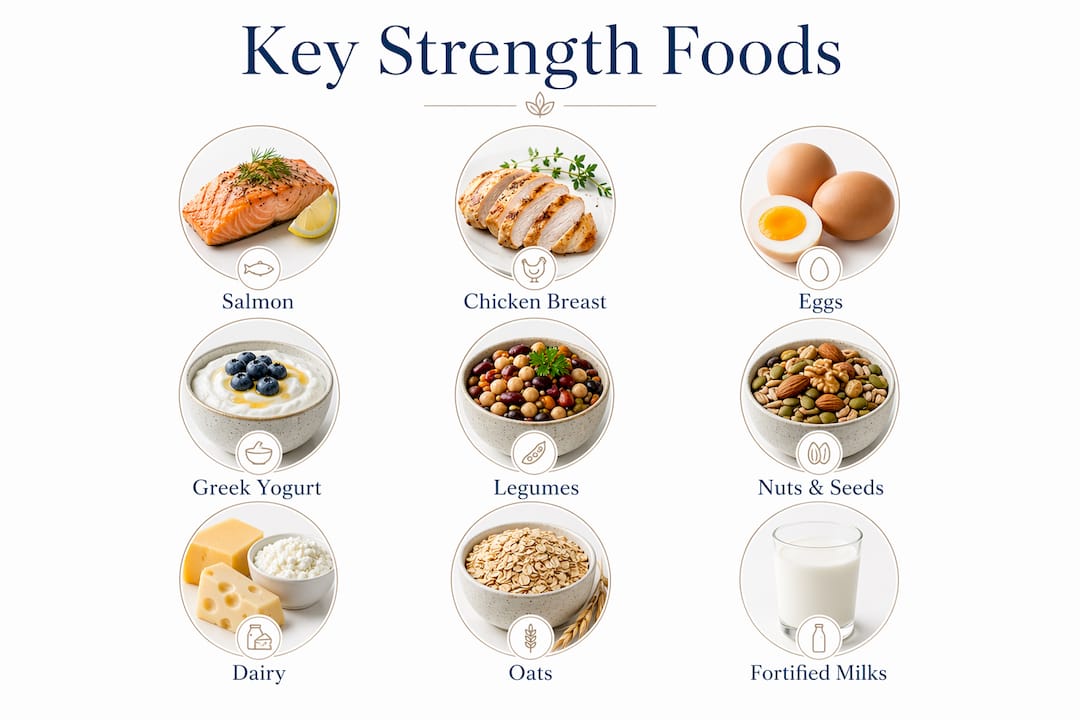
The foods below are not a generic “eat well” list. Each one earns its place through a specific nutrient contribution to muscle repair, synthesis, or function.
1. Salmon
Salmon delivers roughly 25g of protein per 100g cooked, alongside meaningful amounts of vitamin D and long-chain omega-3 fatty acids (EPA and DHA). The vitamin D content is particularly relevant in the UK context, where dietary sources matter most during the winter months when sunlight is scarce. Oily fish is one of the few foods that provides vitamin D in a form the body absorbs efficiently. Two portions a week aligns with NHS guidance and covers both the protein and the omega-3 angle simultaneously.

2. Eggs
A large egg contains approximately 6g of protein with a complete amino acid profile, meaning it supplies all nine essential amino acids your muscles need for repair. Egg yolks also provide vitamin D, choline, and leucine, the amino acid most directly linked to triggering muscle protein synthesis. Scrambled, poached, or hard-boiled, eggs are one of the most versatile and cost-effective whole-food protein sources available in UK supermarkets.
3. Chicken breast
Chicken breast provides around 31g of protein per 100g cooked, with minimal fat and a high leucine content. It is the most widely consumed lean protein in the UK for good reason: it is affordable, widely available, and easy to prepare in bulk. The key is preparation. Grilling, baking, or poaching preserves the protein content without adding unnecessary calories from frying oils.
4. Greek yogurt
Greek yogurt contains roughly 10g of protein per 100g, along with calcium and live bacterial cultures that support gut health. The calcium content directly supports muscle contraction and bone density, both of which matter for long-term strength. Full-fat versions provide a modest amount of fat-soluble vitamins alongside the protein, making them a more complete option than fat-free variants stripped of micronutrients.
5. Legumes (lentils, chickpeas, black beans)
Legumes are the backbone of plant-based strength nutrition. Cooked lentils provide around 9g of protein per 100g, along with iron, folate, and fibre. They are not a complete protein source on their own, as they are low in methionine, but pairing them with grains (rice, bread, oats) creates a complementary amino acid profile. For those building muscle on plant proteins, legumes combined with grains across the day deliver the full spectrum of essential amino acids the body requires.
6. Nuts and seeds
Almonds, walnuts, pumpkin seeds, and hemp seeds each contribute protein, healthy fats, magnesium, and zinc. Magnesium plays a direct role in muscle relaxation and energy production; zinc supports testosterone levels and immune function, both relevant to recovery. A 30g handful of almonds provides around 6g of protein. Nut butters, particularly those made from whole nuts with no added oils or sugars, are a practical way to increase protein and healthy fat intake without significant meal preparation. The nutrient synergy in whole foods found in nuts and seeds goes well beyond their protein content alone.
7. Seeds (chia, hemp, flaxseed)
Hemp seeds stand out among seeds for their protein quality: they contain all essential amino acids and provide around 31g of protein per 100g. Chia seeds offer a useful combination of protein, omega-3 alpha-linolenic acid, and calcium. Flaxseeds contribute lignans and omega-3s alongside modest protein. All three are easy to add to porridge, smoothies, or yogurt without altering flavour significantly.
8. Dairy (milk, cheese, cottage cheese)
Dairy provides both whey and casein proteins, which digest at different rates. Whey is fast-absorbing and particularly effective post-exercise for triggering muscle protein synthesis; casein digests slowly and is useful before sleep to sustain overnight muscle repair. Milk also delivers calcium and, when fortified, vitamin D. Cottage cheese is especially useful as a high-protein, low-calorie option: around 11g of protein per 100g with a favourable calcium-to-calorie ratio.
9. Oats
Oats are not a primary protein source, but they contribute around 13g of protein per 100g dry weight alongside beta-glucan fibre, B vitamins, and iron. The slow-release carbohydrates in oats sustain energy during training sessions, which indirectly supports the training stimulus that muscle growth requires. Oats also pair naturally with protein-rich additions such as Greek yogurt, nut butter, or hemp seeds.
10. Fortified plant milks
For those avoiding dairy, fortified oat, soy, or almond milks provide calcium and often vitamin D in amounts comparable to cow’s milk. Soy milk is the strongest plant-based option for protein, at around 3–4g per 100ml, and has a more complete amino acid profile than oat or almond alternatives. Checking the label for calcium fortification (at least 120mg per 100ml) and vitamin D addition is worth the ten seconds it takes.
Protein and key nutrient content per 100g (cooked or as consumed):
| Food | Protein (g) | Vitamin D | Calcium | Notes |
|---|---|---|---|---|
| Salmon (cooked) | ~25 | Good source | Low | Also provides omega-3 EPA/DHA |
| Chicken breast (cooked) | ~31 | Negligible | Low | High leucine; very lean |
| Eggs (whole) | ~13 | Moderate (yolk) | Low | Complete amino acid profile |
| Greek yogurt | ~10 | Low | Good source | Contains live cultures |
| Cooked lentils | ~9 | None | Moderate | Pair with grains for completeness |
| Almonds | — | None | Good source | Also provides magnesium and zinc |
| Hemp seeds | ~31 | None | Moderate | Complete amino acid profile |
| Cottage cheese | ~11 | Low | Good source | Slow-digesting casein protein |
| Oats (dry) | ~13 | None | Moderate | Slow-release energy; pairs well with protein |
| Fortified soy milk | ~3–4 per 100ml | Often added | Fortified | Best plant milk for protein completeness |
Practical meals and snacks built around strength
Knowing which foods to eat is only half the equation. Getting 20–40g of protein into each meal, spread across the day, is what the NHS and BDA guidance actually calls for, and that requires some deliberate meal construction.
11. High-protein breakfasts
Three scrambled eggs with smoked salmon on wholegrain toast delivers around 35g of protein and a useful dose of vitamin D from the salmon. Alternatively, overnight oats made with full-fat Greek yogurt, hemp seeds, and a tablespoon of nut butter provide roughly 25–30g of protein with slow-release carbohydrates to fuel a morning training session. Both options take under ten minutes to prepare.
Pro Tip: Add a tablespoon of hemp seeds to any breakfast bowl. It contributes around 5g of complete protein with no change to the flavour, and it takes three seconds.
12. Lunches that sustain afternoon training
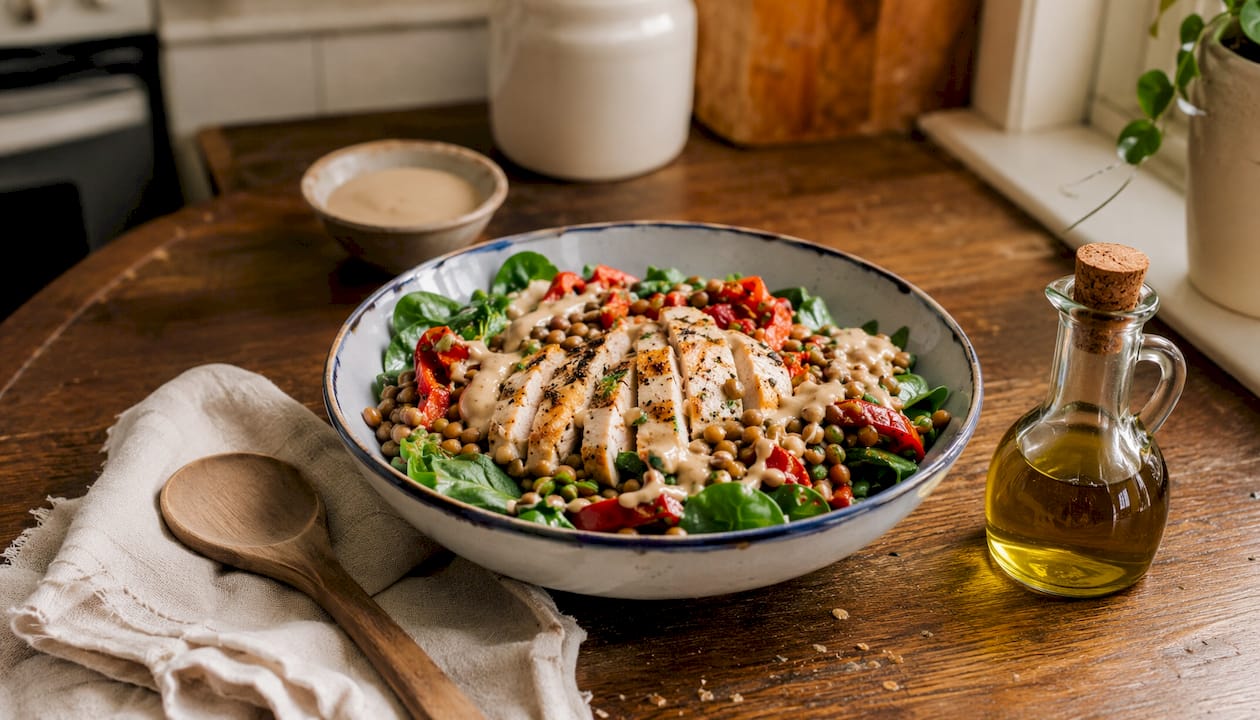
A chicken and lentil salad with spinach, roasted peppers, and a tahini dressing covers protein from two sources (animal and plant), iron from the spinach and lentils, and calcium from the tahini. The combination illustrates the protein synergy principle: different protein sources together provide a broader amino acid spectrum than either alone. A tin of sardines on rye bread with cucumber achieves a similar nutritional outcome in under five minutes.
13. Post-training dinners
Baked salmon with roasted sweet potato and steamed broccoli is a near-perfect post-training meal. The salmon provides protein and vitamin D; the broccoli contributes calcium, vitamin C, and sulforaphane; the sweet potato replenishes glycogen. Aim to eat within two hours of training to take advantage of the post-exercise window when muscle protein synthesis is elevated. A portion of salmon at 150g gives approximately 37g of protein, comfortably within the 20–40g target per meal.
14. Snacks that actually contribute
Greek yogurt with a handful of walnuts and a drizzle of honey provides around 15g of protein with calcium and anti-inflammatory omega-3s. Boiled eggs (two) with a small portion of hummus and oatcakes reach approximately 18g of protein. A tablespoon of almond or pecan nut butter on wholegrain crackers adds protein, healthy fats, and magnesium in a format that requires no preparation at all.
Cooking technique matters more than most people realise. Steaming and baking preserve heat-sensitive B vitamins and omega-3 fatty acids better than frying. Soaking legumes before cooking reduces antinutrients such as phytates, which can otherwise inhibit iron and zinc absorption. Traditional processing methods like fermenting (think sourdough bread, live yogurt, miso) actively improve nutrient bioavailability rather than simply preserving it.
What the science says about protein and muscle strength
Muscle strength is defined as the maximum force a muscle or muscle group can exert, typically measured by 1RM tests (one-repetition maximum) or isometric assessments such as handgrip dynamometry. Gait speed and functional performance tests are related but distinct measures; they assess physical performance rather than raw strength. That distinction matters when interpreting research, because studies measuring grip strength or 1RM tell you something different from those measuring walking speed.
The UK Biobank data on 146,816 participants aged 40–69 is the most relevant large-scale evidence for UK adults. It found that per 0.5g/kg/day increment in protein intake, fat-free mass increased by 5.1% in men and 7.7% in women, while grip strength rose by approximately 0.075kg/kg. Critically, fat-free mass and grip strength were highest in those consuming at or above 2.00g/kg/day, with no plateau observed across the intake range studied. The current standard recommendation of 0.8g/kg/day appears calibrated to prevent deficiency rather than to support optimal muscle mass and strength.
The biological mechanism is straightforward. Dietary amino acids, particularly leucine, act as direct signals for muscle protein synthesis. Without adequate protein, the training stimulus triggers breakdown without sufficient repair. Without the training stimulus, even high protein intake produces minimal muscle adaptation. The two inputs are not interchangeable; they are interdependent.
The distinction between animal and plant proteins is real but manageable. Animal proteins (meat, fish, dairy, eggs) are generally leucine-rich and rapidly absorbed, making them highly effective at triggering muscle protein synthesis. Plant proteins tend to be lower in leucine and often incomplete in their amino acid profiles. However, resistance training combined with protein from diverse whole-food sources produces comparable strength gains across different dietary patterns, provided total intake and amino acid variety are adequate. Combining legumes with grains, and including hemp or soy as complete plant proteins, closes most of the gap.
Age and sex both influence protein requirements. Women in the UK Biobank cohort showed a larger proportional increase in fat-free mass per unit of protein than men (7.7% versus 5.1%), suggesting protein intake may be particularly important for women seeking to maintain muscle mass. Older adults face a different challenge: muscle protein synthesis becomes less responsive to protein intake with age, a phenomenon called anabolic resistance, which means older people may need higher per-meal protein doses to achieve the same synthetic response as younger adults.
Pro Tip: Distribute protein across three to four meals rather than concentrating it in one. The body can only use roughly 20–40g of protein per meal for muscle protein synthesis; consuming 80g in a single sitting does not double the benefit.
Vitamin D and calcium are not secondary concerns. Vitamin D receptors are present in muscle tissue, and deficiency is associated with reduced muscle function and increased fall risk in older adults. Calcium is required for the electrical signals that trigger muscle contraction. Both nutrients work alongside protein, not independently of it.
- Protein timing: consuming protein within two hours post-exercise maximises the anabolic window
- Leucine threshold: a minimum of roughly 2–3g of leucine per meal is thought to maximally stimulate muscle protein synthesis
- Vitamin D: 10µg/400IU daily from october to march per NHS guidance; year-round for those with minimal sun exposure
- Calcium: aim for 700mg daily (UK reference nutrient intake for adults), primarily from food sources
Applying UK guidelines to build real food strength in practice
The NHS and BDA guidance is specific: 20–40g of protein per meal, calcium from dairy or fortified alternatives, and a 10µg vitamin D supplement from october through to early march. Resistance exercise targeting all major muscle groups at least twice a week completes the picture. These are not aspirational targets; they are the minimum framework for maintaining muscle mass and function across adult life.
The 2025 UK Biobank findings add an important layer to this guidance. The standard 0.8g/kg/day recommendation was designed around nitrogen balance studies, which measure the threshold for avoiding deficiency rather than the intake needed to optimise muscle mass and strength. For adults aged 40–69 who are physically active, the evidence points toward intakes considerably higher than current guidelines suggest.
One nuance that UK guidance does not always make explicit: the relationship between protein intake and muscle strength is not linear at all ages. A study of older British twins found that high protein intake above 1.3g/kg/day was associated with increased sarcopenia risk in adults aged 60 and over, suggesting that for older adults, protein quality, distribution across meals, and overall dietary balance matter more than simply maximising total intake. The optimal range for older adults appears to sit between 1.0–1.3g/kg/day, with careful attention to meal-level distribution.
UK food labelling provides a practical tool for navigating this. Nutrition labels on packaged foods list protein per 100g and per serving, making it straightforward to estimate whether a meal reaches the 20–40g target. Foods labelled as “high protein” must contain at least 20% of energy from protein under UK/EU retained food labelling regulations. That threshold is a useful filter when choosing convenience options, though whole foods will almost always outperform processed alternatives on the breadth of nutrients they deliver.
Traditional processing methods deserve a mention here. Fermented dairy (live yogurt, kefir), sourdough bread, and traditionally prepared legumes all improve nutrient bioavailability compared to their raw or ultra-processed counterparts. These are not niche health foods; they are ordinary UK staples that happen to align well with the whole-food nutrition model.
UK nutrition guidelines and research evidence summary:
| Nutrient/Factor | NHS/BDA Recommendation | UK Biobank / Research Evidence |
|---|---|---|
| Protein per meal | 20–40g high-quality protein | Highest fat-free mass and grip strength at ≥2.00g/kg/day (UK Biobank data); 0.8g/kg/day is not sufficient for optimal muscle strength in adults aged 40–69 |
| Protein in older adults (60+) | Higher than younger adults | >1.3g/kg/day associated with increased sarcopenia risk; optimal range 1.0–1.3g/kg/day |
| Vitamin D | 10µg/400IU supplement oct–mar | Deficiency linked to reduced muscle function; year-round supplement for low sun-exposure groups |
| Calcium | 700mg/day from food | Supports muscle contraction and bone density alongside protein |
| Resistance training | Twice weekly, all major muscle groups | Synergy with protein intake essential; neither alone is sufficient |
Build your real food strength with Granavitalis

Granavitalis sources the whole foods that make this nutritional framework practical rather than theoretical. The Raw Organic Pecan Butter from RAWGORILLA delivers protein, healthy fats, and magnesium in a minimally processed format with no added oils or sugars. It is the kind of product that fits into a post-training snack or a pre-workout breakfast without any preparation overhead.
For those building a plant-based protein foundation, the Organic Nut & Seed Butter Selection Box provides variety across almond, cashew, and other whole-nut butters, each contributing a different micronutrient profile alongside protein and healthy fats. Variety in your protein sources is not just a flavour preference; it is how you cover the full spectrum of amino acids and supporting nutrients that whole-food nutrition requires.
Key takeaways
Real food strength depends on the compound effect of adequate whole-food protein, supporting micronutrients (vitamin D, calcium, iron), and consistent resistance training, with protein distributed across meals at 20–40g per sitting.
| Point | Details |
|---|---|
| Protein per meal matters most | Aim for 20–40g of high-quality protein per meal to support muscle protein synthesis effectively. |
| Current guidelines may underestimate needs | UK Biobank data shows fat-free mass and grip strength are highest in those consuming ≥2.00g/kg/day, while the standard 0.8g/kg/day recommendation may be too low for optimal results. |
| Whole foods outperform isolates | The synergistic nutrient matrix in whole foods supports muscle repair and gut health beyond what isolated protein powders provide. |
| Older adults need careful dosing | In adults aged 60 and over, protein intake above 1.3g/kg/day is associated with increased sarcopenia risk; quality and distribution matter more than volume. |
| Vitamin D requires active supplementation in the UK | The NHS recommends 10µg/400IU daily from october to march; dietary sources alone are insufficient during UK winter months. |