
Why minimalist ingredients work for your health
TL;DR:
- A diet with fewer, high-quality ingredients outperforms complex, ultra-processed foods in weight loss and health outcomes.
- Minimalist foods build on natural, recognizable components like grains, nuts, and legumes while avoiding unnecessary additives.
Why minimalist ingredients work: the core health case
Fewer ingredients, done well, genuinely outperform complexity. A minimally processed diet produces significantly greater weight and fat loss than an ultra-processed one, even when both follow UK Eatwell Guide recommendations. That finding alone reframes the conversation: it is not just about nutrients on a label, but about what the food itself does to your body.
Whole foods deliver this advantage through several overlapping mechanisms:
- Nutrient density: Ancient grains, nuts, seeds, and legumes supply vitamins, minerals, and phytonutrients in their natural ratios, without displacement by additives.
- Fibre and satiety: The British Heart Foundation notes that fibre in whole foods keeps you fuller for longer, supporting healthier blood pressure and cholesterol levels.
- Lower additive exposure: Short ingredient lists mean fewer emulsifiers, colour stabilisers, and flavour enhancers entering your diet daily.
- Better metabolic outcomes: UK modelling data links reduced ultra-processed food intake to a meaningful reduction in cardiovascular deaths.
- Improved craving control: Participants on minimally processed diets showed greater reductions in hedonic appetite and cravings than those on ultra-processed equivalents.
The Scientific Advisory Committee on Nutrition (SACN) confirms that higher consumption of ultra-processed foods is consistently associated with increased risks of obesity, type 2 diabetes, cardiovascular disease, and all-cause mortality. The mechanism is not fully settled, but nutrient profile, energy density, and eating rate all play a role.
Table of Contents
- What are minimalist ingredients, and why does simplicity matter?
- How ultra-processed foods compare to minimally processed ones
- How Granavitalis puts minimal processing into practice
- Are there real drawbacks to minimalist ingredient approaches?
- How does ingredient minimalism compare to keto and paleo diets?
- The case for keeping it simple, without keeping it rigid
- Granavitalis: real food, genuinely simple
- Key takeaways
What are minimalist ingredients, and why does simplicity matter?
Ingredient minimalism means building meals and products around short, recognisable ingredient lists: whole grains, nuts, seeds, natural oils, legumes, and unprocessed proteins. The principle is not about counting ingredients obsessively. It is about choosing foods whose components you could name and, broadly, source yourself.
A critical nuance: a short list does not automatically mean a healthy product. As nutrition experts note, a biscuit made from sugar, white flour, and butter has three ingredients and poor nutritional value. Quality matters as much as quantity. Research into consumer psychology confirms that people perceive fewer ingredients as more natural, which is often correct but not universally so.
Practical considerations when evaluating minimalist ingredients:
- Ingredient quality: Whole oats beat refined oat flour; cold-pressed rapeseed oil beats hydrogenated vegetable fat.
- Processing method: Freezing, steaming, and grinding can all preserve nutrients. A registered dietitian perspective confirms that not all processing is harmful.
- Food structure: Physical form changes nutrient absorption. Whole almonds release less fat than ground almonds or nut butter, because the fat stays bound within intact cells.
- Nutritional completeness: A minimalist plate still needs adequate protein, fat, and micronutrients. Simplicity supports, but does not replace, balance.
Common minimalist ingredients in UK diets include rolled oats, lentils, whole rye, walnuts, flaxseed, extra-virgin olive oil, and plain full-fat yoghurt.
How ultra-processed foods compare to minimally processed ones
Over 50% of UK energy intake currently comes from ultra-processed foods (UPF). That figure sits at the centre of a genuine public health concern.
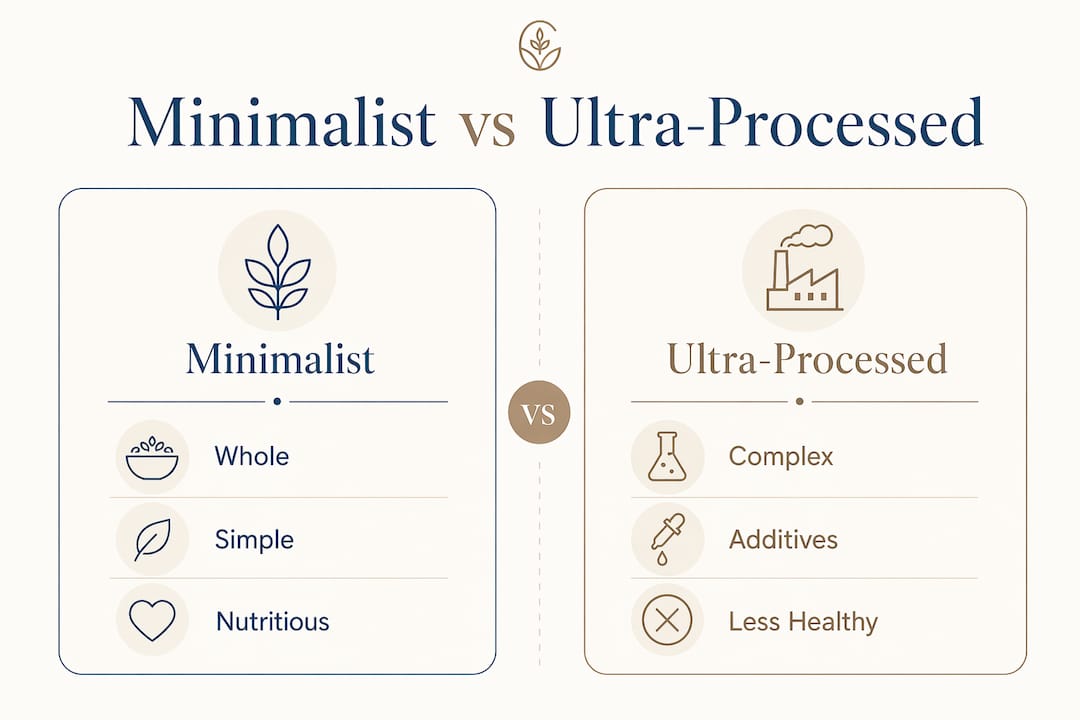
The NOVA classification system groups foods into four categories, from unprocessed to ultra-processed. UPFs are industrial formulations combining food extracts with additives, flavour enhancers, and processing aids. Examples include mass-produced bread, breakfast cereals, and packaged snacks. Minimally processed foods (MPF) are whole or lightly modified: fresh vegetables, plain nuts, whole grains, unprocessed meat and fish.
The health contrast is stark:
- UPF diets are typically higher in energy density, which promotes faster eating and greater calorie intake before satiety signals register.
- MPF diets produce greater reductions in fat mass and triglycerides in clinical trials.
- UPF consumption is associated with higher incidence of constipation and gastrointestinal issues in trial participants.
- Whole food fibre slows sugar absorption, unlike fruit juice where fibre is absent and sugar hits the bloodstream rapidly.
SACN is careful to note that the associations may partly reflect the nutrient profile of most UPF rather than processing per se. Reformulated “healthier” UPF can be nutritionally comparable to MPF. Still, even nutritionally matched UPF diets produce less weight and fat loss than MPF equivalents, pointing to mechanisms beyond nutrients alone.
How Granavitalis puts minimal processing into practice
Granavitalis was built on a single conviction: that the best nutrition comes from ingredients with a history, not a laboratory. The range draws on ancient grains unchanged by industrial hybridisation, premium nuts and seeds in their natural state, and clean plant proteins with nothing added that does not need to be there.
Minimal processing at Granavitalis means:
- Ancient grain flours milled to preserve bran, germ, and the full micronutrient profile.
- Nut and seed butters crafted to balance bioavailability with whole-food integrity, understanding that grinding releases oils and changes absorption.
- Clean plant proteins sourced without synthetic additives, supporting recovery and sustained energy.
- Mindful power-ups from botanicals selected for function, not novelty.
Reducing ingredients in food manufacturing is genuinely difficult. Many producers do not fully understand the role of every additive in their formulas. Granavitalis sidesteps that problem by starting with ingredients that do not require additives to perform. Explore wholefood nutrition for practical guidance on building meals around these principles.

Are there real drawbacks to minimalist ingredient approaches?
Honesty matters here. A minimalist ingredient approach has genuine limitations worth knowing.
Cost is the most immediate. Products made with fewer, higher-quality ingredients tend to cost more. Removing additives often requires more expensive raw materials or processing methods. Shelf life is shorter too, since many additives exist precisely to extend it.
Nutritional gaps are possible if the approach becomes too restrictive. Cutting out fortified foods, for instance, can reduce intake of vitamin D, B12, or iodine, particularly for those eating plant-based diets. Dietitian Priya Tew emphasises that simple, minimally processed ingredients work best when combined sensibly, without perfectionism or fear of all processing.
Convenience is a real-world constraint. Whole foods require more preparation time, and not everyone has equal access to fresh produce or the time to cook from scratch. Processed foods, including some UPF, genuinely improve food access for many households.
How does ingredient minimalism compare to keto and paleo diets?
Ingredient minimalism is a principle, not a dietary pattern. That distinction matters when comparing it to structured approaches like ketogenic or paleo diets.
Keto restricts carbohydrates sharply to induce ketosis, which means it can include heavily processed low-carb products with long ingredient lists. Ingredient minimalism and keto can overlap when someone eats whole eggs, avocado, and nuts, but they diverge when keto relies on processed protein bars or synthetic sweeteners.
Paleo aligns more closely with minimalist ingredient thinking, emphasising unprocessed meats, vegetables, fruits, and nuts while excluding grains and legumes. The key difference is that ingredient minimalism does not exclude food groups. Whole oats, lentils, and rye bread all qualify, which makes the approach more nutritionally complete and easier to sustain long-term in a UK context.
The nutrient integrity of a diet matters more than its label. A minimalist ingredient framework is flexible enough to sit inside almost any dietary pattern, which is precisely why it works as a foundation rather than a rulebook.
The case for keeping it simple, without keeping it rigid
The conventional wisdom around “clean eating” often tips into anxiety about purity. That is where the approach loses people, and rightly so.
Ingredient minimalism works because it shifts your dietary centre of gravity, not because it demands perfection. Eating whole oats for breakfast, a handful of walnuts mid-morning, and a lentil-based lunch does more for your metabolic health than obsessing over whether your tinned tomatoes count as processed. The evidence supports a direction of travel, not a binary pass-or-fail test.
What gets underestimated is the cumulative effect of small, consistent choices. Swapping one ultra-processed snack daily for a whole-food alternative, over months, changes your nutrient intake, your satiety patterns, and your relationship with food. That is not a dramatic intervention. It is just a better default.
The mistake is treating minimalism as an aesthetic rather than a nutritional strategy. A short ingredient list on a product is a useful signal, but the real question is always: what does this food do for my body? Start there, and the rest follows.
Granavitalis: real food, genuinely simple
If you have spent time reading labels and finding that “natural” products still carry a paragraph of additives, Granavitalis offers something different. Every product starts with the ingredient, not the formula.

The raw organic pecan butter is a good example: one ingredient, cold-pressed, nothing added. No emulsifiers to stabilise it, no flavourings to mask it. The nut and seed butter selection extends that same principle across a range of whole-food sources, each chosen for nutritional density and flavour integrity. These are not compromise products. They are what minimalist ingredients actually look like when the sourcing is taken seriously. Browse the full range at Granavitalis and find the products that fit your daily routine.
Key takeaways
Minimally processed, whole-food diets produce greater fat loss and better metabolic outcomes than ultra-processed equivalents when both aim to meet UK dietary guidelines.
| Point | Details |
|---|---|
| Processing level matters beyond nutrients | MPF diets produce greater weight and fat loss than UPF diets even when nutrient profiles are matched. |
| Ingredient quality beats ingredient count | A short list containing mainly sugar and refined flour offers poor nutrition; whole-food quality is the real measure. |
| Fibre drives satiety | Whole-food fibre slows sugar absorption and supports healthy cholesterol and blood pressure levels. |
| Minimalism is a principle, not a diet | It works inside keto, paleo, or any pattern; it sets a direction rather than a rigid rulebook. |
| Granavitalis applies this daily | Products like the raw organic pecan butter use single, whole-food ingredients with no additives or fillers. |