
What is sprouted grain? Benefits, safety, and uses
TL;DR:
- Sprouted grains are whole grains soaked until germination begins, activating enzymes that improve nutrition. They reduce anti-nutrients like phytic acid and enhance mineral absorption and digestibility, offering significant health benefits. Proper home sprouting involves thorough rinsing, controlled soaking, and cooking when necessary, especially for vulnerable groups.
Sprouted grains have moved from health food shops to mainstream supermarket shelves, yet most people reaching for a loaf of sprouted bread are not entirely sure what they are buying. What is sprouted grain, exactly? The short answer is that it is not some exotic new food. It is a whole grain that has been soaked in water until it begins to germinate, triggering a cascade of biochemical changes that alter its nutritional profile in genuinely meaningful ways. Understanding what happens inside that tiny sprouting seed, and why it matters for your health, is what this article is here to explain.
Table of Contents
- Key takeaways
- What is sprouted grain and how does germination work?
- Sprouted grain nutrition: what the evidence shows
- How to sprout grains safely at home
- Incorporating sprouted grains into your diet
- My honest take on sprouted grains
- Pair sprouted grains with whole-food nutrition
- FAQ
Key takeaways
| Point | Details |
|---|---|
| Sprouted grains are whole grains | They are standard whole grains soaked until germination begins, not a separate food category. |
| Nutrients become more available | Enzymes break down anti-nutrients like phytic acid, making minerals and vitamins easier to absorb. |
| Safety matters at home | Rinse sprouting grains at least twice daily and cook them if you belong to a vulnerable health group. |
| Label reading is non-negotiable | Some commercial sprouted products contain added sugars or mixed flours that dilute their benefits. |
| Practical use is straightforward | Sprouted grains work in baking, porridge, salads, and as direct swaps for regular whole grains. |
What is sprouted grain and how does germination work?
A sprouted grain is a whole grain that has germinated after being soaked in water, producing a small visible shoot before being dried, milled, or used directly. The process stops well before a full plant forms. Think of it as catching the grain at its most metabolically active moment, right at the point where it is converting its stored energy into something a seedling could use.
What makes this moment nutritionally interesting is the enzyme activity happening inside the grain. When water is absorbed, metabolic activity rises sharply, and enzymes begin breaking down complex starches into simpler sugars, long protein chains into shorter amino acid sequences, and fats into their component fatty acids. The grain is, in effect, partially pre-digesting itself.
This matters for you because:
- Digestibility improves. Simpler compounds are easier for your gut to process than their complex precursors.
- Anti-nutrients reduce. Compounds like phytic acid, which bind to minerals and prevent absorption, are significantly degraded during sprouting.
- Nutrient density shifts. Vitamins that were either absent or present in small amounts begin to appear or increase substantially.
- Bioavailability increases. Minerals that were locked away become accessible once their phytate bonds are broken.
Sprouted grains are also worth understanding in the context of ancient and traditional grain varieties, which naturally carry lower levels of anti-nutrients and respond particularly well to germination.
Pro Tip: Sprouting does not require specialist equipment. A clean glass jar, a piece of muslin cloth, and a rubber band are all you need to get started.
Sprouted grain nutrition: what the evidence shows
The nutritional benefits of sprouted grains are not marketing claims. They are measurable changes documented in peer-reviewed research, and the differences compared to unsprouted whole grains can be substantial.
One of the most striking findings comes from studies on green gram. Phytic acid levels dropped from roughly 754 to 906 mg per 100 g down to just 102 to 175 mg per 100 g after optimised germination. Vitamin C, which was entirely absent in the raw grain, reached 55 to 85 mg per 100 g after sprouting. These are not marginal shifts.
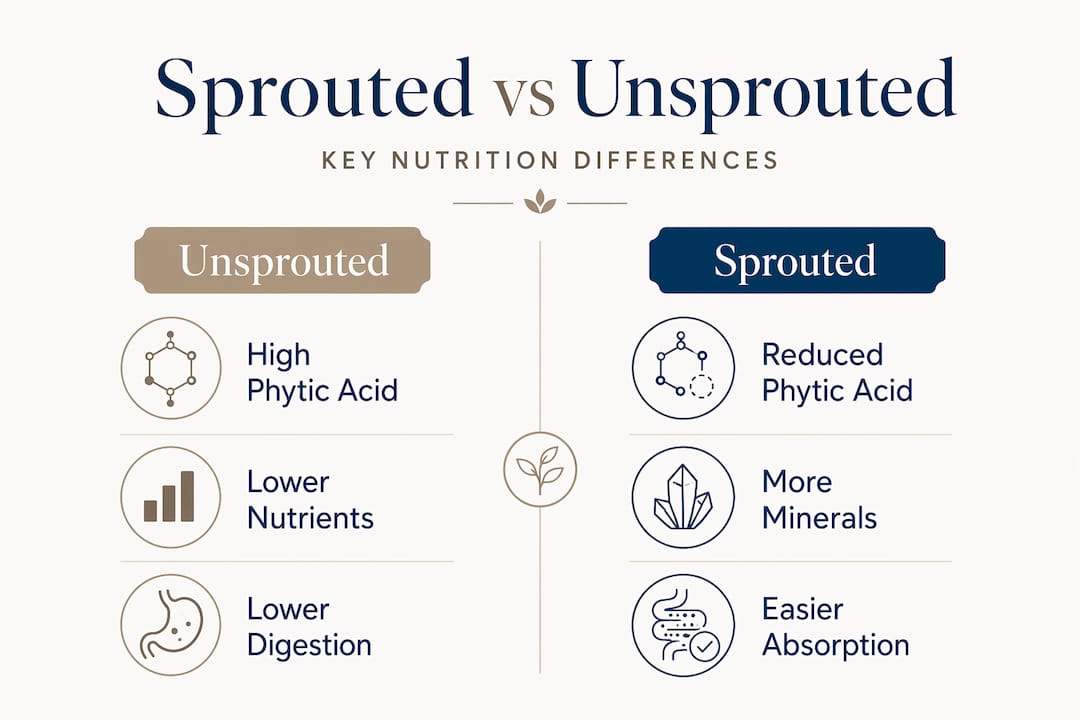
Here is how sprouted grains compare nutritionally to their unsprouted equivalents across key markers:
| Nutrient marker | Unsprouted whole grain | Sprouted grain |
|---|---|---|
| Phytic acid | High (binds minerals) | Significantly reduced |
| Vitamin C | Absent or trace | Present and measurable |
| Protein digestibility | Moderate | Improved |
| Antioxidant activity | Baseline | Increased |
| Gluten content | Standard | Roughly 47% lower in sprouted bread |
Real-world product profiles reinforce the science. Sprouted grain cereals like Ezekiel offer approximately 8 g of protein and 6 g of fibre per serving, figures that outperform most conventional cereals by a meaningful margin.
It is worth being honest about one nuance here. The degree of improvement depends on which grain you sprout and how long you sprout it. Phytate reduction varies widely between grain types and germination schedules. Sprouted wheat behaves differently from sprouted barley or lentils. Getting the most from the process requires matching the grain to the right soaking and germination time, not just assuming any sprouted product is automatically superior.
“Sprouted grains are not fundamentally new foods but metabolically active grains with enzyme-driven biochemical transformation after soaking.” Source: Sprouting on Wikipedia
For a deeper look at how specific micronutrients shift during sprouting, including the interplay between phytic acid and mineral absorption, Granavitalis has covered this territory in detail.
How to sprout grains safely at home
Knowing how to sprout grains correctly is where theory meets your kitchen. The process itself is simple. Getting it safely right requires paying attention to a few non-negotiable steps.
- Choose your grain. Wheat berries, barley, rye, buckwheat, and lentils all sprout well. Start with one grain before experimenting with combinations.
- Rinse thoroughly before soaking. Remove any debris, dust, or damaged kernels under cold running water.
- Soak in clean cold water. Soaking times range from 20 minutes to 12 hours depending on the grain. Smaller seeds like lentils need less time; harder grains like wheat berries need longer.
- Drain and transfer to a sprouting vessel. A wide-mouth jar covered with muslin cloth works perfectly. Invert it at a slight angle to allow continuous drainage.
- Rinse and drain at least twice daily. This is the single most important step for safety. Skipping rinses or allowing sprouts to overgrow significantly increases contamination risk and degrades texture.
- Watch for visible sprout tails. Most grains show a small white tail within 1 to 3 days. That is your cue to use them.
- Refrigerate or use immediately. Once sprouted, keep them in a sealed container in the fridge and use within 2 to 3 days.
Food safety here is not a footnote. Warm, moist sprouting conditions are exactly the environment that bacteria like Salmonella and E. coli thrive in. Raw sprouts have been linked to over 30 foodborne outbreaks. Cooking your sprouted grains before eating them eliminates this risk entirely. If you are pregnant, elderly, immunocompromised, or managing a chronic condition, cooked sprouted grains are the only sensible choice.
Pro Tip: Rinse your sprouting jar with boiling water before each new batch. It takes 30 seconds and removes any residual bacteria that could contaminate your sprouts from the start.

Safe home sprouting methods are also covered thoroughly by trusted food preparation resources, and this sprouting safety guide from PreparednessMama provides practical protocols worth bookmarking alongside your kitchen notes.
Incorporating sprouted grains into your diet
The role of sprouted grains in diet goes well beyond a loaf of speciality bread. Once you understand what sprouted grains actually are, the options for working them in feel natural rather than effortful.
Here are the most practical ways to build sprouted grains into your regular eating:
- Sprouted grain bread. The most accessible starting point. Look for loaves where sprouted grain appears as the first listed ingredient, not the third or fourth. Ezekiel-style breads are a well-documented example.
- Porridge and hot cereals. Sprouted oats or wheat berries cooked as porridge have a slightly sweeter, nuttier flavour than their unsprouted counterparts and sit more comfortably for people who find conventional oats heavy.
- Grain bowls and salads. Lightly cooked sprouted lentils, chickpeas, or barley add protein and texture to bowls. They hold their bite better than fully cooked legumes.
- Baking with sprouted flour. Sprouted grain flours are available commercially and behave much like whole grain flours in most recipes. They deliver improved nutritional profiles without any technique change on your part.
- As a cereal topping. A tablespoon of freshly sprouted grain scattered over yoghurt or fruit adds crunch and a live nutritional boost.
Reading labels on commercial sprouted products requires some scepticism. Some sprouted grain products contain added sugars or mixed flours that water down their health value considerably. The words “made with sprouted grains” on packaging can legally describe a product where sprouted grains are a minor ingredient. Check that fibre content is genuinely higher than a standard whole grain equivalent, that protein content reflects the sprouted grain’s profile, and that the ingredient list names specific sprouted grains rather than vague grain blends.
Understanding the broader benefits of unprocessed grains also helps put sprouted grains in context within a whole-food diet, particularly when you are deciding how much of your grain intake to shift toward sprouted varieties.
My honest take on sprouted grains
I find sprouted grains genuinely fascinating, not because they are a trend but because the science underneath them is so elegantly simple. A grain soaking in water, preparing to become a plant, unlocking nutrients it would otherwise guard behind biochemical locks. That is not a marketing story. It is biology.
What I have found in practice, though, is that people either over-complicate sprouting or under-estimate the safety side. I have seen readers go all-in on raw sprouted grain salads without grasping that warm, moist sprouting conditions are a near-perfect bacterial incubator. The benefits are real, but so is the risk if you skip your rinse cycles or eat raw sprouts belonging to a vulnerable group.
My advice is this: start with commercially sprouted products while you build confidence, then try home sprouting with one grain, follow the rinse schedule without shortcuts, and cook the results until you are genuinely comfortable with the process. The nutritional payoff is worth the learning curve. What it does not reward is impatience.
The role of sprouted grains in a well-rounded diet is as a reliable, high-quality carbohydrate source with better mineral availability and improved digestibility. Not a cure. Not magic. Just genuinely well-prepared food that your body handles more efficiently than its unsprouted equivalent.
— Jarrod
Pair sprouted grains with whole-food nutrition

Sprouted grains do their best work as part of a broader whole-food diet, and at Granavitalis, we think carefully about what belongs alongside them. A nutrient-dense breakfast built on sprouted grain bread becomes significantly more complete when paired with a quality nut or seed butter. Our raw organic pecan butter from RAWGORILLA is cold-pressed, unprocessed, and rich in healthy fats that complement the slower-releasing carbohydrates of sprouted grains perfectly. If you want to explore further, the nut and seed butter selection box gives you a range of RAWGORILLA butters to find what works best in your daily routine. Purity in ingredients, flavour that earns its place, and nutrition that genuinely supports your day.
FAQ
What is a sprouted grain, exactly?
A sprouted grain is a whole grain that has been soaked in water until it begins to germinate, producing a small shoot. The process triggers enzyme activity that improves nutrient availability and digestibility before the grain is dried or used.
Why eat sprouted grains instead of regular whole grains?
Sprouting significantly reduces anti-nutrients like phytic acid, which means your body absorbs more of the iron, zinc, and magnesium present in the grain. Vitamin C is synthesised during germination and protein digestibility improves, making sprouted grains nutritionally superior to their unsprouted counterparts.
Are raw sprouted grains safe to eat?
Raw sprouts carry a genuine food safety risk. Sprouting conditions promote bacterial growth, and over 30 foodborne outbreaks have been linked to raw sprouts. Cooking sprouted grains eliminates this risk and is recommended for anyone pregnant, elderly, or immunocompromised.
How long does it take to sprout grains at home?
Most grains show visible sprout tails within 1 to 3 days after soaking. Soaking time ranges from 20 minutes to 12 hours depending on the grain, followed by twice-daily rinsing during germination.
How do I identify a genuine sprouted grain product in a shop?
Check that a specific sprouted grain appears as one of the first ingredients on the label. Look for higher fibre and protein figures compared to standard whole grain equivalents, and be cautious of products where “sprouted grain” appears alongside added sugars or mixed flours that dilute the nutritional benefit.