
Grain-free diets explained: benefits, risks, and tips
TL;DR:
- Grain-free diets eliminate all grains, including pseudograins like quinoa and amaranth.
- Evidence for health benefits of grain-free diets is limited and often due to overall dietary changes.
- Most people should focus on whole, minimally processed grains rather than complete removal.
Many people assume that going grain-free is simply a stricter version of going gluten-free. It is not. The two diets differ significantly in scope, nutritional impact, and the evidence supporting them. If you have been considering a grain-free approach for better digestion, reduced inflammation, or more stable energy, understanding exactly what you are cutting out and why matters enormously. This article walks you through the science, the risks, and the practical realities so you can make a genuinely informed decision rather than following a trend that may not suit your body.
Table of Contents
- What is a grain-free diet?
- Health claims and scientific evidence
- Potential risks and nutrient concerns
- Who should (or shouldn’t) try grain-free?
- A realistic perspective on grain-free diets
- Explore grain-free options with Granavitalis
- Frequently asked questions
Key Takeaways
| Point | Details |
|---|---|
| Distinction from gluten-free | Grain-free diets exclude all grains, not just those with gluten, making them much stricter. |
| Benefits remain debated | While some report improved digestion and reduced inflammation, current research shows mixed results. |
| Nutritional risks exist | Going grain-free may increase chances of missing key nutrients, especially fibre and B vitamins. |
| Ideal for select cases | Grain-free eating is most relevant to those with grain sensitivities or autoimmune conditions. |
| Personalise your approach | For most people, whole and minimally processed grains support better overall nutrition and wellness. |
What is a grain-free diet?
A grain-free diet removes every grain from your plate, full stop. That includes the obvious ones like wheat and rye, but also corn, rice, oats, barley, and even foods commonly called pseudograins. Quinoa, buckwheat, and amaranth all fall into that last category. Many people are surprised to learn that these plant seeds, though nutritionally impressive, are still excluded on a strict grain-free plan.
A gluten-free vs grain-free comparison reveals a meaningful difference. Gluten-free eating removes only grains that contain gluten, namely wheat, barley, and rye. Someone following a gluten-free diet can still eat rice, corn, oats (if certified gluten-free), and quinoa without issue. A grain-free diet, by contrast, eliminates all grains including wheat, corn, rice, oats, barley, rye, quinoa, and pseudograins, going considerably further than gluten-free ever does.
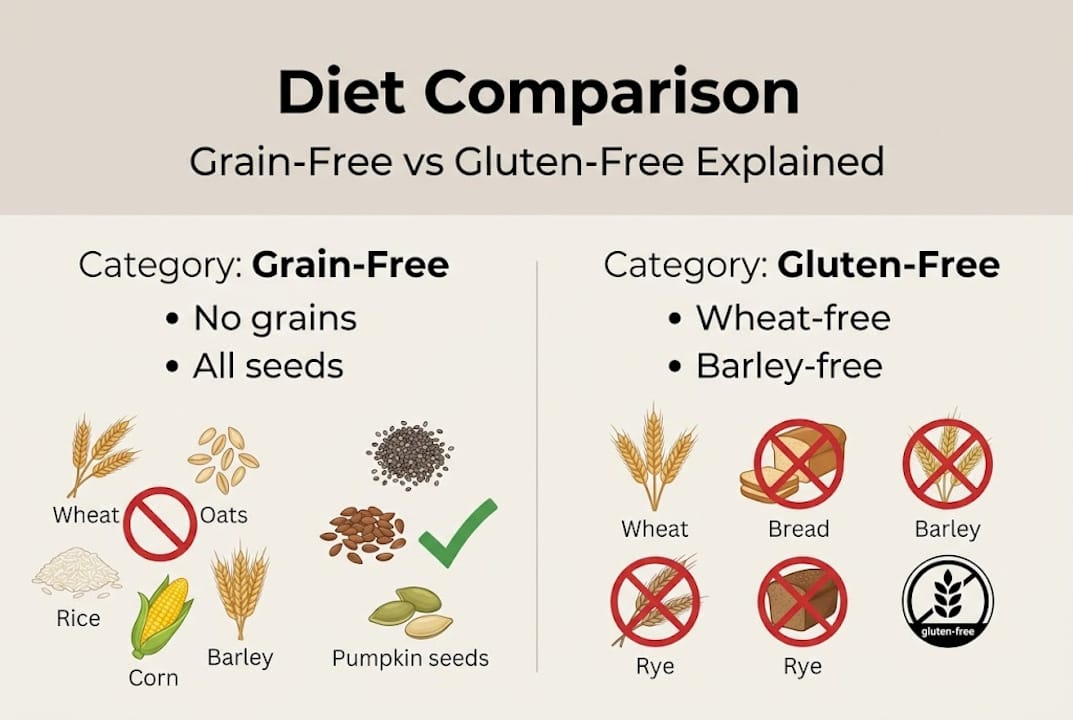
Understanding the gluten content in grains helps clarify why some people need to go further than simply avoiding gluten. Those with autoimmune conditions or broader grain sensitivities may react to proteins found in grains with gluten as well as those without it.
Foods excluded on a grain-free diet:
Wheat, spelt, kamut, rye, barley, oats, corn, rice, millet, sorghum, teff, quinoa, buckwheat, amaranth.
Foods permitted on a grain-free diet:
- Fresh and cooked vegetables (all varieties)
- Fruits in moderation (berries, citrus, apples)
- Nuts and seeds (almonds, walnuts, sunflower seeds, pumpkin seeds)
- Quality proteins (grass-fed meat, poultry, fish, eggs)
- Healthy fats (avocado, olive oil, coconut oil)
- Grain-free flours (almond flour, coconut flour, cassava flour)
- Legumes (depending on the specific protocol)
| Feature | Gluten-free | Grain-free |
|---|---|---|
| Removes wheat, barley, rye | Yes | Yes |
| Removes rice, corn, oats | No | Yes |
| Removes quinoa, buckwheat | No | Yes |
| Allows grain-free flours | Yes | Yes |
| Suitable for coeliac disease | Yes | Yes |
| Stricter than medical need for most | No | Often yes |
Health claims and scientific evidence
Proponents of grain-free eating point to a compelling list of potential benefits: improved digestion, reduced inflammation, more stable blood sugar, and support for autoimmune conditions. The reasoning centres on grain proteins called prolamins and glutelins, which some researchers suggest may trigger leaky gut and molecular mimicry, a process where the immune system mistakenly attacks the body’s own tissues after being activated by food proteins.
Those are meaningful claims. But what does the evidence actually show?
The honest answer is: less than the headlines suggest. Most studies on grain-free diets specifically are short-term, small-scale, or conducted in populations with pre-existing conditions. One area where data does exist is gluten-free eating in people with hypertension. A 90-day gluten-free study in hypertensive males showed 13 kg weight loss versus 7.66 kg in the control group, alongside measurable blood pressure reductions. That is notable, though it involves gluten-free eating rather than full grain-free.
“The evidence base for grain-free diets in the general population remains limited. Observed benefits may reflect broader improvements in diet quality rather than grain removal itself.”
| Health outcome | Gluten-free/grain-free | Whole grain diet |
|---|---|---|
| Weight loss (90 days) | 13 kg (hypertensive males) | Varies by study |
| Blood pressure | Reduced in some studies | Neutral to positive |
| Inflammation markers | Mixed results | Generally reduced |
| Gut health | Positive for sensitivities | Positive for general population |
Research on grain-free foods and gut inflammation suggests real benefits for those with sensitivities, but the picture changes when you compare grain-free vs whole grains for the broader population. Whole grains consistently outperform refined alternatives across cardiometabolic markers.
Pro Tip: If you are tracking your response to dietary changes, keep a simple food and symptom diary for at least four weeks. Patterns become visible quickly, and you will have something concrete to discuss with a registered dietitian.
Potential risks and nutrient concerns
The appeal of grain-free eating is real. The risks, however, deserve equal attention. Grains are a primary source of several key nutrients, and removing them without a deliberate plan can leave meaningful gaps in your diet.

Nutrient deficiencies are the most documented concern: fibre, iron, calcium, B vitamins, and folate are all commonly supplied by grains, and grain-free products sold as alternatives are often higher in fat and sugar than their conventional counterparts. Buying a grain-free biscuit is not the same as eating a nutrient-dense whole food.
A 12-week randomised controlled trial found that whole grains produced a 2.0 kg weight reduction versus the control group, alongside improvements in cardiometabolic markers. That is meaningful data for anyone weighing up whether to remove whole grains entirely.
Looking at modern grains vs ancient grains reveals that the problem is often not grains themselves but the heavily processed, industrially hybridised versions that dominate supermarket shelves. Exploring grain alternatives may be a smarter starting point than eliminating grains altogether.
Steps to monitor and mitigate nutrient deficiencies on a grain-free diet:
- Get a full blood panel before starting, including iron, ferritin, B12, folate, and vitamin D.
- Prioritise fibre from vegetables, legumes, nuts, and seeds every single day.
- Include calcium-rich foods such as leafy greens, almonds, and tinned fish with bones.
- Consider a B-complex supplement, particularly if you are also plant-based.
- Retest bloods at three and six months to catch any emerging deficiencies early.
- Work with a registered dietitian rather than self-directing a major dietary shift.
Pro Tip: Grain-free packaged products are not automatically healthier. Read the label. Many are loaded with added sugars and refined fats that undermine the very goals you are working towards.
Who should (or shouldn’t) try grain-free?
Grain-free eating is not a universal upgrade. For a specific group of people, it can make a genuine difference. For the majority, it is stricter than necessary and may introduce more problems than it solves.
Those most likely to benefit include people with confirmed grain sensitivities, non-coeliac gluten sensitivity, or autoimmune conditions where dietary triggers have been clinically identified. For this group, grain-free suits those with grain sensitivities or autoimmunity, and careful nutrient monitoring is essential throughout.
For everyone else, the picture is different. Expert guidance consistently suggests that grain-free is stricter than needed for most people, and that focusing on whole and minimally processed grains over refined ones is a more evidence-based approach. Personalising based on your actual symptoms and health status matters far more than following a blanket dietary rule.
If you are exploring nutritious grain alternatives or looking for grain-free breakfast ideas to trial the approach, starting with a structured short-term experiment is sensible before committing fully.
Signs grain-free might be worth considering:
- Persistent bloating or digestive discomfort after grain-containing meals
- Diagnosed autoimmune condition with suspected dietary triggers
- Confirmed non-coeliac gluten sensitivity or wheat allergy
- Ongoing fatigue or brain fog that has not responded to other interventions
- Recommendation from a qualified healthcare professional
Pro Tip: Trying grain-free for 30 days under professional guidance, then systematically reintroducing grains one at a time, is far more informative than committing to permanent restriction without a clear diagnosis.
A realistic perspective on grain-free diets
Here is something worth saying plainly: most people who go grain-free do so without a clinical reason. They feel bloated, sluggish, or inflamed, and grain-free seems like a logical fix. Sometimes it helps. But the improvement often has less to do with removing grains and more to do with removing processed food in general.
When someone cuts out bread, pasta, cereals, and crackers, they tend to eat more vegetables, more protein, and fewer ultra-processed snacks. That shift alone can produce noticeable improvements in energy and digestion. Attributing those gains purely to grain removal misses the bigger picture.
The evidence on grain-free is clear: no robust human randomised controlled trials exist specifically for grain-free diets, and gluten-free studies show mixed results, with no superiority over sham or hypocaloric diets in conditions like IBS and fibromyalgia. Meanwhile, whole grains and wellness research consistently supports their role in obesity management and cardiometabolic health.
The more useful question is not “should I go grain-free?” but “which grains serve my body, and which do not?” That is a more honest, more personalised, and ultimately more effective way to approach nutrition.
Explore grain-free options with Granavitalis
If you are genuinely exploring grain-free eating, having the right foods to hand makes the transition far more sustainable. At Granavitalis, we stock a range of products that fit naturally into a grain-free lifestyle, from nutrient-dense nut butters to whole seeds and snacking options built around real ingredients.

Our raw organic pecan butter is a rich, grain-free source of healthy fats and minerals, perfect for breakfasts and post-workout recovery. The nut and seed butter box is ideal if you want to explore a variety of options in one go. For snacking and baking, our nibbed hazel nuts add texture, flavour, and genuine nutritional value without any grain content whatsoever.
Frequently asked questions
Which foods are excluded in a grain-free diet?
All grains including wheat, corn, rice, oats, barley, rye, quinoa, and other pseudograins are excluded. This goes considerably further than a standard gluten-free diet.
Is a grain-free diet healthier than a gluten-free diet?
Not necessarily. Grain-free is stricter, but whole grains are linked to improved cardiometabolic health in randomised controlled trials, making blanket grain removal hard to justify for most people.
What are the risks of removing grains from my diet?
Excluding grains raises the risk of missing fibre, iron, calcium, B vitamins, and folate. Regular blood monitoring and a well-planned diet are essential to avoid deficiencies.
Who benefits most from grain-free eating?
Grain-free suits those with confirmed grain sensitivities or autoimmune conditions most. For the general population, prioritising whole and minimally processed grains is a more evidence-based approach.
Are grain alternatives like almond or coconut flour allowed?
Yes. Almond flour, coconut flour, cassava flour, and similar options are all permitted, making grain-free baking entirely achievable with the right ingredients.