
What defines wholefood vitality: a clear guide
TL;DR:
- Wholefood vitality is about achieving sustained physical and mental well-being through consistently eating minimally processed, nutrient-dense foods. It emphasizes choosing foods close to their natural state and being mindful of processing levels, fiber sources, and ingredient quality. Building vitality requires gradual, consistent dietary habits that support body systems, with measurable benefits emerging over weeks.
Vitality gets misunderstood constantly. Most people associate it with a caffeine kick or a mid-morning energy spike, something you feel for an hour and then chase again. What defines wholefood vitality is something steadier and more meaningful than that. In nutritional science, this concept aligns closely with what researchers call dietary quality and nutrient adequacy — the sustained, system-wide state of physical and mental well-being that comes from consistently eating foods close to their natural state. This guide explains what that actually means, why it matters more than you might expect, and how to build it into real daily life.
Table of Contents
- Key takeaways
- What defines wholefood vitality
- The science behind wholefood nutrition and vitality
- Misconceptions about wholefood vitality
- Building wholefood vitality into daily life
- My honest take on wholefood vitality
- Fuel your vitality with Granavitalis
- FAQ
Key takeaways
| Point | Details |
|---|---|
| Whole foods, defined clearly | Foods minimally processed and free from added sugars, salts, and fats form the foundation of wholefood vitality. |
| Processing level changes everything | The NOVA framework distinguishes minimally processed foods from ultra-processed ones, and the difference in energy and cravings is measurable. |
| Fibre drives more than digestion | Dietary fibre from whole food sources regulates blood sugar, supports gut microbes, and sustains steady energy throughout the day. |
| Vitality is systemic, not momentary | True vitality reflects body systems working in harmony, shaped by food quality, sleep, movement, and stress management together. |
| Label awareness matters | Some foods marketed as natural contain added sugars or additives that shift them out of the wholefood category entirely. |
What defines wholefood vitality
To answer this properly, you need two definitions working together: what counts as a whole food, and what vitality actually means in a physiological sense.
Whole foods are minimally processed and kept close to their natural state. The British Heart Foundation places fruits, vegetables, wholegrains, nuts, seeds, beans, legumes, plain dairy, and unprocessed meats and fish in this category. What they share is the absence of added sugars, salts, or fats introduced during manufacturing. Plain yogurt qualifies. Flavoured yogurt with added sweeteners does not.
The NOVA food classification system, developed by nutrition researchers, organises foods by degree of processing rather than nutrient content alone. It draws a clear line between:
- Minimally processed foods: washed, dried, frozen, or cooked with no added ingredients beyond safety requirements
- Processed foods: whole foods with added salt, sugar, or oil (think tinned tomatoes with salt, or cheese)
- Ultra-processed foods: industrially manufactured products containing additives, emulsifiers, and artificial flavourings with little resemblance to their original ingredients
Minimally processed foods aid steady energy and reduce cravings compared to ultra-processed alternatives, which is where the connection to vitality begins.
Vitality, in this context, is not a burst of alertness. It is the steady, system-wide balance that emerges when your body receives the nutrients it needs to repair, regulate, and sustain itself. Wholefood vitality, then, is the state of sustained well-being that comes specifically from building your diet around minimally processed, nutrient-rich foods.
Pro Tip: Use the NOVA framework as a mental filter when shopping rather than relying on front-of-pack marketing claims. If a product has a long ingredient list with names you would not find in a kitchen, it is almost certainly ultra-processed.
The science behind wholefood nutrition and vitality
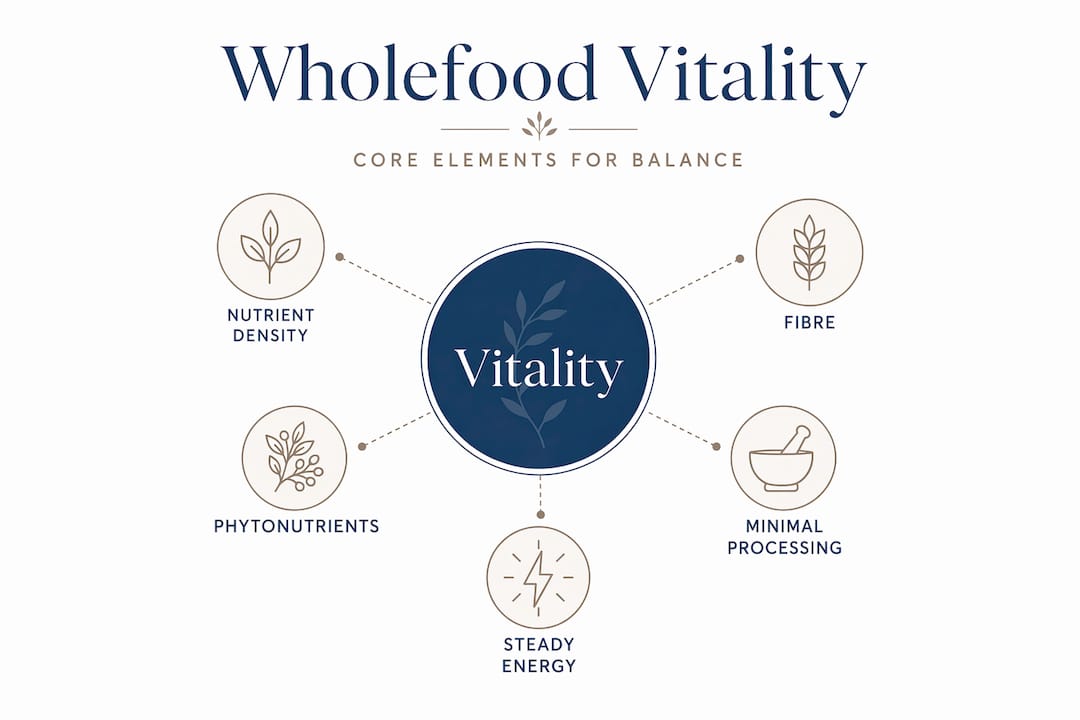
Understanding why whole foods support vitality requires looking at three interconnected mechanisms: nutrient density, the role of dietary fibre, and the effect of macronutrient balance on energy regulation.

Nutrient-dense foods deliver vitamins, minerals, antioxidants, and phytonutrients in amounts that genuinely fuel cellular repair and metabolic function. The physical structure of these foods also matters. Whole food structure affects how the body absorbs and uses nutrients. Whole almonds, for example, result in less fat absorption than ground almond butter because the cell walls slow digestion. Eating an apple produces a slower blood sugar rise than drinking apple juice, even when the sugar content is identical, because the fibre matrix is intact. This is why the form of food counts, not just its ingredient list.
Dietary fibre is perhaps the most underappreciated driver of real-food vitality. Fibre from whole food sources supports digestive health and helps regulate blood sugar and cholesterol. Different types of fibre feed different gut microbes, and a diverse microbiome is increasingly linked to mood regulation, immune function, and sustained energy. The best sources include oats, whole grains, kale, nuts, seeds, lentils, beans, and apples.
The table below shows how macronutrient sources from whole foods compare to processed equivalents in their effect on energy regulation:
| Food source | Energy effect | Satiety | Blood sugar response |
|---|---|---|---|
| Oats (whole rolled) | Sustained release | High | Gradual rise |
| Sweetened breakfast cereal | Rapid spike, then dip | Low | Sharp rise |
| Whole almonds | Slow, steady | High | Minimal impact |
| Processed snack bar with sugar | Brief spike | Low | Sharp rise |
| Lentils | Long-lasting | High | Very gradual |
| White bread | Rapid then drops | Low | Quick rise |
Added sugar actively works against vitality. 2026 dietary guidelines recommend limiting added sugar to no more than 10g per meal, reflecting growing evidence that excess sugar disrupts energy regulation, contributes to inflammation, and undermines the steady metabolic function that defines wholefood vitality.
Pro Tip: Aiming for five different fibre sources daily is a practical target that supports microbiome diversity without requiring radical dietary changes. Start with one or two additions and build up gradually to avoid bloating.
Misconceptions about wholefood vitality
The biggest misunderstanding is treating vitality as synonymous with immediate energy. If you feel sluggish after lunch, you might reach for a sugary snack for a quick lift. That is the opposite of wholefood vitality. That is managing an energy deficit caused by a poorly structured meal, not building genuine well-being.
“Vitality is not something you consume in a single sitting. It is what you build, gradually, through consistent choices that your body can actually use.”
True vitality reflects body systems working in harmony, shaped by sleep quality, physical movement, stress levels, and food quality together. Diet is the most controllable lever, but it is not the only one.
The second common misconception involves assuming that anything labelled “natural” or “minimally processed” is automatically a whole food. This is where ingredient awareness becomes non-negotiable. Consider these distinctions:
- Plain yogurt contains milk and live cultures. It qualifies as a whole food.
- Flavoured yogurt typically contains added sugar, fruit concentrates, and sometimes stabilisers. It does not.
- Rolled oats are minimally processed and whole. Instant flavoured oat sachets often contain salt, sugar, and artificial flavourings.
- Nut butter with one ingredient (the nut itself) is a whole food. Many commercial nut butters contain added palm oil and sugar.
Added sweeteners and additives often shift foods out of the whole category despite marketing claims. Reading the ingredient list, rather than the front of the pack, is the most reliable way to confirm a food’s actual status.
The form of the food also changes its nutritional behaviour. Eating whole fruit delivers fibre, slows sugar absorption, and keeps you fuller for longer. Drinking the same amount of fruit as juice removes the fibre matrix, accelerates sugar absorption, and does little for satiety. These are not equivalent choices, even if the underlying ingredients are similar.
You can explore the role of food physical form in nutrient delivery for a more detailed breakdown of why structural integrity in food matters as much as ingredient quality.
Building wholefood vitality into daily life
The practical application of these principles does not require a dramatic overhaul. Small, consistent shifts compound into meaningful change over weeks and months. Here is a structured approach:
-
Anchor each meal to a whole food base. Build around minimally processed staples: whole grains like oats, brown rice, or buckwheat; legumes such as lentils or chickpeas; vegetables in as many colours as you can manage; and a quality protein source. This alone changes the nutritional character of your day significantly.
-
Balance fibre, protein, and micronutrients deliberately. A meal of white rice and plain chicken is low in fibre and micronutrients. The same calories from brown rice, grilled salmon, and roasted broccoli delivers B vitamins, omega-3 fatty acids, vitamin C, and complex carbohydrates. The calorie count can be similar. The vitality outcome is not. For practical guidance on foods high in protein and fibre, the Granavitalis nutrition blog is a useful starting point.
-
Increase fibre intake gradually with adequate water. Gradual fibre increases with hydration are crucial for benefiting from fibre without gastrointestinal discomfort. Adding a cup of lentils to your diet overnight can cause bloating if your gut microbiome is not accustomed to it. Add one new fibre source per week and drink at least 1.5 to 2 litres of water daily alongside it.
-
Make direct swaps for ultra-processed items. Replace a shop-bought cereal bar with a small handful of mixed nuts and dried fruit. Swap flavoured crisps for roasted chickpeas seasoned with smoked paprika. Shift from sweetened yogurt to plain Greek yogurt with fresh berries. These swaps are not about restriction. They are about upgrading the nutritional quality of what you already enjoy. A guide to healthy convenience snacks offers practical ideas for maintaining wholefood choices when time is short.
-
Track your subjective signals, not just your food log. Notice digestion regularity, how stable your energy feels between meals, whether cravings have reduced, and how your concentration holds across the afternoon. These are the real indicators of sustained vitality, more reliable than any single nutritional metric. Tracking these outcomes confirms whether a wholefood pattern is genuinely working for you.
Pro Tip: Meal variety supports both nutrient breadth and gut microbiome diversity. Eating variety in meals consistently provides wider micronutrient coverage than rotating between five familiar meals.
My honest take on wholefood vitality
I have spent years watching people chase vitality through supplements, detox programmes, and the latest trending superfood, only to return to baseline within weeks. The pattern is predictable. The intervention is exciting, the initial results feel promising, and then real life resumes and so do old habits.
What I have found actually works is far less dramatic. It is building a default way of eating where whole, minimally processed foods are simply the easiest option available. Not perfect, not rigid, but consistently leaning towards quality over convenience when you have the choice.
The uncomfortable truth is that vitality as sustained well-being takes months to build, not days. You do not feel it dramatically. You notice it gradually. Your energy stops crashing at 3pm. You stop craving sugar after meals. Your digestion becomes something you simply do not think about, which is how it should be.
My advice is to ignore the noise about any single food being transformative and focus instead on the ratio of whole to processed food across your week. If most of what you eat is minimally processed and varied, you are already practising wholefood vitality. Perfection is not the point. Direction is.
— Jarrod
Fuel your vitality with Granavitalis
If you want to put these principles into practice without spending hours sourcing ingredients, Granavitalis has done the groundwork for you.

Every product in the Granavitalis range is built around the same principles this article lays out: minimal processing, whole ingredients, no unnecessary additives. The immune booster superfood bundle is a standout starting point, bringing together carefully selected wholefood ingredients designed to support immunity and vitality from the inside out. If you are looking to add quality fats and protein from a single, clean source, the organic nut and seed butter selection delivers exactly that, with nothing added beyond the ingredient itself.
Granavitalis sources ancient grains, premium nuts, seeds, and clean plant proteins so your daily meals can reflect genuine wholefood quality, without compromise or complication.
FAQ
What is wholefood vitality?
Wholefood vitality is the state of sustained physical and mental well-being that comes from consistently eating minimally processed, nutrient-dense foods. It is a systemic condition shaped by diet quality, not a temporary energy spike.
Which foods count as whole foods?
Whole foods include fruits, vegetables, wholegrains, nuts, seeds, legumes, plain dairy, and unprocessed meats and fish, provided they contain no added sugars, salts, or manufactured additives.
How does fibre support vitality?
Dietary fibre from whole food sources regulates blood sugar, lowers cholesterol, and feeds diverse gut microbes, all of which contribute to steady energy and overall well-being. Variety in fibre sources matters as much as quantity.
Are all minimally processed foods whole foods?
No. Some minimally processed foods still contain added sugars or additives, such as flavoured yogurts or processed nut butters with palm oil. Reading ingredient labels is the most reliable way to confirm a food’s wholefood status.
How long does it take to feel the benefits?
Meaningful improvements in energy stability, digestion, and reduced cravings typically emerge over several weeks of consistent wholefood eating. Tracking subjective signals like afternoon energy levels and craving frequency is the most practical way to measure progress.