

The role of nutrient timing: a practical 2026 guide
TL;DR:
- Nutrient timing enhances performance and recovery mainly when training volume and frequency are high.
- For most people, total daily protein and calorie intake are more important than precise meal timing.
Nutrient timing is defined as the deliberate scheduling of food and macronutrient intake around exercise and daily rhythms to support performance, recovery, and metabolic health. The International Society of Sports Nutrition (ISSN) confirms that total daily intake outranks specific meal timing for most people, yet timing still provides a meaningful edge under the right conditions. The emerging field of chrononutrition adds another layer, showing that when you eat relative to your circadian rhythm shapes insulin sensitivity and cardiometabolic health independently of what you eat. For fitness enthusiasts who have already nailed their calories and macros, understanding the role of nutrient timing is the logical next step.
How does nutrient timing affect exercise performance and recovery?
Carbohydrate timing is the most evidence-backed application of nutrient timing for performance. Muscle glycogen is the primary fuel for moderate to high-intensity exercise, and depleting it reduces output and delays recovery. For athletes training twice a day, consuming carbohydrates 30–60 minutes pre-exercise and immediately post-exercise with 15–30 minute feedings accelerates glycogen resynthesis. This matters most when sessions are spaced fewer than eight hours apart.
Protein timing works differently. The classic belief was that you had a narrow 30–60 minute “anabolic window” after training to consume protein or risk wasting your session. Research now shows that muscle sensitivity to amino acids extends at least 24 hours post-exercise. That finding does not mean timing is irrelevant. It means the window is far wider than the fitness industry once claimed.
The practical implications split into two groups:
- Multiple daily sessions: Timing is critical. Rapid glycogen resynthesis and protein delivery between sessions directly affects the quality of your second workout.
- Single daily sessions: Timing is a fine-tuning tool, not a foundation. Getting your total protein and carbohydrate intake right across the day matters far more.
- Pre-exercise nutrition: A meal containing both carbohydrates and protein 2–3 hours before training supports energy availability and reduces muscle breakdown during the session.
- Post-exercise nutrition: A protein-containing meal or snack within a few hours of training is sensible, but it does not need to happen within minutes of finishing.
Pro Tip: If you train in the morning and cannot face a full meal beforehand, a small carbohydrate snack such as a banana or a spoonful of nut butter 30 minutes before your session can sustain energy without causing discomfort.
What are the benefits and limitations of nutrient timing?
The ISSN recommends a daily protein intake of 1.4–2.0 g per kg of body weight, spread across doses of 20–40 g every 3–4 hours. That distribution pattern supports muscle protein synthesis more consistently than eating the same total protein in one or two large meals. The spacing matters because muscle protein synthesis has a ceiling response per dose; excess protein in a single sitting does not simply carry over.
For body composition, the benefits of timing are real but modest. Nutrient timing offers roughly a 5–10% edge once total daily intake is adequate. Recreational lifters gain less from precise timing than elite athletes who train at high volumes and frequencies. If your total protein is too low, no timing strategy compensates for that deficit.
Chrononutrition adds a health dimension that goes beyond performance. Eating later in the biological night impairs glucose regulation and insulin sensitivity compared to earlier, circadian-aligned eating. That finding has direct implications for body composition and long-term metabolic health, not just athletic output.
Here is how the benefits and limitations compare across different contexts:
| Context | Benefit of timing | Practical priority |
|---|---|---|
| Elite athlete, multiple sessions | High: glycogen and protein delivery critical | Prioritise timing alongside total intake |
| Recreational lifter, one session daily | Moderate: protein distribution supports synthesis | Focus on total intake first, then distribution |
| Health-conscious non-athlete | Moderate: circadian alignment improves metabolic markers | Favour earlier meals, avoid late-night eating |
| Calorie deficit phase | Low: total intake deficit outweighs timing effects | Hit protein targets before worrying about timing |
The numbered priorities for anyone starting out with nutrient timing strategies:
- Hit your total daily protein target consistently before adjusting timing.
- Distribute protein across 3–5 meals rather than concentrating it in one or two.
- Place carbohydrates around training sessions, particularly if you train more than once a day.
- Shift your eating window earlier in the day where your lifestyle allows.
- Treat timing as a refinement, not a replacement for sound daily nutrition.
How to implement nutrient timing strategies in everyday life
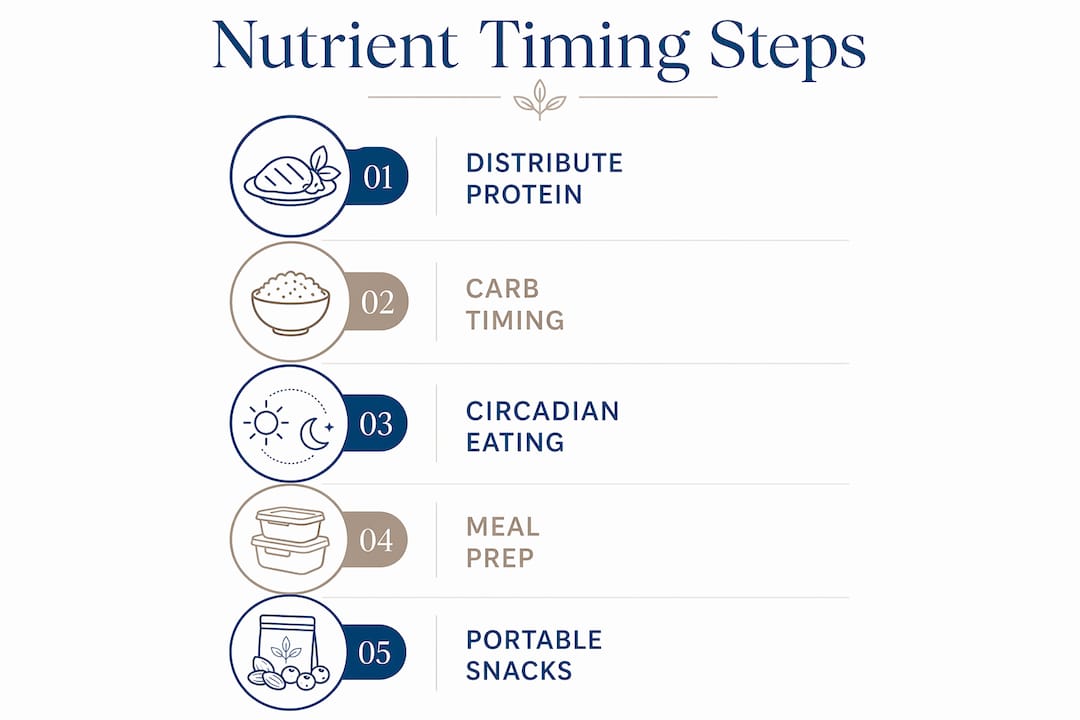
Distributing protein evenly through the day is the single most practical nutrient timing strategy for most fitness enthusiasts. Aim for 20–40 g of protein per meal across four to five eating occasions. This is not about eating every two hours with military precision. It is about avoiding the common pattern of a low-protein breakfast, a moderate lunch, and a protein-heavy dinner that leaves muscle protein synthesis under-stimulated for most of the day.

Carbohydrate timing around training is the second priority. If you train in the morning, include a carbohydrate-containing meal or snack beforehand and a mixed meal with protein and carbohydrates within two hours after. If you train in the evening, your regular dinner serves as your post-workout meal. There is no need to add an extra meal. For plant-based recovery options that deliver both protein and carbohydrates, whole foods such as legumes, ancient grains, and nut butters work well in this window.
Circadian alignment is the most underused nutrient timing strategy. Aligning food intake with circadian biology supports cardiometabolic health beyond what nutrient content alone achieves. Practically, this means front-loading your calories earlier in the day and keeping evening meals lighter. Late-night eating is not catastrophic, but it consistently produces worse metabolic outcomes than the same food eaten earlier.
Pro Tip: Meal prepping two or three protein-rich options on a Sunday makes it far easier to hit your protein distribution targets across the week without relying on willpower at 7am. A guide on meal prep for complete nutrition covers the practical steps in detail.
For busy schedules, the key is reducing friction. Keep portable, protein-containing foods accessible: hard-boiled eggs, Greek yoghurt, nut butters, or a handful of nuts. These are not perfect meals, but they prevent the long gaps between eating that undermine consistent protein distribution. Rigid timing schedules fail because life intervenes. A flexible framework that you actually follow beats a perfect plan you abandon by Wednesday.
Common misconceptions and debates about nutrient timing
The anabolic window is the most overhyped concept in sports nutrition. Earlier studies that appeared to show a critical post-workout timing advantage failed to control for total protein intake. When researchers matched total daily protein between groups, the timing advantage largely disappeared. The window exists, but it spans many hours, not 30 minutes.
“The ‘window of opportunity’ concept is oversimplified; nutrient timing matters under specific conditions but usually provides at most a small edge.” — MySportScience
Total daily protein intake remains the primary driver of muscle growth and recovery, consistently outranking timing effects across meta-analyses. This is not an argument against timing. It is an argument for getting your priorities right. Timing is a layer of refinement, not a foundation.
Fasted training is another area where the debate runs ahead of the evidence. Training in a fasted state can shift metabolic signals, but it does not reliably improve long-term performance. Strategic rather than default fasted training is the sensible approach. If fasted training suits your schedule and you perform well, it is a valid choice. If it reduces your output, the metabolic signals are not worth the performance cost.
The conditions where timing genuinely matters are specific: multiple training sessions per day, competition preparation over 24–36 hours pre-event, and athletes with very high training volumes. For the majority of fitness enthusiasts training once a day, the 4Ps framework of Personalise, Periodise, Prefuel, and Prepare offers a more useful lens than chasing a narrow post-workout window.
Key takeaways
Nutrient timing refines performance and recovery, but total daily protein and calorie intake remains the foundation that timing cannot replace.
| Point | Details |
|---|---|
| Total intake comes first | Hit your daily protein and calorie targets before adjusting meal timing. |
| Distribute protein evenly | Spread 20–40 g doses across 3–5 meals to support muscle protein synthesis consistently. |
| Time carbs around training | Place carbohydrates before and after sessions, especially when training more than once a day. |
| Align meals with your body clock | Eating earlier in the day improves insulin sensitivity and cardiometabolic markers. |
| The anabolic window is wide | Muscle sensitivity to amino acids lasts 24+ hours post-exercise, not 30 minutes. |
Nutrient timing in practice: what I have actually learned
The most common mistake I see fitness enthusiasts make is treating nutrient timing as a shortcut. They obsess over the post-workout shake while their total daily protein sits well below their target. Timing cannot rescue a diet that is fundamentally under-fuelled.
That said, once the basics are solid, timing does make a noticeable difference. Distributing protein evenly across the day rather than back-loading it into dinner genuinely changes how recovered you feel the next morning. It is not dramatic, but it is consistent. And consistency is what compounds over months of training.
The chrononutrition research has shifted how I think about evening eating. I used to treat a late dinner as neutral. The evidence that circadian-aligned eating improves metabolic markers independently of what you eat is persuasive enough to change behaviour. Shifting the main meal earlier is one of the lowest-effort, highest-return adjustments you can make. For purposeful nutrition strategies that integrate timing with individual goals, the principles are the same: personalise, be consistent, and do not let perfect be the enemy of good.
Individual variation is real. Some people perform brilliantly fasted. Others need food before any meaningful training session. The framework matters more than the rigid rule. Build your timing strategy around your training schedule, your sleep pattern, and the foods you actually enjoy eating.
— Jarrod
Granavitalis and your nutrient timing goals
Timing your nutrients well means having the right foods ready when your body needs them most.

Granavitalis sources whole, minimally processed foods that fit naturally into a nutrient timing approach. The Raw Organic Pecan Butter by RAWGORILLA delivers healthy fats and protein in a format that travels easily, making it a practical pre or post-workout option without preparation. For variety across the week, the Organic Nut and Seed Butter Selection Box gives you multiple nutrient-dense options to rotate around your training sessions. Every product Granavitalis offers is rooted in purity and built for real-life performance, not convenience at the cost of quality.
FAQ
What is nutrient timing?
Nutrient timing is the practice of scheduling food intake, particularly protein and carbohydrates, around exercise and daily biological rhythms to support performance and recovery.
Does the post-workout anabolic window really exist?
The anabolic window exists but spans at least 24 hours post-exercise, not 30–60 minutes. Total daily protein intake has a greater effect on muscle growth than the precise timing of a post-workout meal.
How much protein should I eat per meal for best results?
The ISSN recommends 20–40 g of protein per meal, spread across 3–5 eating occasions throughout the day, as the most effective distribution for supporting muscle protein synthesis.
Does eating late at night affect body composition?
Eating later in the biological night impairs glucose regulation and insulin sensitivity compared to earlier meals. Over time, this pattern negatively affects cardiometabolic markers and body composition.
Is nutrient timing worth it for recreational athletes?
Nutrient timing offers a modest edge for recreational athletes once total daily intake is adequate. The benefit is more pronounced for elite athletes or those training multiple times per day.