
4 Week Start for Real Food Diets Backed by UK Guidance
A real food diet means building meals around whole or minimally processed foods rather than packaged, reformulated products. UK public-health guidance, including the NHS Eatwell Guide and the British Dietetic Association, backs this pattern for long-term heart, weight and metabolic health. The rest comes down to definitions, portions and small habits you can start this week.
TL;DR:
- Consuming over 400 grams of fruit and vegetables daily, mainly fresh, frozen, or canned, is linked to reduced risks of heart disease, stroke, and some cancers.
- Replacing refined grains with wholegrain versions and avoiding ultra-processed foods should be prioritized to boost nutrient intake and satiety.
- Public-health data shows that higher fruit and vegetable intake and wholegrain consumption support better cardiovascular health, but total calorie and activity levels remain influential.
- Starting with simple additions, such as extra vegetables and wholegrain swaps, builds sustainable habits more effectively than strict restriction.
- Choosing single-ingredient staples without additives, like ancient grain flours and nut butters, supports long-term adherence to a real food diet.
Table of Contents
- What is a real food diet, really?
- How does a real food diet map onto the Eatwell Guide?
- What does the evidence actually say about real food diets?
- How do you actually start eating this way?
- Quick swaps and meal templates you can use today
- What myths get in the way of eating real food?
- Jarrod’s perspective: applying real food principles with Granavitalis products
- The gap between good advice and what people actually do
- Stocking a real food kitchen with Granavitalis
- Sources
What is a real food diet, really?
“Real food” is not an official nutrition term, but it maps closely onto what dietitians call whole or minimally processed food: ingredients that look roughly like they did when they came out of the ground, off the tree, or off the animal. Think oats, not oat-flavoured cereal bars; a whole chicken breast, not reformed nuggets.
The confusion usually sits in the word “processed” itself. Processing runs on a spectrum. Freezing peas, canning tomatoes and pasteurising milk are processing steps that preserve nutrients and keep food safe. They are not the enemy. The NHS notes that the real concern is ultra-processed food, which tends to be energy-dense, nutrient-poor, and easy to overeat because it’s engineered to be moreish.
A quick label check tells you most of what you need to know:
- Short ingredient lists (five or fewer, ideally recognisable as food) usually signal minimal processing.
- Long lists with emulsifiers, flavour enhancers, or multiple sweeteners point towards ultra-processed territory.
- “Made with wholegrain” on the front doesn’t guarantee wholegrain is the main ingredient. Check the list.
- Frozen and tinned fruit and vegetables count as real food and are often cheaper than fresh.
How does a real food diet map onto the Eatwell Guide?
A real food diet isn’t a separate eating pattern from official guidance. It’s what the Eatwell Guide looks like once you swap refined and packaged versions for whole ones. The government model splits your plate into groups, and each has a real-food equivalent worth knowing:
- Vegetables and fruit: roughly a third of what you eat, fresh, frozen, tinned or dried.
- Wholegrain starchy carbohydrates: another third, covering oats, brown rice, wholewheat pasta and wholegrain bread.
- Protein sources: beans, pulses, fish, eggs, and meat, plus other plant proteins.
- Dairy or fortified alternatives: milk, yoghurt, cheese, or unsweetened plant versions.
- Nuts and seeds: small amounts, unsalted where possible.
- Healthy fats in small quantities: olive or rapeseed oil rather than heavily processed spreads.
Statistic callout: The Eatwell Guide sets five-a-day as a minimum, built from portions of roughly 80g each, meaning at least 400g of fruit and vegetables daily.
A practical portion cue: a 80g portion is about a handful of berries, a medium apple, or three heaped tablespoons of cooked vegetables. Hitting five a day is the floor, not the ceiling.
What does the evidence actually say about real food diets?
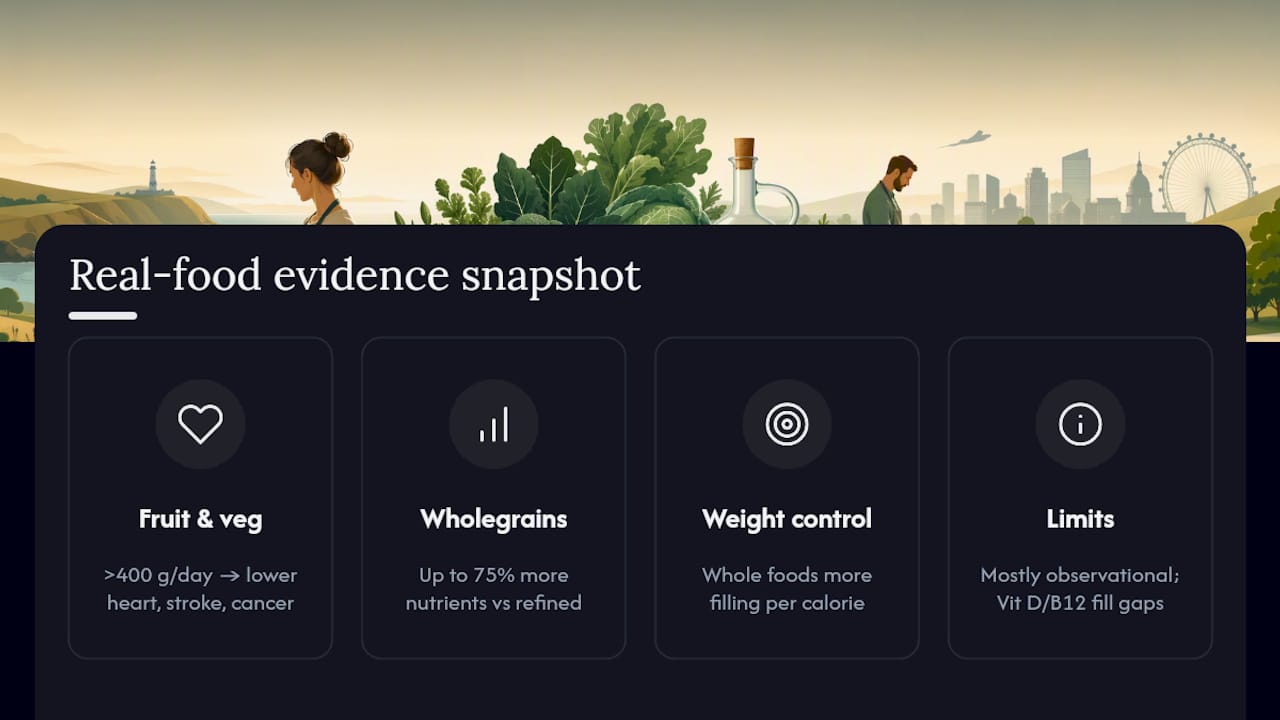
The strongest, most consistent signal in UK public-health data links higher fruit and vegetable intake with lower cardiovascular risk. Government guidance states that consuming more than 400g of fruit and vegetables daily is associated with reduced risk of heart disease, stroke and some cancers. Wholegrains carry a similar weight of evidence: the British Dietetic Association notes that wholegrains can contain up to 75% more nutrients than their refined equivalents, and swapping refined cereals for wholegrain versions supports steadier blood sugar and better appetite control.
A whole grain isn’t just “more fibre”. It’s a complete package of fibre, protein, vitamins, minerals and plant compounds that refining strips away piece by piece.
Weight management benefits from real food diets mostly through mechanism rather than magic: whole foods are typically more filling per calorie, which makes it easier to eat within your energy needs without consciously restricting.
None of this is proof in the strict clinical sense. Most of the supporting data comes from observational studies, which track associations rather than prove direct cause and effect. Total calorie intake and physical activity still shape outcomes regardless of how whole your food is. And no supplement regime replaces the combined nutrient package whole food delivers. Vitamin D in autumn and winter, or B12 for those avoiding animal products, fill specific gaps. They don’t substitute for the diet itself.
How do you actually start eating this way?
Cutting out food groups rarely sticks. Adding nutrient-dense whole foods first does, according to programmes like the NHS-supported Real Food Real Health course, which builds change around addition rather than restriction.
- Week 1: add two extra vegetable portions daily and swap one refined grain for a wholegrain version, such as swapping white rice for brown.
- Week 2: introduce one pulse-based meal (lentils, chickpeas, beans) and a nut or seed snack.
- Week 3: drop one ultra-processed item from your usual rotation and batch-cook two meals from scratch.
- Week 4 onward: repeat the pattern, tracking fibre and five-a-day rather than calories.
Before any of that, do a pantry sweep. Pull everything with an ingredient list longer than you can read in one breath and decide what actually earns a place back on the shelf. Shop the edges of the supermarket first, where fresh, frozen and chilled whole foods live, then dip into the middle aisles for pulses, oats, and tinned tomatoes, following practical tips for eating healthy on holiday to maintain your wholefood habits even when away.
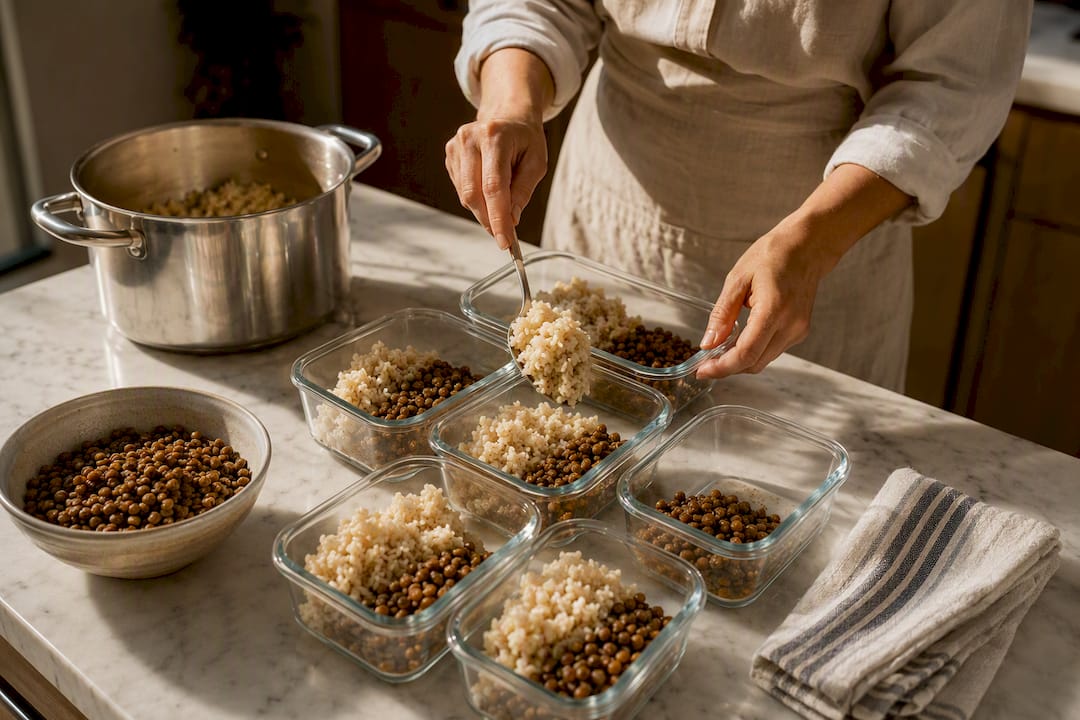
Pro Tip: Batch-cook a base grain (wholegrain rice, quinoa, or barley) and a base protein (lentils, beans, or roast chicken) once a week. Having both ready in the fridge removes the main excuse for reaching for something ultra-processed on a tired evening.
Track progress loosely: a simple tally of vegetable portions and wholegrain swaps on your phone tells you more than obsessive calorie logging ever will.
Quick swaps and meal templates you can use today
Small substitutions add up faster than a full meal-plan overhaul. Try these one-for-one swaps:
- Sugary breakfast cereal → porridge oats with fruit.
- White bread → wholegrain or seeded bread.
- Fruit juice → whole fruit.
- Flavoured yoghurt → plain yoghurt with berries and seeds.
- Processed deli meat → grilled chicken, tinned fish, or roasted chickpeas.
Plant-forward template: overnight oats with chia and berries for breakfast, a lentil and vegetable curry with brown rice for dinner, hummus and vegetable sticks as a snack. For more high-fibre vegan recipes, there’s a fuller collection worth working through.
Omnivore template: eggs with wholegrain toast and spinach for breakfast, grilled salmon with roasted vegetables and quinoa for dinner, a handful of nuts as a snack. If mornings feel like the hardest meal to fix, a protein and fibre breakfast guide covers ten workable ideas.
What myths get in the way of eating real food?
Carbohydrates get blamed for problems that usually trace back to refining and portion size, not the macronutrient itself. Wholegrain carbs behave very differently in the body than the refined versions stripped of fibre.
- “All carbs are bad” ignores the gap between wholegrain and refined sources; the BDA links wholegrain intake to better appetite control, not weight gain.
- “Processed means unhealthy” misses the difference between freezing or canning and ultra-processing; the former preserves nutrients, the latter often strips them out.
- “A daily multivitamin covers the gaps” overstates what supplements do. They fill specific deficiencies, not the broader package of fibre and phytochemicals whole food delivers.
- “Five-a-day is the target” undersells it. Government guidance treats it as a minimum, and more tends to track with better outcomes.
Jarrod’s perspective: applying real food principles with Granavitalis products
Sourcing decisions matter more than most people assume. An ancient grain flour milled from a single grain variety behaves differently on a label, and in a recipe, than a blended flour with additives to extend shelf life. That’s the standard worth applying when checking any pantry staple.
The same logic applies to nut butters and plant proteins: a jar with one ingredient does a specific job (fat, protein, texture) without needing sugar or palm oil to prop it up. Granavitalis staples like ancient grain flours and single-ingredient nut butters are built to slot into the meal templates above without extra additives doing the work fibre and protein should be doing.
The test I keep coming back to isn’t a health claim on the front of the pack. It’s whether I recognise every word on the ingredient list.
The gap between good advice and what people actually do
Most “eat real food” advice fails not because it’s wrong, but because it asks for total transformation on day one. Cut the carbs, ditch the sugar, meal-prep every Sunday, forever. That’s a recipe for a fortnight of enthusiasm followed by a full retreat to the old pattern.
The evidence behind wholefood eating is genuinely strong on the big levers: fibre, wholegrains, and hitting five-a-day as a floor rather than a target to hover near. Where conventional advice gets it wrong is treating restriction as the starting point instead of the last step. Add the vegetable portion before you worry about removing the biscuit. Swap the white rice for brown before you overhaul the whole cupboard.
If you take one thing from this, prioritise consistency over intensity. A wholegrain swap you make every day beats a perfect clean-eating week you can’t repeat. The people who make this stick are the ones tracking additions, not restrictions, and giving the pattern months rather than days to prove itself.
— Jarrod
Stocking a real food kitchen with Granavitalis
A practical shortcut to the pantry sweep covered above is choosing single-ingredient staples that pass the label test without you having to read every line yourself. The ancient-grain flours, nut butters and plant proteins in the range are chosen for short ingredient lists, not for shelf-life tricks or added sugar.

If you’re starting the pantry sweep this week, the Raw Organic Pecan Butter is a straightforward swap for a processed spread, and it’s genuinely one ingredient. For a broader starter kit, the Immune Booster Superfood Bundle covers several pantry categories in one order, so you’re not hunting through five separate deliveries to fill the gaps. Browse the full Granavitalis shop to build out a wholefood pantry that matches the templates above.
This article is general information, not a substitute for advice from a qualified doctor. Consult a qualified healthcare professional about your own circumstances before acting on anything here.
Sources
- The Eatwell Guide - NHS
- Gov
- Wholegrains - British Dietetic Association
- Real Food Real Health course - The Alexandra Practice (NHS-supported)