
Explaining sustainably sourced ingredients for UK shoppers
TL;DR:
- Sustainable sourcing involves verifying origin, farming methods, certification, processing, and traceability of wholefoods.
- It ensures environmental, social, and nutrient integrity, with certifications providing partial guarantees that require scrutiny.
Sustainably sourced ingredients are those grown, harvested and processed in ways that protect ecosystems, support fair livelihoods and preserve the nutritional quality of the food itself. For nutrient-dense wholefoods, that means knowing where an ingredient came from, how it was farmed, and how little was done to it before it reached you. At a glance, look for: named origin on the label, a recognised certification (Soil Association, Red Tractor, Fairtrade Foundation, Marine Stewardship Council), minimal processing steps, and a producer you can actually contact. The Competition and Markets Authority has warned consumers to treat vague terms like “eco-friendly” or “natural” with scepticism — if a claim cannot be verified, it probably should not be trusted. Granavitalis builds its entire range around these principles: traceable provenance, ancient grains, and nothing hidden behind marketing language.
- Origin: Is the growing region named, not just the country of packing?
- Production method: Organic, regenerative, pasture-fed, or equivalent — stated explicitly?
- Certification: A recognised scheme with published standards, not a brand’s own badge?
- Processing level: Whole, stone-ground, cold-pressed — or refined and reconstituted?
- Traceability: Can you contact the farm or cooperative directly?
Table of Contents
- What does ‘sustainably sourced’ actually cover for wholefoods?
- UK certifications and labels: what do they actually guarantee?
- A practical shopper’s checklist for nutrient-dense, traceable wholefoods
- Trade-offs and common myths about sustainable ingredients
- Why sourcing choices change what ends up in your food
- Questions to ask producers, farmers and retailers
- How Granavitalis sources ingredients
- Key takeaways
- Why this matters more than most guides admit
- Granavitalis: traceable wholefoods, ready to use
- Further reading and authoritative UK sources
What does ‘sustainably sourced’ actually cover for wholefoods?
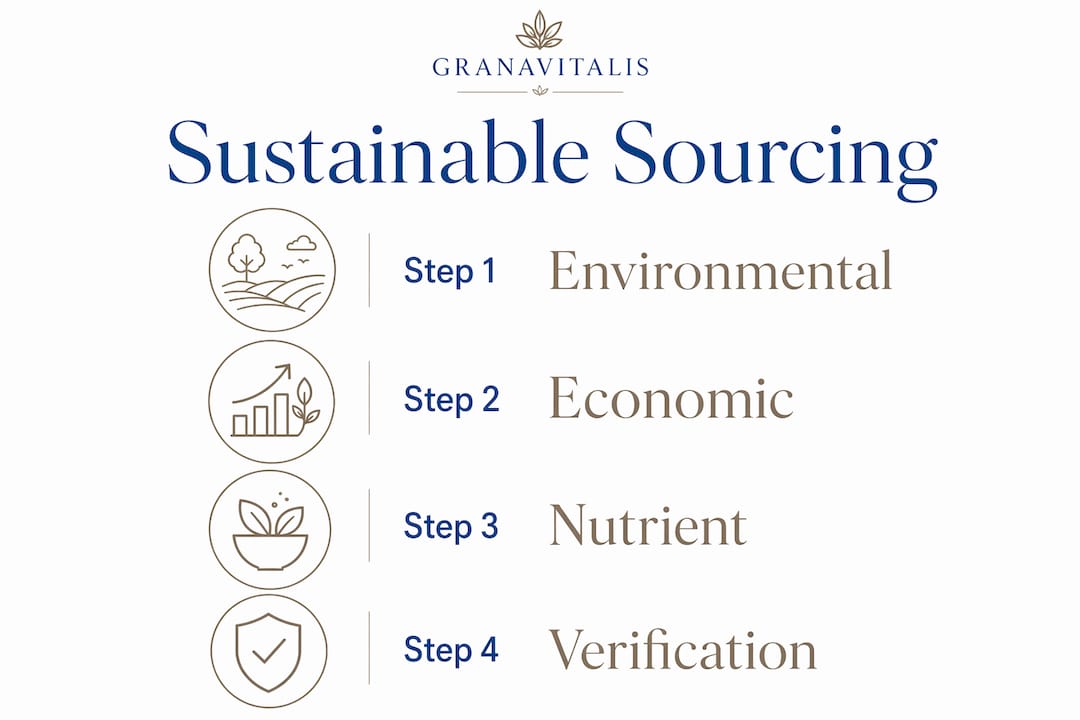
Sustainable sourcing for nutrient-dense wholefoods has four practical dimensions, and most shoppers only think about one of them.
Environmental is the obvious one: lower carbon emissions, reduced chemical inputs, protection of soil and water. Regenerative farming reduces or avoids synthetic inputs and focuses on soil health, which supports biodiversity and carbon storage. Techniques such as reduced tilling, herbal leys and rotational grazing improve soil carbon and nutrient retention in crops simultaneously.
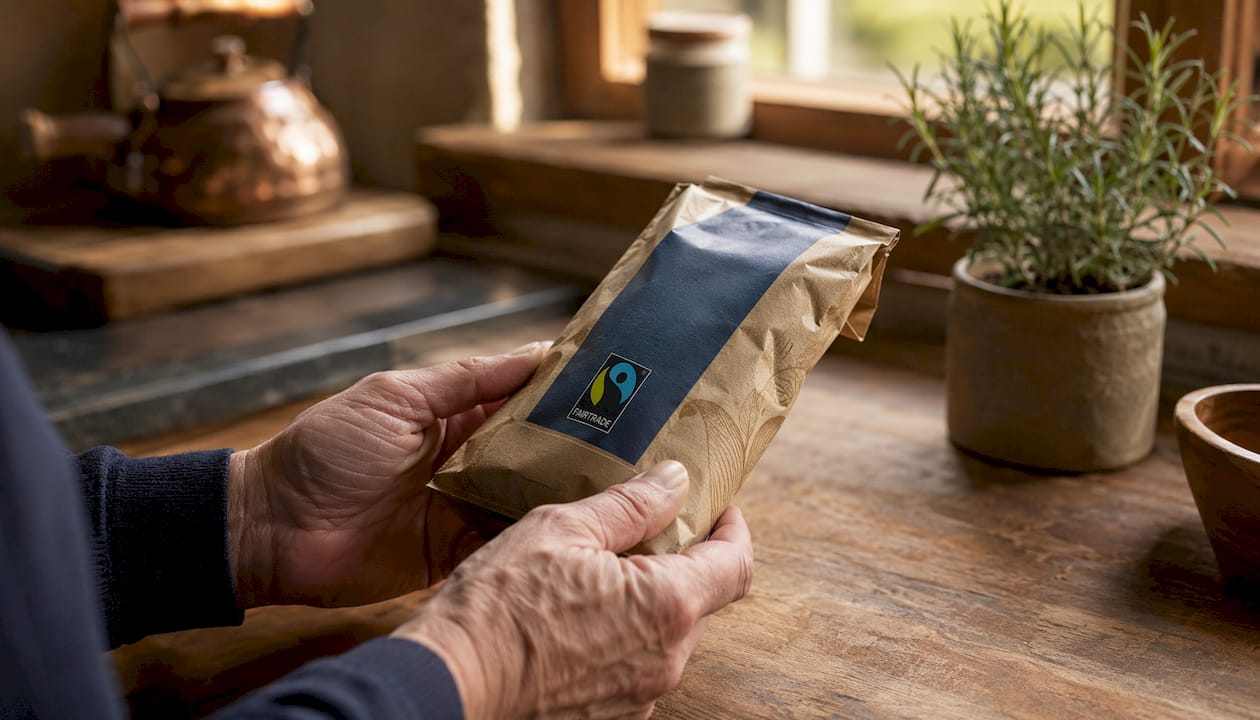
Social and economic is often overlooked. Fairtrade and equivalent schemes address both environmental standards and fair labour conditions, ensuring that farmers in lower-income regions receive a living wage and safe working conditions. Purchasing decisions that favour these schemes help reshape supply chains over time, not just tick a box.
Nutrient integrity is the dimension most relevant to wholefood shoppers specifically. Harvest timing, soil mineral content and processing level all affect how many vitamins, phytonutrients and healthy fats survive to your plate. An ingredient grown in depleted soil, picked unripe and refined at high heat can carry a certified label and still deliver a fraction of its potential nutrition.
The CMA’s caution on ambiguous claims applies directly here: a product described as “sustainably grown” with no certification or origin detail is making an unverifiable assertion. Prefer specifics.
UK certifications and labels: what do they actually guarantee?
Six schemes dominate UK wholefood packaging. Each has real value — and real limits.
| Scheme | What it guarantees | Key caveat |
|---|---|---|
| Soil Association | Organic production to UK/EU retained standards; no synthetic pesticides or GMOs | Higher-cost products; some imported ingredients still permitted |
| Red Tractor | UK provenance and basic food safety/animal welfare standards | Does not require organic or regenerative methods |
| Fairtrade Foundation | Minimum price and social premium for producers in lower-income countries | Mass-balance accounting may mean only part of a product’s content is certified |
| RSPO | Sustainable palm oil sourcing to defined environmental criteria | Mass-balance and “book and claim” options mean certified and uncertified palm oil can be mixed in supply chains |
| MSC | Wild-caught fish from fisheries assessed against sustainability criteria | Chain-of-custody certification required at each stage; check the blue fish label is present |
| Rainforest Alliance | Environmental and social standards for farms in tropical regions | Percentage-based certification: a product can carry the label when only part of its content is certified |
The mass-balance point deserves emphasis. Some schemes permit a product to carry a certification label when only a proportion of its ingredients meet the standard. Always check the scheme’s own percentage rules before assuming full-product coverage.
Pro Tip: When a certification label appears on pack, search the scheme’s website for the product or producer by name. Legitimate certified operators are listed publicly. If they are not, ask the brand directly — a confident, specific answer is a good sign; evasion is not.
Understanding how certifications interact with supply chains is also covered well in how certifications drive sustainability in beverage supply chains, which illustrates the same mass-balance dynamics for tea and coffee.
A practical shopper’s checklist for nutrient-dense, traceable wholefoods
Use this in any shop, market or online checkout:
- Check the origin first. A named region or farm beats a country of packing. “Grown in Shropshire” is more useful than “packed in the UK.”
- Read the production method. Look for organic, stone-ground, cold-pressed, raw, or pasture-fed — terms that describe how the ingredient was handled, not just what it is.
- Assess the processing level. Fewer steps between field and pack generally means more intact nutrients. Whole rolled oats beat instant oat powder; raw nut butter beats hydrogenated spread.
- Compare unit price, not pack price. Sustainably sourced wholefoods often cost more per pack but less per serving when nutrient density is factored in.
- Look for a producer contact. A website, email or farm address on the label signals genuine traceability. Its absence is a red flag.
- Consider frozen when fresh is out of season. Frozen produce retains nutrients because freezing typically occurs at peak ripeness, and it reduces spoilage and waste.
Pro Tip: Veg box schemes and local farm shops often give you direct access to the grower. That conversation — “when was this harvested?” — tells you more about nutrient freshness than any label.
Trade-offs and common myths about sustainable ingredients
The palm oil question is a good example of where reflexive boycotts backfire. Replacing palm oil with alternatives such as coconut or sunflower oil typically requires significantly more land to produce the same yield. RSPO certification, for all its mass-balance limitations, is a more constructive route than blanket avoidance — it creates financial incentive for producers to meet environmental standards rather than simply shifting demand to less-regulated crops.
The “local vs organic” debate is similarly nuanced. Local and seasonal sourcing reduces transport emissions, cuts packaging needs and often preserves nutrients because food is consumed closer to harvest. But a local product grown with heavy pesticide use can be less nutritionally and environmentally sound than an imported organic equivalent. Neither label wins automatically — the combination of both is the ideal, and when you cannot have both, production method usually matters more than distance.
Red flags to watch on packaging:
- “Eco-friendly,” “natural,” or “sustainable” with no certification or origin detail
- Country of packing stated instead of country of growing
- No producer name, website or contact information
- Certification logos that are not linked to a publicly searchable register
Why sourcing choices change what ends up in your food
Soil health is the starting point. Crops grown in mineral-rich, biologically active soil absorb more micronutrients than those grown in depleted ground with synthetic inputs compensating for what the soil cannot provide. Regenerative techniques such as reduced tilling and rotational grazing actively rebuild that biological activity.
Heritage and ancient grains — einkorn, emmer, spelt — are particularly relevant here. Farmers using regenerative methods often favour these varieties because their deep root systems increase resilience and reduce the need for chemical fertilisers and pesticides. The nutritional profile of these grains also tends to be more complex than modern high-yield varieties bred primarily for output.
Processing level compounds the sourcing effect. Stone-grinding preserves the bran and germ; high-heat roller milling strips them. Cold-pressing retains volatile phytonutrients in oils; solvent extraction does not. The link between minimal processing and nutrient integrity is direct: every additional step is an opportunity for nutritional loss.
Statistic callout: Industry reporting shows a clear shift towards traceability, regenerative agriculture and ancient-grain sourcing as manufacturers respond to consumer demand and net-zero pressures — confirming that the market is moving in the direction conscientious shoppers have been pushing for.
Questions to ask producers, farmers and retailers
Retail staff rarely hold the farming-practice data that a conscientious shopper needs. Contacting producers directly is the most reliable route. Use these questions:
- “Which region or farm does this ingredient come from?”
- “What farming method is used — organic, regenerative, conventional?”
- “Which certification scheme covers this product, and what percentage of the content is certified?”
- “When was the most recent harvest, and how has it been stored since?”
- “Can you share a farm contact or traceability document?”
A specific, confident answer to any of these is a positive signal. Vague responses (“we work with trusted suppliers”) or deflection (“that information is commercially sensitive”) suggest the traceability chain is thin. When a producer provides a farm name, region and harvest date unprompted, that is the clearest sign of genuine transparency.
Pro Tip: Email is often more productive than asking in-store. A written question creates a paper trail and tends to reach someone with actual supply-chain knowledge rather than a shop-floor team member.
How Granavitalis sources ingredients
Granavitalis centres its sourcing on three commitments: provenance transparency, minimal processing and ingredient integrity.
- Ancient and heritage grains are selected for their nutritional complexity and resilience, sourced from farming systems that prioritise soil health over yield maximisation.
- Nuts and seeds are chosen raw or minimally processed, with origin and production method published on ingredient pages so shoppers can verify rather than trust.
- Plant proteins are sourced with the same traceability standard — region, method and processing level stated, not implied.
- Third-party certifications are used where available, with the scheme and scope clearly communicated rather than a logo dropped on pack without context.
The brand’s sustainable nutrition guide expands on how sourcing decisions connect to nutrient density and long-term wellness. Jarrod, Granavitalis’s nutrition author, applies the same sourcing criteria to every product in the range — the questions in the section above are the same ones the brand asks its own suppliers.
Key takeaways
Sustainably sourced wholefood ingredients combine environmental responsibility, fair producer economics and preserved nutrient integrity — and all three dimensions matter equally for health-conscious shoppers.
| Point | Details |
|---|---|
| Named origin beats vague claims | Look for a specific region or farm, not just a country of packing or an unverifiable “eco” label. |
| Certifications have limits | Mass-balance accounting means a label does not always mean fully certified content — check the scheme’s percentage rules. |
| Soil health drives nutrient density | Regenerative farming and heritage grains produce more nutritionally complex ingredients than depleted-soil, high-yield alternatives. |
| Frozen is a legitimate choice | Produce frozen at peak ripeness retains nutrients and reduces waste when fresh seasonal options are unavailable. |
| Granavitalis publishes provenance | The brand states origin, farming method and processing level on ingredient pages, giving shoppers verifiable information rather than marketing claims. |
Why this matters more than most guides admit
The standard advice on sustainable shopping focuses almost entirely on carbon footprint. That framing misses something important: for wholefood shoppers specifically, the nutrient question is inseparable from the sourcing question. A grain grown in exhausted soil, harvested early for transport logistics and milled at high heat can carry a green label and still deliver a nutritionally hollow product. The environmental and nutritional cases for careful sourcing are the same case.
What also gets underplayed is the consumer’s role beyond purchasing. Asking producers direct questions, leaving specific feedback to retailers, and choosing brands that publish verifiable sourcing information all create pressure on supply chains that a purchase alone does not. The local sourcing community benefits argument applies here too: demand signals matter, and a shopper who asks “where exactly is this from?” is doing something a passive buyer is not.
The certification system is imperfect — mass-balance accounting, partial-percentage allowances and the CMA’s ongoing scrutiny of vague claims all confirm that. But the answer is not to dismiss labels; it is to read them critically, ask follow-up questions and prefer brands that make verification easy rather than opaque.
Granavitalis: traceable wholefoods, ready to use
If you want the sourcing work already done, Granavitalis offers a range of minimally processed, provenance-transparent wholefood ingredients built around the principles in this guide. The Raw Organic Pecan Butter is a single-origin, cold-pressed nut butter with no additives — the label tells you exactly what is in it and where it came from. For variety, the Organic Nut & Seed Butter Selection Box brings together several traceable, minimally processed options so you can compare provenance and flavour without committing to one product.
Every product in the Granavitalis range is selected against the same sourcing criteria described above: named origin, defined production method, minimal processing and published ingredient transparency. Browse the full range at granavitalis.com and check the ingredient pages directly — the information is there to be read, not hidden.
Further reading and authoritative UK sources
These sources underpin the claims in this guide and are worth bookmarking for ongoing reference:
- BBC Food: questions to ask when buying food — practical consumer guidance on seasonal, local and regenerative sourcing, including direct producer contact advice.
- Which?: food assurance labels explained — clear breakdown of eleven UK certification schemes, including mass-balance caveats.
- Food Manufacture: sustainable sourcing trends — industry-side reporting on traceability, regenerative agriculture and ancient-grain adoption.
- British Business Bank: sustainable food brand guidance — business-facing sourcing steps that translate directly to what to look for as a consumer.
- GOV.UK: Government Buying Standard for food and catering — the UK government’s own mandatory procurement standards for sustainable food, a useful benchmark for what “higher environmental production standards” means in practice.
- Granavitalis: nutrient integrity explained — how provenance and handling affect nutrient levels, with practical guidance for shoppers.
For verification of specific certification claims, go directly to the scheme’s own producer register: Soil Association, Fairtrade Foundation, MSC, RSPO and Rainforest Alliance all maintain publicly searchable databases. If a producer is not listed, ask them why.
This article provides general information for UK consumers and does not constitute nutritional or legal advice. Verify current certification standards directly with the relevant scheme or a qualified professional for your specific situation.