
Ancestral nutrition: what it is and why it matters
Ancestral nutrition is the practice of aligning your diet with the nutrient-rich foods that shaped human evolution, prioritising whole, minimally processed ingredients over the industrialised products that dominate modern eating. The ancestral diet definition is not a single historical menu to replicate exactly. It is a framework built on the principle that our genome evolved alongside specific foods over millennia, and that departing sharply from those foods carries metabolic consequences. Research shows that hunter-gatherer populations have markedly lower rates of obesity, type II diabetes, and coronary heart disease than populations eating modern Western diets.
The core features of ancestral nutrition at a glance:
- Whole, unprocessed foods sourced as close to their natural state as possible
- Seasonal eating that mirrors the rhythms of local food availability
- Nose-to-tail consumption of animals, including organ meats, marrow, and connective tissue
- Diverse plant foods rich in fibre, phytochemicals, and resistant starches
- Traditional preparation methods such as fermentation, soaking, and germination to improve nutrient uptake
- High nutrient density per calorie, not merely adequate macronutrients
What are the real health benefits of ancestral eating?
The health case for ancestral nutrition rests on evolutionary biology, not trend. Because the human genome evolved within a specific nutritional environment, eating foods that match that environment tends to support the body’s systems rather than strain them.
Weight management is one of the clearest benefits. Whole, fibre-rich foods produce stronger satiety signals than calorie-dense processed alternatives, partly through short-chain fatty acid production in the gut. Hormonal balance follows a similar logic: stable blood glucose from low-glycaemic whole foods reduces the insulin spikes that drive fat storage and inflammation.
Gut health is where the evidence gets particularly striking. The human gut microbiota co-evolved with diets rich in resistant starches and fibres from wild plants, substrates that are scarce in modern diets. Restoring those fibres through ancestral eating supports microbial diversity in ways that probiotics alone cannot replicate. Hunter-gatherers and rural populations in Africa and South America consistently show higher levels of microbial richness than Westernised urban residents.
Key benefits supported by research:
- Reduced chronic disease risk: lower incidence of type II diabetes, cardiovascular disease, and obesity in populations eating ancestral-style diets
- Improved gut microbiome diversity through fibre-rich, varied plant foods
- Better omega-3 to omega-6 balance: ancestral diets achieved an n-6 to n-3 ratio of approximately 2:1, compared to the 10:1 typical of modern Western diets
- Lower inflammation linked to reduced intake of refined sugars and industrial seed oils
- Reduced hypertension risk: ancestral sodium intake below 1,000 mg per day correlates with lower rates of high blood pressure in hunter-gatherer groups
What to eat on an ancestral nutrition plan
The foods that form the backbone of an ancestral diet share one quality: they are as close to their natural form as possible, with nutrient density as the primary selection criterion rather than convenience or shelf life.
Animal foods:
- Wild-caught oily fish (salmon, mackerel, sardines) for EPA and DHA
- Organ meats, particularly liver, kidney, and heart, which provide copper, vitamin A, and essential amino acids absent in muscle meat alone
- Bone broth and marrow for collagen, glycine, and minerals
- Pasture-raised eggs and poultry
- Grass-fed red meat
Plant foods:
- Seasonal vegetables and leafy greens
- Berries, stone fruits, and other low-sugar whole fruits
- Nuts and seeds in their raw or lightly prepared forms
- Root vegetables and tubers as primary carbohydrate sources
- Legumes when traditionally prepared (soaked or fermented)
Fermented and traditionally prepared foods:
- Naturally fermented vegetables such as sauerkraut and kimchi
- Kefir and raw dairy where tolerated
- Sourdough made with long fermentation, which reduces antinutrients
Estimates suggest ancestral diets provided 1.5 to 8 times higher vitamin and mineral intakes per calorie than modern diets. Organ meats and wild plants drive much of that gap. Nuts such as hazelnuts and pecans fit naturally here too: raw, minimally processed, and dense in fat-soluble vitamins, minerals, and healthy fats. You can explore nutrient-dense whole foods as a practical starting point for building an ancestral-aligned pantry.
Pro Tip: Pair vitamin C-rich foods (bell peppers, parsley, citrus) with iron-rich plant sources to significantly improve non-haem iron absorption. This food-pairing principle is a cornerstone of traditional food wisdom that modern nutrition science has since confirmed.
Which foods does ancestral nutrition ask you to avoid?
Ancestral nutrition is as much about what you remove as what you add. The foods most at odds with an ancestral framework are those that did not exist for the vast majority of human evolutionary history.
Foods to avoid or significantly limit:
- Ultra-processed foods containing artificial additives, emulsifiers, and preservatives
- Refined sugars and high-fructose corn syrup found in soft drinks, confectionery, and most packaged snacks
- Industrial seed oils such as sunflower, rapeseed, and soybean oil, which skew the omega-6 to omega-3 ratio sharply upward
- Highly processed cereal grains including white bread, most breakfast cereals, and refined pasta
- High-sodium processed foods including crisps, ready meals, and processed meats, given that ancestral sodium intake was well below 1,000 mg per day
- Sugary beverages including fruit juices, energy drinks, and most commercial smoothies
- Conventional dairy for many people, particularly those with Northern European ancestry who may tolerate it, but it remains a food with no deep ancestral precedent for most global populations
Grains and dairy occupy a nuanced middle ground. Whole, unprocessed grains consumed with traditional preparation methods (soaking, fermentation) are far less problematic than their refined counterparts. The issue is not grains per se but the industrial processing that strips fibre, increases glycaemic load, and removes the antinutrient-reducing steps that traditional cultures always applied.
The science and history behind ancestral nutrition
Human dietary patterns shifted dramatically with the agricultural revolution roughly 10,000 years ago, and again with industrialisation in the 19th century. The ancestral nutrition framework argues that these shifts outpaced genetic adaptation, creating a mismatch between what we eat and what our metabolism was built for. Failure to adapt to dietary changes over the last 10,000 years has been implicated in obesity, type II diabetes, certain cancers, and coronary heart disease.
Hunter-gatherer diets were not uniform. They varied enormously by ecology, season, and geography. What they shared was an absence of ultra-processed foods and a consistent emphasis on nutrient density and dietary diversity. That diversity itself is a principle worth carrying forward, as explored in research on why dietary variety matters for long-term health.
Traditional food processing techniques are a particularly underappreciated part of the ancestral framework. Fermentation, soaking, and germination were not just preservation methods. They actively improve mineral absorption, protein quality, and vitamin uptake compared to modern processing. Phytic acid in grains and legumes, for instance, binds minerals and reduces their absorption. Soaking overnight breaks down much of it. These techniques represent functional nutrition architecture built up over generations, not mere culinary tradition.
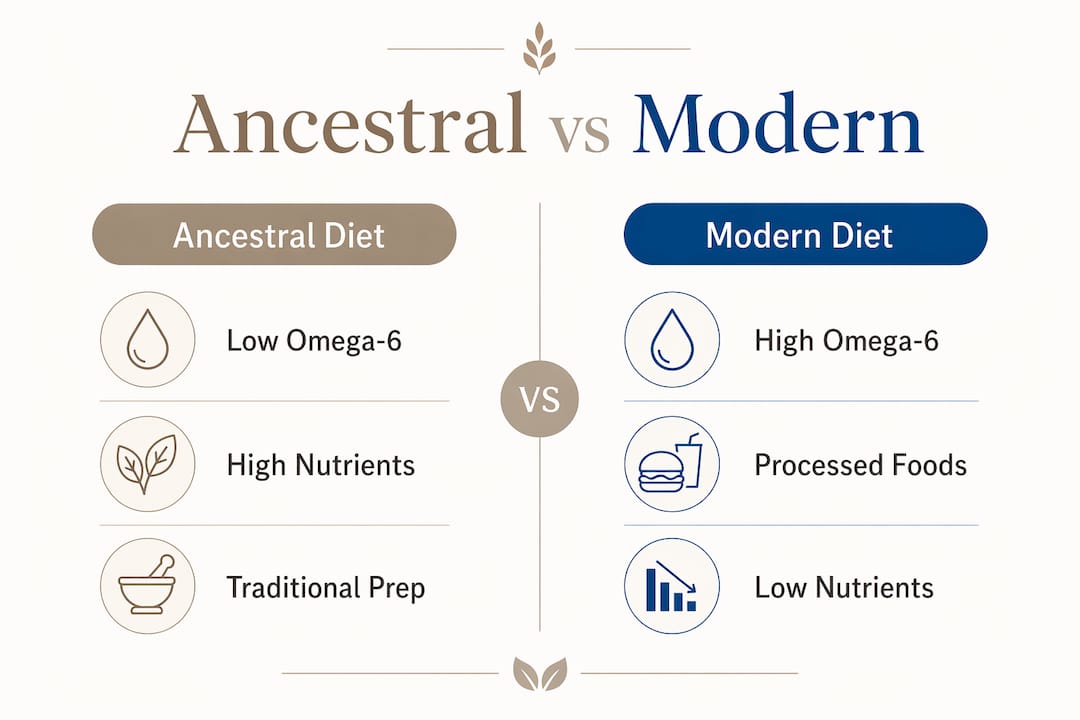
| Feature | Ancestral diet | Modern Western diet |
|---|---|---|
| Omega-6 to omega-3 ratio | Approximately 2:1 | Approximately 10:1 |
| Sodium intake | Below 1,000 mg per day | — |
| Micronutrient density | Up to 8x higher per calorie | Reduced by processing and crop selection |
| Fibre sources | Wild plants, tubers, diverse vegetation | Predominantly refined grains |
| Food processing | Fermentation, soaking, germination | Industrial refining, additives, fortification |
| Dietary diversity | High, ecologically driven | Low, commodity-crop dominated |
Ancestral nutrition also reframes what “adequate” nutrition means. Rather than preventing deficiency, the evolutionary nutrition framework sets a hypothesis for optimal intake, the level at which the body genuinely thrives rather than merely avoids illness. That distinction shifts the entire conversation about what a healthy diet looks like.
How to start eating ancestrally: practical steps for 2026
Transitioning to an ancestral diet does not require a complete overnight overhaul. The most durable changes tend to come from layering new habits onto existing ones rather than eliminating everything at once.

Start with subtraction. Before adding anything new, remove the foods with the clearest ancestral mismatch: refined sugars, industrial oils, and ultra-processed snacks. This single step tends to produce noticeable changes in energy and digestion within two to three weeks.
Build around whole animal protein. Introduce one organ meat per week, liver being the most practical starting point given its availability and nutrient density. If the flavour is a barrier, chicken liver pâté is a well-tolerated entry point that most people find genuinely enjoyable.
Prioritise seasonal, local produce. Seasonal eating is not just an ancestral principle; it also tends to mean higher phytochemical content, since produce harvested at peak ripeness retains more of its nutritional value. UK seasonal highlights include brassicas in winter, asparagus in spring, and stone fruits through summer.
Apply traditional preparation. Soak oats, legumes, and grains overnight before cooking. Introduce fermented foods gradually, starting with a tablespoon of sauerkraut daily, to support gut microbiome adaptation without digestive disruption.
Embrace nose-to-tail eating progressively. Bone broth is an accessible first step. It requires minimal preparation, costs very little, and delivers glycine, collagen, and minerals that muscle meat simply does not provide.
Diversify your nuts and seeds. Raw nuts and seeds are one of the easiest ancestral foods to incorporate immediately, requiring no preparation and fitting naturally into any meal pattern. Variety matters here: different nuts offer different micronutrient profiles, so rotating between walnuts, hazelnuts, almonds, and pecans covers more nutritional ground than relying on one type.
Track progress through how you feel, not just metrics. Sleep quality, energy consistency, and digestive comfort are often the first things to shift on an ancestral diet, frequently before any measurable change in weight or blood markers.
Common misconceptions about ancestral nutrition
“It’s just another name for the paleo diet.” The paleo diet is one interpretation of ancestral principles, but ancestral nutrition is broader. It does not prescribe a single historical menu or exclude all grains categorically. The emphasis is on nutrient density, bioavailability, and food quality rather than rigid food group elimination.
“You have to eat large amounts of meat.” Hunter-gatherer diets varied widely. Many relied heavily on plant foods, tubers, and fish. The ancestral framework accommodates plant-forward approaches provided they prioritise whole, traditionally prepared foods and address nutrient gaps such as omega-3s, zinc, and vitamin B12.
“It ignores modern food science.” The opposite is true. Ancestral nutrition uses evolutionary biology as a hypothesis-generating framework, then tests it against contemporary research. The omega-3 ratio data, the gut microbiome findings, and the traditional food processing evidence are all products of modern nutritional science.
“It’s too expensive to follow.” Organ meats are among the cheapest cuts available in UK butchers and supermarkets. Seasonal vegetables cost less than out-of-season imports. Dried legumes, soaked overnight, are inexpensive and highly nutritious. The ancestral diet’s cost depends almost entirely on which foods you choose to centre it around.
Granavitalis and the ancestral nutrition approach
Granavitalis was built around exactly this philosophy: that the most nourishing foods are those closest to their natural, traditional forms. Every product in the Granavitalis range reflects the ancestral nutrition principle of minimal processing and maximum integrity, from ancient grain flours unchanged by industrial hybridisation to raw nut butters that retain the full nutritional profile of the whole nut.
If you are building an ancestral-aligned pantry, raw nut butters are one of the most practical places to start. Granavitalis’s raw organic pecan butter delivers healthy fats, minerals, and fat-soluble vitamins in a form your body recognises. For variety across different nut profiles, the nut and seed butter selection box lets you rotate between options and cover more nutritional ground, exactly as ancestral eating intended.
Key takeaways
Ancestral nutrition works because it aligns your diet with the nutrient-dense, minimally processed foods that shaped human metabolism over millennia, reducing the mismatch that drives modern chronic disease.
| Point | Details |
|---|---|
| Core principle | Prioritise whole, unprocessed foods that match the nutritional environment in which the human genome evolved. |
| Omega-3 balance | Ancestral diets achieved an n-6 to n-3 ratio of approximately 2:1, versus the 10:1 typical of modern Western diets. |
| Micronutrient density | Ancestral diets provided up to 8 times higher vitamin and mineral intakes per calorie than modern diets. |
| Gut microbiome | Restoring fibre-rich, diverse plant foods supports microbial diversity that probiotics alone cannot replicate. |
| Practical entry point | Remove refined sugars and industrial oils first, then build around whole animal protein, seasonal produce, and traditionally prepared foods. |