
Clinician Backed: Add 500 kcal Daily With Calorie Dense Boosters
The most useful calorie-dense foods fall into a handful of categories: oils and fats, nuts and nut butters, full-fat dairy, starchy carbs, dried fruit, oily fish, and a few well-chosen treats. The tactic that actually works isn’t eating bigger meals. It’s picking nutrient-dense versions of these foods and stirring small fortifiers into what you already eat, a spoonful at a time.
TL;DR:
- Consuming oils and fats, nuts, full-fat dairy, and starchy carbs in calorie-dense forms is the most effective way to increase energy intake without larger portions.
- Using small, daily fortified boosters like nut butters, olive oil, cheese, or milk powder can add roughly 100 kcal each time, helping reach a 500 kcal daily surplus.
- Spreading four to six of these boosters evenly across the day prevents discomfort while making it easier to meet calorie goals without overeating.
- People with high cholesterol, diabetes, or allergies should choose nutrient-dense, heart-healthy options like oils, nuts, and plant-based fortifiers, avoiding high-sugar or processed treats.
- Batch-preparing fortified milk and pre-portioning high-energy snacks simplifies consistent calorie boosting for busy or out-of-home routines.
Table of Contents
- What does “calorie dense” actually mean?
- Who actually needs more calories, and how much?
- Which food groups deliver the most calories per bite?
- What are good 100-kcal boosters to add throughout the day?
- What meals and snacks add calories without big portions?
- When should you be cautious about adding calories?
- Why food fortification beats “just eat more”
- Where Granavitalis fits into your fortification plan
- Sources
What does “calorie dense” actually mean?
Calorie density is simply how many calories a food packs into each gram. Fat delivers roughly 9 kcal per gram, nearly double what carbohydrate or protein provides at around 4 kcal per gram. That gap is why a tablespoon of olive oil drizzled over vegetables adds more energy than an extra potato, without adding much bulk to the plate.
This matters most for anyone struggling to eat enough. If your appetite is small, low-calorie-density foods like soup or salad fill you up before you’ve taken in enough energy. Calorie-dense foods solve that problem by letting you get more fuel from less volume.
Nuts sit in the middle ground, at roughly 5 to 7 kcal per gram, thanks to their fat and protein combination. Checking a label’s “kcal per 100g” figure is the fastest way to compare two products, and it beats guessing from portion size alone. Two breads can look identical and differ by 50 kcal per slice depending on the seed content and fat used in the dough.
Who actually needs more calories, and how much?
Several groups genuinely need to eat more energy than their appetite naturally demands. Recovery from illness or surgery increases the body’s calorie requirements while often shrinking appetite at the same time, which is a frustrating combination. Older adults with a reduced appetite, people in deliberate muscle-building phases, and anyone training hard several times a week all fall into this bracket too.
The practical target most dietitians work towards is an additional amount of calories each day, added gradually rather than in one sitting. NHS guidance on healthy weight gain recommends aiming for around 500 kcal above your current intake, built from small, repeatable changes rather than one large meal.
Trying to hit that target in three sittings usually backfires, because it means eating past the point of comfort. Spreading the same calories across five or six smaller, fortified meals and snacks tends to work far better in practice. You’re not asking your appetite to do more work in one go. You’re just feeding it more often, with richer food each time.
Which food groups deliver the most calories per bite?
Some categories punch well above their weight in energy terms, and knowing which ones lets you fortify meals without overhauling how you eat.
Oils and fats sit at the top of the scale. A tablespoon of olive oil, rapeseed oil, butter or ghee adds close to 100 to 120 kcal with barely a change in how a dish looks or tastes. Use them in dressings, stirred into mash, or brushed over roasted vegetables before they go in the oven.
Nuts and nut butters combine calories with genuine nutrition, rather than empty energy. Almonds, peanuts and pecans all sit around 160 to 200 kcal per 30g handful, and a tablespoon of pecan or peanut butter adds roughly 90 to 100 kcal along with unsaturated fat and protein. Spread them on toast, stir into porridge, or blend into a smoothie.
Full-fat dairy and milk powder raise both calories and protein without demanding you eat more food. Whole milk, cream, and grated cheese all fortify existing meals quietly. Skimmed milk powder deserves special mention here, because it adds concentrated protein and calories to liquids without changing the taste much at all.
Starchy carbs are the workhorse category. Roasted or fried rice, potatoes mashed with butter, granola, and wholegrain bread all provide a dependable calorie base, particularly once oil or dairy is added on top.
Dried fruit and energy bars are the portable option. Dates, raisins and a good energy bar deliver 100 to 150 kcal in a 30 to 50g serving, which makes them a genuinely useful snack for anyone out of the house for long stretches.
Oily fish and red meat bring calories and protein together in a way that supports recovery and muscle maintenance, not just weight gain. Salmon and mackerel are the standouts here, both for their energy content and their fat quality.
Treats and convenience foods have a place too, in moderation. Dark chocolate, ice cream, and pastries are calorie-dense by definition, and they’re useful for closing a calorie gap when appetite is genuinely poor. NHS dietetic guidance is clear that these should sit alongside nutrient-dense choices, not replace them, because full-fat dairy, nuts, eggs and oily fish deliver vitamins and protein that plain sugar and fat cannot.
What are good 100-kcal boosters to add throughout the day?
Booster foods are the single most practical tool in this whole approach, because they let you add calories without changing your meals or forcing extra volume onto your plate. Clinical leaflets built specifically around this idea list several standard 100 kcal boosters, and the advice is to use several of them daily to reach that 500 kcal target.
- 1 tablespoon of olive oil stirred into soup, pasta, or mash.
- 1 heaped tablespoon of nut butter spread on toast or stirred into porridge.
- 3 tablespoons of grated cheese melted over vegetables, potatoes, or eggs.
- 2 tablespoons of skimmed milk powder whisked into milk, sauces, or mashed potato.
- A small handful of mixed nuts eaten alone or scattered over yoghurt.
- 2 tablespoons of double cream added to porridge, coffee, or a pudding.
Aim for four to six of these across the day rather than trying to fit them into one or two meals. Spacing them roughly every two to three hours keeps intake manageable and avoids the discomfort of one huge meal.
The fortified milk recipe is worth learning properly, because it works as a base for almost everything. Whisk four heaped tablespoons of skimmed milk powder into one pint of whole milk, and you’ve added roughly 200 kcal and 20g of protein to something you were going to drink anyway. Use it in tea, over cereal, or as the base for a milkshake, and you barely notice the change in taste.

Pro Tip: Batch-make a full pint of fortified milk at the start of the week and keep it in the fridge. It removes the daily decision-making and means every cup of tea or bowl of cereal is quietly doing more work.
What meals and snacks add calories without big portions?
Templates make this easier than trying to invent fortified meals from scratch every day. NHS “Food First” guidance leans heavily on the principle of eating little and often, building meals from familiar foods with fortifiers folded in rather than served on the side.
Breakfast:
- Porridge made with fortified milk, topped with a tablespoon of nut butter and a scatter of nuts.
- A smoothie blended with whole milk, milk powder, nut butter and banana.
- Buttered toast with mashed avocado, a fried egg, and grated cheese on top.
A full breakdown of fortified breakfast options, including quantities, sits in this guide to high-calorie breakfasts for bulking.
Lunch and dinner:
- Pasta or rice tossed in olive oil and finished with grated cheese.
- A jacket potato loaded with butter, tuna mayonnaise, or cheese.
- A stew or curry thickened with ground almonds or a splash of double cream.
Snacks and evening options:
- Yoghurt layered with granola and a spoon of nut butter.
- A small handful of mixed nuts, eaten alongside a piece of fruit.
- Fortified hot chocolate or a milkshake made with the pint of fortified milk from the fridge.
Preparation is where this tends to fall apart for busy people, so remove the friction in advance. Batch the fortified milk, pre-portion nut and seed snack packs into small containers, and keep two or three ready-to-eat high-energy items in the cupboard at all times.
When should you be cautious about adding calories?
Adding calories isn’t a free pass to ignore what those calories are made of. NHS dietetic advice consistently favours nutrient-dense fortifiers over empty calories, and there’s good reason for that beyond general healthy eating advice.
Anyone managing high cholesterol should lean towards unsaturated fats: olive oil, rapeseed oil, avocado, unsalted nuts and oily fish, rather than relying heavily on butter and cream. Guidance on increasing calories while protecting heart health makes this trade-off explicit, and it’s worth taking seriously if cardiovascular risk is already a concern.
People with diabetes need to watch how starchy carbs and dried fruit affect blood sugar, since these boosters can cause sharper spikes than fat-based ones. Nut allergies rule out an entire category of boosters, but seed butters and dairy-based fortifiers usually fill that gap without much fuss. Anyone avoiding dairy can lean on oils, nut butters and plant-based milk powders instead.
Track your weight weekly rather than daily, since daily fluctuation from water and food volume is normal and tells you very little. If weight changes without you intending it, or you’re managing a chronic condition alongside this, speak to a GP or dietitian before making significant changes.
Why food fortification beats “just eat more”
Most advice on gaining weight still defaults to “eat bigger portions,” and it’s the wrong starting point for most people who genuinely struggle to increase their intake. If your appetite is already limited, telling you to eat more food is like telling someone with a fear of heights to just climb higher. The advice ignores the actual barrier.
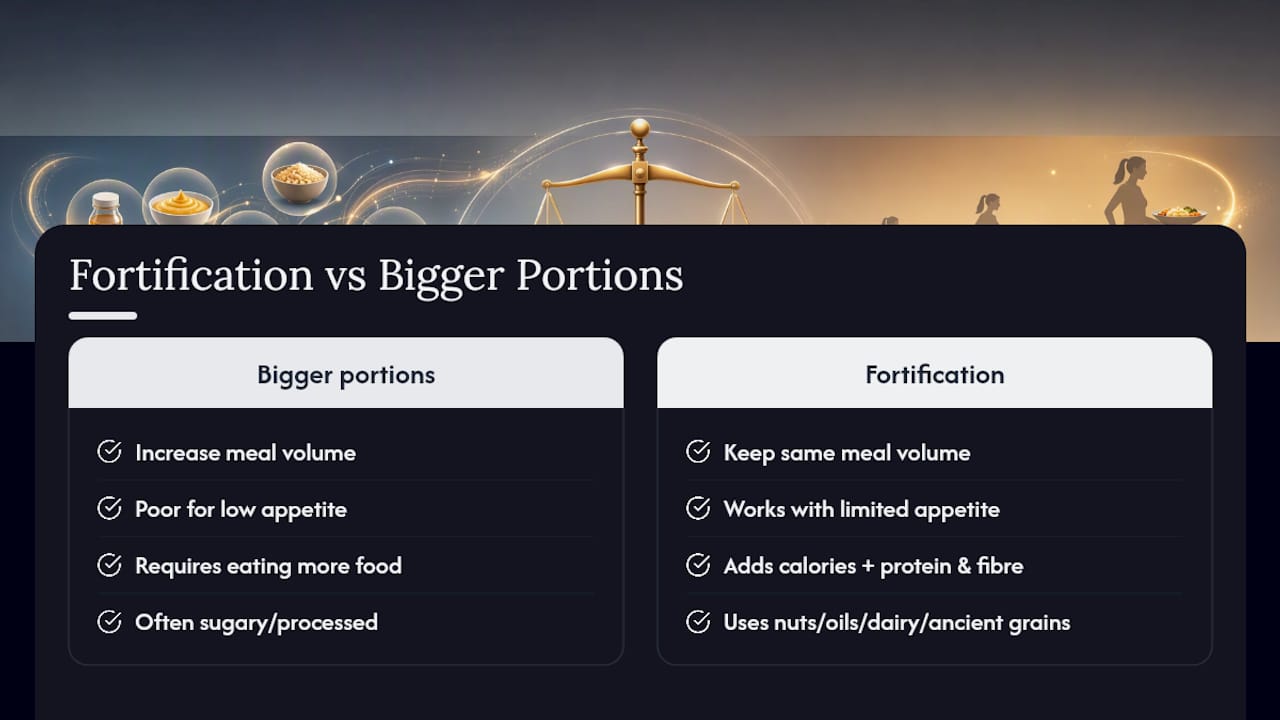
Fortification works because it separates the volume problem from the calorie problem. You’re not eating more food. You’re eating richer food, in the same bowl, at the same pace you already manage. That distinction is why clinical dietitians reach for boosters and fortified recipes long before they reach for bigger plates.
Where I’d push back on the wider conversation around calorie-dense eating is the obsession with convenience treats as the default answer. Pastries and ice cream have their place when appetite is genuinely poor, but building a fortification strategy around sugar and refined fat rather than nuts, oils and dairy is a missed opportunity. The nutrient-dense route delivers the same energy plus protein, fibre and unsaturated fat your body can actually use, whether that’s fighting off illness or supporting a training block. Wholefood ingredients like ancient grains and minimally processed nut butters do the fortification job without the trade-off, and that’s the version worth building daily habits around.
— Jarrod
Where Granavitalis fits into your fortification plan
A jar of proper nut butter is one of the easiest fortifiers to keep on hand, and it’s exactly the kind of product Granavitalis builds around: minimally processed, nutrient-dense, and useful in almost every meal template above. The raw organic pecan butter works as a straight 100-kcal booster stirred into porridge or spread on toast, adding fat and protein rather than empty sugar.

If you want variety without buying five separate jars, the organic nut and seed butter selection box gives you several fortifiers to rotate through the week, so breakfast doesn’t taste the same every day. Pair any of these with a scoop of plant protein in a smoothie or a spoonful stirred through fortified porridge, and you’ve covered two or three boosters before lunch. Check the product pages for full ingredient sourcing, nutrition figures and recipe ideas before you order.
Sources
For fuller instructions, printable recipes and clinical detail beyond what fits here, these leaflets are worth reading directly:
- Healthy ways to gain weight — NHS
- 100 kcal boosters — Medway NHS (MKUH)
- High calorie, high protein diet — Gateshead Health NHS
- Food First general leaflet — HDFT NHS
If you’re travelling and worried about keeping this up outside your own kitchen, this guide to eating well on holiday covers similar little-and-often tactics adapted for time away from home.
This article is general information, not a substitute for advice from a qualified doctor. Consult a qualified healthcare professional about your own circumstances before acting on anything here.