
What are functional botanicals? A UK consumer guide
TL;DR:
- Functional botanicals are plants and fungi used in food or supplements to support normal body functions, not to treat diseases. They come in various forms, are regulated depending on their claims and presentation, and require transparency through certificates of analysis. Choosing high-quality options involves clear labeling, sourcing, and avoiding exaggerated therapeutic promises.
Functional botanicals are plants, fungi, lichens, or their preparations — such as dried powders, extracts, and concentrates — used in food or food supplements to support normal physiological function, not to treat or cure disease. That single distinction shapes everything: the label, the legal status, and what a brand is actually allowed to tell you.
Three things worth knowing straight away:
- Format matters. Botanicals appear as whole dried herbs, standardised extracts, tinctures, fermented preparations, and powdered concentrates — each with different potency and safety profiles.
- Claims are regulated. In the UK, a product that claims to treat a condition becomes a medicine under MHRA oversight. “Helps maintain” is food law; “treats” is not.
- Transparency is the signal. Reputable suppliers publish Certificates of Analysis (COAs), declare the Latin name, the plant part used, and the dose per serving. If that information is missing, that is reason enough to look elsewhere.
Table of Contents
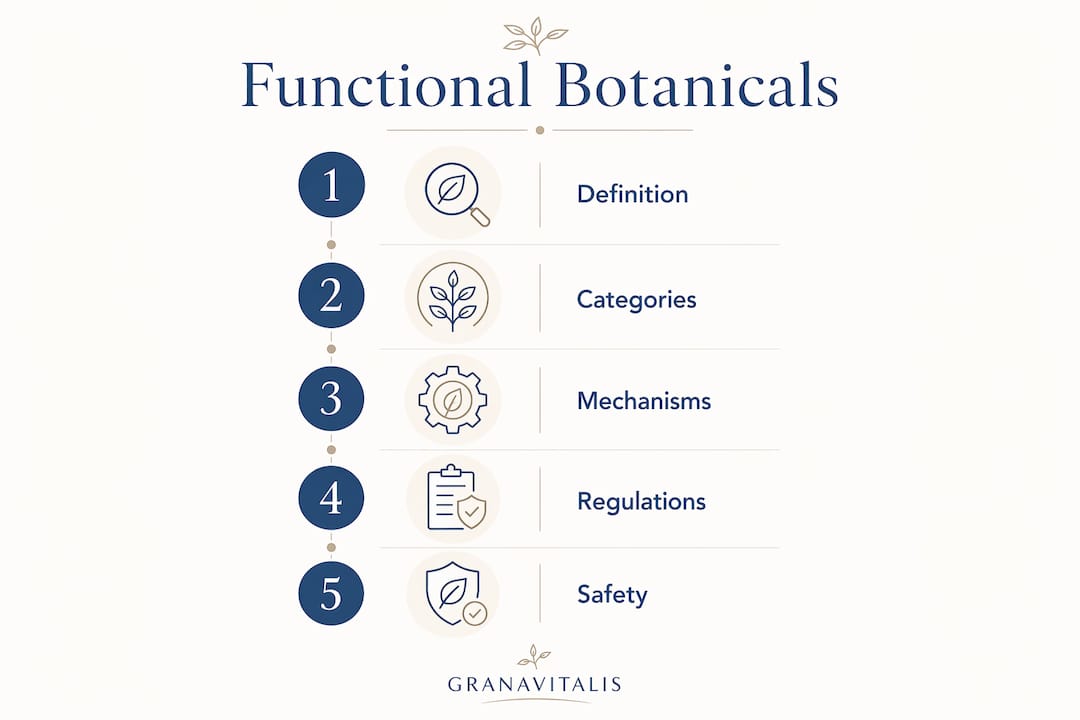
- What counts as a functional botanical in the UK?
- How do functional botanicals work in the body?
- UK rules you need to know: food, medicine, and health claims
- Safety points, interactions, and who should take extra care
- How to choose high-quality functional botanicals
- Practical ways to add functional botanicals to your daily routine
- How we define terms and where our guidance comes from
- Key takeaways
- The case for wholefood botanicals over extract culture
- Granavitalis: clean botanical nutrition, clearly labelled
- Authoritative UK sources and further reading
What counts as a functional botanical in the UK?
Botanicals in UK food law are defined as fresh or dried plants, plant parts, fungi, and lichens, or preparations derived from them — including aqueous and ethanolic extracts, tinctures, essential oils, oleoresins, and fermented preparations. The word “functional” signals that the ingredient is included for a specific physiological role beyond basic nutrition, rather than purely for flavour or texture.
The category label on a product changes what rules apply. A food supplement is a concentrated source of nutrients or other substances marketed in dose form — capsules, sachets, drops — and governed by food law. A traditional herbal medicine is licensed under a separate MHRA scheme and must meet safety and quality standards. A novel food is any ingredient without a significant history of consumption in the UK before May 1997, which requires pre-market authorisation before it can be sold. Knowing which category a product falls into tells you how much regulatory scrutiny it has received before reaching the shelf.
How do functional botanicals work in the body?
The mechanisms vary considerably by ingredient. Some botanicals deliver vitamins, minerals, and dietary fibre directly. Others contain phytochemicals — polyphenols, alkaloids, anthocyanins — that interact with metabolic pathways, modulate the gut microbiome, or stimulate sensory receptors such as bitter taste receptors linked to digestive function. The key word throughout is support: these ingredients are positioned to assist normal physiological processes, not to produce pharmacological effects strong enough to classify the product as a medicine.
| Category | Typical form | What it’s used for |
|---|---|---|
| Whole botanicals | Dried leaf, berry, seed | Broad nutrient and phytochemical delivery |
| Standardised extracts | Capsule, tablet, powder | Consistent dose of a target compound |
| Concentrates | Powder, oleoresin | High phytochemical density in small volume |
| Fermented preparations | Liquid, powder | Enhanced bioavailability, prebiotic effects |
Beta-glucans from oats and barley, and phytosterols from plant oils, are among the few botanical ingredients with positive EFSA opinions supporting specific health wordings. Polyphenol-rich berries, culinary herbs, and seaweeds are widely used for their broader nutrient profiles. Understanding botanical protein sources is another useful angle if you are building a nutrient-dense diet around plant foods.
Pro Tip: Wholefood preparations — dried berries, ground seeds, whole mushroom powders — tend to deliver a broader range of phytochemicals than single-compound extracts, and carry a longer history of safe use.
UK rules you need to know: food, medicine, and health claims
The decisive regulatory question in the UK is intent and presentation. A product that claims to treat, prevent, or cure a disease is classified as a medicinal product and falls under MHRA enforcement. Language such as “helps maintain normal cholesterol levels” keeps a product within food law; “lowers cholesterol” does not.
The regulatory grey area is real. Industry experts note that a botanical modifying physiology may be acceptable as a food supplement, but where the effect appears pharmacological in degree, the MHRA may reclassify it as a medicine — assessed case by case, not by a fixed threshold.
Health claims are a separate layer. EFSA evaluated thousands of botanical health claim dossiers, and many remain on an ‘on-hold’ list — neither authorised nor rejected. Brands using on-hold claims should hold documented scientific justification, because a change in regulatory status can invalidate marketing copy overnight.
| Regulatory category | Governing body | Pre-market check? |
|---|---|---|
| Food supplement | Food Standards Agency / local authorities | No centralised authorisation |
| Traditional herbal medicine | MHRA | Yes — safety and quality review |
| Novel food ingredient | FSA / EFSA | Yes — safety assessment required |
| Medicinal product | MHRA | Yes — full licensing |
The Novel Foods (England) Regulations 2018 apply when an ingredient lacks a significant history of UK consumption before May 1997. Ingredients such as certain algae and exotic plant extracts may fall here, requiring pre-market assessment before sale.
Safety points, interactions, and who should take extra care
Natural does not mean risk-free. Botanical ingredients can raise safety issues through species misidentification, contamination with heavy metals or pesticide residues, or uncertainty about maximum daily doses — particularly in concentrated extract form.
Interaction risk is often underestimated. Some botanicals affect CYP450 liver enzymes, which metabolise many prescription medicines. St John’s Wort is the most documented example, but stimulant botanicals and those with anticoagulant properties also warrant caution alongside prescribed drugs.
Vulnerable groups should seek professional advice before using botanical supplements: pregnant and breastfeeding women, children, people on anticoagulants or immunosuppressants, and anyone with a chronic condition. Dose and form matter too — a culinary quantity of turmeric in food is very different from a high-dose curcumin extract capsule taken daily.
This article is general information, not medical or nutritional advice. Confirm suitability for your own situation with a qualified healthcare professional or pharmacist.
How to choose high-quality functional botanicals
The checklist below applies whether you are buying a loose botanical powder or a formulated supplement.
- Latin name declared. Every botanical ingredient should carry its full scientific name (e.g. Withania somnifera, not just “ashwagandha root extract”). This confirms species identity and rules out substitution.
- Plant part specified. Root, leaf, seed, and berry can have entirely different phytochemical profiles. The label should state which part is used.
- Dose per serving stated. A supplement listing “botanical blend 500 mg” without individual quantities is a proprietary blend — you cannot assess what you are actually consuming.
- Standardisation or wholefood listing. Standardised extracts should declare the marker compound and percentage. Wholefood powders should list the ingredient as-is, with no hidden processing aids.
- Allergen and origin information. Food labelling rules require clear allergen declarations and accurate country-of-origin details for botanical ingredients.
- Organic or clean credentials verified. Organic certification reduces pesticide residue risk. Look for recognised UK or EU organic marks, not self-declared “natural” claims.
- COA available on request. A Certificate of Analysis from a third-party laboratory confirms botanical identity, active marker levels, and contaminant testing. If a brand cannot supply one, that is a red flag.
- No dramatic therapeutic claims. Exaggerated marketing language — “cures”, “reverses”, “rapid fix” — signals either regulatory non-compliance or a product that has not been assessed for medicinal use. Walk away.
When comparing labels, plant-based supplement guidance can help you understand what honest ingredient transparency actually looks like across different product formats.
Practical ways to add functional botanicals to your daily routine
The simplest approach is food-first. Blueberries, blackcurrants, and rosehips deliver polyphenols and vitamin C in their whole form. Culinary mushrooms such as shiitake and maitake contribute beta-glucans alongside protein and B vitamins. Ground flaxseed, chia, and hemp seeds add omega-3 fatty acids, fibre, and plant protein to porridge or smoothies with minimal effort.
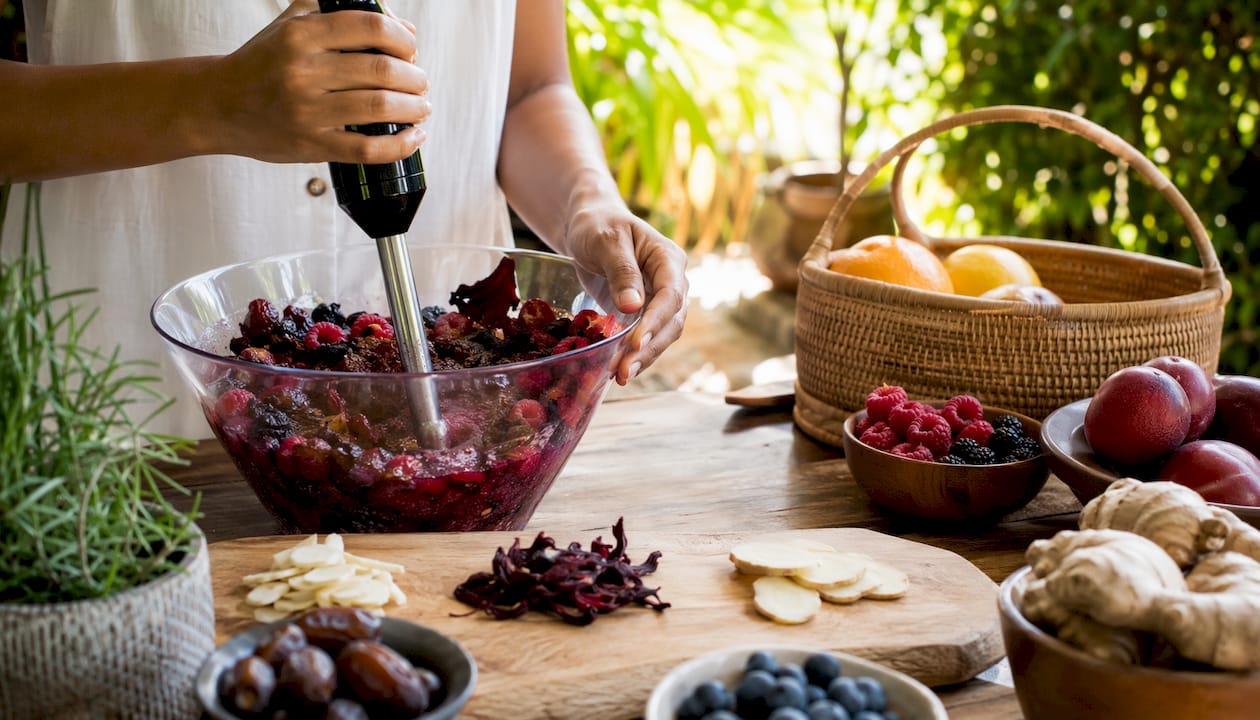
For more targeted use, powdered botanical blends stirred into a morning smoothie or mixed into yoghurt are practical and low-risk. A compact superfood mix — acai, chia, and acerola, for example — covers antioxidant polyphenols, omega-3s, and natural vitamin C in a single spoonful. Nut butters blended with botanical add-ins (cacao, maca, or adaptogenic mushroom powders) are another convenient format that keeps processing minimal and ingredients readable. Prioritise preparations where the ingredient list is short and every item is recognisable.
How we define terms and where our guidance comes from
The definitions used throughout this article draw on EFSA’s botanical framework, MHRA guidance on the food/medicine boundary, the Food Standards Agency’s novel foods guidance, and peer-reviewed reviews published in Applied Sciences and the Nutrition Bulletin. Regulatory tables reflect UK-applicable rules post-2018.
Editorial approach: this article synthesises regulatory texts, peer-reviewed literature, and industry guidance to give consumers a clear, evidence-aware picture of functional botanicals. It does not constitute medical advice, and readers should verify current regulatory status with the FSA or MHRA for specific products.
Granavitalis publishes sourcing information, ingredient origins, and product credentials openly. Readers are encouraged to request COAs directly from any botanical brand — including Granavitalis — before purchasing.
Key takeaways
Functional botanicals support normal physiological function within food law, but quality, transparency, and regulatory compliance vary widely across the market.
| Point | Details |
|---|---|
| Definition | Plants, fungi, lichens, or their preparations used in food or supplements to support normal body function — not to treat disease. |
| Regulatory boundary | MHRA classifies a product as medicinal if it claims to treat or cure; “helps maintain” language keeps it within food law. |
| Safety awareness | Concentrated extracts carry interaction and contamination risks; wholefood preparations generally carry a longer safety history. |
| Buyer’s checklist | Look for Latin name, plant part, dose per serving, COA availability, and organic or clean credentials on every label. |
| Granavitalis | Offers transparently labelled, wholefood botanical products — including superfood mixes and plant proteins — with sourcing information available on request. |
The case for wholefood botanicals over extract culture
The botanical supplement market has a concentration problem. Brands race to standardise ever-higher percentages of a single marker compound, and in doing so they strip out the broader phytochemical context that made the whole plant interesting in the first place. A 95% curcumin extract is not turmeric — it is a pharmaceutical-adjacent isolate dressed in wellness language, and the regulatory system is only beginning to catch up with that reality.
What the evidence actually supports, for most consumers, is a food-first approach: diverse, minimally processed botanical foods that deliver nutrients and phytochemicals in the ratios nature assembled. The on-hold status of so many EFSA botanical claims is not a bureaucratic failure — it is an honest reflection of how thin the clinical evidence is for many high-dose extract products. That should make you more interested in whole berries, culinary mushrooms, and ground seeds, not less.
The brands worth trusting are the ones that publish their COAs without being asked, name every ingredient by its Latin name, and resist the temptation to claim their product does something a food supplement legally cannot claim to do. Transparency is not a marketing feature. It is the minimum standard.
Granavitalis: clean botanical nutrition, clearly labelled
If the buyer’s checklist above describes what you are looking for, Granavitalis is built around exactly those principles: wholefood ingredients, minimal processing, and full ingredient transparency. Every product carries a readable ingredient list with no hidden blends.
The Immune Booster Superfood Bundle brings together a curated selection of botanical ingredients in one place, with clear nutrient claims and sourcing information. For a compact daily botanical boost, the Superfoods Mix Beauty — acai, chia, and acerola — delivers polyphenols, omega-3s, and natural vitamin C in a single, transparent formulation. Browse the full range at granavitalis.com or contact the team directly to request COAs or ask about ingredient origins.
Authoritative UK sources and further reading
- EFSA Botanicals topic page — EFSA’s framework for safety assessment of botanical food supplements, including the Compendium of Botanicals.
- Food Standards Agency: Novel Foods guidance — explains which ingredients require pre-market authorisation in the UK.
- MHRA: Classifying vitamins, supplements and herbal medicines — the primary UK government source for food/medicine classification.
- The Novel Foods (England) Regulations 2018 — the statutory instrument governing novel food authorisation in England.
- Botanicals in functional foods and food supplements (MDPI, Applied Sciences) — peer-reviewed review covering definitions, efficacy, and regulatory aspects.
- Botanical ingredients: intakes, regulations, risks and attitudes (Nutrition Bulletin) — covers labelling requirements and consumer safety considerations.
On-hold EFSA botanical claims remain a live regulatory issue. Brands using such claims should hold current scientific justification and monitor FSA and EFSA updates, as status changes can affect marketing language with little notice. When in doubt about a specific product, request the COA and check the FSA novel foods authorised list before purchasing.