
Role of healthy fats in plant diets explained
TL;DR:
- Healthy fats are essential unsaturated fatty acids and vital lipids that the body cannot produce on its own. Including whole-food sources like avocados, nuts, and seeds provides these fats along with fiber and antioxidants, supporting heart and brain health.
Healthy fats are defined as unsaturated fatty acids and essential lipids that the body cannot produce on its own. The role of healthy fats in plant diets goes far beyond calories: they supply energy, enable the absorption of fat-soluble vitamins A, D, E, and K, and support hormone production and neurological function. Harvard Health recommends adults consume 44–77 grams of fat per day, representing 20%–35% of total daily calories. Plant-based diets are often mistakenly labelled as low-fat, but the reality is that whole-food plant sources like avocados, walnuts, and flaxseeds deliver precisely the fats your body needs most.
What is the role of healthy fats in plant diets?
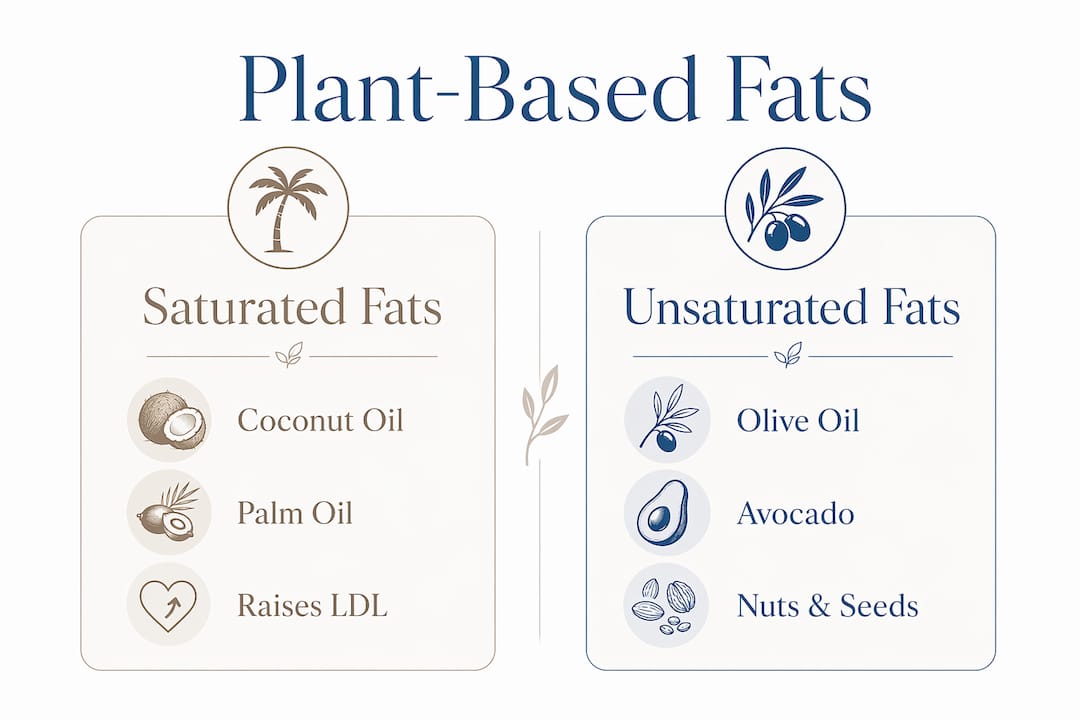
Dietary fats fall into four main categories: saturated, monounsaturated, polyunsaturated, and trans fats. Each behaves differently in the body, and plant diets contain all four to varying degrees. Understanding the difference is the foundation of eating well on a plant-based plan.
Saturated fats are solid at room temperature and found in coconut oil and palm oil. Excessive saturated tropical oils can counteract the cardiovascular benefits of plant diets when consumed in large amounts. They should be used sparingly rather than as everyday cooking staples.
Monounsaturated fats are found in olive oil, avocados, and most nuts. They lower LDL cholesterol without reducing HDL cholesterol. This makes them the most straightforward fat upgrade you can make in a plant-based kitchen.
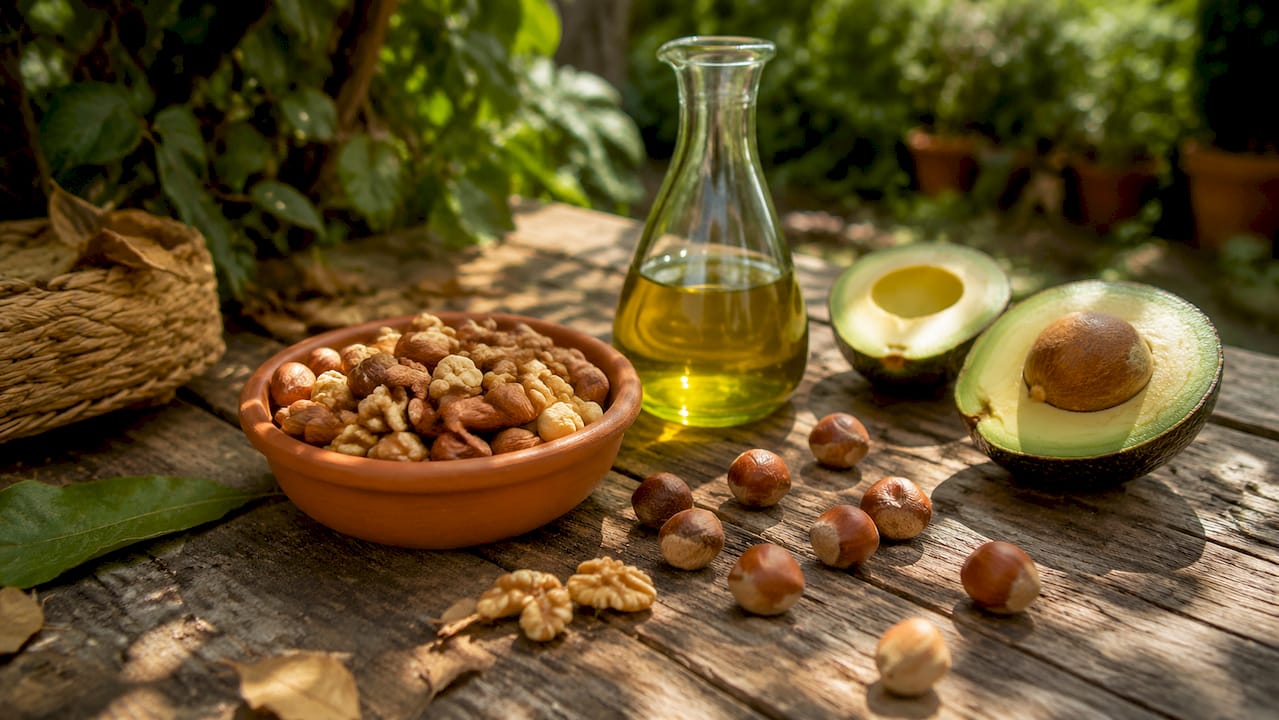
Polyunsaturated fats include omega-3 and omega-6 fatty acids, both of which are essential. The body cannot synthesise them, so they must come from food. Flaxseeds, chia seeds, hemp seeds, and walnuts are the primary plant sources. Replacing saturated fats with unsaturated plant fats from olive oil, rapeseed oil, nuts, and seeds lowers LDL cholesterol and reduces cardiovascular risk, according to the NHS and the British Heart Foundation.
Rapeseed oil deserves particular attention. The BHF highlights rapeseed oil for its favourable ratio of omega-3 to omega-6 polyunsaturated fats, making it one of the most effective everyday oils for cholesterol management. It is also widely available and affordable, which matters for long-term dietary consistency.
| Fat type | Main plant sources | Effect on health |
|---|---|---|
| Saturated | Coconut oil, palm oil | Raises LDL cholesterol; use sparingly |
| Monounsaturated | Olive oil, avocados, almonds | Lowers LDL; supports heart health |
| Polyunsaturated (omega-6) | Sunflower oil, walnuts, pumpkin seeds | Lowers LDL when replacing saturated fats |
| Polyunsaturated (omega-3) | Flaxseeds, chia seeds, hemp seeds | Reduces inflammation; supports brain health |
| Trans fats | Partially hydrogenated plant oils | Raises LDL and lowers HDL; avoid entirely |
Pro Tip: Swap coconut oil for rapeseed or extra-virgin olive oil in everyday cooking. You keep the plant-based credentials and gain a measurable cardiovascular benefit.
What are the best whole-food sources of healthy fats for a plant-based diet?
Whole-food fat sources outperform refined oils because they deliver fibre, antioxidants, and micronutrients alongside the fat itself. A drizzle of olive oil is useful, but a handful of walnuts provides omega-3s, vitamin E, polyphenols, and protein in the same mouthful. That nutritional density is what separates whole foods from processed alternatives.
Harvard Health recommends including walnuts, chia seeds, flaxseeds, hemp seeds, and avocados daily to meet fat and nutrient needs on a plant-based plan. These foods consistently appear across clinical dietary guidelines because the evidence base behind them is strong. You can explore the full picture of plant-based diet foods to see how fats fit alongside proteins and carbohydrates.
The best whole-food fat sources for plant-based eating include:
- Avocados: Rich in monounsaturated oleic acid, potassium, and folate. Half an avocado adds roughly 10–15 grams of healthy fat to a meal.
- Walnuts: One of the few plant foods with a meaningful amount of ALA omega-3. They also provide magnesium and polyphenols linked to reduced inflammation.
- Chia seeds: Two tablespoons deliver omega-3 ALA, calcium, and soluble fibre. They absorb liquid and work well in overnight oats or smoothies.
- Flaxseeds: The richest plant source of ALA. Ground flaxseed is better absorbed than whole seeds. Add to porridge, baking, or salad dressings.
- Hemp seeds: Provide both omega-3 and omega-6 in a near-ideal ratio, plus complete protein. Sprinkle over salads or blend into plant milk.
- Hazelnuts and pecans: High in monounsaturated fats and vitamin E. Nut butters made from these nuts are a convenient, concentrated fat source.
- Olives and extra-virgin olive oil: Deliver oleic acid and powerful polyphenols. Use cold-pressed olive oil on salads rather than heating it at high temperatures.
Processed plant snacks are a different matter entirely. Ultra-processed plant foods often contain refined oils and excess salt, which strip away the health benefits associated with whole-food fat sources. A vegan crisp is still a crisp. Reading ingredient labels and choosing minimally processed options protects the quality of your fat intake.
Pro Tip: Keep a jar of raw nut butter at your desk. A tablespoon of hazelnut or pecan butter on rice cakes or apple slices is one of the fastest ways to hit your healthy fat target mid-afternoon without reaching for processed snacks.
How do you balance essential fatty acids on a plant-based diet?
The omega-3 story in plant diets is more complicated than most people realise. Plant sources provide ALA (alpha-linolenic acid), found in flaxseeds, chia seeds, and walnuts. The body must convert ALA into EPA and DHA, the forms used directly by the brain and cardiovascular system. Human conversion of ALA to EPA and DHA is inefficient, which means relying on ALA alone may leave gaps in long-chain omega-3 status.
Algae-based omega-3 supplements close this gap directly. Algae is the original source of EPA and DHA in the marine food chain, so algae-based supplements deliver the same forms found in oily fish without any animal products. The NHS advises people following vegan diets to consider these supplements, particularly for brain and heart health.
Certain groups need to plan with extra care:
- Pregnant and breastfeeding women have higher DHA requirements for foetal and infant brain development. Algae-based DHA supplements are the recommended plant-based solution.
- Older adults may have reduced conversion efficiency, making direct EPA and DHA sources more important with age.
- Children on vegan diets benefit from regular inclusion of ALA-rich foods and, where appropriate, algae-based supplementation under dietary guidance.
Iodine is a separate but related concern. Many plant diets are low in iodine because the main dietary sources are dairy and seafood. Seaweed provides iodine but in highly variable amounts. A consistent iodine supplement or iodine-fortified plant milk is the most reliable solution for people avoiding animal products. Intentional planning is needed to avoid omega-3 and iodine deficiencies, especially in sensitive populations.
Common myths about plant-based fats you should stop believing
The biggest misconception in plant-based nutrition is that all plant fats are automatically healthy. This is false. The source and processing of the fat matters as much as whether it comes from a plant.
-
“Coconut oil is a health food.” Coconut oil is roughly 90% saturated fat. Consuming it in large quantities raises LDL cholesterol. It is not equivalent to olive oil or avocado oil, regardless of its plant origin. Use it occasionally for flavour, not as a daily cooking fat.
-
“Vegan snacks are always a good fat source.” Many vegan biscuits, crisps, and confectionery products contain partially hydrogenated vegetable oils or high amounts of palm oil. These are the least beneficial fats in any diet. The label “vegan” does not mean nutritionally sound.
-
“More fat is better on a plant diet.” Fat is calorie-dense at 9 calories per gram. Eating large amounts of even healthy fats can displace other nutrients and contribute to excess calorie intake. The NHS and Harvard Health both recommend staying within the 20%–35% of calories from fat guideline.
-
“Plant-based diets are naturally low in fat.” A diet centred on whole grains, legumes, vegetables, and fruit can be low in fat. But the moment you add nuts, seeds, avocados, and oils, fat intake rises substantially. This is a feature, not a flaw, provided the sources are whole foods.
Research published in Nature confirms that high-quality plant-based diets are inversely linked to fat mass, and that reduced fat mass is a key mechanism behind their cardiovascular benefits. The quality of the diet, not just its plant origin, drives the outcome.
Key takeaways
Healthy fats are non-negotiable in plant-based diets: they enable vitamin absorption, support brain and heart function, and reduce cardiovascular risk when chosen from whole-food sources.
| Point | Details |
|---|---|
| Fat intake targets | Adults need 44–77 grams of fat daily, representing 20%–35% of total calories. |
| Best whole-food sources | Avocados, walnuts, chia seeds, flaxseeds, hemp seeds, and nut butters deliver fat alongside fibre and antioxidants. |
| Omega-3 conversion gap | ALA from plants converts poorly to EPA and DHA; algae-based supplements are the most reliable solution. |
| Saturated fats in plant diets | Coconut and palm oils are high in saturated fat and should be used sparingly, not as daily staples. |
| Processed plant foods | Ultra-processed vegan snacks often contain refined oils and salt that undermine the benefits of plant-based eating. |
Why I think most people get plant-based fats completely wrong
People come to plant-based eating expecting simplicity. Eat plants, feel better. The fat conversation complicates that, and I understand why people avoid it. But ignoring it is where things go wrong.
The most common pattern I see is people loading up on coconut oil and vegan snack bars because they carry a plant-based label, while barely touching walnuts, flaxseeds, or a proper avocado. They are technically eating plant fats, but they are getting the least useful versions of them.
The psychological shift that actually works is reframing fat as a delivery mechanism. Fat is how your body accesses vitamins A, D, E, and K. Without adequate fat at a meal, those nutrients pass through largely unused. A spinach salad with no fat source is nutritionally incomplete, regardless of how virtuous it feels.
The other thing I would push back on is the idea that fat planning is complicated. It is not. A tablespoon of ground flaxseed in your porridge, half an avocado at lunch, and a small handful of walnuts in the afternoon covers a significant portion of your daily needs. The difficulty is not the knowledge. It is building the habit until it becomes automatic.
Fats also make plant-based eating more enjoyable and sustainable. Meals with adequate fat are more satisfying, more flavourful, and less likely to leave you reaching for something processed an hour later. That sensory satisfaction is not a luxury. It is a retention mechanism for the diet itself.
— Jarrod
Get more from your plant-based fat intake with Granavitalis
Whole-food fat sources work best when they are genuinely good to eat. Granavitalis stocks a range of organic nut and seed butters that make hitting your daily fat targets straightforward and satisfying. The Raw Organic Pecan Butter by RAWGORILLA is cold-pressed, minimally processed, and rich in monounsaturated fats. For variety, the Organic Nut and Seed Butter Selection Box brings together multiple butter styles so you can rotate sources and keep your fat intake diverse. Every product is sourced with the same commitment to purity and nutritional integrity that defines the Granavitalis approach.
FAQ
What are healthy fats in a plant-based diet?
Healthy fats in plant-based diets are unsaturated fatty acids found in whole foods such as avocados, nuts, seeds, and plant oils. They include monounsaturated fats, polyunsaturated fats, and essential omega-3 and omega-6 fatty acids.
Do plants provide enough omega-3 fatty acids?
Plant foods provide ALA omega-3, but the body converts ALA to EPA and DHA inefficiently. Algae-based omega-3 supplements are recommended by the NHS to ensure adequate long-chain omega-3 intake on a vegan diet.
How much fat should I eat on a plant-based diet?
Harvard Health recommends 44–77 grams of fat per day for adults, representing 20%–35% of total daily calories. This applies equally to plant-based diets and is best met through whole-food sources rather than refined oils.
Is coconut oil healthy for plant-based eaters?
Coconut oil is approximately 90% saturated fat and raises LDL cholesterol when consumed in large amounts. It should be used sparingly rather than as a primary cooking fat, despite its plant origin.
What is the easiest way to add healthy fats to a plant diet?
Adding ground flaxseed to porridge, half an avocado to lunch, and a small handful of walnuts as a snack covers a substantial portion of daily fat needs with minimal effort. Nut butters from hazelnuts or pecans are equally convenient and nutritionally dense.