
Pre-industrial grains: real nutrition or wellness hype?
TL;DR:
- The health benefits of pre-industrial grains depend mainly on consuming them as wholefoods.
- Ancient grains are not inherently healthier; overall wholegrain intake and dietary patterns matter most.
- Gluten content varies; many ancient grains are not suitable for coeliac individuals, but some are naturally gluten-free.
The shelves of UK health food shops are fuller than ever with spelt loaves, einkorn pasta, and millet porridge. The promise is compelling: eat like your ancestors, feel better for it. But the science tells a more nuanced story. Recent research suggests that ancient grain superiority is not a clear-cut case, and that how your grain is processed matters just as much as which grain it is. This guide cuts through the marketing, explains what the evidence actually supports, and shows you how to make pre-industrial grains work meaningfully in your daily diet.
Table of Contents
- What are pre-industrial grains and why are they popular?
- Wholegrain wisdom: the real driver of health benefits
- Ancient grains, gluten, and individual wellness needs
- More variety, not a miracle: how to add pre-industrial grains for real wellness
- What most people miss about eating pre-industrial grains
- Discover and enjoy a world of nuts, seeds, and grains
- Frequently asked questions
Key Takeaways
| Point | Details |
|---|---|
| Wholegrain matters most | Choosing wholegrain forms delivers proven health benefits, regardless of a grain’s age. |
| Diversity boosts nutrition | Including a wider range of pre-industrial grains offers greater micronutrient variety for UK diets. |
| Gluten content varies | Some pre-industrial grains suit gluten avoidance, but always confirm specific grain characteristics. |
| Ancient is not always better | Health benefits often come from how the grain is processed, not just whether it is ancient. |
What are pre-industrial grains and why are they popular?
The term “pre-industrial grain” refers to cereal crops that were cultivated and eaten by humans long before the industrialisation of agriculture in the nineteenth and twentieth centuries. These are grains that largely escaped the intensive hybridisation programmes that transformed modern wheat and corn into the high-yield, highly refined staples we recognise today. In the UK, the most commonly discussed examples include:
- Spelt (an ancient relative of wheat, used in medieval European baking)
- Einkorn (one of the earliest domesticated grains, originating in the Fertile Crescent)
- Emmer (another ancient wheat variety, still grown in parts of Italy and the Middle East)
- Millet (a small-seeded grass with roots in African and Asian cultivation)
- Sorghum (a drought-resistant grain popular in traditional African diets)
- Quinoa (technically a seed, but widely grouped with ancient grains in the wellness space)
- Teff (a staple in Ethiopian cooking, now increasingly available in UK health shops)
- Amaranth (used by the Aztecs and gaining traction among UK plant-based eaters)
Part of their appeal is rooted in authenticity. There is something genuinely satisfying about eating a grain that has remained structurally unchanged for thousands of years. Our ancient grain guide explores the history and characteristics of many of these varieties in depth, and the story behind each one is fascinating.
However, the wellness world has not always been careful to separate tradition from evidence. As the BBC’s Future food analysis notes, ancient grains are marketed as healthier largely because many are lower in gluten and consumed whole, but broad superiority claims remain unproven. That is an important distinction. Tradition is not the same as therapeutic benefit.
“The evidence-based benchmark remains overall wholegrain intake and dietary pattern quality, not the grain’s age or heritage.”
This does not mean pre-industrial grains are a fad worth dismissing. It means they deserve honest evaluation. Their value to UK wellness seekers is real, but it comes primarily from the dietary variety they introduce and the wholegrain forms in which they are typically eaten, rather than from any intrinsic superiority over a well-prepared, minimally processed portion of oats or wholemeal wheat.
The growing UK interest in these grains also reflects a broader cultural shift. People are questioning ultra-processed foods, looking for connection to food traditions, and seeking a more diverse plate. All of that is genuinely worthwhile. The key is ensuring the conversation stays grounded in what the research actually supports.
Wholegrain wisdom: the real driver of health benefits
Now that we have defined what pre-industrial grains actually are, we need to examine what drives their health credentials. And the answer, perhaps surprisingly, is not their age. It is their structure.
For most significant health outcomes, the clearest driver is whether grains are eaten as wholegrains, meaning the bran and germ are still present, rather than whether they carry an “ancient” or “pre-industrial” label. This distinction matters enormously.
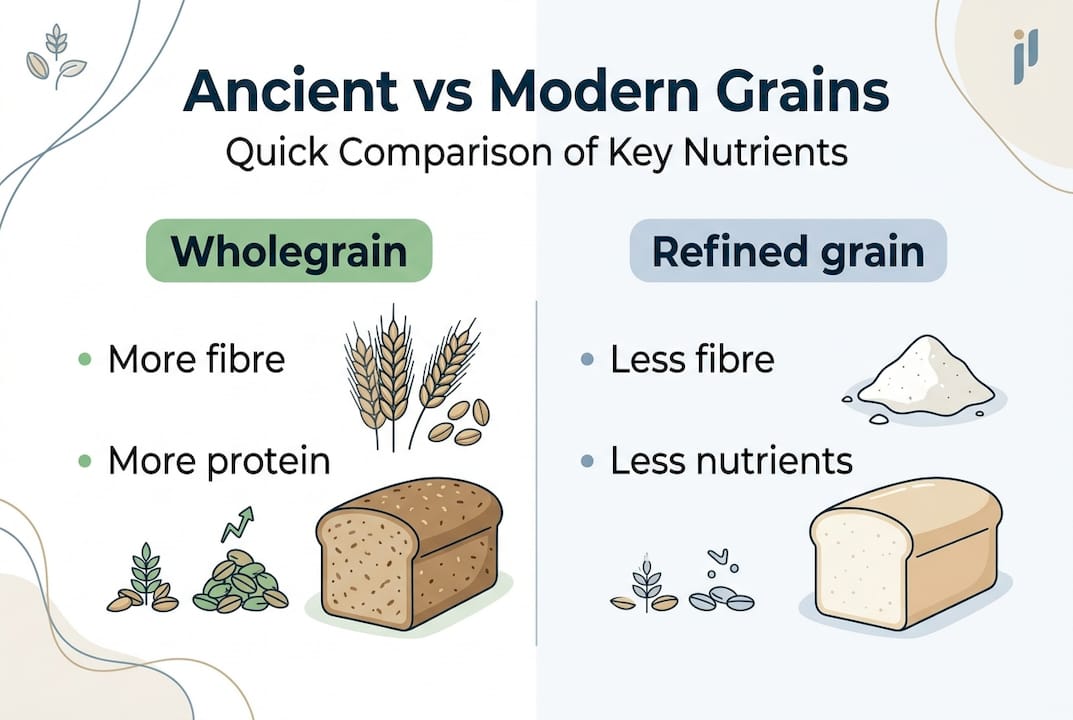
A wholegrain contains three layers: the outer bran (rich in fibre and B vitamins), the starchy endosperm (the energy component), and the germ (packed with healthy fats, vitamin E, and phytonutrients). When grains are refined, the bran and germ are stripped away, leaving mostly starch. The resulting food is quicker to prepare and longer-lasting on a shelf, but nutritionally diminished.
What wholegrains actually deliver
The British Heart Foundation confirms that wholegrains provide fibre that supports steadier blood sugar and benefits both gut and heart health. Beyond fibre, wholegrains deliver a broad spectrum of vitamins and minerals including magnesium, iron, zinc, and B vitamins, alongside polyphenols and antioxidants concentrated in the bran layer. These compounds work synergistically. Eating them together in a wholegrain form is more effective than taking any one of them in isolation.
The micronutrients in ancient grains are a genuinely compelling reason to include variety in your grain rotation. But those benefits depend entirely on the grain being eaten whole.
Here is a comparison to illustrate the nutritional gap between whole and refined versions of the same grain:
| Nutrient | Wholegrain (per 100g) | Refined grain (per 100g) |
|---|---|---|
| Dietary fibre | 6.5–12g | 1.5–3g |
| Magnesium | 80–160mg | 20–35mg |
| Vitamin B1 (thiamine) | 0.3–0.5mg | 0.1–0.2mg |
| Iron | 2.5–4mg | 0.8–1.5mg |
| Polyphenols | Moderate to high | Very low |
The differences are stark. Choosing wholegrain spelt over refined spelt flour, for instance, is a far more impactful decision than simply choosing spelt over modern wheat in refined form.

You can explore the differences among ancient grains in terms of their specific nutrient profiles, because each variety does bring something distinct to the table. However, the golden rule holds across all of them.
Pro Tip: Always check your packaging. A product labelled “made with ancient grain” may still use refined flour. Look for the word “wholegrain” or “whole” before the grain name in the ingredients list.
Ancient grains, gluten, and individual wellness needs
Understanding the importance of wholegrain status is essential. But there is another dimension that regularly comes up in conversations about pre-industrial grains, and that is gluten. It is one of the most misunderstood aspects of the ancient grain discussion, so it warrants careful examination.
Many people are drawn to spelt, einkorn, or emmer partly because they have heard these grains are “lower in gluten” than modern wheat. There is some truth to this. The gluten structures in older wheat varieties tend to be different in composition and, in some cases, lower in the specific gluten proteins that trigger the most common sensitivities. However, this does not make them safe for people with coeliac disease, which is an autoimmune condition requiring strict gluten avoidance. As the BBC’s research clearly notes, health effects may be linked to processing and whole-food patterns rather than gluten content alone.
“Spelt and einkorn still contain gluten. They are not coeliac-safe alternatives to modern wheat, regardless of how they are marketed.”
If you have been diagnosed with coeliac disease or a confirmed gluten intolerance, you need grains that are naturally free from gluten entirely. The following ancient and pre-industrial grains are genuinely gluten-free:
- Millet (a mild, versatile grain that works well in porridge and flatbreads)
- Quinoa (a complete protein source containing all nine essential amino acids)
- Sorghum (great for baking and as a whole grain side dish)
- Teff (used in injera flatbread; high in iron and calcium)
- Amaranth (rich in protein and lysine, an amino acid often lacking in grain-based diets)
For a fuller understanding of which grains are appropriate for gluten-free living, our gluten-free ancient grains guide walks through each option with practical meal ideas. If you are still unclear on terminology, our explanation of what is gluten-free grain is a useful starting point.
For people without coeliac disease or diagnosed gluten sensitivity, the gluten content of spelt or einkorn is unlikely to be a meaningful health concern. Some individuals do report improved digestion when switching to older wheat varieties, and this may relate to differences in fermentability or fibre content rather than gluten reduction specifically. It is also possible that people who make the switch are simultaneously eating more whole, minimally processed foods overall, which would independently improve digestion. Context matters.
Pro Tip: If you suspect gluten is affecting your digestion but have not been tested for coeliac disease, speak to your GP before eliminating gluten. Removing it from your diet before testing can produce inaccurate results. Learn more about gluten in ancient grains explained to make more informed choices.
More variety, not a miracle: how to add pre-industrial grains for real wellness
With dietary variety so important, and the evidence now clearly framing pre-industrial grains as a vehicle for nutritional breadth rather than a cure-all, the practical question becomes: how do you actually incorporate them well?
The research is clear that diversity of grain types supports broader nutrient and micronutrient intake, and that the evidence-based benchmark remains overall wholegrain intake and dietary pattern quality. In other words, rotating through several wholegrains over the course of a week is a more meaningful strategy than stocking up on one “superfood” grain.
Here is how different ancient grains stack up in terms of fibre, protein, and key micronutrients per 100g dry weight:
| Grain | Fibre (g) | Protein (g) | Iron (mg) | Magnesium (mg) |
|---|---|---|---|---|
| Quinoa | 2.8 | 14.1 | 4.6 | 197 |
| Millet | 8.5 | 11.0 | 3.0 | 114 |
| Teff | 8.0 | 13.3 | 7.6 | 184 |
| Amaranth | 6.7 | 13.6 | 7.6 | 248 |
| Sorghum | 6.3 | 11.3 | 4.4 | 165 |
Each of these grains brings something distinct. Teff and amaranth stand out for iron, which is particularly relevant for plant-based eaters in the UK who may be at risk of deficiency. Millet offers an excellent fibre contribution alongside a mild flavour that makes it easy to use as a rice substitute.
Here is a practical, step-by-step approach for introducing pre-industrial grain variety without falling for marketing noise:
- Start with one swap. Replace your usual morning porridge oats with millet or teff once or twice a week. Cook them in the same way and add the same toppings you already enjoy.
- Batch cook whole grains. Cook a large portion of quinoa, sorghum, or amaranth at the weekend and use it as a base for lunches throughout the week.
- Choose whole grain flours for baking. If you enjoy making bread or flatbreads at home, experiment with whole spelt or whole einkorn flour rather than their refined equivalents.
- Read ingredient lists critically. Many packaged products capitalise on the ancient grain trend while containing refined flour, added sugar, and excessive salt. The British Heart Foundation advises choosing wholegrain forms, watching added sugar and salt in packaged products, and treating “ancient” as a route to variety rather than a guarantee of superior health.
- Compare grains to your usual choices. Our breakdown of ancient grains vs modern wheat helps you understand where genuine nutritional differences lie.
Pro Tip: Be especially cautious with “ancient grain” crisps, cereals, and snack bars. The ingredient list often tells a different story to the front-of-pack messaging. If refined grain, sugar, or seed oil appears in the first three ingredients, the ancient grain content is largely cosmetic.
What most people miss about eating pre-industrial grains
There is a psychological pull to ancient grains that goes beyond nutrition labels, and it is worth naming it honestly. Eating spelt or einkorn connects you to something older, slower, and less industrialised. That feeling is not irrational. Food culture, heritage, and a sense of connection to the land genuinely matter for how we relate to what we eat, and there is growing evidence that our relationship with food affects our wellbeing as much as its nutrient content.
But here is what we see too often: people trade one rigid food rule for another. They swap refined white bread for an “ancient grain” loaf that is still made with refined flour, and feel virtuous for doing so. Or they invest heavily in one grain, expecting transformational results, rather than building the diverse, wholegrain-rich diet that the evidence consistently points to.
The differences among ancient grains are real and meaningful, but no single grain, ancient or modern, carries enough nutritional power to compensate for an otherwise poor diet. What pre-industrial grains genuinely offer is an invitation to rotate, to explore, and to eat a broader spectrum of nutrients across the week. That rotation is the actual mechanism of benefit.
Our honest take: embrace the tradition, enjoy the flavours, and use the variety. But hold the health claims lightly, stay curious about the evidence, and always check whether that beautiful heritage grain you have just bought is actually arriving at your table in its whole form.
Discover and enjoy a world of nuts, seeds, and grains
Building a genuinely varied, nutrient-dense diet means going beyond grain choices alone. The most effective dietary patterns layer wholegrains with quality proteins, healthy fats, and the natural richness of nuts and seeds.

At Granavitalis, we source products that complement your grain rotation with real nutritional depth. Our raw organic pecan butter delivers healthy fats and natural sweetness without additives, pairing beautifully with ancient grain porridges and flatbreads. If you are looking to explore further, our organic nut and seed selection offers a curated range to support both flavour and nutrition goals. Explore the full whole-food wellness range to find minimally processed, thoughtfully sourced products that sit naturally alongside your pre-industrial grain journey.
Frequently asked questions
Are pre-industrial grains better for your heart than modern grains?
Wholegrain intake, not just grain age, is key for reducing heart disease risk. The British Heart Foundation confirms that wholegrains are associated with reduced risk of coronary heart disease, so choose minimally processed grains whether ancient or modern.
Which pre-industrial grains are best for people avoiding gluten?
Millet, quinoa, and sorghum contain little or no gluten and are suitable options for many people avoiding gluten, but always check labels and confirm suitability for your specific needs with a healthcare professional.
Does eating ancient grains guarantee better nutrition?
Not necessarily. What matters most is eating wholegrain forms and maintaining a diverse, balanced diet. The evidence-based benchmark remains overall wholegrain intake and dietary pattern quality, not the heritage of any single grain.
Is there strong scientific evidence that ancient grains are always healthier?
No. Empirical evidence for superiority in ancient grains is limited, and observed benefits may simply reflect the healthier overall dietary patterns of people who choose them rather than properties unique to the grains themselves.