
Ancient Wheat Types After 10,000 Years: Science, Baking, Cost
The main ancient wheat types are einkorn, emmer, spelt and khorasan (marketed as Kamut®). Einkorn is diploid, emmer and khorasan are tetraploid, and spelt is hexaploid like modern bread wheat, and the difference in ploidy shapes gluten strength, hulling, and how each behaves in a loaf. Kernel studies show modest nutrient edges over modern wheat, but baking and milling tend to shrink those differences, and clinical evidence remains limited to small trials worth reading with caution.
TL;DR:
- Ancient wheats like einkorn, emmer, spelt, and khorasan show only modest mineral and antioxidant differences compared to modern wheat, which diminish further after processing.
- Gluten structure varies with ploidy, meaning einkorn is weaker and more crumbly, while spelt and khorasan handle baking better but still require recipe adjustments.
- Hulled ancient grains cost more due to extra processing, lower yields, and regional cultivation, making them less widely available and more expensive than modern wheat.
- None of these ancient grains are suitable for people with coeliac disease, as they all contain gluten and trigger autoimmune responses.
- For best results, use shorter, gentler mixing, higher hydration, and blend ancient flours with stronger bread wheat to improve dough strength and loaf volume.
Table of Contents
- What makes a wheat “ancient” rather than just heritage or modern?
- Species profiles: einkorn, emmer, spelt and khorasan
- What the nutrition studies actually show
- How ancient wheats behave in baking and cooking
- Why hulled ancient wheats cost more and are harder to find
- Is ancient wheat safe if you have coeliac disease or a wheat sensitivity?
- How Granavitalis approaches sourcing ancient grains
- The real cost of choosing ancient wheat over modern flour
- When ancient wheat is actually worth choosing
- Try ancient grains through Granavitalis’s flour and wholefood range
- Sources
What makes a wheat “ancient” rather than just heritage or modern?
“Ancient” wheat refers to species and landraces that have stayed largely unchanged by the intensive crossbreeding programmes of the 20th century. Modern bread wheat is still Triticum, but decades of selective breeding pushed it towards higher yields and stronger industrial gluten. Heritage wheat sits somewhere in between: older bread-wheat varieties grown before that intensification, but genetically still the same free-threshing species most bakers know.
The domestication story is where things get genuinely old. Einkorn and emmer were among the first plants humans ever farmed, domesticated roughly 10,000 to 12,000 years ago in the Near East. Spelt and khorasan came later, evolving or being cultivated as regional variants once agriculture had already spread across the Fertile Crescent and into Central Asia.
Ploidy is the concept that ties the whole family together, and it’s worth grasping early:
- Diploid wheats (einkorn) carry two sets of chromosomes, the simplest genetic structure among wheats.
- Tetraploid wheats (emmer, khorasan, and modern durum) carry four sets, giving denser, harder kernels.
- Hexaploid wheats (spelt and modern bread wheat) carry six sets, which is what allows the elastic, stretchy gluten network that traps gas and gives bread its rise.
That last point matters more than it sounds. Gluten strength isn’t just about protein quantity, it’s about which gluten proteins are present and how they interact, and ploidy sets the genetic ceiling for that interaction before a single grain reaches a mill.
Species profiles: einkorn, emmer, spelt and khorasan
Each of these grains has its own personality in the kitchen, and confusing one for another is a common mistake among first-time bakers reaching for “ancient flour” as if it were one product.
Einkorn (Triticum monococcum)
Einkorn is the oldest and simplest of the four, diploid and hulled, meaning the tough outer husk clings to the kernel and has to be removed before milling. It has a nutty, almost sweet flavour with a porridge-like softness once cooked whole, and datasets consistently show it scoring high for protein and ash content, the mineral residue left after burning a sample, which is a rough proxy for overall mineral density.
Pro Tip: Einkorn flour produces a noticeably softer, more crumbly crumb than bread wheat. If you want structure rather than a flatbread texture, blend it rather than using it alone.
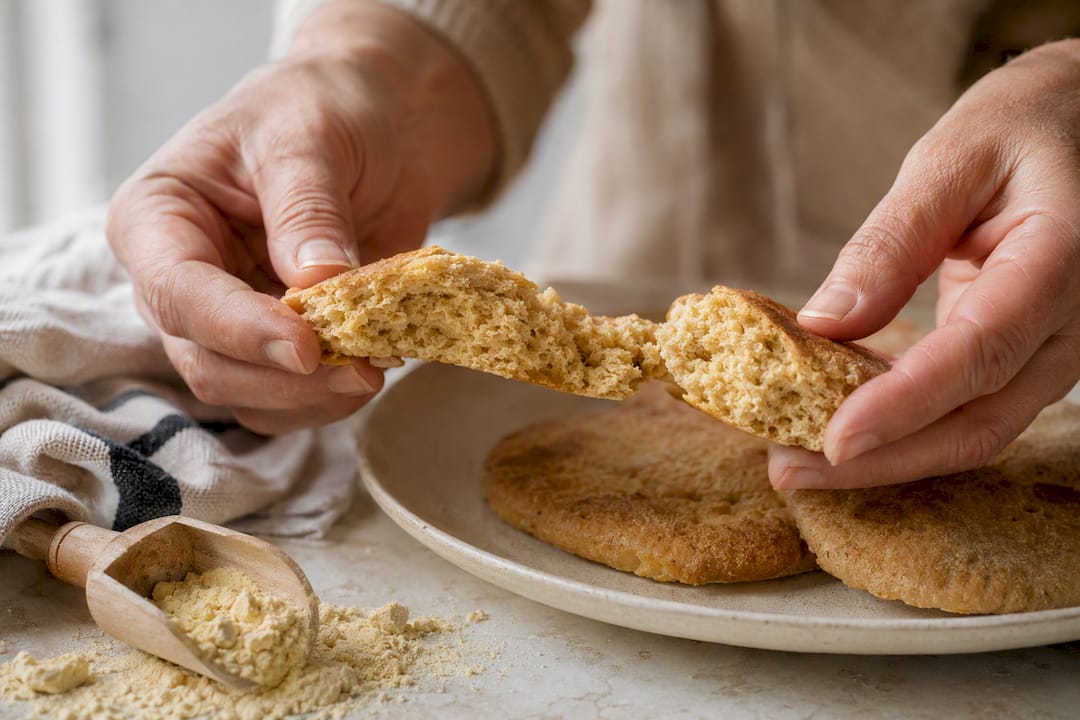
Bakers report an easier, softer crumb with einkorn but weaker dough strength, since the gluten simply isn’t built for long proofs or vigorous kneading. It suits flatbreads, shortbread-style biscuits, and porridge far better than a tall sandwich loaf.
Emmer (Triticum dicoccum)
Emmer is tetraploid and also hulled, historically the workhorse grain of ancient Egypt and much of the early Mediterranean world. It has a robust, slightly earthy, chewy bite that holds its shape well in cooked grain salads, closer to farro (a name often used interchangeably with emmer in Italian cooking) than to a soft flour.
Emmer flour works nicely in rustic, dense breads and traditional pasta, where its firmer bite is an asset rather than a flaw. Whole emmer berries also cook up well as a rice or barley substitute in savoury dishes.
Spelt (Triticum spelta)
Spelt is hexaploid, the same ploidy class as modern bread wheat, which is why it handles far more like a conventional flour than einkorn or emmer do. It’s also hulled, but its gluten, while present and workable, is more extensible and less elastic, so doughs tolerate less aggressive kneading before they tear. The flavour runs mildly sweet and nutty, less assertive than emmer.
Spelt is the most forgiving ancient wheat for home bakers moving away from standard flour for the first time, and it performs well in everyday loaves, pancakes and pizza bases. Granavitalis covers the practical side of working with spelt in more depth, including how it behaves across different recipe types.
Khorasan / Kamut® (Triticum turanicum)
Khorasan is tetraploid and free-threshing, meaning the kernel separates from its husk during ordinary harvesting, unlike the three hulled grains above. Kamut® is the registered trademark under which most commercial khorasan is sold, grown to specific organic and purity standards under that branding. The grain is large, golden and buttery in flavour, with a firm, slightly chewy texture that holds up well in pasta and pilafs.
Small clinical trials on khorasan/Kamut® have reported reduced markers of metabolic risk and inflammation compared with modern wheat, though sample sizes were small and growing conditions varied between studies, so the findings point to a promising signal rather than settled proof.
What the nutrition studies actually show
Kernel-for-kernel, several ancient wheats do outperform modern bread wheat on specific measures, but the size of that advantage depends heavily on which grain, which nutrient, and how it’s grown.
Systematic reviews find that einkorn, emmer, spelt and khorasan often show modest advantages in minerals and polyphenols at the raw kernel stage, plant compounds linked to antioxidant activity. The 2023 Foods review found einkorn bran particularly high in ash and mineral content across several datasets, with emmer and spelt showing their own smaller but measurable edges depending on the specific mineral tracked.
Here’s the finding that deserves more attention than it usually gets: those kernel-level advantages shrink substantially once the grain becomes bread. The Altergrain research project in Belgium measured higher protein, ash and phenolic content in ancient wheat kernels, but breads baked from those same grains showed far smaller differences in actual nutrient intake compared with bread made from modern wheat.
- Kernel-level differences in minerals and polyphenols are real but modest, not dramatic.
- Milling, fermentation and baking all reduce those differences further.
- Genotype and soil mineral levels strongly influence the result — Kamut® grown in mineral-rich North American soil, for instance, has shown higher selenium content than the same species grown elsewhere, which is an agronomic effect as much as a species one.
The honest takeaway: choosing an ancient wheat for nutrition alone is a reasonable but modest bet, not a guaranteed upgrade. Marketing claims that treat these grains as inherently superior tend to overstate what a genuinely mixed evidence base supports.
How ancient wheats behave in baking and cooking
Weaker or differently structured gluten is the single biggest adjustment bakers need to make when switching from bread wheat. Dough made with einkorn or emmer tears more easily under vigorous kneading and won’t hold as much gas during a long proof, which means smaller, denser loaves unless you compensate.
- Cut mixing time. Ancient wheat doughs need gentler, shorter mixing than modern flour, since overworking the dough breaks the weaker gluten structure down further.
- Raise hydration. Slightly wetter doughs help compensate for reduced elasticity and make the dough easier to shape without tearing.
- Blend for structure. Mixing 20 to 40% ancient wheat flour with a stronger bread flour keeps rise and crumb reliable while still adding flavour.
- Match the grain to the product. Spelt for everyday loaves, emmer for rustic bread and pasta, einkorn for flatbreads and biscuits, khorasan for pasta and pilaf-style dishes.
Pro Tip: Wholegrain ancient flours absorb more water than white or semi-whole versions of the same grain, so adjust hydration again if you switch milling forms mid-recipe.
Granavitalis has a dedicated look at how these flours perform once milled, covering specific blend ratios and recipe outcomes in more detail than a single section here can manage.
Why hulled ancient wheats cost more and are harder to find
Einkorn, emmer and spelt are all “hulled” wheats, meaning the husk stays fused to the kernel even after threshing and has to be removed in a separate dehulling step before milling can happen. That extra processing stage adds cost and slows down small-scale production compared with free-threshing grains like khorasan, durum or modern bread wheat, where the husk falls away easily during harvest.
- Hulled grains need specialised dehulling equipment that many conventional mills simply don’t have.
- Lower yields per hectare than modern wheat make large-scale cultivation less commercially attractive to big growers.
- Several ancient landraces tolerate poorer soil and lower water input better than modern high-yield varieties, a trait of growing interest as drought pressure increases in parts of Southern Europe.
- Regional cultivation still clusters around traditional growing areas, spelt across parts of Central Europe, emmer in Italy, khorasan largely in North America and the Middle East, rather than being spread globally.
The trade-off is straightforward: lower yield and extra processing mean higher retail prices, but also a grain that’s often grown with fewer chemical inputs than intensively farmed modern wheat.
Is ancient wheat safe if you have coeliac disease or a wheat sensitivity?
No ancient wheat is safe for coeliac disease. Einkorn, emmer, spelt and khorasan all contain gluten, and all trigger the same autoimmune response in people with coeliac disease as modern bread wheat does, regardless of how “ancient” or minimally processed the marketing sounds.
For people without coeliac disease but with a general wheat sensitivity, the picture is murkier and worth approaching carefully:
- Some individuals report easier digestion with einkorn or spelt, though controlled evidence for this remains limited to small studies, not large trials.
- The Kamut®/khorasan trials showing reduced inflammatory markers involved small groups over short periods, a promising signal rather than proof of a broader health benefit.
- Reviews caution that many marketing claims overstate universality, when the science actually points to genotype and soil conditions rather than an inherent advantage tied to the species itself.
- Always check product labels for “gluten-free” certification separately. No wheat variety, ancient or modern, qualifies as gluten-free.
If you suspect non-coeliac wheat sensitivity, a supervised elimination and reintroduction process with a healthcare professional is the reliable way to test it, not a switch to a different wheat species based on assumption.
How Granavitalis approaches sourcing ancient grains
Granavitalis selects ancient grain flours based on minimal processing and traceable sourcing, the same principle running through everything from the einkorn flour on the site to the plant protein and nut butter ranges. The idea is straightforward: grains that haven’t been pushed through decades of industrial hybridisation, kept as close as possible to their original nutritional profile.
The product range maps onto most of what this article has covered:
- Ancient grain flours (einkorn, spelt and related varieties) for home baking.
- Gluten-free flour options for readers who need to avoid wheat protein entirely.
- Plant proteins and nut butters that pair naturally with ancient grain baking, whether stirred into porridge or spread on a finished loaf.
For readers who want to go deeper on any single grain, Granavitalis’s ancient flour guide covers the consumer-facing case for choosing these grains over standard flour in more detail. This piece was put together by Jarrod, drawing on the peer-reviewed research cited throughout.
The real cost of choosing ancient wheat over modern flour
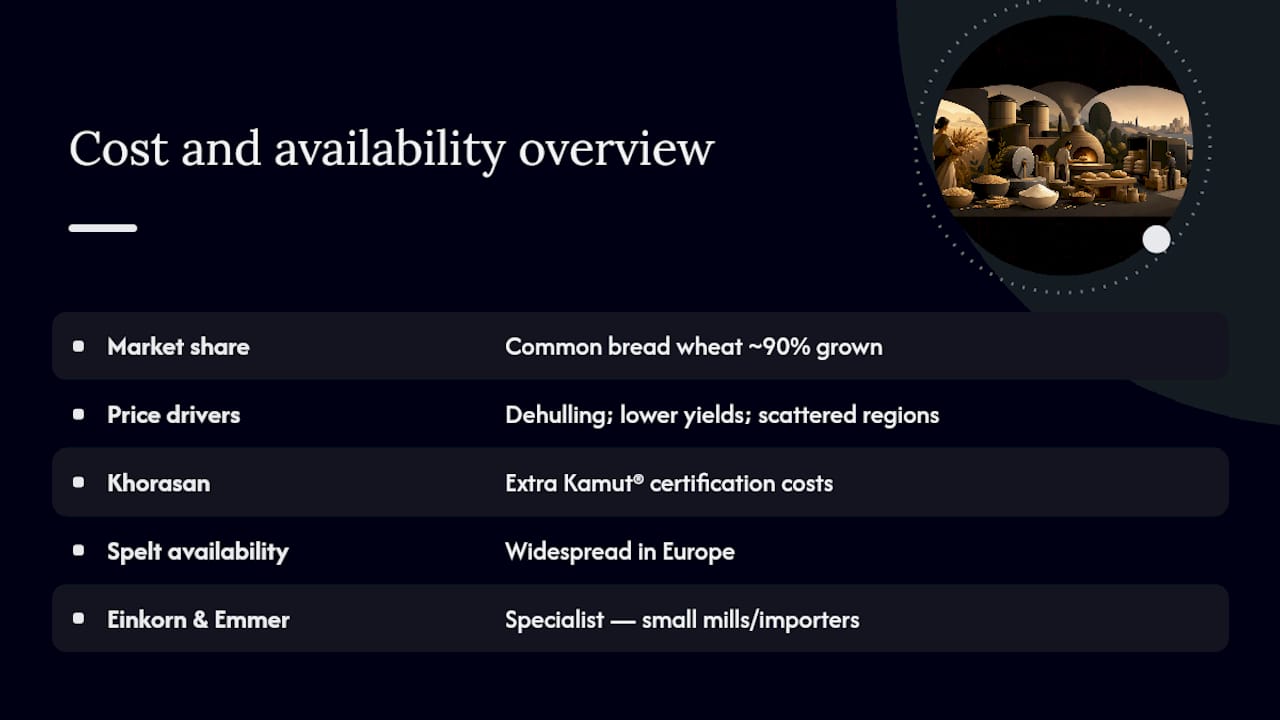
Price is where the theory of “ancient wheat is better” meets the reality of the supermarket shelf. Common bread wheat accounts for roughly 90% of all wheat grown globally, a scale advantage that keeps its price low through mechanised harvesting, established supply chains and decades of yield-focused breeding.
That scarcity shows up directly at checkout. Hulled grains need extra dehulling before milling, yields per hectare run lower than modern varieties, and the growing regions are smaller and more scattered, so there’s less competition driving prices down. Khorasan sold under the Kamut® trademark carries additional certification costs tied to its organic growing standards, which pushes the price further above a standard bag of flour.
Sourcing also varies by grain. Spelt is now grown widely enough across Europe to be reasonably easy to find in most health food shops. Einkorn and emmer remain more of a specialist purchase, often sourced from smaller mills or importers rather than mainstream supermarket supply chains. That scarcity is part of what keeps interest in these grains alive among bakers looking for something genuinely different, rather than a mass-market substitute at a mass-market price.
When ancient wheat is actually worth choosing
Choosing an ancient wheat comes down to what you’re actually optimising for, and being honest about it saves disappointment. If you want flavour and texture variety, einkorn and emmer deliver something genuinely different from a standard loaf. If you want a gentler transition away from bread wheat with a similar bake, spelt is the sensible starting point.
If you’re chasing a specific health outcome, be realistic about what the evidence supports: modest kernel advantages, often diluted by processing, not a transformation. Cost and availability should factor into the decision too, not just as an afterthought. Experiment with small blends before committing a whole loaf to a grain you’ve never baked with, and read a dedicated guide on gluten differences if allergy status is part of your decision.
— Jarrod
Try ancient grains through Granavitalis’s flour and wholefood range
Granavitalis is the practical route into ancient grains without hunting across specialist importers and small mills for each variety separately. Buying flour in wholegrain form preserves more of the bran and germ nutrients discussed earlier, while a finer semi-whole grind bakes closer to a standard loaf if you’re still adjusting to the texture, and both should be stored in a cool, airtight container since the natural oils in wholegrain flour turn rancid faster than heavily refined flour.
Beyond flour, the range extends naturally into what pairs well with ancient grain baking. Spread a slice of fresh spelt or emmer loaf with the organic raw pecan butter, or pick up the nut and seed butter selection box if you want to try a few pairings before settling on a favourite. Browse the flour range on the Granavitalis site and order what suits your next bake.
Sources
- Do ‘ancient’ wheat species differ from modern bread wheat in their contents of bioactive components?
- Ancient wheats—A nutritional and sensory analysis review (Foods, 2023)
- Altergrain project results — comparative kernel and bread nutrition