

Home Cooks: Keep Split Red Lentils Firm, Creamy or Pureed
Rinse split red lentils in a sieve until the water runs clear, then simmer in about three parts water to one part lentils until they reach your preferred texture, which varies with cooking time. No soaking needed. Pressure cookers manage it with a short natural release to prevent foaming. Season with salt and acid only once the lentils are tender, and drain or spread them out on a tray the moment they hit your preferred texture.
TL;DR:
- Red split lentils cook quickly because they are hulled and split, requiring no soaking and only about 12 to 20 minutes of simmering to reach desired textures.
- The water-to-lentil ratio heavily influences final texture: 2:1 for firmness, 3:1 for creaminess, and 4:1 or more for purees, with gentle simmering and frequent tasting.
- Pressure cooking reduces cook time to around 8 to 10 minutes with a 2:1 water ratio, but requires a natural release and careful handling of foam to prevent messes.
- Slow cooking at low heat develops flavor but risks turning lentils into mash if cooked too long; quick cooling and portioning aid weekly meal prep.
- Season salt after tenderness, incorporate aromatics early in cooking, and enrich dishes at the end with acid or oils to enhance flavor without affecting texture.
Table of Contents
- What split red lentils actually are and how to prep them
- Stovetop method: ratios, timing and the technique that actually works
- Pressure cooker and Instant Pot timings that avoid a mess
- Slow cooker method and batch cooking for the week ahead
- Getting the texture right: firm, creamy, or fully puréed
- When and how to season split red lentils
- Storing, reheating and repurposing cooked lentils
- Where Granavitalis fits into your lentil cooking routine
- A cook’s honest take on lentil texture tolerances
- Sources
- FAQ
What split red lentils actually are and how to prep them
Split red lentils have already been hulled and split in half before they reach the packet, so they cook much faster than whole green or brown varieties. That processing strips away the tough seed coat and halves the surface area exposed to water, so the starches inside hydrate and soften much faster than whole lentils or dried chickpeas.
That speed is the whole point of the ingredient, and it’s why split lentils are usually sold dehulled rather than whole. Soaking them overnight, the way you might treat kidney beans, does nothing useful and can actually work against you by over-hydrating the lentil before it even hits the pan.
Before anything goes near a pot, though, a proper look and rinse pays off:
- Tip the lentils onto a plate or tray and scan for small stones, grit, or shrivelled pieces, which do occasionally slip through packing lines.
- Transfer them to a fine-mesh sieve and rinse under cold running water, swirling with your fingers until the water runs clear rather than cloudy.
- Skip soaking for standard cooking, since it offers no textural benefit and can make lentils fall apart even faster once they hit heat.
- If digestion is a personal concern, a short 15 to 30 minute soak won’t hurt, though it isn’t necessary for flavour or safety.
- Check the colour and shape if the packaging is unclear: split red lentils are salmon pink, flat, and roughly half the size of a whole brown lentil, which retains its coat and a slightly domed shape.
Once rinsed, you’re ready to cook, and the method you choose from here determines exactly what texture lands on the plate.
Stovetop method: ratios, timing and the technique that actually works
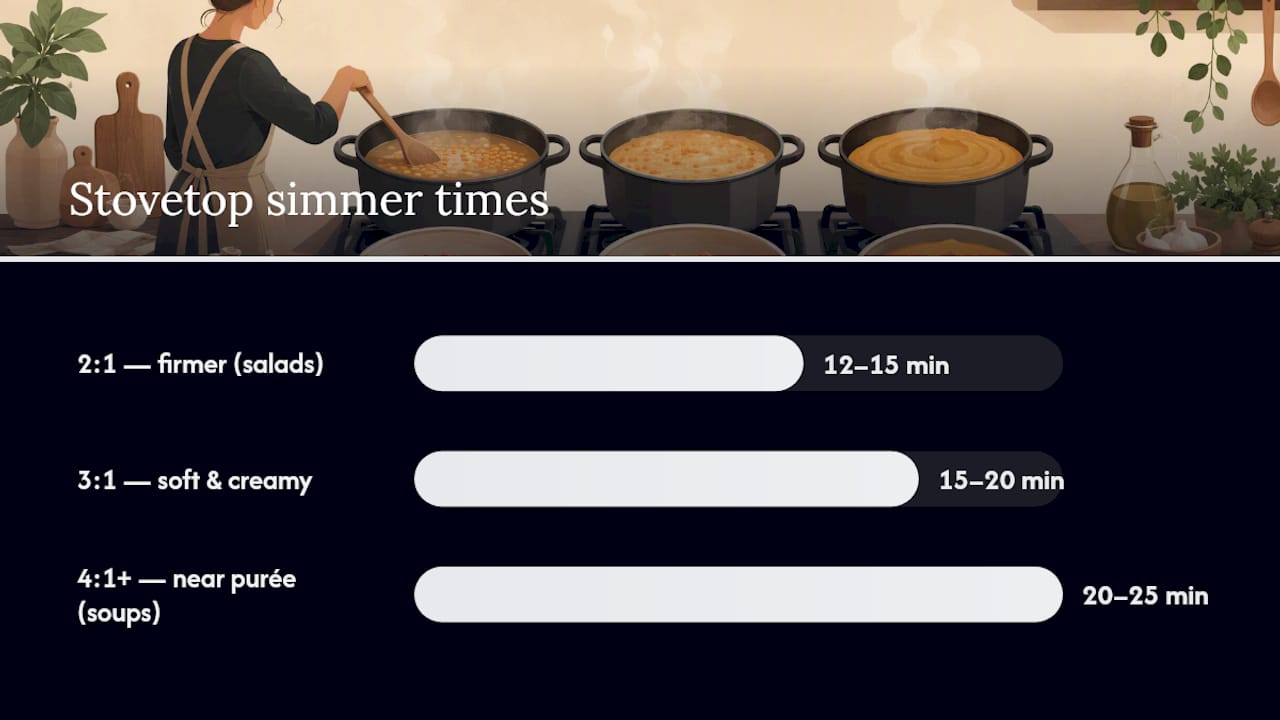
The stovetop gives you the most control, and control comes down to one variable more than any other: how much water you use relative to lentils; for inspiration on finishing ideas and flavours, see seasonal vegan menu ideas for every time of year. Grocefully’s ratio guidance puts the standard range at 2 to 3 cups of water per 1 cup of dry lentils, with more liquid pushing you toward a purée and less holding some shape.
| Water to lentil ratio | Typical simmer time | Resulting texture |
|---|---|---|
| 2:1 | 12–15 minutes | Firmer, holds some shape, good for salads |
| 3:1 | 15–20 minutes | Soft and creamy, classic dal or stew consistency |
| 4:1 or more | 20–25 minutes | Near-complete purée, ideal for soups |
Start the lentils in cold water rather than dropping them into an already-boiling pot. Bring the whole thing up to a boil together, then immediately drop the heat to a lazy simmer, just a few lazy bubbles breaking the surface rather than a rolling boil. A hard boil agitates the lentils too aggressively and breaks them down faster than you’d want, even at a firmer ratio.
Stir gently every 5 to 10 minutes, partly to stop sticking on the base of the pan and partly to check progress. You’ll see foam rise in the first few minutes; skim it off with a spoon, since it’s just released starch and can make the finished dish look cloudier than it needs to be, a behaviour NYT Cooking notes as typical of split, skinned lentils. FineDiningLovers puts the general cook window at 15 to 20 minutes for a standard tender texture, though age of the dried lentil and your actual stove output shift that window slightly either way.
Pro Tip: Start tasting at the 10 minute mark, not at the end. Split red lentils go from “still a bit chalky” to “falling apart” faster than most cooks expect, sometimes in under five minutes of extra simmering.
If you overshoot and end up with soup when you wanted salad lentils, don’t panic. Strain immediately to stop the residual heat cooking them further, spread the lentils on a tray to cool quickly, and repurpose them into a thicker dip or blended soup base rather than trying to force them back into a firmer state.
Pressure cooker and Instant Pot timings that avoid a mess
Pressure cooking split red lentils needs less water than the stovetop and a lot less time. Connoisseurus Veg recommends roughly a 2:1 ratio, two cups of water per cup of dry lentils, cooked on high pressure for 8 to 10 minutes.
That shorter time isn’t just about speed. Split red lentils foam as they cook, and a rapid quick release under pressure can force that foam straight up through the valve, leaving a starchy mess on your counter and occasionally clogging the release mechanism itself.
- Use the 2:1 water ratio rather than the 3:1 you’d use on the stovetop, since a sealed pot loses far less liquid to evaporation.
- Cook on high pressure for a short time, with less time for firmer texture and a bit longer for softer, soup-like texture.
- Let the pressure release naturally for around 10 minutes before opening the valve, which lets the foam settle rather than erupt.
- Once the lid is off, stir and taste. If the lentils feel too thick or gluey, stir in a splash of hot water or stock until the consistency loosens.
- If they’re looser than you’d like, simmer uncovered on the sauté function for a few minutes to reduce.
This method suits anyone making dal, soup, or a curry base on a weeknight, since the total active time rarely exceeds 20 minutes including pressurising.
Slow cooker method and batch cooking for the week ahead
A slow cooker rewards patience with lentils that pick up far more flavour from onions, garlic, and spices simply because they spend hours in contact with them, an effect FineDiningLovers highlights when comparing slow, low cooking against a quick stovetop simmer. The trade off is that split red lentils, left unattended on high, can turn to complete purée well before you’re ready to eat.
- Combine lentils with water or stock at a 3:1 to 4:1 ratio, adjusting toward the higher end if you’re planning a soup rather than a stew.
- Cook on low for 4 to 6 hours for a soft, melt-in-the-mouth texture that still holds together as a dish rather than dissolving completely.
- Avoid the high setting unless you actually want a purée, since it can push lentils past tender and into mush in under half the time.
- Check midway through and add a splash more liquid if the mixture looks like it’s drying out around the edges.
- Once cooked, cool the batch quickly by transferring it out of the hot pot into shallow containers, then refrigerate or portion straight into freezer bags for later.
Batch cooking this way turns one slow cooker session into several ready meals, which suits anyone building a weekly rotation of quick lunches around a single big cook.
Getting the texture right: firm, creamy, or fully puréed
Every texture split red lentils can reach comes down to three levers working together: how much water you use, how hard the liquid is simmering, and how long you leave them in it. Get those three right and you can hit any point on the spectrum on purpose rather than by accident.
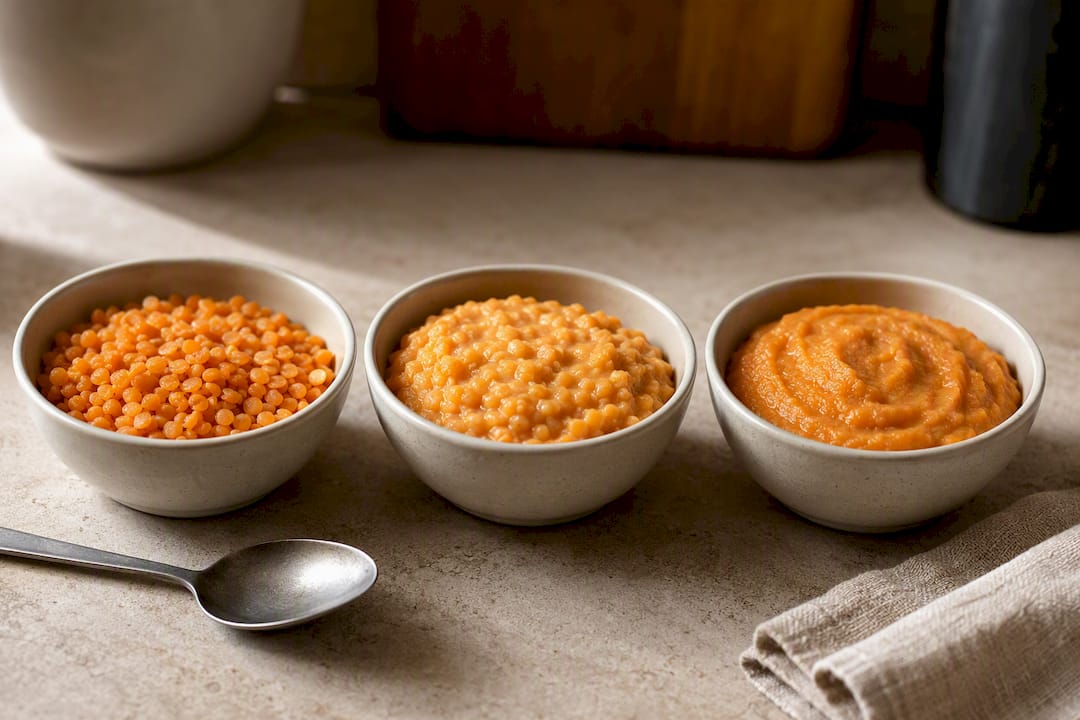
- Firm but tender, the texture you want for a lentil salad, needs a 2:1 water ratio, a gentle simmer of 12 to 15 minutes, and minimal stirring so the lentils hold their shape.
- Creamy and stew-like, the classic dal texture, sits at a 3:1 ratio with 15 to 20 minutes of cooking and occasional gentle stirring to help the starch release evenly.
- Full purée, ideal for soup bases or spreads, needs 4:1 or more water, 20 to 25 minutes of simmering, and a final whisk or blitz with a stick blender to smooth out any remaining texture.
If you’re chasing firm lentils and they’ve gone soft too quickly, drain them the moment they hit the texture you want and run cold water over them briefly to arrest the cooking. Going the other way, from a batch that’s too watery toward something thicker, is easier: simmer uncovered for a few more minutes to let excess liquid evaporate, or stir in a spoonful of flour or a splash of coconut milk to add body.
Pro Tip: If a batch has gone further than you intended and turned into soup, don’t throw it out. Blend it fully, thin it with stock, and you’ve got the start of a proper lentil soup rather than a wasted pan of lentils.
Overcooked lentils that have collapsed completely aren’t a failure, in other words. They’re just a different dish than the one you planned, and split red lentils are forgiving enough to pivot in either direction.
When and how to season split red lentils
Salt goes in after the lentils are tender, not before. Adding significant salt at the start of cooking can toughen the outer layer of some legumes and slow how quickly they soften, so holding back until the last five minutes or after draining gives a more reliable result.
Aromatics behave differently, and it helps to think of them in two waves. Ingredients like onion, garlic, carrot, celery, ginger, and whole spices such as cumin or turmeric belong in the pot from the start, since they need the simmer time to release their flavour into the liquid. Finishing touches, on the other hand, go on right at the end or even after plating.
- A squeeze of lemon juice or a dash of vinegar brightens what can otherwise taste flat and one-note.
- A spoonful of ghee or good olive oil stirred through right before serving adds richness that cooking oil added earlier simply cooks away.
- A quick tempering, or tadka, of cumin seeds, mustard seeds, and dried chilli fried briefly in oil and poured over the finished dal, transforms a plain pot into something genuinely restaurant-standard.
- Fresh herbs like coriander or parsley, roughly chopped and scattered on top, add a contrast in both flavour and texture that cooked-in herbs lose entirely.
- Avoid adding acidic ingredients like tomatoes or lemon juice too early in the simmer, since it can slow tenderisation, a point BBC Good Food also notes in its cooking guidance.
Storing, reheating and repurposing cooked lentils
Cooked lentils need to come off the heat and cool quickly rather than sitting in a warm pot on the counter for an hour. Get them into the fridge within two hours of cooking, and they’ll keep well for three to four days in a sealed container. For longer storage, portion them into freezer bags or containers and freeze for up to three months.
- Reheat gently on the stove with a splash of water or stock stirred in, since lentils thicken considerably once chilled and need loosening.
- A microwave works too, covered, in short bursts with a stir between each to avoid uneven hot spots.
- Thicken a thin vegetable soup by stirring in leftover lentils rather than reaching for flour or cornflour.
- Shape cooled, thick lentils into patties with breadcrumbs and spices for a quick veggie burger base.
- Blend leftovers with olive oil, garlic, and lemon into a spread that works well on toast or as a dip.
Where Granavitalis fits into your lentil cooking routine
Split red lentils pair naturally with the kind of wholefood pantry Granavitalis builds its range around: ancient grains, clean plant proteins, and minimally processed staples that hold up to real cooking rather than shortcuts. A pot of lentils bulks up nicely alongside organic chickpeas for a mixed-pulse stew with more textural interest, or gets folded into a grain bowl built on one of the site’s ancient grain flours for baking flatbread to scoop it up.
If you’re building meals around plant protein more broadly, the vegetable protein sources guide covers how lentils sit alongside other staples in a balanced plate.
A cook’s honest take on lentil texture tolerances
Cook a double batch every time you make lentils and freeze half. That single habit does more for weeknight cooking than any technique in this guide, since defrosted lentils reheat into a curry or soup base in minutes flat.
Don’t chase perfect texture every single time, either. A slightly overcooked pot still makes an excellent soup, and a slightly undercooked one just needs five more minutes. What actually lifts a plain pot of lentils is the finishing touch: a spoon of good nut butter stirred into a curry for richness, a crunchy topping, or a hit of acid right at the end. Get comfortable with the range rather than obsessing over one exact outcome.
— Jarrod
Sources
- How to Cook Lentils - NYT Cooking
- How to Cook Red Lentils: FineDiningLovers
- How to Cook Dried Lentils: Grocefully (UK)
- How to Cook Red Lentils (Stove or Instant Pot!) - Connoisseurus Veg
FAQ
Do you have to soak split red lentils before cooking?
No. Split red lentils are already hulled and split, which lets them absorb water and soften quickly without a soak. A short 15 to 30 minute soak is fine if you prefer it for digestion, but it makes no real difference to cooking time or final texture.
How do you prepare dried split red lentils before cooking?
Tip them onto a plate to check for small stones or debris, then rinse thoroughly in a fine-mesh sieve under cold water until it runs clear. From there, they go straight into the pot with no soaking step required.
Is there a difference between red lentils and red split lentils?
In most kitchens the two names refer to the same product: red lentils are typically sold already split and hulled, which is why they’re often labelled either way interchangeably. Whole lentils, by contrast, keep their seed coat and cook noticeably slower.
How do you cook red split lentils so they don’t turn mushy?
Use a firmer ratio of around two parts water to one part lentils, keep the simmer gentle rather than a rolling boil, and start tasting from around the 10 minute mark. The moment they reach the texture you want, drain them and rinse briefly under cold water to stop further cooking.