
6 Whole Grain Breakfast Combos UK Cooks Can Make in Minutes
A genuine whole grain breakfast food combines a fibre rich grain, like oats, quinoa or buckwheat, with a protein source and some fruit or veg for lasting energy and better nutrient absorption. Start with oats, quinoa, barley, buckwheat, millet or brown rice. Skip anything where sugar sits above the grain on the ingredients list.
TL;DR:
- Combining oats, quinoa, or barley with protein and fruit or vegetables creates more satisfying and nutrient-dense breakfast options.
- Properly identifying genuine wholegrain cereals requires checking that wholegrain ingredients are listed first, with at least 51% of the grain content being wholegrain.
- Whole grains provide key nutrients from the bran and germ layers, including fibre, antioxidants, vitamins, and minerals, unlike refined grains.
- Storage in airtight containers in cool, dark places extends the shelf life of dry whole grains to around six months, with cooked grains lasting three to four days in the fridge.
- Batch cooking grains like oats or barley on weekends and rotating pairings reduces morning prep and helps build sustainable, healthy breakfast habits.
Table of Contents
- Which whole grains work best for breakfast?
- What nutrients do whole grains actually deliver?
- How do you build a balanced whole grain breakfast?
- How do you spot a genuine whole grain cereal on the shelf?
- Where Granavitalis fits into your breakfast routine
- How long do whole grains actually keep?
- How do you cook different whole grains properly?
- Why small daily habits beat a perfect breakfast plan
- Stock your kitchen with ingredients built for these breakfasts
- Sources
- FAQ
Which whole grains work best for breakfast?
Not every grain suits a rushed weekday morning, but most of the ones worth stocking need no more than a saucepan or a jar left on the counter overnight.
Oats are the obvious starting point. Rolled oats make classic porridge or overnight oats; steel-cut oats give a chewier baked porridge if you have 30 minutes to spare. A standard portion is 27g dry oats, roughly three tablespoons.
Quinoa isn’t just for lunch bowls. Cooked in milk with cinnamon, it becomes a protein-rich porridge, or you can fold cooked quinoa into pancake batter for extra texture. The usual ratio is one part quinoa to two parts liquid, simmered for around 15 minutes.
Pearled barley and farro take longer, closer to 25 to 30 minutes, but reward you with a nuttier, chewier bite that holds up well in a savoury breakfast bowl with egg on top.
Buckwheat and kasha (toasted buckwheat) are naturally gluten-free despite the misleading name, and buckwheat flour makes some of the most reliably fluffy pancakes you’ll find. Soba noodles are another buckwheat route, though less of a breakfast staple.
Millet, amaranth and teff are worth knowing even if you’ve never cooked with them. All three are small, quick-cooking and gluten-free, making them useful porridge bases when you want variety beyond oats.
Brown rice and puffed wholegrains round out the list as pantry backups. Leftover brown rice warmed with milk, fruit and seeds is a five-minute breakfast, and puffed wholegrain cereals work as a crunchy topping when you’re out of granola.
A 40g portion of dry wholegrain cereal is a reasonable everyday serving to aim for.
What nutrients do whole grains actually deliver?
The structure of a wholegrain explains most of its benefit. Each kernel has three layers: the bran (fibre and antioxidants), the germ (magnesium, potassium, vitamin E and other micronutrients), and the endosperm (mostly starch and protein). Refined grains strip away the bran and germ, leaving mostly endosperm, which is why white flour and white rice offer far less nutritional value than their wholegrain counterparts.
In numbers: oats and barley contain beta-glucans, a soluble fibre, that is clinically linked with modest cholesterol reduction when eaten regularly as part of a varied diet.
Fibre from wholegrains also supports regular digestion and feeds gut bacteria, and the British Nutrition Foundation points out that health benefits improve when fibre comes from a range of plants rather than one grain on repeat. Rotating oats with quinoa, buckwheat and barley through the week does more for your gut than eating porridge from the same tub every day.
One caution worth repeating: if your current breakfast is white toast, don’t jump straight to a fibre-loaded bowl of bran and seeds. Increase your intake gradually and drink enough water as you do, since a sudden jump in fibre can cause bloating or discomfort while your gut adjusts.
How do you build a balanced whole grain breakfast?
The rule is simple enough to remember without a recipe card: grain, plus protein, plus fruit or veg, plus a healthy fat. A bowl of plain oats will fill you up for an hour; add nuts, seeds, yoghurt or eggs and it holds you until lunch. The British Dietetic Association frames this pairing as the most reliable way to boost both nutrient density and satiety at breakfast.
Here are six combinations worth putting into rotation:
- Porridge oats with a spoonful of pecan butter and fresh berries — the fat and protein from the nut butter slow digestion, keeping energy steadier than oats alone.
- Quinoa porridge with Greek yoghurt and stewed apple — cooked the night before, this reheats in two minutes.
- Buckwheat pancakes topped with sliced banana and a drizzle of honey — naturally gluten-free and freezer-friendly if you batch cook a stack.
- Barley breakfast bowl with a soft-boiled egg and wilted spinach — a savoury option for anyone who finds sweet breakfasts unsatisfying.
- Millet breakfast pudding with cinnamon, dates and toasted seeds — closer to rice pudding, and children tend to like it.
- Warm brown rice with chopped mango, coconut flakes and pumpkin seeds — the easiest way to use up leftover rice.
Pro Tip: Soak oats or barley overnight in the fridge with milk or yoghurt. Overnight soaking improves texture and cuts active cooking time to almost nothing, which matters far more than any recipe on a weekday morning.
For something portable, a jar of overnight oats or a batch of buckwheat pancake wraps filled with nut butter both travel well. If you’re truly stuck for time, swap porridge for a slice of dense wholegrain toast with nut butter and banana; it takes 90 seconds and still ticks the same nutritional boxes.
How do you spot a genuine whole grain cereal on the shelf?
Packaging claims like “made with whole grains” or “contains oats” tell you almost nothing about how much wholegrain is actually in the box. The ingredient list does the real talking.
- Check that a wholegrain, such as “wholegrain wheat” or “wholegrain oats”, appears first on the ingredients list, not buried halfway down.
- Look for products meeting or exceeding the general guidance that at least 51% of the grain content should be wholegrain to earn the label meaningfully.
- On the nutrition panel, prioritise fibre per portion first, then check sugars and sodium; a decent breakfast cereal or porridge oat should carry noticeably more fibre and less sugar than a “toasted granola cluster” style product.
- Ignore front-of-pack claims like “source of fibre” or “with whole grains” on their own. They’re marketing shorthand, not proof.
- Budget-friendly swap: own-brand porridge oats or basic wholegrain wheat biscuits are almost always cheaper than branded granolas and just as nutritious, sometimes more so.
Breakfast cereals remain one of the main sources of fibre in the UK diet, so choosing well here has an outsized effect on your daily fibre total. As above, build up your intake gradually rather than switching from a sugary cereal to a bran-heavy one overnight.
Where Granavitalis fits into your breakfast routine
Some providers source ancient grain flours and nut butters with minimal processing, which matters because heavy refining is exactly what strips the bran and germ out of a grain in the first place. A few practical uses for the recipes above:
- Ancient grain flours work well in the buckwheat or barley pancake recipes when you want a flour that hasn’t been stripped of its natural nutrients.
- A spoonful of nut butter stirred into porridge, quinoa or millet pudding adds protein and healthy fat in seconds, rather than reaching for a separate protein source.
- Seeds and nuts sold whole rather than pre-mixed let you control exactly what goes into your bowl, useful if you’re watching added sugar.
None of this replaces varying your grains or reading labels carefully; it simply makes the good choices easier to reach for on a Tuesday morning.
How long do whole grains actually keep?
Whole grains spoil faster than refined ones because the germ contains natural oils that can turn rancid over time. That’s the trade-off for the extra nutrition.
Store dry, uncooked grains like oats, quinoa, barley and buckwheat in airtight containers, away from direct sunlight and heat. A cool, dark cupboard keeps most wholegrains fresh for around six months; the fridge or freezer extends that considerably, particularly for oats and buckwheat, which have a higher oil content than white rice.
Buy in quantities you’ll actually use within a few months rather than stockpiling a five kilogram bag because it was on offer. If a grain smells musty, faintly sour, or “off” in any way, it’s past its best. Wholegrains don’t go visibly mouldy the way bread does; the oils just degrade quietly, so trust your nose over your eyes.
Cooked grains behave differently. Cooked oats, quinoa or barley keep in the fridge for three to four days in a sealed container, which is exactly why batch cooking on a Sunday works so well for weekday breakfasts. Cooked wholegrains also freeze well; portion them into individual containers before freezing so you can defrost exactly what you need rather than an entire batch.
How do you cook different whole grains properly?
Cooking times and water ratios vary more than people expect, and getting them wrong is the main reason some home cooks give up on grains beyond oats.
Oats need roughly double their volume in liquid (water or milk), simmered for 5 minutes for rolled oats or up to 20 for steel-cut. Soaking steel-cut oats overnight cuts that cooking time significantly.
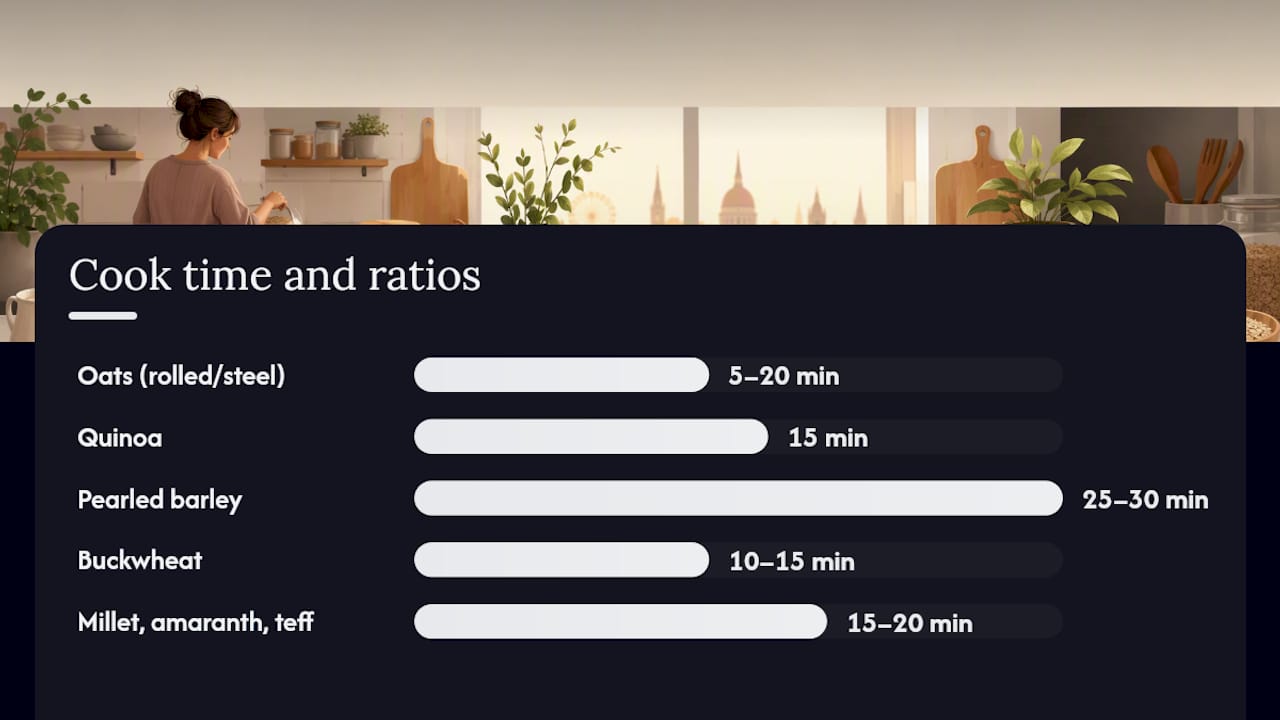
Quinoa cooks in a 1:2 ratio of grain to liquid, simmered for about 15 minutes until the liquid absorbs and the grain shows its characteristic little curl.
Pearled barley needs closer to a 1:3 ratio and 25 to 30 minutes of simmering; unpearled barley takes even longer and benefits from an overnight soak to soften.
Buckwheat cooks fast, around 10 to 15 minutes in a 1:2 ratio, and needs almost no soaking, which is part of why it’s such a convenient weeknight grain.
Millet, amaranth and teff are the quickest of the lot, generally ready in 15 to 20 minutes at a 1:2 or 1:3 ratio depending on how thick you want the finished porridge.
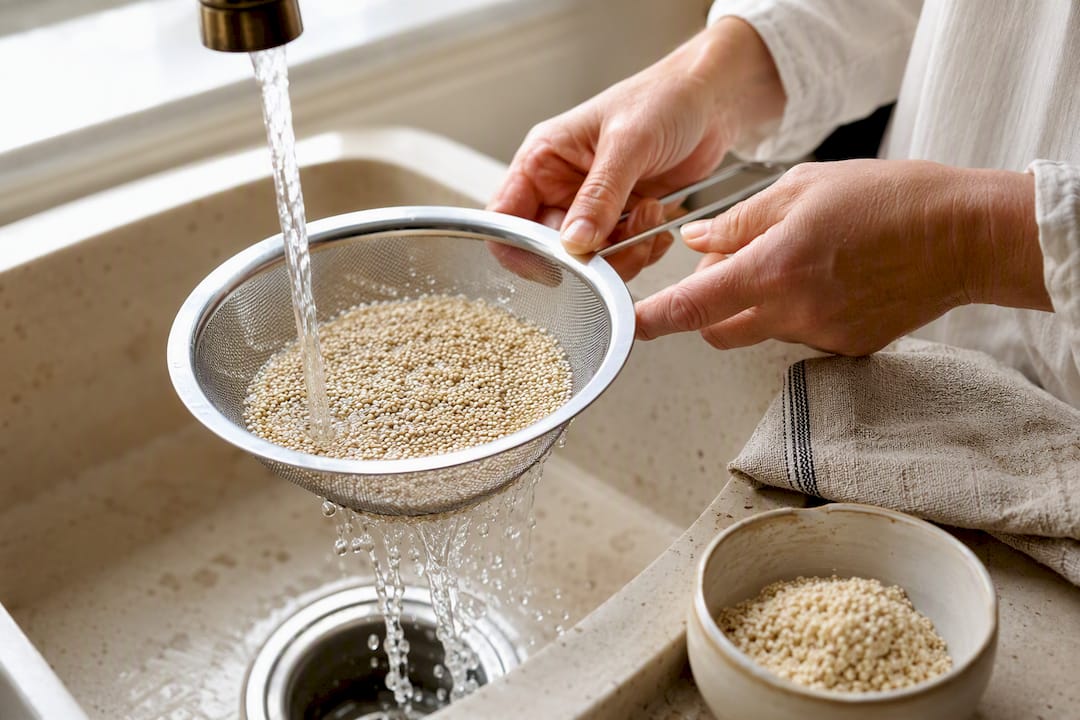
As a general habit, rinsing grains before cooking removes surface starch and any bitterness, particularly with quinoa, and soaking harder grains like barley overnight both shortens cooking time and can improve digestibility for people with sensitive digestion.
Why small daily habits beat a perfect breakfast plan
I’ve come to think the biggest mistake people make with wholegrain breakfasts isn’t ignorance, it’s overcomplication. Nobody sustains a five-step recipe on a Wednesday. What actually works is batch cooking one grain on a Sunday, oats or barley, then rotating what you pair it with through the week. Try mixing two grains you already own into one pot this week and see which combination you reach for again without thinking.
— Jarrod
Stock your kitchen with ingredients built for these breakfasts
Granavitalis exists for exactly the mornings this article describes: the ones where you want a wholegrain breakfast that actually delivers, without hunting through ten ingredient lists to check it’s genuine. Our ancient grain flours are minimally processed, keeping the bran and germ intact rather than milled away, which is the whole point of choosing wholegrain in the first place.

If you’re building any of the bowls above, the Raw Organic Pecan Butter is worth keeping on the counter. Stir a spoonful into porridge or quinoa pudding and you’ve covered the protein and healthy fat side of the plate in one move. Not sure which nut butter suits your routine? The Organic Nut & Seed Butter Selection Box lets you try several before committing to one. For more ways to combine grains with protein, our guide on adding protein to porridge naturally walks through the options in more depth, and our seed-based meal ideas from Wild Foodz offer further combinations worth trying. Visit the Granavitalis shop and add a nut butter to your next order.
Sources
- Healthy breakfast ideas & guides — British Dietetic Association
- Wholegrains: why there’s more to them than wholemeal bread — British Heart Foundation
- Fibre — British Nutrition Foundation
FAQ
What is the healthiest grain to eat for breakfast?
There’s no single “healthiest” grain, but oats and barley stand out for their beta-glucan content, which is linked with modest cholesterol benefits, while quinoa and buckwheat offer complete plant protein alongside their fibre.
Which cereal counts as wholegrain?
A cereal counts as genuinely wholegrain when a wholegrain ingredient, such as wholegrain oats or wholegrain wheat, appears first on the ingredients list rather than refined flour or sugar.
Are Weetabix whole grains?
Weetabix is made primarily from wholegrain wheat, which places it among the wholegrain cereal options, though it’s still worth checking the fibre and sugar figures on the nutrition panel against other cereals you’re considering.
What are ten whole grain foods?
Oats, quinoa, barley, buckwheat, brown rice, millet, spelt, amaranth, teff and wholegrain wheat products such as wholemeal bread all count as wholegrain foods.
How much wholegrain should I eat at breakfast?
A practical everyday portion is around 27g of dry oats or 40g of dry wholegrain cereal, adjusted to your appetite and paired with protein and fruit or veg.