

15 fibre-rich breakfast ideas for gut health and steady energy
Porridge with seeds, high-fibre muesli, chia pudding, and wholegrain toast with beans are the fastest, highest-impact options you can reach for this morning. Each delivers meaningful fibre in a single serving, supports gut regularity, and helps blunt the blood-sugar spike that follows a carbohydrate-heavy start to the day. The NHS recommends 30 g of dietary fibre per day for adults, yet most UK adults average less fibre than recommended — there is a shortfall that breakfast alone can go a long way to closing.
Quickest high-fibre breakfasts and approximate fibre per serving:
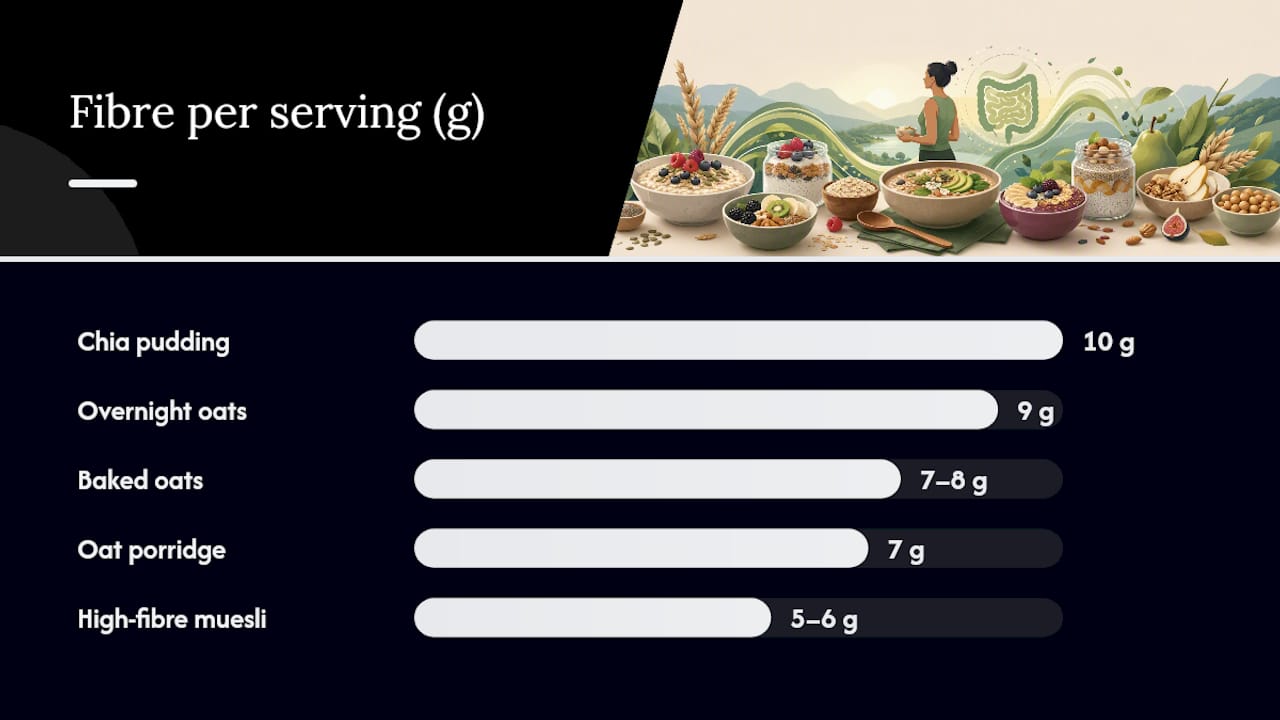
- Porridge (80 g oats) with 1 tbsp ground flaxseed: ~6–7 g fibre
- High-fibre muesli (60 g, no added sugar): ~5–6 g fibre
- Chia pudding (3 tbsp chia seeds in plant milk): ~10 g fibre
- Wholegrain toast (2 slices) with half a tin of baked beans: ~10–11 g fibre
- Overnight oats with berries and hemp seeds: ~7–8 g fibre
- Seeded wholemeal toast with avocado and pumpkin seeds: ~6–7 g fibre
UK fibre gap: The SACN recommends 30 g of dietary fibre daily for adults, yet typical intake sits at roughly 20 g. A well-chosen breakfast can contribute 8–12 g of that target before you leave the house.
Key takeaways
A fibre-rich breakfast is the single most practical lever for closing the UK’s 10 g daily fibre gap, supporting gut health, and steadying morning blood sugar.
| Point | Details |
|---|---|
| UK recommendation | Adults need 30 g of fibre daily; most UK adults average around 20 g. |
| Top breakfasts to try | Chia pudding, beans on wholegrain toast and lentil bowls each deliver 10–12 g fibre per serving. |
| Increase gradually | Add fibre over two to three weeks and drink at least 1.5–2 litres of water daily to avoid bloating. |
| Pair fibre with protein | Combining fibre with protein and healthy fat improves satiety and blunts glucose peaks. |
| Granavitalis | Nut butters and seed-based products from Granavitalis add fibre and healthy fats to any breakfast. |
Table of Contents
- 15 high-fibre breakfast ideas — sweet and savoury
- Six easy high-fibre breakfast recipes to make this week
- Why fibre at breakfast matters: UK guidance and the evidence
- Practical swaps and a sample plan to reach 30 g/day
- Managing insulin resistance? Here is what to pick at breakfast
- The small changes that actually stick
- Granavitalis: whole foods that make fibre-rich mornings easier
- Sources
15 high-fibre breakfast ideas — sweet and savoury
These are practical, not aspirational. Each entry includes a rough fibre estimate, a one-line method, and a swap to push fibre higher if you want it.
Sweet options
1. Classic oat porridge with seeds Cook 80 g rolled oats in water or milk, stir in 1 tbsp ground flaxseed and top with a handful of blueberries. Around 7 g fibre. Swap: use jumbo oats and add 1 tbsp psyllium husk for an extra 3–4 g.
2. Overnight oats with berries Combine 60 g oats, 200 ml plant milk and 1 tbsp chia seeds; refrigerate overnight, then top with raspberries. Around 9 g fibre. Swap: add 2 tbsp hemp seeds to push past 11 g.
3. Chia pudding Mix 3 tbsp chia seeds with 200 ml oat milk; leave overnight. Top with kiwi and a handful of granola. Around 10 g fibre. Chia seeds alone deliver roughly 10 g per 30 g serving, making this one of the most fibre-dense options available.
4. High-fibre muesli Choose a no-added-sugar muesli with oats, bran flakes, nuts and dried fruit. A 60 g serving typically yields 5–6 g fibre. Swap: add 1 tbsp sunflower seeds and a sliced pear to reach 8–9 g.
5. Granola with Greek yogurt and fruit Use a granola made with oats, nuts and seeds (check the label for at least 5 g fibre per 45 g serving). Top with 150 g Greek yogurt and sliced banana. Around 6–7 g fibre. Swap: choose a bran-enriched granola and add 1 tbsp ground flaxseed.
6. Seeded wholemeal toast with nut butter and banana Two slices of seeded wholemeal toast (around 4 g fibre) spread with almond or pecan butter, topped with half a sliced banana. Around 6–7 g fibre. The nut butter adds healthy fats that slow glucose absorption.
7. Smoothie with spinach, flaxseed and frozen mango Blend 200 ml oat milk, 1 large handful of spinach, 1 tbsp ground flaxseed, 100 g frozen mango and 1 tbsp oat bran. Around 6–7 g fibre. Swap: add half an avocado for an extra 3 g and a creamier texture.
8. Baked oats with apple and cinnamon Mix 80 g oats with 1 egg (or flax egg), 150 ml milk, 1 grated apple and a pinch of cinnamon; bake at 180 °C for 20 minutes. Around 7–8 g fibre. The apple skin contributes pectin, a soluble fibre that supports cholesterol management.
Savoury options
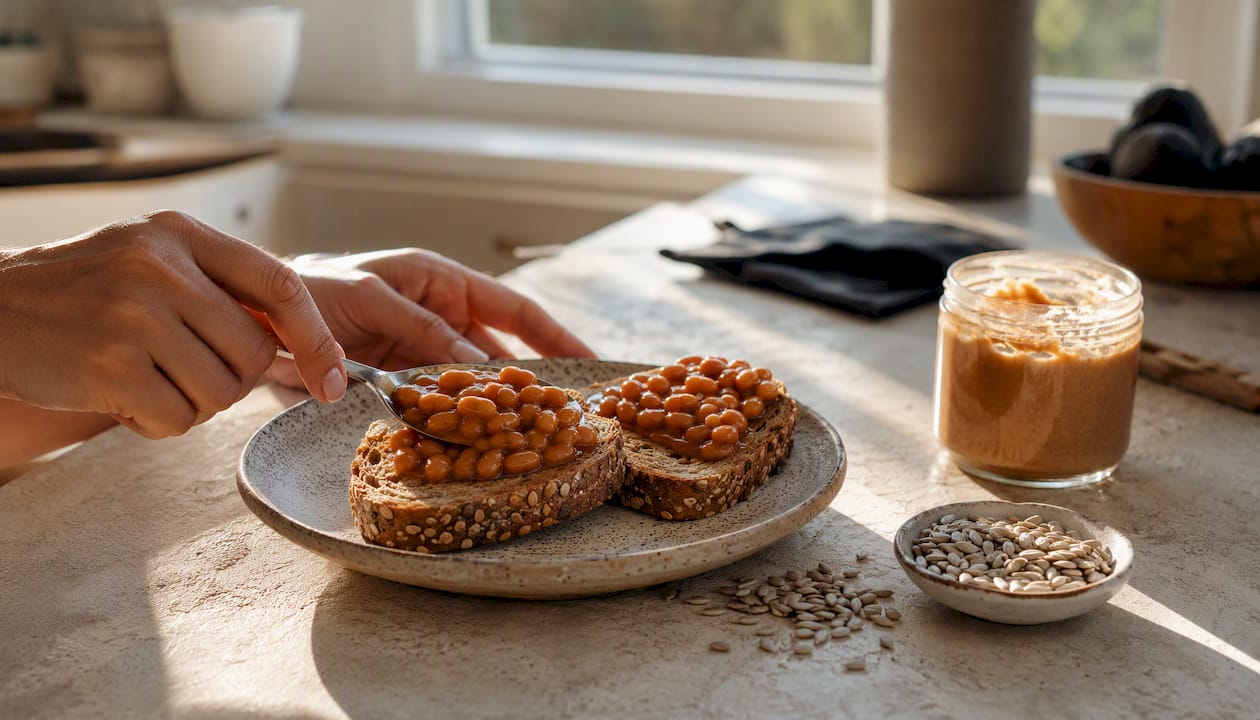
9. Beans on seeded wholegrain toast Half a tin of baked beans (around 7 g fibre) on two slices of seeded wholemeal toast (around 4 g fibre). Total: roughly 10–11 g fibre. One of the most affordable and genuinely effective high-fibre breakfasts in the UK.
10. Avocado on wholegrain toast with pumpkin seeds Mash half an avocado onto two slices of seeded wholemeal toast; scatter 1 tbsp pumpkin seeds on top. Around 7 g fibre. Avocado contributes both soluble and insoluble fibre, plus monounsaturated fats.
11. Savoury oats with spinach and a poached egg Cook 80 g oats in vegetable stock; stir in a large handful of spinach until wilted. Top with a poached egg and a pinch of chilli flakes. Around 6–7 g fibre. This is the format that surprises people most — oats work just as well in a savoury context.
12. Lentil and vegetable breakfast bowl Warm 150 g cooked green or puy lentils with diced tomato, cumin and a handful of kale; serve with one slice of wholegrain toast. Around 10–12 g fibre. Lentils are among the most fibre-dense pulses available and cost very little per serving.
13. Shakshuka-style eggs with cannellini beans Simmer tinned tomatoes with garlic, paprika and 100 g cannellini beans; crack in two eggs and cook until set. Serve with one slice of wholegrain toast. Around 9–10 g fibre. The beans add both soluble fibre and plant protein.
14. Sweet potato toast with tahini and hemp seeds Slice a sweet potato lengthways into 1 cm slabs and toast in a toaster (two cycles). Spread with tahini and scatter 1 tbsp hemp seeds. Around 5–6 g fibre. A useful option for those avoiding gluten or wheat.
15. Mushroom, spinach and lentil omelette wrap Fill a wholemeal wrap with a two-egg omelette, 60 g cooked lentils, sautéed mushrooms and spinach. Around 8–9 g fibre. For plant-based seed-based meal ideas that work equally well for breakfast, the principle is the same: layer fibre sources rather than relying on one.
Fibre summary table
| Breakfast idea | Approx. fibre/serving | Quick swap to boost fibre |
|---|---|---|
| Oat porridge with seeds | 7 g | Add 1 tbsp psyllium husk (+3–4 g) |
| Overnight oats with berries | 9 g | Add 2 tbsp hemp seeds (+2 g) |
| Chia pudding | 10 g | Add sliced kiwi and granola (+2 g) |
| High-fibre muesli | 5–6 g | Add seeds and a pear (+3 g) |
| Granola with yogurt and fruit | 6–7 g | Choose bran-enriched granola (+2 g) |
| Seeded toast with nut butter and banana | 6–7 g | Add 1 tbsp ground flaxseed (+2 g) |
| Seeded smoothie | 6–7 g | Add half an avocado (+3 g) |
| Baked oats with apple | 7–8 g | Add 1 tbsp oat bran (+2 g) |
| Beans on wholegrain toast | 10–11 g | Use butter beans for more fibre |
| Avocado toast with pumpkin seeds | 7 g | Add a tin of chickpeas (+5 g) |
| Savoury oats with spinach | 6–7 g | Add 50 g lentils (+3 g) |
| Lentil breakfast bowl | 10–12 g | Add extra kale (+1 g) |
| Shakshuka with cannellini beans | 9–10 g | Add an extra 50 g beans (+2 g) |
| Sweet potato toast with tahini | 5–6 g | Add sliced avocado (+3 g) |
| Lentil and mushroom wrap | 8–9 g | Use a high-fibre wrap (+2 g) |
Six easy high-fibre breakfast recipes to make this week
These six recipes are designed to be genuinely usable on a weekday. Fibre figures are estimates based on typical ingredient weights; always check labels on commercial products, as fibre content varies by brand.
Recipe 1: Seeded porridge bowl
Ingredients (1 serving): 80 g rolled oats, 300 ml oat milk, 1 tbsp ground flaxseed, 1 tbsp pumpkin seeds, 80 g blueberries, 1 tsp honey (optional).
Method:
- Bring oat milk to a gentle simmer in a small pan.
- Stir in oats and cook for 4–5 minutes, stirring regularly.
- Remove from heat; stir in ground flaxseed.
- Top with pumpkin seeds and blueberries.
- Drizzle with honey if using.
Estimated fibre: ~8 g per serving.
Recipe 2: No-added-sugar overnight muesli
Ingredients (1 serving): 60 g rolled oats, 1 tbsp sunflower seeds, 1 tbsp pumpkin seeds, 1 tbsp raisins, 200 ml unsweetened almond milk, 1 small grated apple.
Method:
- Combine oats, seeds and raisins in a jar.
- Pour over almond milk; stir well.
- Refrigerate overnight.
- Stir in grated apple before serving.
Estimated fibre: ~7–8 g per serving.
Recipe 3: Savoury oats with white beans and spinach
Ingredients (1 serving): 80 g rolled oats, 250 ml vegetable stock, 100 g tinned white beans (drained), 1 large handful of spinach, ½ tsp smoked paprika, 1 tbsp olive oil.
Method:
- Bring stock to a simmer; add oats and cook for 5 minutes.
- Stir in beans and spinach; cook for 1–2 minutes until spinach wilts.
- Season with smoked paprika and a pinch of salt.
- Drizzle with olive oil before serving.
Estimated fibre: ~10–11 g per serving.
Recipe 4: Chia and berry pudding
Ingredients (1 serving): 3 tbsp chia seeds, 200 ml oat milk, 80 g mixed frozen berries (thawed), 1 tsp maple syrup.
Method:
- Whisk chia seeds into oat milk; leave for 5 minutes, then whisk again to prevent clumping.
- Refrigerate overnight or for at least 4 hours.
- Spoon thawed berries on top.
- Drizzle with maple syrup.
Estimated fibre: ~10–11 g per serving.
Recipe 5: Seeded wholegrain pancakes
Ingredients (makes 4 small pancakes): 80 g wholemeal flour, 1 tbsp ground flaxseed, 1 tsp baking powder, 1 egg, 150 ml milk, 1 tbsp mixed seeds (sesame, poppy, sunflower).
Method:
- Whisk flour, flaxseed and baking powder together.
- Beat in egg and milk until a smooth batter forms.
- Stir in mixed seeds.
- Cook in a lightly oiled pan over medium heat, 2 minutes per side.
Estimated fibre: ~6–7 g per serving (all 4 pancakes).
Recipe 6: Lentil and vegetable breakfast bowl
Ingredients (1 serving): 150 g cooked puy lentils, 1 large handful of kale (roughly chopped), 4 cherry tomatoes (halved), 1 tsp cumin, 1 tbsp olive oil, 1 slice seeded wholegrain toast.
Method:
- Warm olive oil in a pan; add cumin and cook for 30 seconds.
- Add kale and tomatoes; cook for 2–3 minutes.
- Stir in lentils; heat through.
- Serve alongside the toast.
Estimated fibre: ~12 g per serving.
Note: all fibre figures above are estimates based on typical raw ingredient weights. Fibre content in commercial products (tinned beans, muesli, bread) varies; always check the nutrition label for the actual fibre per serving.
Why fibre at breakfast matters: UK guidance and the evidence
The SACN’s recommendation of 30 g of dietary fibre daily for adults is grounded in a substantial body of evidence linking adequate fibre intake to bowel regularity, reduced colorectal cancer risk, lower LDL cholesterol and better glycaemic control. SACN specifically favours fibre from a variety of whole foods — grains, pulses, fruit and vegetables — rather than isolated supplements, because the food matrix itself appears to matter.
Breakfast is the most reliable moment to front-load fibre, because it sets the tone for the day’s intake and influences postprandial glucose for hours afterwards. A randomised crossover trial found that raising breakfast fibre from approximately 2 g to 8 g using psyllium reduced insulin area-under-the-curve over the 120–240 minute postprandial period in overweight adults. Separately, a trial in adults with Type 2 diabetes found that a low-glycaemic, psyllium-containing breakfast produced lower postprandial glucose and insulin AUC compared with a high-glycaemic breakfast.
The long-term picture is equally compelling. Large cohort studies associate high cereal and whole-grain fibre intakes with a roughly 20–30% reduced risk of developing Type 2 diabetes, with effects appearing strongest for cereal and whole-grain fibre specifically.
Soluble versus insoluble fibre: why both matter
Soluble (viscous) fibres — found in oats, psyllium, legumes and some fruits — form a gel in the gut that slows glucose absorption and can lower LDL cholesterol. Insoluble fibres — found in wheat bran, whole grains and many vegetables — add bulk to stool and support bowel transit. A well-constructed fibre-rich breakfast draws on both: oats or psyllium for the glycaemic benefit, and wholegrain bread or bran-enriched cereals for gut motility.
Statistic: NHS data confirms the average UK adult consumes around 20 g of fibre per day — 10 g below the recommended 30 g. Closing that gap at breakfast is the most practical starting point.
Practical swaps and a sample plan to reach 30 g/day
Reaching 30 g of fibre daily does not require a complete diet overhaul. The NHS advises that adding modest fibre boosters to existing meals is the most sustainable approach. The British Dietetic Association reinforces this: pair fibre with protein and healthy fats at breakfast for satiety and steady energy, rather than loading up on fibre alone.
Simple breakfast swaps:
- White bread → seeded wholemeal bread: gains roughly 2–3 g fibre per two slices
- Cornflakes → no-added-sugar muesli or bran flakes: gains 3–5 g per serving
- Plain yogurt → yogurt with 1 tbsp ground flaxseed and berries: gains 3–4 g
- Fruit juice → whole fruit: gains 1–3 g (the fibre is in the flesh and skin)
- Butter on toast → nut butter: gains 1–2 g plus healthy fats
Three-day sample breakfast plan (fibre contribution only):
- Day 1: Seeded porridge bowl with blueberries and flaxseed (~8 g) + mid-morning apple (~3 g) = 11 g from morning alone
- Day 2: Beans on seeded wholegrain toast (~11 g) + a small handful of almonds (~2 g) = 13 g
- Day 3: Chia pudding with kiwi and granola (~12 g) + a pear (~4 g) = 16 g
Lunch and dinner contribute the remaining fibre to reach 30 g. A lentil soup at lunch and a vegetable-heavy dinner will typically cover the balance.
Pro Tip: Increase fibre gradually over two to three weeks rather than all at once. A sudden jump from 15 g to 30 g can cause bloating and discomfort. Drink at least 1.5–2 litres of water daily as you increase intake — fibre needs fluid to work properly, as NHS Inform explains.
Reading labels: look for the “of which fibre” line in the nutrition panel. A product with 6 g or more per 100 g is a good source; 3 g or more per 100 g is a moderate source. Watch for sugar-coated cereals that list wholegrains on the front but carry 20 g+ of sugar per 100 g — the fibre benefit is largely cancelled by the glycaemic load.
For a broader approach to combining fibre with plant protein, the Granavitalis guide on high-fibre, high-protein breakfasts covers the meal-composition detail in full.
Managing insulin resistance? Here is what to pick at breakfast
If you are managing insulin resistance, pre-diabetes or Type 2 diabetes, the type and combination of fibre at breakfast matters more than the total gram count alone. The goal is to slow glucose absorption, reduce the postprandial insulin demand, and sustain satiety through to lunch.
Focus on soluble fibre first. Oats (beta-glucan), psyllium husk, legumes and chia seeds all form viscous gels that slow gastric emptying and blunt glucose peaks. Clinical trial evidence shows that a psyllium-containing, low-glycaemic breakfast produced meaningfully lower postprandial glucose and insulin AUC in people with Type 2 diabetes compared with a high-glycaemic alternative. A separate crossover trial found that raising breakfast fibre to around 8 g with psyllium reduced insulin AUC in the later postprandial window in overweight adults.
Pair fibre with protein and healthy fat. The BDA’s breakfast guidance is clear on this: fibre alone is not enough. Adding a protein source (Greek yogurt, eggs, legumes, nut butter) and a healthy fat (avocado, nuts, seeds) further slows digestion and reduces the glycaemic response. A bowl of oats with psyllium, a spoonful of almond butter and a handful of berries is a genuinely well-constructed breakfast for glucose management.
Practical meal examples for insulin resistance:
- Savoury oats with white beans, spinach and olive oil (~10–11 g fibre, high protein)
- Chia pudding with Greek yogurt and berries (~12 g fibre, high protein)
- Lentil breakfast bowl with kale and a poached egg (~12 g fibre, high protein)
Pro Tip: If you take glucose-lowering medication, speak to your GP or a registered dietitian before making significant changes to your carbohydrate or fibre intake. Increasing fibre substantially can alter how quickly glucose is absorbed, which may affect medication timing and dosage.
For readers who travel and want to maintain these habits away from home, tips for eating healthily on holiday include practical strategies for keeping fibre intake consistent when your usual routine is disrupted.
The small changes that actually stick
The conventional wisdom around fibre tends to focus on dramatic overhauls: swap everything, buy specialist products, follow a strict plan. That framing puts people off before they start.
What actually works, in my experience of reading the evidence and watching how people eat, is far more modest. Three swaps, repeated daily, move the needle more reliably than any ambitious week-one plan that collapses by Thursday. Seeded wholemeal bread instead of white. A tablespoon of ground flaxseed stirred into whatever you are already eating. Beans on toast once or twice a week instead of something with no fibre at all.
Granavitalis’s commitment to ancient grains, seeds and minimally processed whole foods is not just a brand position — it reflects a genuine nutritional principle. The foods that have sustained human populations for millennia (oats, lentils, seeds, whole grains) are still the most effective fibre sources available, and they require no special preparation. The nutrient-dense breakfast approach Granavitalis advocates is, at its core, just this: real ingredients, combined thoughtfully, eaten consistently.
Small changes, repeated. That is the whole strategy.
Granavitalis: whole foods that make fibre-rich mornings easier
Getting 8–12 g of fibre at breakfast is straightforward when your ingredients are already working for you. Granavitalis sources premium nut butters, seeds and ancient-grain products specifically chosen for their nutritional density — the kind of ingredients that add fibre, healthy fats and flavour to a bowl of oats or a slice of wholegrain toast without requiring a separate supplement.

The Raw Organic Pecan Butter from RAWGORILLA, available through Granavitalis, is a single-ingredient nut butter that stirs into porridge, spreads onto seeded toast, or blends into a smoothie — adding healthy fats and fibre in one move. For readers who want to try several options, the Organic Nut & Seed Butter Selection Box covers multiple flavours and formats, useful for building variety into a weekly breakfast rotation. Browse the full range at Granavitalis and find the ingredients that fit your morning.
Sources
These are the most useful, authoritative sources for anyone who wants to check the evidence or read official UK guidance:
- How to get more fibre into your diet - NHS
- Carbohydrates and health (SACN report)
- Healthy breakfast - British Dietetic Association
- Effects of Higher Dietary Protein and Fiber Intakes at Breakfast on Postprandial Glucose, Insulin, and 24-h Interstitial Glucose in Overweight Adults
- Effects of breakfast meal composition on second meal metabolic responses in adults with type 2 diabetes mellitus | European Journal of Clinical Nutrition
- Review: Mechanistic insights of high‑cereal‑fiber diets and insulin resistance (scientific review)
For personalised advice, particularly if you are managing a health condition, consult a registered dietitian or your GP. The British Dietetic Association’s Find a Dietitian directory is a good starting point.
This article provides general nutritional information and is not a substitute for professional medical or dietetic advice. Always consult a qualified healthcare professional before making significant changes to your diet, especially if you are managing a medical condition or taking medication.