
Reduce seven hot flashes a week with turmeric for menopause
Standardised curcumin extracts show a real, measurable effect on hot flash frequency and musculoskeletal symptoms in early clinical trials, with one 2026 pilot trial reporting a significant reduction in hot flashes per week. The evidence is promising rather than settled: sample sizes remain small and dosing varies widely between studies. Anyone with a hormone-sensitive condition should speak to a doctor before adding curcumin supplements to their routine.
TL;DR:
- Standardized curcumin extracts at doses between 500 mg and 1,000 mg daily may reduce hot flashes and improve musculoskeletal symptoms, but larger and longer studies are needed.
- Short-term trials show good tolerability and safety over eight to twelve weeks, though long-term effects remain unstudied and caution is advised for hormone-sensitive conditions.
- Absorption-enhanced formulations, often combined with piperine or lipids, are crucial for effectiveness, making product choice based on bioavailability important.
- Taking turmeric through food sources can support menopause health, especially when combined with fats and black pepper to improve absorption; pairing with protein and antioxidants boosts benefits.
- Turmeric should complement, not replace, medical treatments like hormone therapy, and consulting a healthcare professional before use is strongly recommended.
Table of Contents
- What does the clinical evidence say about turmeric and menopause?
- Inside the key randomised trials on curcumin and menopause symptoms
- How might curcumin affect menopause biology?
- Is turmeric safe to take during menopause?
- How much turmeric should you take for menopause symptoms?
- Can food alone help you get more from turmeric during menopause?
- Where does turmeric actually fit in a menopause care plan?
- A food-first way to support your body through menopause
- Sources
- FAQ
What does the clinical evidence say about turmeric and menopause?
The strongest data on turmeric for menopause comes from a handful of randomised controlled trials published between 2025 and 2026, backed by a systematic review that tried to make sense of them all. None of this is folklore. These are placebo-controlled trials with measured doses, defined durations, and statistical outcomes.
The headline numbers are worth sitting with. A 2026 pilot randomised, double-blind, placebo-controlled trial found that women taking 1,000 mg of curcuminoids daily for 12 weeks saw weekly hot flash frequency drop significantly compared with placebo. That is a meaningful reduction for anyone counting hot flashes through a working day or a broken night’s sleep.
A separate 2025 double-blind RCT tested a different regimen entirely: 500 mg of curcumin twice daily for 8 weeks, in 74 postmenopausal women. The result wasn’t about hot flashes at all. Musculoskeletal health scores improved against placebo, and fatigue scores showed a meaningful reduction. Joint aches and low energy are two of the most under-discussed menopause complaints, and this trial gives them a specific evidence base.
Statistic callout: In the pilot vasomotor trial, the reduction in hot flashes per week translates to roughly one fewer hot flash per day, sustained over the 12-week treatment period.
Sitting above the individual trials is a 2025 systematic review covering a dozen RCTs. Its conclusion is a fair summary of where things stand: curcumin shows genuine antioxidant and anti-inflammatory potential in postmenopausal women, but findings on vasomotor symptoms and sex hormones are inconsistent across studies, and the field needs larger, better-designed trials before anyone can call this settled.
What holds the evidence back isn’t the direction of the results. It’s the shape of the studies:
- Most trials run for 8 to 12 weeks, too short to say much about long-term effects.
- Sample sizes are modest, often under 100 participants.
- Curcuminoid formulations differ between trials, making direct comparisons difficult.
- Dosing ranges from 500 mg to 1,000 mg daily, split differently across studies.
None of that erases the signal. It just means “promising” is the honest word, not “proven.”
Inside the key randomised trials on curcumin and menopause symptoms
Trial data rewards a closer look, because the devil is genuinely in the detail here. Dose, duration, and what was actually measured all shape how much weight a finding deserves.
The vasomotor trial is the one most women searching for hot flash relief will care about most. Conducted as a pilot study, it recruited women aged 41 to 65 and gave the treatment group 1,000 mg/day of standardised curcuminoids for 12 weeks. According to the trial’s BMC publication, the capsules used quality-controlled, standardised extract rather than generic turmeric powder, and participants tolerated the regimen without serious adverse events. Some benefit reportedly emerged by around week 6 and held through week 12, though that early-onset pattern comes from a single pilot study and needs replication before anyone treats it as reliable.
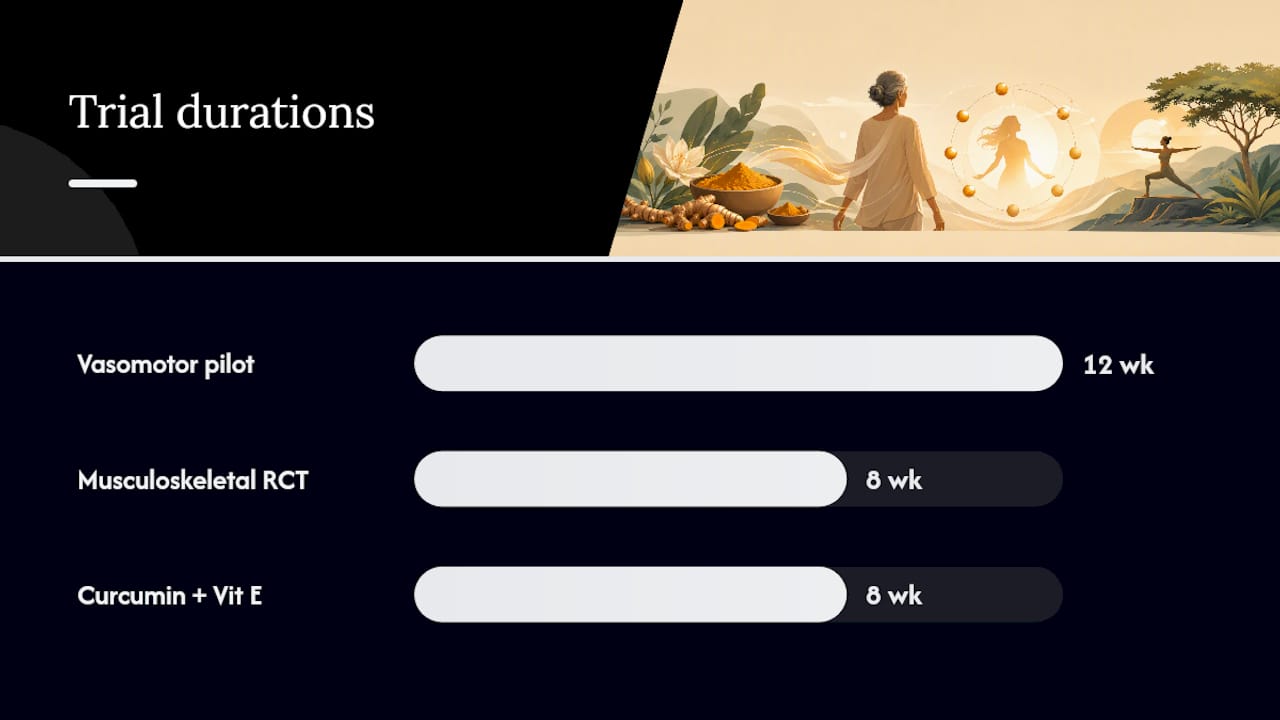
The musculoskeletal and fatigue trial took a different approach. Its 500 mg twice-daily protocol, run over 8 weeks, produced the fatigue and joint-health improvements mentioned above. Fatigue is notoriously hard to treat with anything short of addressing sleep, stress, and iron levels directly, so a measurable change from a dietary supplement is worth flagging, even from a study of this size.
A third strand of research looked at curcumin alongside vitamin E. A triple-blind RCT using 500 mg of curcumin twice daily found metabolic changes that went beyond symptom scores: fasting blood glucose and total cholesterol both fell compared with placebo, while the vitamin E arm showed separate improvements on some vasomotor measures. That trial reported no serious hepatic or renal safety signals over its study period, though the researchers noted that long-term safety data is still limited.
| Trial | Dose | Duration | Key outcome |
|---|---|---|---|
| Pilot vasomotor RCT (2026) | 1,000 mg/day curcuminoids | 12 weeks | Hot flashes down about 7 per week |
| Musculoskeletal/fatigue RCT (2025) | 500 mg twice daily | 8 weeks | Musculoskeletal and fatigue scores improved |
| Curcumin + vitamin E RCT | 500 mg twice daily | 8 weeks | Lower fasting glucose and total cholesterol; vitamin E arm improved some vasomotor measures |
A few patterns repeat across all three trials:
- Every study used a standardised curcuminoid extract, not culinary turmeric powder.
- Doses cluster around 500 mg to 1,000 mg of total curcuminoids per day.
- Trial durations top out at 12 weeks, so nobody yet knows what happens at 6 or 12 months.
- Tolerability was consistently good, with no serious adverse events reported.
The systematic review’s caution about heterogeneous formulations is the thread tying all of this together. A 500 mg capsule of a 95% curcuminoid extract is a fundamentally different dose to 500 mg of ground turmeric root, and trials rarely make that distinction obvious to a casual reader.
How might curcumin affect menopause biology?
Curcumin’s proposed mechanisms line up reasonably well with what menopause actually does to the body: rising inflammation, oxidative stress, and a sudden drop in circulating oestrogen. Whether the mechanism fully explains the trial results is still an open question, but the biological rationale isn’t far-fetched.
The anti-inflammatory pathway gets the most attention. Curcumin is thought to dampen activity in the NF-κB signalling pathway and reduce COX-2 enzyme activity, both of which drive the low-grade inflammation associated with joint stiffness, fatigue, and some cardiometabolic changes that become more common after menopause. That mechanistic story fits neatly with the musculoskeletal and fatigue improvements seen in the 2025 RCT, though the trial itself measured symptom scores, not inflammatory markers directly.
On the oxidative stress side, some trials tracked biomarkers like malondialdehyde (MDA), a marker of oxidative damage, and total antioxidant capacity (TAC). Reported improvements in these markers give a plausible biological route from “took curcumin” to “felt better,” particularly for the metabolic changes seen in the curcumin and vitamin E trial.
Then there’s the phytoestrogen question, and this is where the evidence gets genuinely thin. Turmeric is thought to have weak oestrogen-like activity, which is one possible explanation for any vasomotor benefit, but it’s a modest effect at best and not something confirmed with the same rigour as the anti-inflammatory pathways.
- NF-κB and COX-2 inhibition, linked to reduced inflammatory symptom burden.
- Reduced MDA and increased TAC, suggesting lower oxidative stress.
- Weak, unconfirmed oestrogen-like activity, a possible but unproven vasomotor mechanism.
- Formulation-dependent absorption, meaning bioavailability shapes how much of any of this actually happens in the body.
Pro Tip: Curcumin on its own absorbs poorly. Trials that report strong results almost always use extracts engineered for absorption, so the formulation matters as much as the milligram number on the label.
Is turmeric safe to take during menopause?
Curcumin has a good short-term safety record in trials, but “trial safe” and “safe for everyone” aren’t the same claim. A handful of situations call for real caution.
The clearest warning comes from the Welsh Medicines Advice Service, which advises caution with turmeric and curcumin in people with hormone-sensitive conditions, including some breast cancers and endometriosis, because of turmeric’s weak oestrogen-like activity. That single caution should sit at the front of any decision about starting a curcumin supplement during perimenopause or after.
Beyond hormone sensitivity, a few other groups need to pay attention:
- People taking anticoagulant or antiplatelet medication, since curcumin may increase bleeding risk in combination with these drugs.
- Anyone with existing liver or gallbladder conditions, given curcumin’s effect on bile production.
- People on medication for diabetes, since curcumin’s effect on fasting blood glucose could compound blood-sugar-lowering drugs.
- Anyone scheduled for surgery, who should stop supplements in advance because of the anticoagulant interaction risk.
Statistic callout: Across the trials reviewed here, running 8 to 12 weeks, none reported serious hepatic or renal adverse events at the doses tested, indicating good short-term tolerability. Researchers were still careful to flag that long-term safety data beyond that window remains limited.
That short-term tolerability is genuinely reassuring, but it’s a narrow window. Nobody has run a two-year trial. The sensible approach is treating curcumin the way you’d treat any active supplement: mention it to a GP or pharmacist, especially if any medication is already in the picture, and don’t assume “natural” means “risk-free.”
How much turmeric should you take for menopause symptoms?
Trial doses only mean something once you know what form of turmeric they’re actually talking about, and this is where most shoppers get confused at the supplement shelf.
Culinary turmeric powder, the stuff in a spice jar, contains a relatively small percentage of active curcuminoids by weight. Trial capsules use concentrated, standardised extracts instead, often boosted with piperine (black pepper extract) or a lipid-based carrier to improve absorption. That distinction explains why a trial dose of “500 mg” bears almost no resemblance to a teaspoon of turmeric stirred into a curry.
Here’s how to think about it practically, in the order most people should approach it:
- Understand what the trials actually used. The 12-week vasomotor trial used 1,000 mg/day of standardised curcuminoids; the 8-week musculoskeletal and fatigue trial used 500 mg twice daily. These are trial protocols, not medical prescriptions, and they came from studies run under supervision.
- Check the label for curcuminoid content, not just turmeric weight. A capsule listing “curcumin extract (95% curcuminoids)” is a fundamentally different product to one listing plain turmeric root powder.
- Look for absorption enhancers. Piperine or a lipid-based (liposomal or phytosome) delivery format both feature in higher-bioavailability products, and their presence explains why some supplements work faster than others at similar doses.
- Give it a fair trial window. Trial data suggests some vasomotor benefit may appear by around week 6, with fuller effects by week 12. Anything shorter than that probably isn’t a fair test.
- Track symptoms as you go. A simple daily note on hot flash count, joint discomfort, or fatigue level turns a vague impression into something you can actually compare week to week.
- Know when to stop. New digestive upset, unusual bruising, or any change in medication effectiveness are reasons to pause and speak to a clinician rather than push through.
Pro Tip: If a hot flash diary sounds tedious, keep it dead simple: a tally mark on your phone’s notes app each time one hits. Two weeks of tallies before starting and two weeks partway through gives you a real before-and-after, not a guess.
None of the trial regimens above are medical advice, and none should be read as a recommendation to self-dose at a specific level. They’re a starting point for a conversation with a GP, particularly for anyone already managing another health condition.
Can food alone help you get more from turmeric during menopause?
Trial-grade doses come from capsules, but the biology behind curcumin doesn’t switch off outside a clinical setting. Building turmeric into meals, alongside the right supporting ingredients, is a reasonable food-first complement to whatever else you’re doing for menopause symptoms.
Absorption is the practical hurdle. Curcumin needs fat and, ideally, black pepper to be absorbed well, since piperine can dramatically boost how much the body actually takes up. A turmeric shot made with pepper and a fat source reportedly improves absorption many times over compared with turmeric taken alone, which is a useful principle to carry into ordinary cooking: turmeric stirred into a dish with olive oil and a pinch of black pepper works harder than turmeric in water.
Pairing turmeric with protein matters just as much during menopause, since protein needs typically rise as muscle mass becomes harder to maintain. A turmeric-spiced protein-boosted porridge or a golden-milk smoothie built on a plant protein base covers two nutritional priorities in one meal rather than treating turmeric as an isolated add-on.
Antioxidant variety adds another layer worth building around turmeric rather than relying on it alone:
- Berries and other polyphenol-rich fruits, which support the same oxidative stress pathways curcumin appears to influence.
- Ancient grains such as quinoa or spelt, which bring fibre and micronutrients that turmeric alone doesn’t provide.
- Nuts and seeds, useful both as a fat source for curcumin absorption and for their own anti-inflammatory fats.
- Oily fish or plant omega-3 sources, which work alongside curcumin’s anti-inflammatory mechanisms rather than against them.
Granavitalis’s own ancient grain range was built with exactly this kind of nutrient-dense, whole-food foundation in mind, alongside protein and antioxidant products designed to sit comfortably next to a spice cupboard rather than replace it.
Where does turmeric actually fit in a menopause care plan?
Curcumin earns a place as an adjunct, not a centrepiece. The trial evidence for hot flashes and musculoskeletal symptoms is real, but it comes from small, short studies, and the systematic review’s own conclusion, promising yet inconsistent, is the right way to hold that evidence in your head.
Severe vasomotor symptoms, significant mood disruption, or anything affecting quality of life at a serious level deserve a proper conversation with a GP first, including a fair look at hormone replacement therapy and other licensed options. Curcumin sits better as something added to a solid foundation of medical care and good nutrition than as a substitute for either.
That’s the same food-first thinking behind Granavitalis: building meals from ingredients doing real biological work, turmeric included, rather than reaching for a single supplement and expecting it to carry the whole load.
A food-first way to support your body through menopause
Turmeric earns its place in a menopause nutrition plan, but it works best alongside proper protein and antioxidant variety, not instead of them. A Menopause Support Duo pairs a plant-based protein blend with nutrient-dense wholefoods intended to complement spices like turmeric in a daily routine rather than compete with them.
The Menopause Support Duo gives you a protein and nutrition foundation to build meals around, the same foundation the trials above suggest matters when you’re adding curcumin to your diet. For a broader antioxidant boost to sit alongside a turmeric habit, the Immune Booster Superfood Bundle covers the polyphenol-rich variety that curcumin research keeps pointing back to. Browse the Menopause Support Pack to see the full collection and pick what fits your daily routine, then build your own turmeric-forward breakfast or smoothie around it.
Sources
- PubMed record: pilot RCT of curcuminoids for vasomotor symptoms (2026)
- PubMed record: randomised trial (2025) reporting curcumin effects on musculoskeletal health and fatigue
- Systematic review: the effect of curcumin on postmenopausal symptoms (Int J Mol Sci, 2025)
- Clinical trial: curcumin and vitamin E effects on menopausal symptoms and biomarkers (PubMed)
- Welsh Medicines Advice Service: Turmeric potential adverse effects
This article is general information, not a substitute for advice from a qualified doctor. Consult a qualified healthcare professional about your own circumstances before acting on anything here.
FAQ
Does turmeric help with hot flashes?
A 2026 pilot RCT found that 1,000 mg/day of standardised curcuminoids reduced weekly hot flashes by 7.35 episodes compared with placebo over 12 weeks, though the trial was small and needs replication.
Does turmeric cause hot flashes?
No trial evidence links turmeric to triggering hot flashes; the research consistently points the other way, towards a possible reduction in frequency at standardised extract doses.
What is the right menopause and turmeric dosage?
Trials used 500 mg twice daily for musculoskeletal and fatigue benefits, or 1,000 mg/day of curcuminoids for vasomotor symptoms, both as standardised extracts rather than culinary turmeric powder, and always under study supervision.
What are natural treatments used for menopause symptoms?
Alongside curcumin, commonly researched options include phytoestrogens like soy isoflavones, black cohosh, regular exercise, cognitive behavioural therapy, dietary changes such as increased protein and fibre, and, for some women, acupuncture.
What happens to your body when you take turmeric every day?
Short-term trials of 8 to 12 weeks report good tolerability with no serious liver or kidney safety signals, alongside possible reductions in inflammatory and oxidative stress markers, though long-term daily use hasn’t been studied in the same depth.