
20 ppm limit: Verify purity and organic code on UK oat groats
Properly produced oat groats can carry both a genuine gluten-free claim and organic certification, but only when the supplier proves it. Look for three things before you buy: a tested or certified ≤20 ppm gluten-free claim backed by dedicated production, an approved organic control body code on the pack, and clear allergy labelling. Get those right and groats work brilliantly for porridge, pilafs, and grain salads.
TL;DR:
- Proper gluten-free oat groats must be produced in dedicated facilities, with batch testing or third-party certification to ensure 20 ppm gluten content.
- Organic certification requires validation by an approved control body, with clear labeling and no genetically modified ingredients, but it does not guarantee gluten-free status.
- Cook groats by simmering for 45 to 60 minutes unless soaked overnight or pressure-cooked to reduce cooking time; they work well in both sweet and savory dishes.
- People with coeliac disease should introduce oat groats gradually and monitor for symptoms, as some individuals react to avenin, a protein present in oats.
- When purchasing, verify supplier transparency on testing methods, certification details, and segregation processes, favoring sealed packs over loose oats for cross-contact safety.
Table of Contents
- What are oat groats, and how do they differ from rolled or instant oats?
- Are oat groats really gluten-free, and how do you verify it?
- What does an organic certification actually guarantee?
- What are the nutrition benefits, and who should be cautious?
- How do you cook oat groats, and how long do they take?
- Where should you buy gluten-free organic oat groats, and what should you check first?
- Why trust Granavitalis on sourcing and purity?
- Why the industry oversimplifies “gluten-free organic” and what actually matters
- Ready to add real oat groats to your kitchen?
- Sources
What are oat groats, and how do they differ from rolled or instant oats?
Oat groats are the whole oat kernel with just the outer hull removed. Nothing is rolled, steamed, or cut away. That single fact explains almost everything else about how they cook and taste.
Every other oat product on the shelf starts life as a groat. Steel-cut oats (sometimes called pinhead oats) are groats chopped into two or three pieces. Rolled oats are steamed groats flattened between rollers. Instant oats go through that rolling process twice, thinner each time, so they cook in minutes rather than the 45 to 60 minutes groats typically need.
That extra time buys you texture. Groats hold a distinct, chewy bite that survives simmering, baking, or even a second reheat, which is why they behave more like a grain than a breakfast cereal.
- Groats: whole kernel, hull removed only, 45 to 60 minutes to cook
- Steel-cut oats: groats chopped into pieces, around 20 to 30 minutes
- Rolled oats: steamed and flattened, roughly 5 to 10 minutes
- Instant oats: rolled twice, ready in 1 to 2 minutes
Because they keep their structure, groats work well beyond the breakfast bowl. Swap them into a grain salad where you might normally reach for rice or wheat berries, or simmer them into a savoury pilaf with stock, onion, and herbs. The dense bite holds its own against roasted vegetables in a way that rolled oats simply cannot.
Are oat groats really gluten-free, and how do you verify it?
Oats themselves contain no gluten. The gluten-free claim on a packet exists because of what happens to oats after harvest, not because of anything in the grain itself.
Wheat, barley, and rye are routinely grown in rotation with oats, harvested with the same combines, and hauled in shared lorries. That means most oats on general sale carry enough cross-contact wheat and barley residue to make them unsafe for coeliac patients, even though nobody added gluten on purpose. NHS guidance is explicit that oats not specifically labelled “gluten-free” should be avoided if you have coeliac disease.
The legal threshold: UK law only permits the “gluten-free” label on foods containing 20 parts per million (ppm) of gluten or less. Hitting that figure with oats demands dedicated fields, dedicated transport, and dedicated milling lines, rather than testing a shared batch and hoping for the best.
Reaching 20 ppm reliably takes what amounts to a documented traceability protocol running from seed selection through to the milling floor. Before you buy, check for:
- An explicit “gluten-free” claim on the front of pack, not just “oats”
- A statement describing dedicated or segregated production, not shared lines
- Batch testing or third-party certification referenced on the product page
- A named allergen advice line if you have specific concerns
Coeliac UK’s own guidance puts it plainly: ignore generic “oats” claims entirely and look for the explicit gluten-free wording from a supplier you trust. If you have coeliac disease and have never eaten oats before, speak to a health professional before introducing them, even when the pack is certified.
What does an organic certification actually guarantee?
Organic is a legally protected term in the UK, not a marketing flourish. A genuine organic product must be certified by an approved control body, and the pack should show that body’s code, typically formatted as GB-ORG-XX, printed near the ingredients list.
Certification for organic groats covers how the oats were grown and handled, not whether they are gluten-free. Under UK organic standards, a product labelled “organic” must be made from at least 95% organically produced ingredients, and any remaining non-organic component has to appear on an approved shortlist. Genetically modified ingredients are excluded outright.
What to check on the pack:
- A visible control body code (GB-ORG-XX or equivalent)
- The word “organic” applied to the product itself, not just one ingredient buried in a longer list
- No GM ingredients, which the certification already rules out
- A supplier willing to name its certifying body on request
Here is the point shoppers most often miss: organic and gluten-free are two entirely separate claims, assessed by different bodies against different rules. A pack can be organic without being gluten-free tested, and it can be rigorously tested for gluten without holding organic status. Verify each one independently rather than assuming one implies the other.
What are the nutrition benefits, and who should be cautious?
Oat groats are a genuinely strong source of soluble fibre, and specifically beta-glucans, a type of fibre with a solid track record for supporting healthy cholesterol levels and steadier blood sugar. Because the kernel is intact rather than processed down, groats tend to deliver that fibre more slowly and consistently than rolled or instant versions.
The main benefits worth knowing:
- Soluble fibre and beta-glucans linked to cholesterol and blood sugar support
- A dense, low-GI carbohydrate source that keeps you fuller for longer
- Useful gut-health contribution when introduced gradually alongside plenty of fluids
There is a genuine caveat, though it applies to a small minority. Even properly produced, uncontaminated gluten-free oats contain a protein called avenin, and a small number of people with coeliac disease react to it much as they would to gluten itself. This is not the same issue as contamination. It is an individual sensitivity that only shows up once contamination has already been ruled out.
Pro Tip: Introduce oat groats slowly rather than switching your whole breakfast overnight. Start with a small serving a few times a week, drink plenty of water, and watch for any digestive symptoms before scaling up. If anything feels off, check with a health professional rather than guessing.
If you’re managing broader gluten sensitivity rather than diagnosed coeliac disease, it’s worth reading up on how gluten sensitivity symptoms differ from coeliac reactions before you draw conclusions from how oats sit with you.
How do you cook oat groats, and how long do they take?
Groats reward a bit of planning, but none of the methods below are complicated. Pick whichever fits your morning.
- Stovetop, unsoaked: Use a 1:3 ratio of groats to water or milk. Bring to the boil, then simmer gently for 45 to 60 minutes, stirring occasionally, until tender with a slight chew.
- Stovetop, soaked overnight: Soak groats in water for 8 to 12 hours, drain, then simmer in fresh liquid for around 25 to 30 minutes. Soaking shortens the cook and improves digestibility.
- Pressure cooker: Cook unsoaked groats with a 1:2 ratio of water for around 10 minutes at high pressure, then allow natural release. This is the fastest route to a fully tender result.
- Slow cooker, overnight: Combine groats with liquid on low heat for 6 to 8 hours, ready to eat straight from the pot in the morning.
Once cooked, groats go far beyond a sweet porridge bowl. Stir in fruit and honey for breakfast, or head savoury: toss cooled groats through a grain salad with roasted vegetables and a sharp dressing, or simmer them risotto-style in stock with mushrooms and parmesan for a genuinely satisfying pilaf. Dried, raw groats can also be milled at home into a coarse flour for baking, adding both texture and fibre to bread or muffins. For more savoury inspiration built around whole grains and seeds, Wild Foodz’s seed-based meal ideas are worth a look.
Where should you buy gluten-free organic oat groats, and what should you check first?
Buying groats online removes the guesswork of reading tiny print in a supermarket aisle, provided the supplier actually publishes its certification details rather than burying them.
Run through this checklist before adding a pack to your basket:
- An explicit “gluten-free” claim naming the testing method or certifying body, not just “oats”
- A visible organic control body code (GB-ORG-XX format or equivalent)
- A clear statement about dedicated or segregated processing lines
- A full ingredients and allergen box, even on a single-ingredient product
- Origin information, so you know which country and supply chain the groats came from
Favour sealed retail packs over loose or bulk-bin oats, since sealed packaging is the only practical way a supplier can guarantee the contents haven’t picked up cross-contact gluten after milling. Read the full product page rather than the headline claim. A supplier confident in its process will tell you exactly how it tests, not just assert that the product is “gluten-free” in bold type.
Once opened, store groats in an airtight container somewhere cool and dry, away from direct sunlight. Kept this way, they typically stay good for 6 to 12 months, though checking the pack’s own best-before date always takes priority over any general rule of thumb.
Why trust Granavitalis on sourcing and purity?
Granavitalis exists to bring grains back to how they were before industrial processing got involved: unchanged by hybridisation, transparently sourced, and stripped of anything that isn’t the food itself. That commitment to purity and minimal processing is exactly what matters when you’re checking a gluten-free organic claim rather than taking it on faith.
For shoppers, this translates into practical reassurance rather than marketing language. Every product is built around clean ingredient lists and clear sourcing, which is the standard you should hold any gluten-free organic pack to, whoever makes it. If oat groats are what you’re after, the Granavitalis oat groats page sets out the product detail directly, and the organic gluten-free jumbo oats offer a rolled alternative if groats’ longer cook time doesn’t suit your week.
Why the industry oversimplifies “gluten-free organic” and what actually matters
The biggest failure in how this category gets marketed is treating “gluten-free” and “organic” as one badge instead of two separate promises that happen to sit on the same bag. Most buying guides blur them together, and that blurring is exactly where coeliac patients get caught out. An organic label tells you nothing about cross-contact risk. A gluten-free claim tells you nothing about how the oats were farmed. Treat them as two questions, not one tick box.
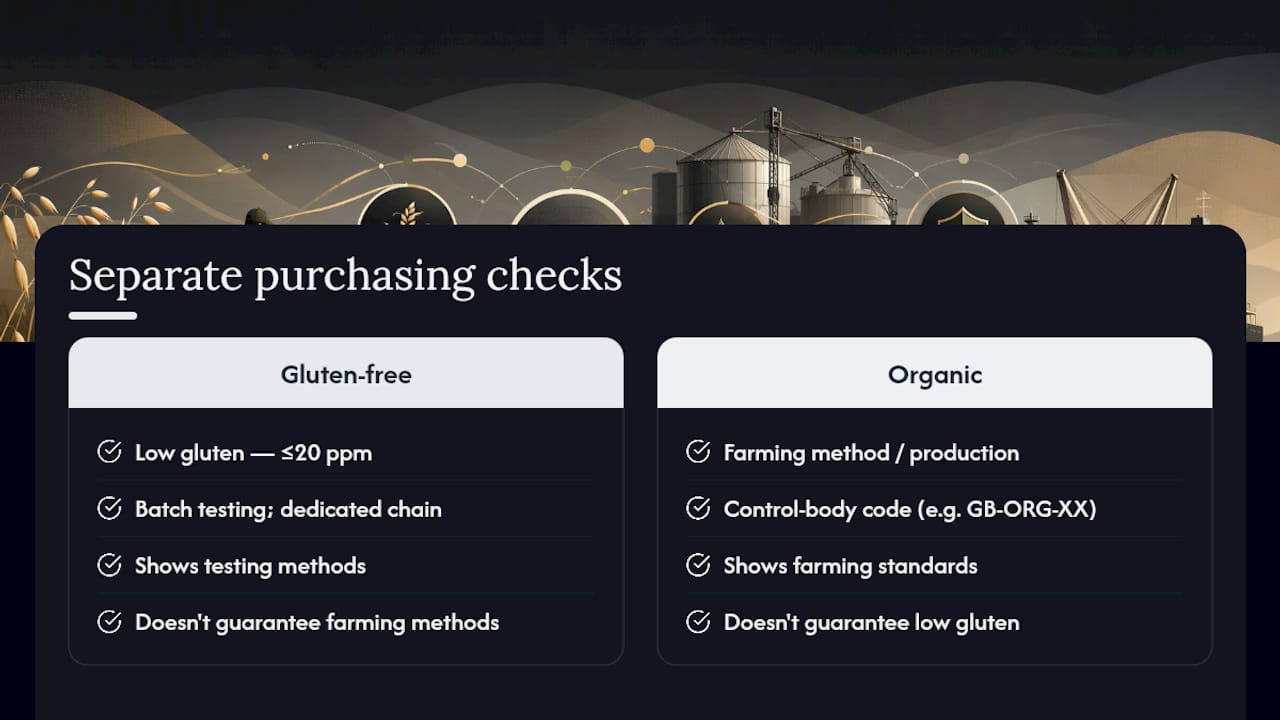
The conventional advice, “just check the label says gluten-free”, also undersells how much that claim depends on invisible groundwork: dedicated fields, dedicated transport, and batch testing that never touches wheat or barley. A pack that skips any explanation of how it hits 20 ppm deserves more scepticism than one that spells it out.
If you take one thing from this guide, prioritise the supplier’s transparency over the price tag. A brand willing to explain its testing and certification in plain language is telling you something a cheaper, vaguer pack cannot.
— Jarrod
Ready to add real oat groats to your kitchen?
If you’ve been comparing loose bins at the health food shop against sealed, certified packs online, the sealed pack wins on one thing that actually matters here: you can verify the claim before you buy, not after you’ve already opened it. Granavitalis builds its whole range around that principle, sourcing grains and nut butters that state their credentials plainly rather than leaving you to guess.

Beyond the oat groats themselves, the same purity standard runs through the wider Granavitalis pantry. If you’re building a broader wholefood breakfast rotation, the Organic Nut & Seed Butter Selection Box pairs naturally with a bowl of groats, and the Raw Organic Pecan Butter makes a genuinely good stir-in for a savoury pilaf or a sweeter porridge alike. Head to the oat groats product page to check current stock, read the certification detail for yourself, and get a pack on its way to your kitchen.
This article is general information, not a substitute for advice from a qualified doctor. Consult a qualified healthcare professional about your own circumstances before acting on anything here.