
Ancient Grains vs Modern Grains: Nutrition That Fuels Real Performance
Searching for nutrient-packed foods that go beyond the standard loaf or pasta? The difference between ancient grains and modern grains runs deeper than a simple swap at the supermarket. British agricultural records reveal that ancient grains like spelt and quinoa have kept their original genetic structure, while modern grains have been extensively bred for higher yields and uniformity. This article highlights the nutritional power and benefits of ancient grains, helping adults in the United Kingdom make informed decisions for a balanced and health-promoting diet.
Table of Contents
- Ancient Grains And Modern Grains Defined
- Key Varieties And Their Unique Profiles
- Nutritional Composition And Digestibility
- Glycaemic Response And Energy Release
- Risks, Sustainability And Cost Considerations
Key Takeaways
| Point | Details |
|---|---|
| Ancient Grains vs. Modern Grains | Ancient grains are minimally altered cereals with higher genetic diversity, whereas modern grains are selectively bred for yield and efficiency. |
| Nutritional Benefits of Ancient Grains | Ancient grains offer superior nutrient density, lower glycaemic indices, and better digestibility compared to modern grains. |
| Sustainability and Economic Considerations | While ancient grains face challenges in yield and cost, they promote biodiversity and sustainable farming practices, appealing to niche markets. |
| Dietary Recommendations | Incorporating a variety of ancient grains can enhance nutritional diversity and support better health outcomes. |
Ancient Grains and Modern Grains Defined
Ancient grains and modern grains represent two distinct categories of cereal crops with profound nutritional and agricultural differences. While they might appear similar at first glance, these grain types tell a compelling story of agricultural evolution and human nutrition.
The distinction between these grain categories stems from their genetic history and breeding practices. Agricultural records in the United Kingdom reveal that ancient grains are cereal species that have remained largely unchanged over centuries, preserving their original genetic structure. Examples include:
- Spelt wheat
- Einkorn
- Emmer
- Kamut
- Quinoa
In contrast, modern grains have undergone extensive selective breeding and genetic modification to enhance specific agricultural traits. These modifications primarily focus on:
- Increasing crop yield
- Improving disease resistance
- Standardising grain size
- Enhancing harvesting efficiency
- Prolonging shelf life
The genetic transformation of modern grains represents a deliberate agricultural strategy to meet growing global food demands. Historical agricultural documents demonstrate how plant geneticists and agricultural scientists have systematically altered grain varieties to optimise production.
Modern wheat, for instance, differs dramatically from its ancient counterparts. Contemporary wheat varieties have shorter stalks, larger kernels, and significantly higher gluten content compared to traditional wheat strains. These modifications, while improving agricultural productivity, have simultaneously raised questions about nutritional complexity and potential health implications.
Pro tip: When selecting grains, consider exploring ancient grain varieties to diversify your nutritional intake and potentially reduce exposure to highly processed modern wheat products.
The following table compares key differences between ancient and modern grains:
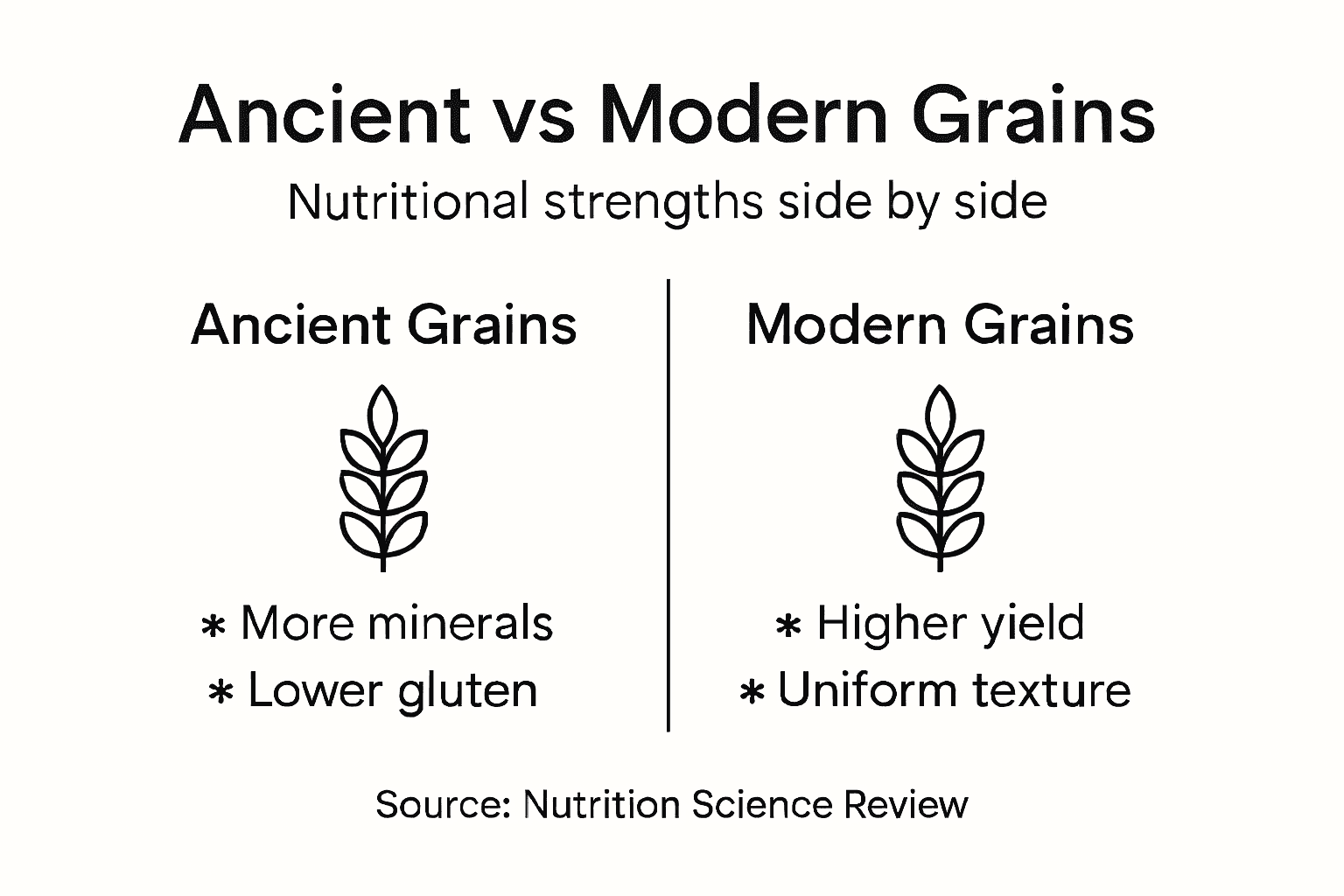
| Aspect | Ancient Grains | Modern Grains |
|---|---|---|
| Genetic Diversity | Highly diverse, minimally altered | Genetically uniform, selectively bred |
| Nutrient Density | Typically higher in micronutrients | Often lower due to yield prioritisation |
| Gluten Composition | Often lower and more digestible | Generally higher, less varied |
| Yield and Productivity | Lower yields, less mechanised farming | Optimised for high yield and efficiency |
| Environmental Impact | Supports biodiversity, lower inputs | Higher input use, monoculture risks |
Key Varieties and Their Unique Profiles
Ancient grains represent a remarkable diversity of nutritional powerhouses, each with distinctive characteristics that set them apart from conventional modern grain varieties. Comprehensive nutritional reviews highlight the exceptional profile of these heritage grains, revealing their remarkable potential for supporting human health.
The most prominent ancient grain varieties include:
- Quinoa: A protein-rich pseudo-grain originating in South America
- Millet: A drought-resistant grain with impressive mineral content
- Amaranth: Known for its complete protein profile
- Teff: A tiny grain packed with calcium and iron
- Sorghum: A gluten-free grain with significant antioxidant properties
- Wild Rice: A nutrient-dense grain with superior fibre content
Agricultural research publications demonstrate that these ancient grains retain genetic traits lost in modern breeding programmes. Their botanical diversity translates into unique nutritional advantages, including:
- Higher protein content
- More complex micronutrient profiles
- Greater genetic diversity
- Enhanced phytochemical composition
- Superior mineral absorption
Each ancient grain variety offers a distinctive flavour profile and nutritional signature. Einkorn wheat, for example, contains higher protein levels and lower gluten content compared to modern wheat variants, making it more digestible for individuals with mild wheat sensitivities.

Modern agricultural practices have systematically reduced grain diversity, prioritising yield and uniformity over nutritional complexity. Ancient grains represent a critical alternative, offering a return to more nutritionally robust food sources that have sustained human populations for millennia.
Pro tip: Rotate different ancient grain varieties in your diet to maximise nutritional diversity and explore unique flavour profiles.
Here is a summary of notable ancient grains and their distinguishing nutritional features:
| Grain | Notable Nutritional Strength | Unique Attribute |
|---|---|---|
| Quinoa | Complete protein source | Contains all essential amino acids |
| Teff | Rich in calcium and iron | Tiny grains, versatile use |
| Amaranth | High in lysine and protein | Naturally gluten-free |
| Millet | High in magnesium and fibre | Drought-resistant |
| Sorghum | Abundant in antioxidants | Beneficial for gluten intolerance |
| Wild Rice | Superior in fibre and zinc | Distinct flavour, high satiety |
Nutritional Composition and Digestibility
Nutritional composition represents the fundamental difference between ancient and modern grains, with scientific research revealing remarkable insights into their distinctive profiles. Comparative grain studies demonstrate that ancient grains consistently outperform modern varieties in key nutritional parameters.
The key nutritional advantages of ancient grains include:
- Higher mineral content
- Enhanced antioxidant levels
- Superior dietary fibre concentration
- More complex protein structures
- Lower glycaemic index
- Increased micronutrient density
Bioactive compound research highlights the unique properties of these grains, revealing their potential beyond basic nutrition. Ancient grains contain powerful compounds such as:
- Phenolic acids
- Flavonoids
- Polyphenols
- Carotenoids
- Trace minerals
Digestibility emerges as another critical distinguishing factor. Modern wheat varieties often trigger inflammatory responses and digestive challenges, whereas ancient grains demonstrate superior digestive compatibility. The lower gluten content and more complex protein structures of heritage grains make them significantly easier for the human body to process.
Interestingly, ancient grains like einkorn and spelt contain different gluten protein compositions compared to contemporary wheat, potentially offering better tolerance for individuals with mild wheat sensitivities. These grains represent a more evolutionarily aligned nutritional approach, connecting modern dietary needs with traditional agricultural practices.
Pro tip: Introduce ancient grains gradually into your diet, starting with small quantities to assess individual digestive tolerance and nutritional response.
Glycaemic Response and Energy Release
Glycaemic response represents a critical health parameter that distinguishes ancient grains from their modern counterparts. Breakfast porridge studies reveal that ancient grains deliver a more stable and controlled energy release compared to refined modern grain products.
Key characteristics of ancient grains’ glycaemic profile include:
- More gradual glucose release
- Lower glycaemic index (GI)
- Reduced insulin spike
- Sustained energy levels
- Enhanced metabolic stability
- Improved blood sugar regulation
Whole grain consumption research demonstrates several metabolic advantages of ancient grains, particularly for individuals managing blood sugar levels. The complex carbohydrate structures in these grains contribute to:
- Slower digestion rates
- Reduced inflammation markers
- Better insulin sensitivity
- Enhanced metabolic efficiency
- Prolonged satiety
The molecular composition of ancient grains plays a fundamental role in their unique energy metabolism. Unlike modern wheat varieties engineered for high yield and quick processing, heritage grains maintain intricate molecular structures that interact more harmoniously with human metabolic systems.
Understanding glycaemic response goes beyond simple blood sugar measurements. These grains offer a nuanced approach to energy metabolism, providing steady nutrient release that supports consistent physical and cognitive performance throughout the day.
Pro tip: Combine ancient grains with protein and healthy fats to further stabilise blood sugar and optimise energy release.
Risks, Sustainability and Cost Considerations
Ancient grains present a nuanced landscape of agricultural and economic challenges that extend beyond their nutritional benefits. Sustainable agriculture research reveals the complex trade-offs between environmental sustainability and economic viability in grain production.
The key sustainability challenges of ancient grain cultivation include:
- Lower crop yields compared to modern varieties
- Higher seed and production costs
- More labour-intensive farming practices
- Limited mechanisation potential
- Greater vulnerability to environmental variations
- Smaller-scale production systems
UK agricultural factsheets highlight several critical considerations for farmers and consumers:
- Reduced agricultural input requirements
- Lower pesticide and fertiliser usage
- Enhanced biodiversity support
- Potential for niche market premium pricing
- Improved soil health
- Greater genetic diversity preservation
Economically, ancient grains represent both a challenge and an opportunity. While production costs remain higher, emerging artisan and organic markets are creating new value propositions. Consumers increasingly demonstrate willingness to pay premium prices for sustainable, nutritionally dense food products that support ecological farming practices.
The transition towards ancient grain cultivation requires systemic changes in agricultural infrastructure, supply chain management, and consumer awareness. These grains are not merely a nutritional alternative but a potential pathway towards more sustainable and resilient food systems.
Pro tip: Consider supporting local farmers and producers who cultivate ancient grain varieties to directly contribute to sustainable agricultural practices.
Discover the Power of Ancient Grains for Real Nutrition and Performance
Feeling overwhelmed by the complex world of grains Learn why ancient grains with their higher nutrient density and better digestibility offer a natural alternative to modern varieties that often prioritise yield over wellness At Granavitalis we understand your goal to fuel strength recovery and balanced energy with foods rooted in tradition and untouched by industrial hybridisation Explore our carefully selected range of Grains – Granavitalis that deliver purity and true wholefood vitality

Start your journey towards smarter nutrition and sustained well-being today with our heritage grain flours and mindful superfoods Browse All Flours – Granavitalis or if you require gentle options explore our Gluten Free Flours – Granavitalis Every product embodies our promise of purity performance and purpose Visit us at https://granavitalis.com and transform your meals with grains that fuel not only your body but your life
Frequently Asked Questions
What are ancient grains?
Ancient grains are cereal species that have remained largely unchanged over centuries, preserving their original genetic structure. Examples include spelt wheat, einkorn, emmer, kamut, and quinoa.
How do ancient grains differ from modern grains in terms of nutrition?
Ancient grains typically offer higher nutrient density, with more micronutrients, complex protein structures, and lower glycaemic indices compared to modern grains, which have been bred for higher yields and uniformity.
Are ancient grains easier to digest than modern grains?
Yes, ancient grains often have lower gluten content and more complex protein structures, making them easier for the body to process, and potentially better tolerated by individuals with mild wheat sensitivities.
What are the environmental impacts of cultivating ancient grains compared to modern grains?
Ancient grains can support biodiversity and require fewer agricultural inputs, but they typically have lower crop yields and can be more labour-intensive to produce, presenting both sustainability challenges and opportunities.
Recommended
- Understanding Ancient Grains for Athletes’ Nutrition – Granavitalis
- 💪 Ancient Grains: The Forgotten Powerhouses for Building Muscle and St – Granavitalis
- Ancient Grains and Modern Wellness Explained – Granavitalis
- Ancient Grains vs Modern Cereals Explained: Benefits & Differences – Granavitalis
- The Essential Guide to Nutrition for Athletes - Dietium
- Guide to Sports Nutrition Basics for Optimal Results – MyGymSupplements